A contract-driven campaign can give an aquarium management game clear goals beyond the next expansion, but it can also affect habitat quality, animal care, visitors, rewards, free-play rules, and saves. Keep the simulation as the authority. Define each contract around measurable state the game already tracks, preserve care constraints, and add one optional chapter before changing the whole aquarium loop.

This guide covers continuing an existing aquarium game, not replacing its habitat or care systems. The habitats, species, visitor targets, contract data, and outcomes are invented. No source code, save, build, or simulation was available; every checklist item below is a proposal, not evidence of successful play.
Map the current aquarium simulation first
Capture a clean commit or a project copy. Trace how habitats update, how animal-care state is calculated, how visitors enter and move, how money is earned and spent, and how the game records long-term progress. Identify which system owns water, temperature, feeding, capacity, and visitor satisfaction values. Do not create a parallel contract copy of state that can drift from the real simulation.
List the current modes and their entry points. If the game supports sandbox play, keep that path available. Determine whether objectives already listen to events or query state summaries. If you cannot run the build, say which systems were inspected and leave their runtime behavior unverified.
| System | Baseline to capture | Protect by default |
|---|---|---|
| Habitat | Water and environment values, capacity | Existing habitat simulation |
| Animal care | Care actions and welfare checks | Care rules and warning behavior |
| Visitors | Entry, routes, services and satisfaction | Visitor movement and feedback |
| Economy | Costs, income and existing unlocks | Scarcity and purchase validation |
| Modes and saves | Sandbox entry, progression and save keys | Free play and old saves |
Write contracts around existing capabilities
Start with one contract objective the game already supports. A goal might ask the player to maintain an existing habitat condition through a defined interval, complete a visitor service improvement, or open a new area after meeting a care threshold. State the target, duration, completion trigger, reward, failure condition, and whether it can be repeated. Avoid goals that reward neglect, overcrowding, or rushed expansion.
In the fictional Blueglass Aquarium chapter, an optional “Quiet Current” contract asks the player to improve one visitor route while maintaining the habitat’s established care range. This example is invented and does not describe an implemented simulator. The target project must decide which metrics it truly tracks and which goals fit its design.
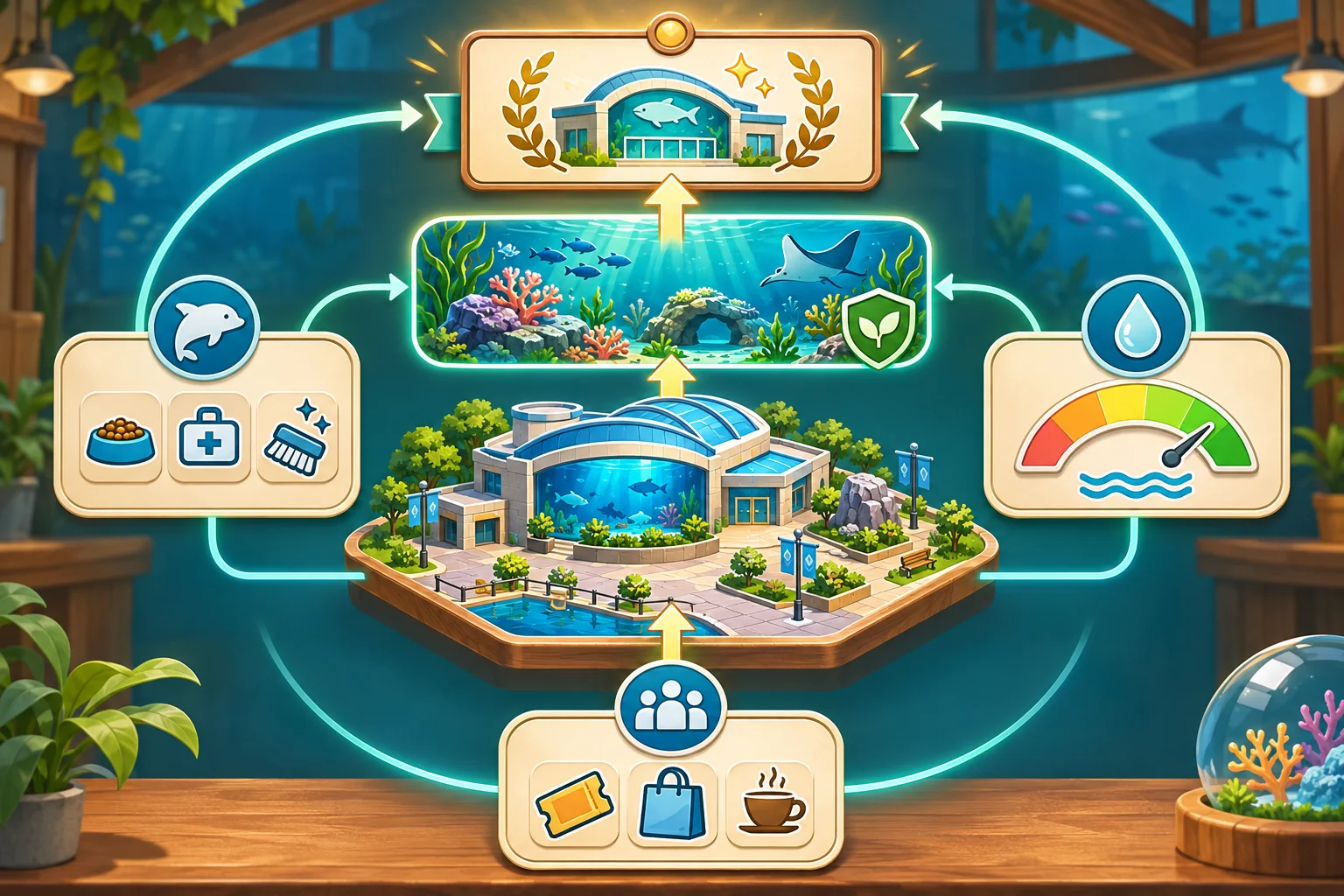
Keep welfare checks authoritative. If a contract target conflicts with the current care model, the care model should remain in control. Show players how progress is counted and what happens when the target is missed. A contract is a layer of objectives and presentation; it should not silently replace habitat simulation or change how an animal’s condition is calculated.
Separate definitions from live aquarium state
Define the contract content separately from a player’s active progress. A contract definition can identify its stable ID, prerequisites, target metric, threshold, timeframe, reward, and completion event. Progress can store which contract is active, its current count or stage, and whether the reward was claimed. Read live habitat and visitor values from the existing simulation rather than copying them into the campaign record.
Godot’s stable Resource documentation describes Resource as a serializable engine-specific data container that can be saved on disk. This is one option for static contract definitions in a Godot project, not a universal recommendation or an aquarium contract schema. Use the target project’s existing content format. Godot’s saving tutorial demonstrates selecting persistent fields and serializing them in one workflow; it does not establish the correct progress model for this game.
Give completion a stable, one-time boundary. If the player saves after meeting the target but before seeing a reward screen, reloading should not duplicate the reward or erase completion. Use the project’s existing transaction or objective-completion owner. Define how old saves behave if a new campaign field is missing and test that fallback on a copy.
Keep campaign rewards inside the existing economy
Reuse the current purchase validation and reward system. Make the contract reward clear and avoid creating a second currency unless the design requires one. Do not let a reward grant resources every time the aquarium scene loads. Keep optional contracts from turning sandbox play into a mandatory checklist or invalidating existing expansion costs.
Separate campaign completion from unlocks that already belong to the main progression. If the same area can be opened through the existing sandbox flow, document how campaign requirements interact with it. If free play should remain unrestricted, do not let a campaign prerequisite block its entry point.
| Contract element | Define clearly | Preserve |
|---|---|---|
| Target | Tracked metric and threshold | Existing simulation value |
| Window | When counting begins and ends | Day/season rules |
| Completion | Event that commits success | Idempotent objective system |
| Reward | Amount and claim timing | Current economy validation |
| Failure | Retry, expiration, or optional skip | Player choice and free play |
Plan a narrow project change
Ask AI to inspect the actual objective, habitat, and save files and propose a list before implementation. A first slice might add one contract definition, a progress listener, a summary panel, and focused tests. Leave habitat formulas, animal-care behaviors, visitor pathing, building costs, and sandbox entry untouched unless code inspection shows a real dependency.
Use an allowlist and review the complete diff. If the patch changes care values or all existing objectives, narrow it. Keep a clean branch or project copy. If save migration is required, split it from the UI and validate on old save copies. State which new fields are optional and what they default to.
| Feature area | Possible edit | Keep stable by default |
|---|---|---|
| Contract data | One definition using existing content format | Habitat and care logic |
| Progress | Subscribe to one existing metric/event | Visitor and simulation updates |
| Reward | Use current reward service once | Economy and purchase validation |
| Campaign UI | One optional objective summary | Sandbox launch and ordinary menus |
| Save | One progress field with old-save fallback | Existing aquarium and unlock data |
Test free play and campaign compatibility
Test a fresh aquarium, a save with an active contract, a save after completion, and a copy created before campaign fields existed. Check that habitat care still updates, visitor routes remain valid, and a missed target does not alter animal state outside the existing rules. Open sandbox mode both with and without campaign progress.
| Proposed check | Action | Evidence to record |
|---|---|---|
| Care boundary | Progress contract near the care threshold | Habitat and animal-care state before/after |
| Visitor goal | Complete the route/service objective | Metric, trigger, and campaign update |
| Reward once | Save after completion and reload | Claim state and balance difference |
| Sandbox | Start free play with campaign active and inactive | Entry path and ordinary objectives |
| Old save | Load a copy without contract fields | Fallback and preserved aquarium state |
| Rollback | Restore the baseline branch | Original care and visitor loop remain |
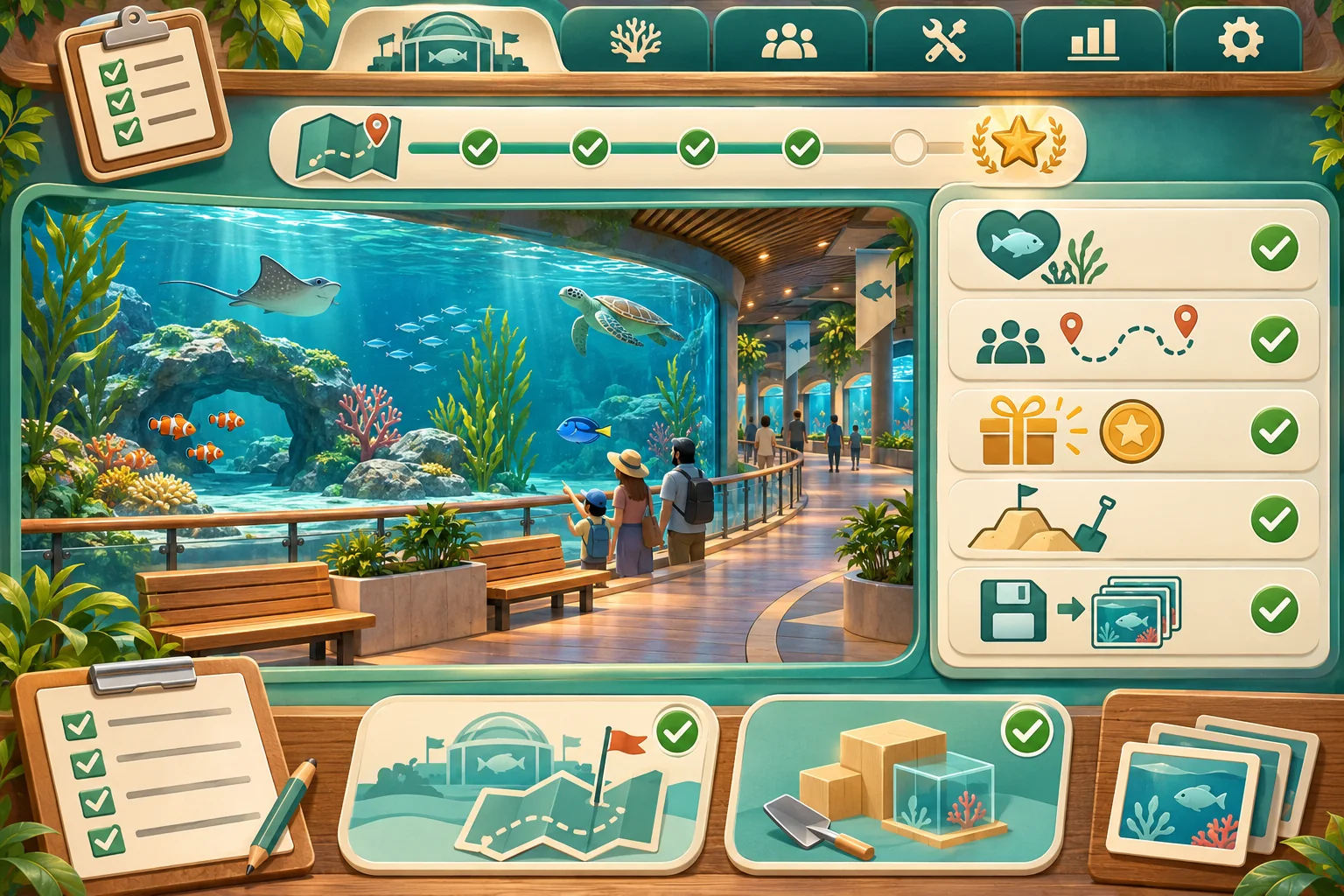
This table proposes validation; it is not a test report. Record build version, aquarium state, contract ID, habitat values, visitor metric, reward balance, save version, expected outcome, and actual result when the real project is run. The generated interface is illustrative and cannot prove that welfare rules or reward claims are correct.
Keep goals clear and the aquarium humane
Use plain language for targets and progress. If a contract is optional, make that visible. Avoid time pressure that contradicts the game’s intended pace, and do not hide care penalties behind campaign scoring. A campaign should give the player a reason to plan; it should not make the core aquarium feel like a pass/fail checklist.
To explore a separate aquarium management concept, try SEELE AI Game Maker. It is a concept tool, not an existing-project editor.
Frequently asked questions
What should an aquarium management contract ask players to do?
Use goals already supported by the simulation, such as maintaining a habitat range or completing a visitor service milestone over a defined period. Make the target and reward clear. Do not ask players to sacrifice animal care or hide failure conditions inside vague campaign language.
How can contracts preserve animal care and habitat rules?
Keep welfare and habitat checks authoritative even when a contract rewards expansion or visitor growth. Define contract objectives that operate within those limits, then test edge cases where a deadline or target conflicts with care. The campaign should not override the game’s existing welfare rules.
Should contract progress be saved separately from the aquarium?
Keep contract definitions separate from the live aquarium state, but reuse the project's existing save owner for active progress and completion. Record stable objective IDs and avoid duplicating habitat values. Test a copied save so reload does not reset a completed contract or grant its reward twice.
How do I add campaign contracts without breaking sandbox mode?
Keep the current sandbox entry point and simulation rules available. Add campaign contracts as an optional layer that listens to supported events or state summaries. Test the same aquarium with campaign disabled and enabled, and confirm that free-play objectives and visitor behavior still work.
Can AI add a contract campaign to my aquarium game?
AI can inspect supplied objective, habitat, and save files, propose a bounded campaign slice, and draft regression cases. It cannot verify welfare or economy behavior without the project and executed simulation. Provide a file allowlist, baseline aquarium save, expected goals, and rollback commit.
Add goals without overriding the aquarium
Use one explicit contract definition, read progress from the existing simulation, and commit rewards through current economy rules. Preserve habitat care, visitor behavior, and sandbox access. Test active, completed, and old-save cases on copies, then maintain a clean rollback path. Treat fictional objectives as design examples, not evidence of a working campaign.