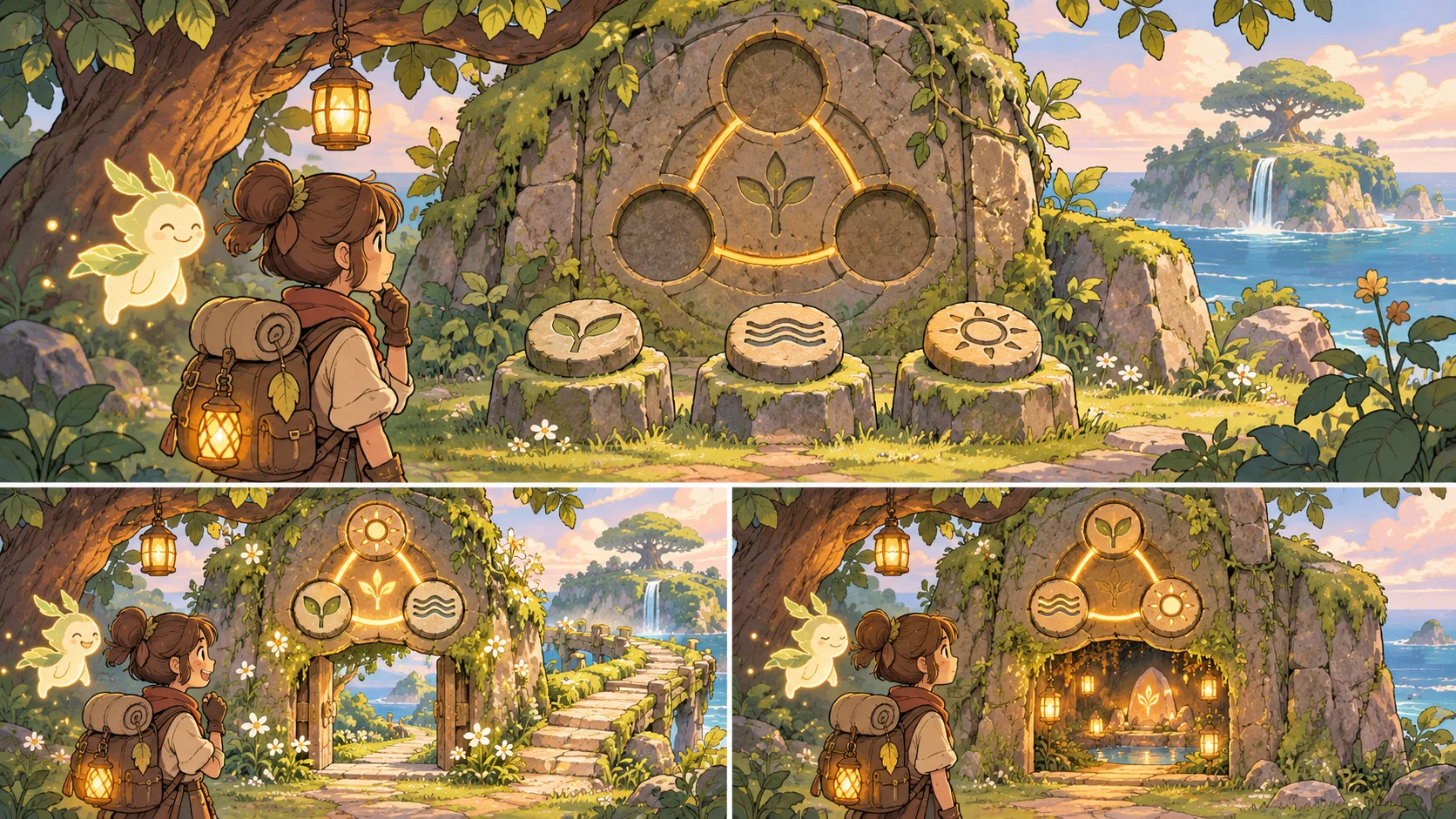
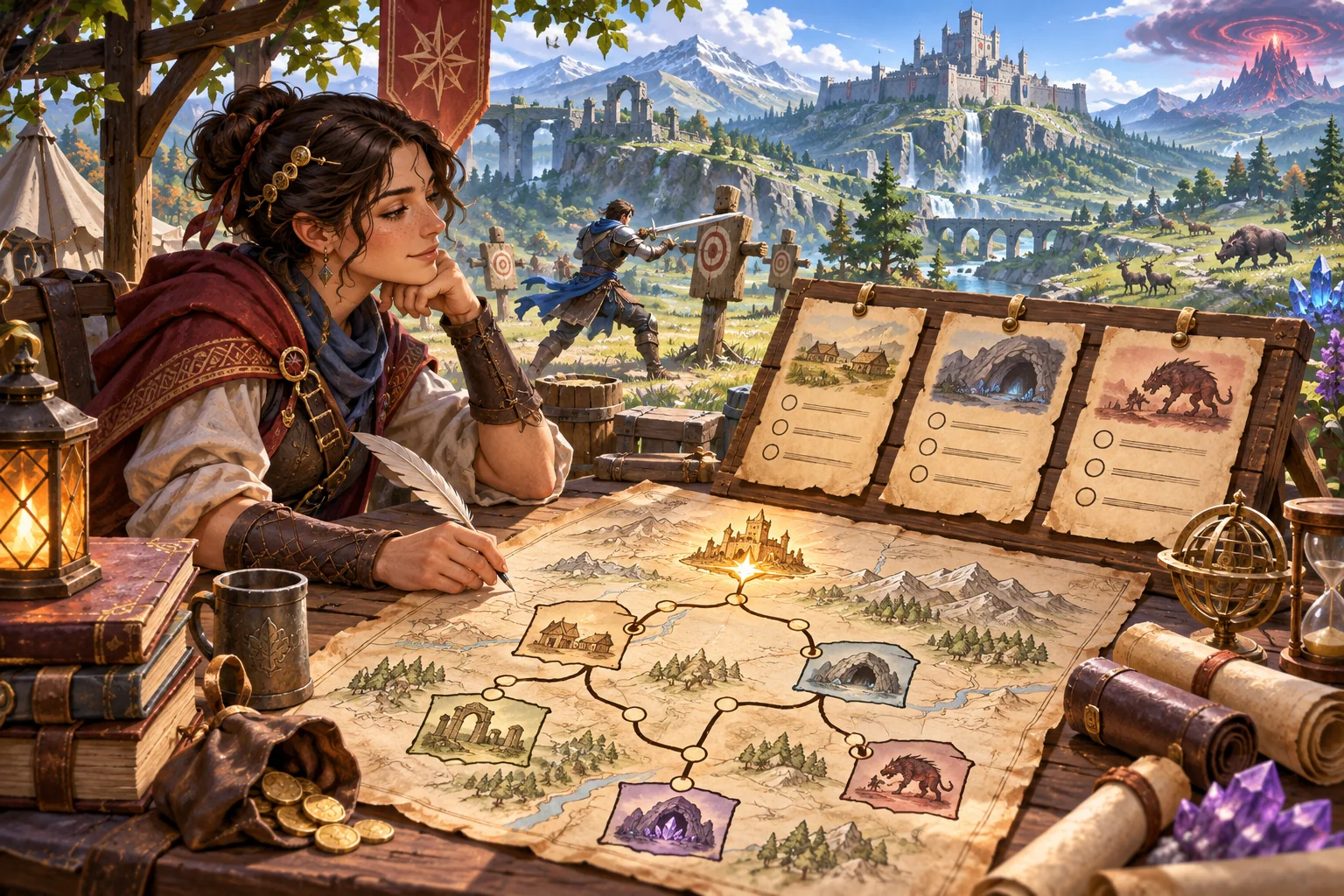
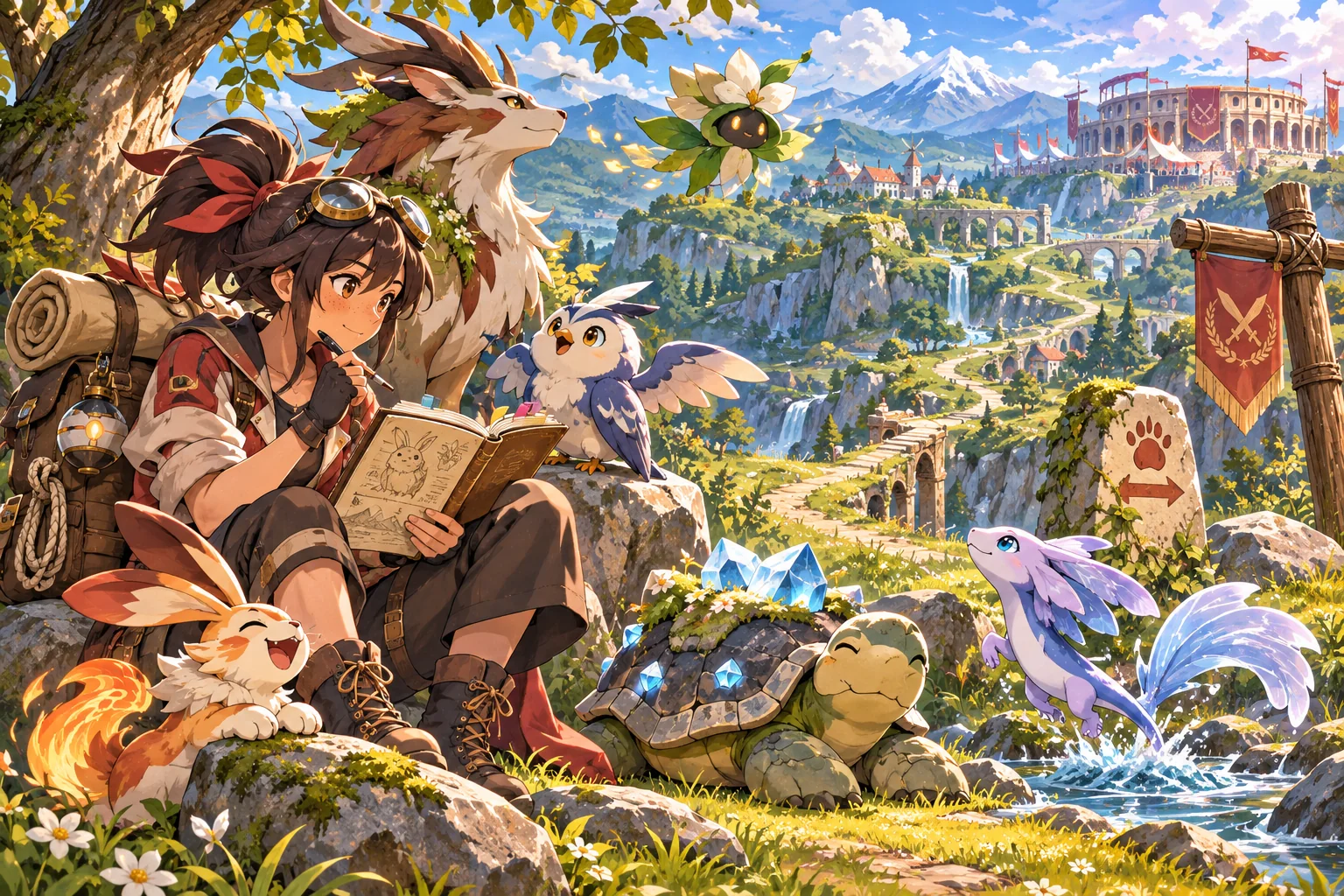
An alternative puzzle rule set can refresh a cozy exploration game, but it can also confuse discoveries, hints, and saved progress if it replaces the original rules invisibly. Keep the current version selectable, describe the new rules before a player commits, and separate clue discovery from puzzle solution state. Start with one optional puzzle and test how both modes behave when players leave and return.

This guide describes a proposed feature for an existing cozy exploration game. The location, clues, puzzle, rule variants, and outcomes below are invented. No project files, build, save, or playtest were available. The checks in this article are plans, not evidence that an implementation works.
Map the current puzzle and discovery loop
Trace how players find a landmark, read its clues, enter an answer, receive feedback, use a hint, solve the puzzle, and revisit the site. Identify what gets saved at each step. A discovery record might mean “the player visited this place,” while a puzzle record means “this mechanism is solved”; those should not be collapsed into one boolean if the game distinguishes them.
Write down the existing rule contract: inputs, symbol meanings, valid sequences, attempt behavior, hint availability, reset conditions, and what counts as completion. Check whether the puzzle logic lives in data, scene scripts, dialogue, or a global quest system. Capture an unsolved save, a partially solved save, and a completed save before editing. Include the game’s ordinary gathering, photo, or walking activities in the baseline so the new feature does not take over the pace.
| State | Question | Preserve |
|---|---|---|
| Discovery | Has the landmark or clue been found? | Journal and map entries |
| Rule selection | Which interpretation is active and at what scope? | Original selectable mode |
| Attempts | Are tries unlimited or staged? | Low-pressure feedback |
| Hints | What is revealed and when? | Optional help path |
| Completion | What event marks solved? | Stable reward/discovery record |
Define both rule sets before adding content
Give each rule set a stable ID, player-facing name, short explanation, input model, clue vocabulary, validation behavior, hint steps, and completion event. Document which puzzles support each mode and what happens if a particular landmark has no alternative version. Avoid a vague “easy” and “hard” toggle if the real change is a different symbol grammar or solving order.
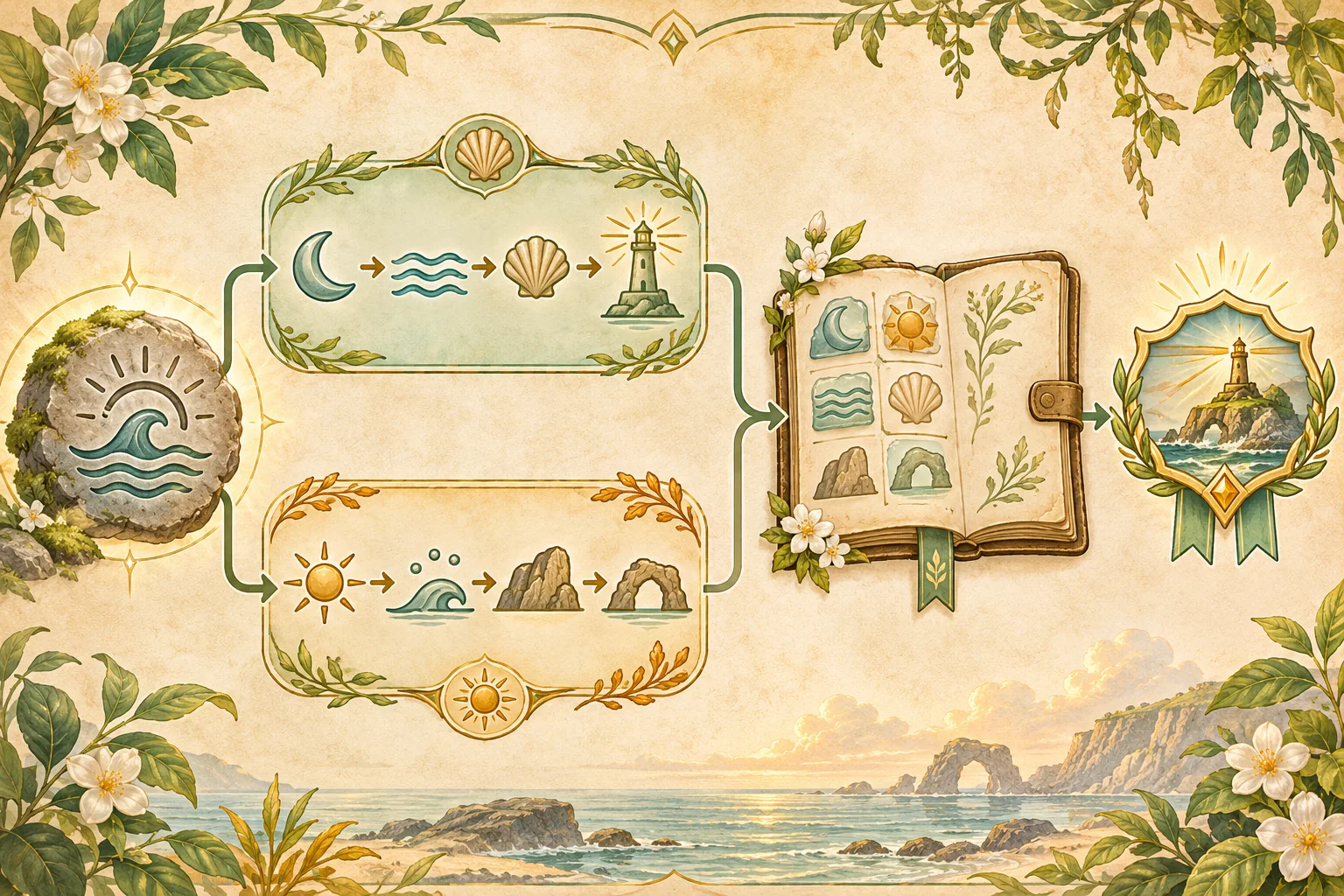
In the fictional Mosslight Coast, the original puzzle reads three tide symbols from left to right. The optional variant asks players to match a moon phase with a shoreline mark before entering the same three-symbol sequence. Both versions unlock the same journal entry and map marker. These mechanics are illustrative, not a description of a real game. The actual design should use clues already present in its world and avoid requiring outside knowledge.
Make the distinction visible before switching. Show a preview of how the rule changes, whether current progress will reset, and whether hints are shared. If the modes are compatible, preserve the player’s discovery and translate only state that has an unambiguous equivalent. If not, keep the original attempt intact and create a separate attempt for the variant.
Keep clues, attempts, and completion separate
Store the selected rule ID separately from the clue journal and completion flag. If a player discovers a symbol during exploration, that knowledge should not vanish because they changed a puzzle option. Record partial progress only if the game promises it, and define whether a hint remains consumed after switching. Use a stable puzzle ID so changing the display title does not break saves.
Define a safe fallback for older saves. If no rule selection exists, load the original mode. If the puzzle has already been solved, preserve its completion and reward regardless of the selected mode. If a partial state cannot be mapped safely, keep it as a snapshot or explain the reset before applying it. Test migration on a copy rather than overwriting a player's only save.
If the project uses Godot, its official documentation describes Resource as a serializable base class used primarily for data containers and notes that resources can be saved on disk. That is an engine example, not a required puzzle data format. Godot’s saving tutorial demonstrates one workflow where persistent objects provide relevant data for serialization and loading; it does not determine which discovery fields this game should keep.
Protect the cozy pace and accessibility
A different rule should change how players interpret clues, not force urgency unless the game already uses timed puzzles. Keep failure feedback informative and avoid punishing repeated experiments. Let players inspect the world again, leave and return, or use a hint without losing unrelated exploration progress. Do not use scarce consumables as the only route past a newly introduced rule.
Check whether meaning depends only on color, quick timing, tiny targets, audio, or a specific controller input. Pair color with shape or pattern; provide readable labels or narration where the game supports them; ensure the interaction works with the existing keyboard and controller settings. Let players adjust text size and motion according to the project’s accessibility options. These are design checks, not a claim that any game is accessible by default.
| Design area | Define | Check |
|---|---|---|
| Symbols | Meaning and interaction | Shape and label, not color alone |
| Hints | Reveal order and cost | Optional and understandable |
| Timing | Whether any input is timed | No surprise pressure |
| Controls | Keyboard/controller mapping | Existing remapping still works |
| Switching | Progress mapping and warning | Discoveries remain intact |
Ask AI for one reviewable puzzle slice
Provide an allowlist for the puzzle data, clue journal, hint flow, input handling, and save path. Ask an assistant to map the current rule and state ownership before editing. Then request one alternative puzzle, its rule definition, and a narrow display or mode selector. Ask it to list changed files and untouched systems. Review the full diff for new global flags or duplicated completion logic.
Keep a clean branch and representative save copies. If the new mode adds a field, version it and provide a default for old saves. Keep the original puzzle path available behind a visible choice or feature flag. A rollback should remove the new variation without deleting solved flags, journal discoveries, or ordinary exploration activities.
Test hints, switching, old saves, and completion
Run the existing puzzle and the alternative from a fresh save, a partially solved save, and a completed save. Switch modes before any attempt, after one clue, after a hint, and after completion. Leave the area, reload, revisit the journal, and verify the map marker. Test both input modes supported by the actual project and check the visual contrast and text settings in context.
| Proposed check | Action | Evidence |
|---|---|---|
| Original mode | Solve with existing interaction | Same clue sequence and completion |
| Alternative mode | Start fresh and solve variant | Rule ID, inputs, and completion event |
| Partial progress | Switch after one clue, then return | Preserved or clearly reset attempt state |
| Hint behavior | Use hint and reload | Hint stage and cost if any |
| Old save | Load before and after feature data | Safe original-mode fallback |
| Accessibility | Try settings and supported controls | Readable cues and valid inputs |
| Rollback | Restore baseline revision | Discoveries and solved puzzles remain |
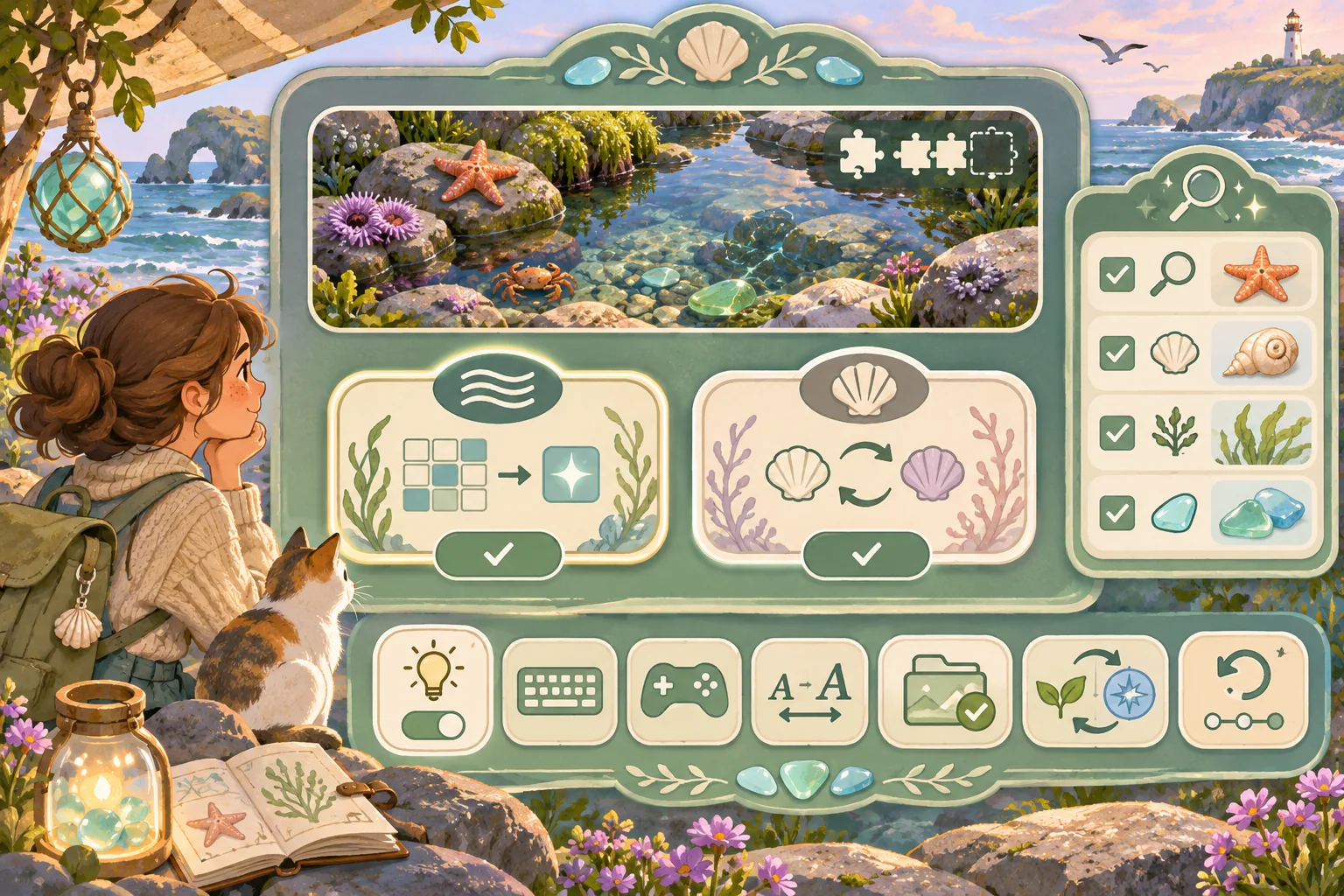
This matrix is proposed validation, not a test report. When the target build is available, record build version, puzzle ID, rule selection, save version, clue and hint state, input device, expected result, and actual result. Generated puzzle art is conceptual and cannot establish that clues are discoverable or the interaction is accessible.
Keep exploration bigger than the puzzle
Make the rule choice optional and preserve non-puzzle activities. Let players decide whether to switch without blocking the trail, journal, or map. If a puzzle is needed for a story route, explain its rule set before the player reaches a dead end and keep the supported hint path available. The new variation should add a fresh way to notice the world, not redefine the whole game’s pace.
To explore a separate cozy game concept, try SEELE AI Game Maker. It is a concept tool, not an editor for an existing project.
Frequently asked questions
How can a second puzzle rule set preserve the original game?
Keep the original rules as a named, selectable default and add the alternative as an optional choice. Give each rule set explicit input, feedback, completion, and reset behavior. Existing discoveries should remain available even if a player switches puzzle modes, and the original activity loop should still work without the new variation.
Should puzzle rule choices be saved with each puzzle?
Choose whether the selection belongs to a single puzzle, a region, or the whole save, then store that scope explicitly. Keep solved state and discovered clues separate from the active rule choice so a player can revisit a puzzle without losing exploration progress. Provide a safe default for older saves that lack the new field.
How do I keep an alternative puzzle accessible?
Preserve readable cues and offer controls that do not depend only on color, timing, tiny targets, or rapid input. Keep hints optional and describe what a symbol means. Test keyboard, controller, text scaling, reduced motion, and the game’s supported accessibility settings against both rule sets.
Can players switch puzzle rules after starting?
Allow switching only where the project can preserve a consistent puzzle state. Decide whether progress resets, maps to the other rule set, or remains on the original version, and tell players before confirmation. Test switching after a partial solve, after using a hint, and after completion so discoveries are not erased.
Can AI add puzzle variations to my existing cozy game?
AI can inspect supplied puzzle, discovery, input, and save files, propose one bounded variation, and draft tests. It cannot confirm that a puzzle is understandable or relaxing without the real project and player sessions. Provide an edit allowlist, solved and unsolved save copies, accessibility goals, and rollback point.
Add a variation without erasing discoveries
Keep the original mode available, give the alternative a clear rule contract, and store puzzle selection separately from clue discovery and completion. Test switching, hints, accessibility settings, and old saves on copies before expanding the feature. Treat Mosslight Coast and the generated mockup as design examples, not proof that a puzzle works or is accessible.