Make specialist tasks useful in each dive while ensuring a returning crew can recover, contribute, and share risk. A useful first prototype connects the player action, its feedback, and the next decision so the system can be tested as a complete loop.
Define the shared-world survival baseline
Define the shared-world survival loop before assigning jobs: prepare at a base, choose a dive objective, manage equipment and oxygen, return, and see what changed. For each phase, mark which actions need coordination and which can be completed by one person. Roles should create useful interdependence without making solo recovery impossible.

The official Darkwater listing describes cooperative extraction horror around a submarine under alien ice, with crews scavenging resources. It supports underwater co-op and resource pressure as context only; the persistent shared world and role framework proposed here are original. See the official Darkwater listing for this context.
Assign roles around dive constraints
Build roles around constraints players can observe. A navigator can reveal route risk, a technician can restore a damaged tool, and a quartermaster can prepare supplies. Make role actions legible through equipment, feedback, and a shared log so teammates understand the contribution even when they are not controlling that task.
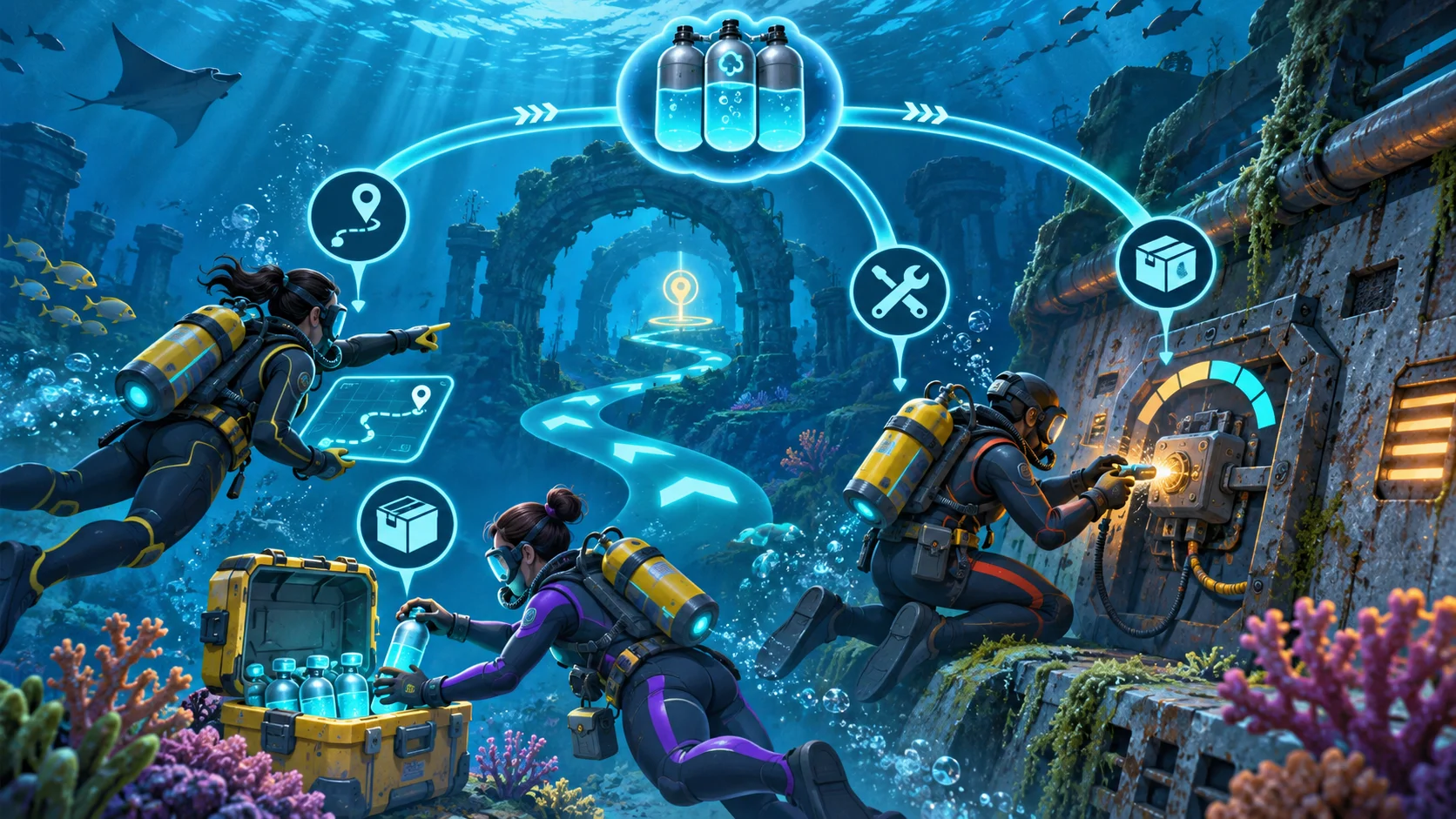
Test a role against each expedition stage. If only one job matters during a dive, rotate its value across objectives: route marking on one trip, repairs on another, and supply planning before a third. Use overlapping emergency actions to prevent a single absent specialist from ending a session.
Persist changes without locking out partners
Persistence should record world changes that help the crew plan: repaired habitat modules, mapped sites, stored supplies, and unresolved hazards. Avoid permanently assigning scarce tools or progression to the first player who logs in. Shared storage rules and clear ownership feedback reduce disputes when players return at different times.
For departures, save a safe state at a clear checkpoint. Decide what happens to carried resources, active expeditions, and a disconnected role. A fair recovery rule is visible before the dive, such as returning carried supplies to a shared cache or allowing the crew to extract early.
Test recovery and role handoffs
Run a repeatable test with one full crew, then remove a role player and repeat the same objective. Record oxygen use, missed tasks, lost supplies, and the time needed to recover. Accept the system when every role changes a meaningful decision, the shared world reflects the trip, and a crew can continue after a teammate leaves.

Check that progress survives reconnect and does not duplicate or erase shared resources. For a related pattern for persistent cooperative duties, read a persistent-world co-op role framework. SEELE AI can help brainstorm role variants, while networking, persistence rules, and multiplayer tests still need implementation.
FAQ
What roles fit a cooperative underwater survival game?
Navigation, equipment repair, supply planning, and environmental scanning are useful starting points because they connect to route choice and dive preparation. Give each role clear information or actions, then make sure teammates can understand the contribution through shared signals and logs.
How can co-op roles use oxygen and depth?
Use oxygen and depth as visible constraints that shape preparation and route choices, not as hidden timers that punish players without warning. A role might identify a safer route, check equipment, or improve supply planning. Test whether the role changes a decision the crew can explain.
How do you make a persistent world fair after a player leaves?
Define what happens to carried supplies, active objectives, and assigned tools before the trip begins. Save at a clear checkpoint, make shared storage rules visible, and allow the remaining crew to extract or redistribute a task. Then test reconnects and repeated departures.
What should you test in a shared underwater world?
Repeat the same expedition with the full crew and with one role absent. Check resource persistence, reconnect behavior, role handoffs, and whether the world records completed work once. Watch for a specialist role that becomes a hard gate instead of a useful contribution.