Training should alter which tasks an employee can handle reliably, and delegation should expose a clear trade-off between speed, quality, and supervision. Use contract outcomes to show whether a staffing decision worked. Prototype one short loop first, then check whether the player can explain the relationship between their choice, the system response, and the next opportunity. The official source below supports genre context only; the system design here is original guidance.
Translate cleaning tasks into trainable skills
List the cleaning tasks in a contract and the skill each one requires: vacuuming, stain treatment, polishing, or handling delicate surfaces. Keep the skill model small enough for players to compare workers quickly. The official House Cleaner Simulator developer page describes a cleaning-business game with jobs, tools, and company growth; it provides context only, not evidence for a staff-training system. See Digital Melody for the limited context claim.

Training should change a worker’s reliability or task speed in a visible way. Give the player a low-risk practice job and a clear before-and-after cue, such as fewer missed stains or a faster room completion. If training consumes time or wages, show that cost before committing and preserve a way to recover from an imperfect assignment.
Match workers to contract requirements
Represent each worker with a small skill profile, stamina or availability, and equipment access. Match those traits to contract requirements, then highlight gaps before accepting a job. Avoid making every worker a universal expert; distinct strengths make hiring and training choices meaningful without requiring a large stat sheet.
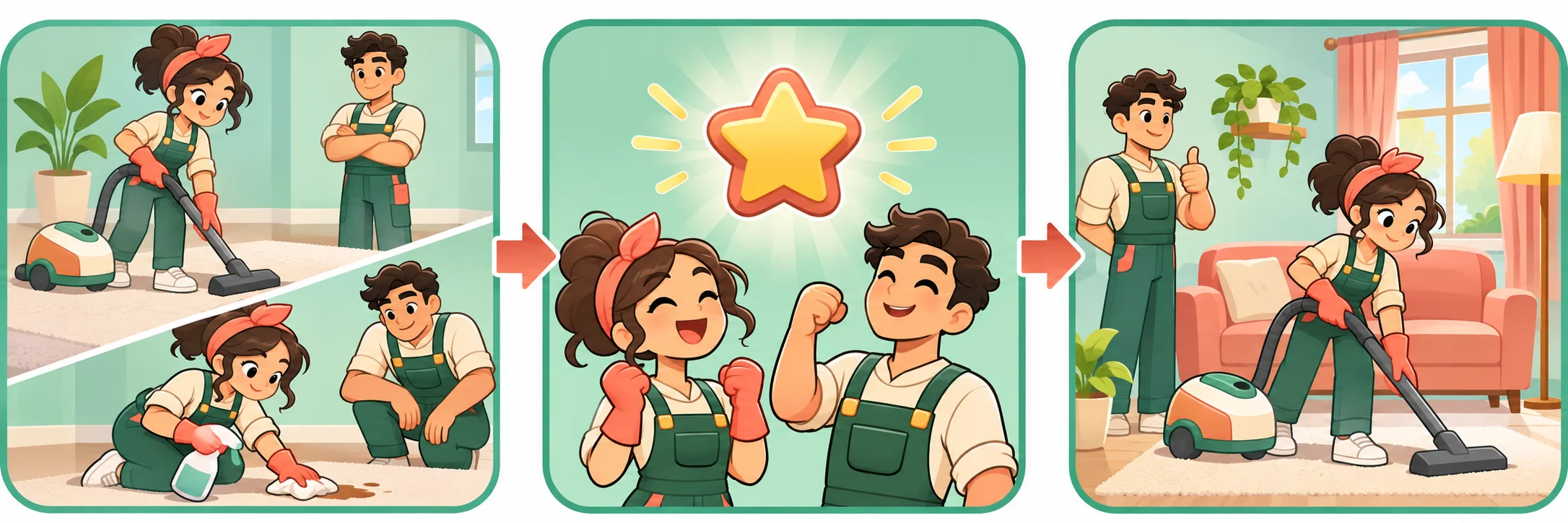
Delegation can happen by assigning rooms, tasks, or equipment. Show which worker owns each task and what dependency blocks progress, such as a surface needing treatment before polishing. Keep reassignment available before the deadline and warn when it may delay another worker. This lets players manage a job plan rather than watch an opaque automation system.
Expose delegation trade-offs during jobs
A strong assignment balances speed, quality, and supervision. A specialist may finish a task quickly but need expensive equipment; a trainee may cost less but benefit from a player check. Show the expected job outcome and the reason behind it, then let the player intervene when a stain, fragile surface, or missing tool changes the plan.
Use customer feedback and contract results to explain the trade. A missed area can reduce quality, while a rushed job may finish on time but leave less profit after supplies. Make these consequences predictable and proportionate. Give players time to correct an error before it becomes a permanent business setback.
Test workload, quality, and recovery
Test a contract with two workers and several task types. Run once with a trained specialist and once with a generalist, then compare time, quality, and intervention count. Ask players to predict which assignments are risky and check whether the interface signals those risks before acceptance.

For a related management example about hiring and staff roles, see a guide to hiring and role design. Pass when workers’ training changes task performance, assignments are understandable, and the player can adjust a plan after seeing new information.
FAQ
How should employee training work in a cleaning game?
Define a few skills that map directly to visible cleaning tasks, then let training improve reliability, speed, or the range of work a person can handle. Give players a safe way to observe the change before relying on it in a high-value contract. Keep training costs and expected benefits visible so progression supports planning.
How can players delegate cleaning tasks?
Let players assign workers to rooms, tasks, or tools based on skill and availability. Show who owns each task, what dependency comes next, and whether a worker lacks a required tool. Allow reassignment before a deadline and make any delay or quality risk clear so delegation remains a decision rather than a hidden simulation.
How do you balance speed and cleaning quality?
Show the expected trade before the player accepts a job: a specialist may improve quality or speed but cost more, while a trainee may need supervision. Keep the result readable through task completion, missed spots, supply use, and customer feedback. Provide a correction window so one poor assignment does not permanently punish the player.
What should you test in a staff system?
Replay the same contract with different training and delegation plans. Compare completion time, quality, profit, and player interventions. Ask players to identify risky assignments before starting and confirm whether the interface exposed the relevant skill and tool requirements. Include a late change to see whether the team can recover.