A car-workshop business sim gets more interesting when the floor plan changes how work gets done. In fictional workshop Grease & Gear, a repair order sends a mechanic through named stations: inspect the vehicle, collect a part, then use a lift. Moving equipment can shorten or lengthen that route, making layout a business decision rather than decoration.
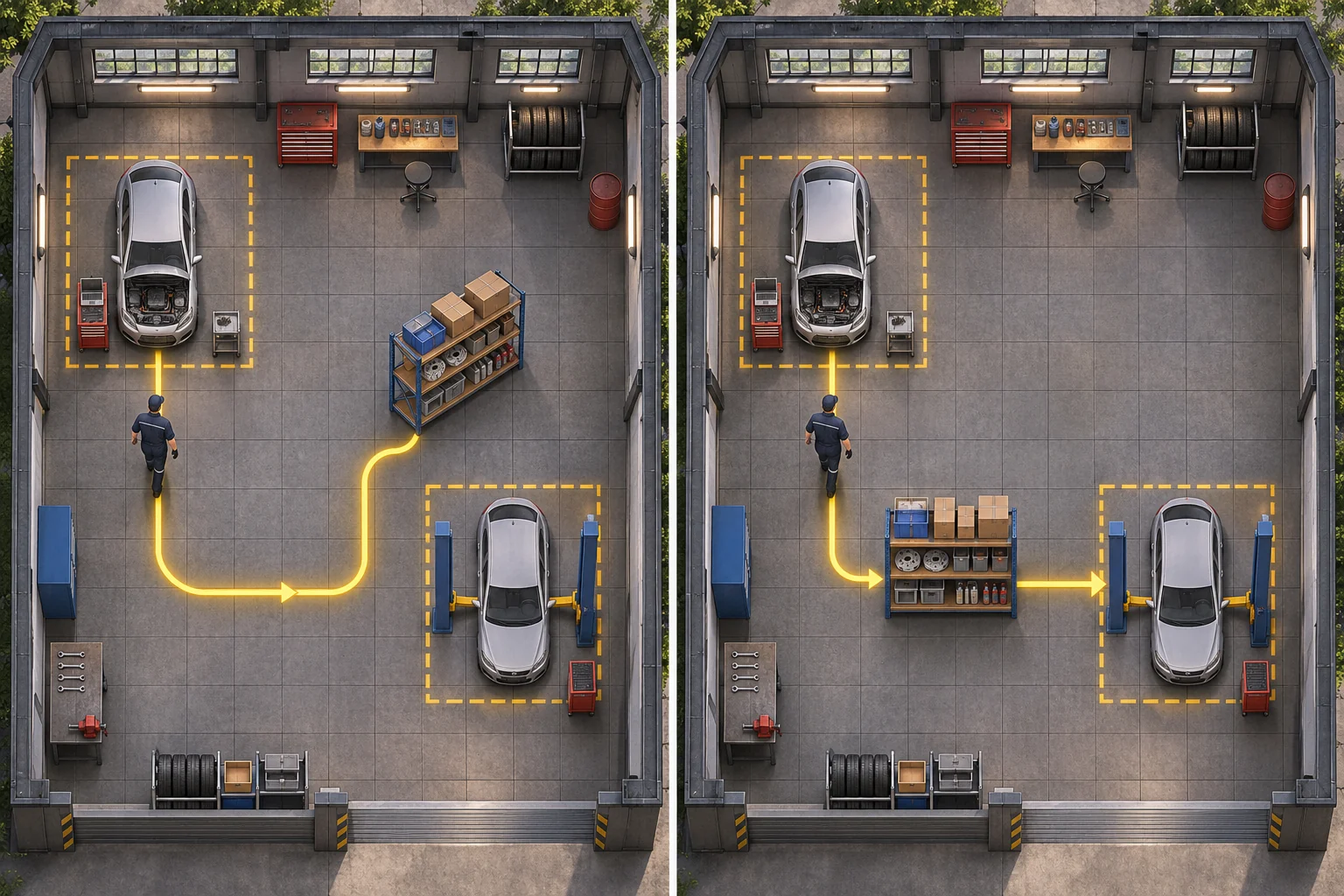
Start with a small, legible rule: the mechanic walks one orthogonal grid edge per step, follows the task order on the repair card, and uses the shortest open route between stations. A fixed paper replay below moves only the Parts Rack. It saves two walking steps under the stated assumptions; it is a design check, not observed game data.
Connect each repair order to a repeatable station route
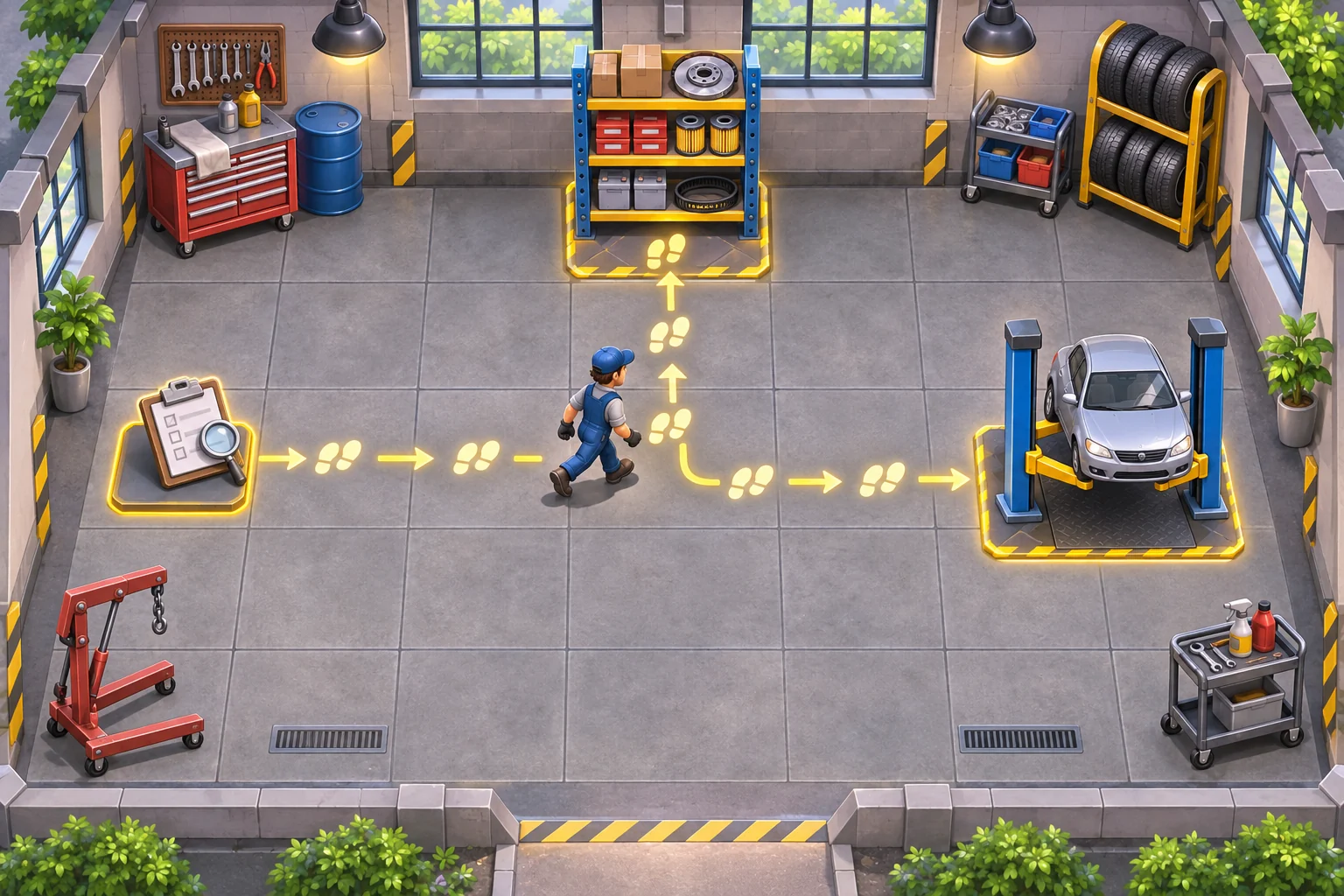
Give every vehicle a compact repair card with an ordered list of stations. For example: Inspection → Parts Rack → Lift. The mechanic completes one station before walking to the next, so players can see which part of the job is creating travel. Start with one worker and one car to keep the route easy to follow.
Let completed orders pay the business, then offer a few grounded investments: relocate a station, add another bay, or stock a needed part. A move should change the route or available space in a way the player can predict. Keep staff skills and customer timers out of the first prototype until the basic path rule is understandable.
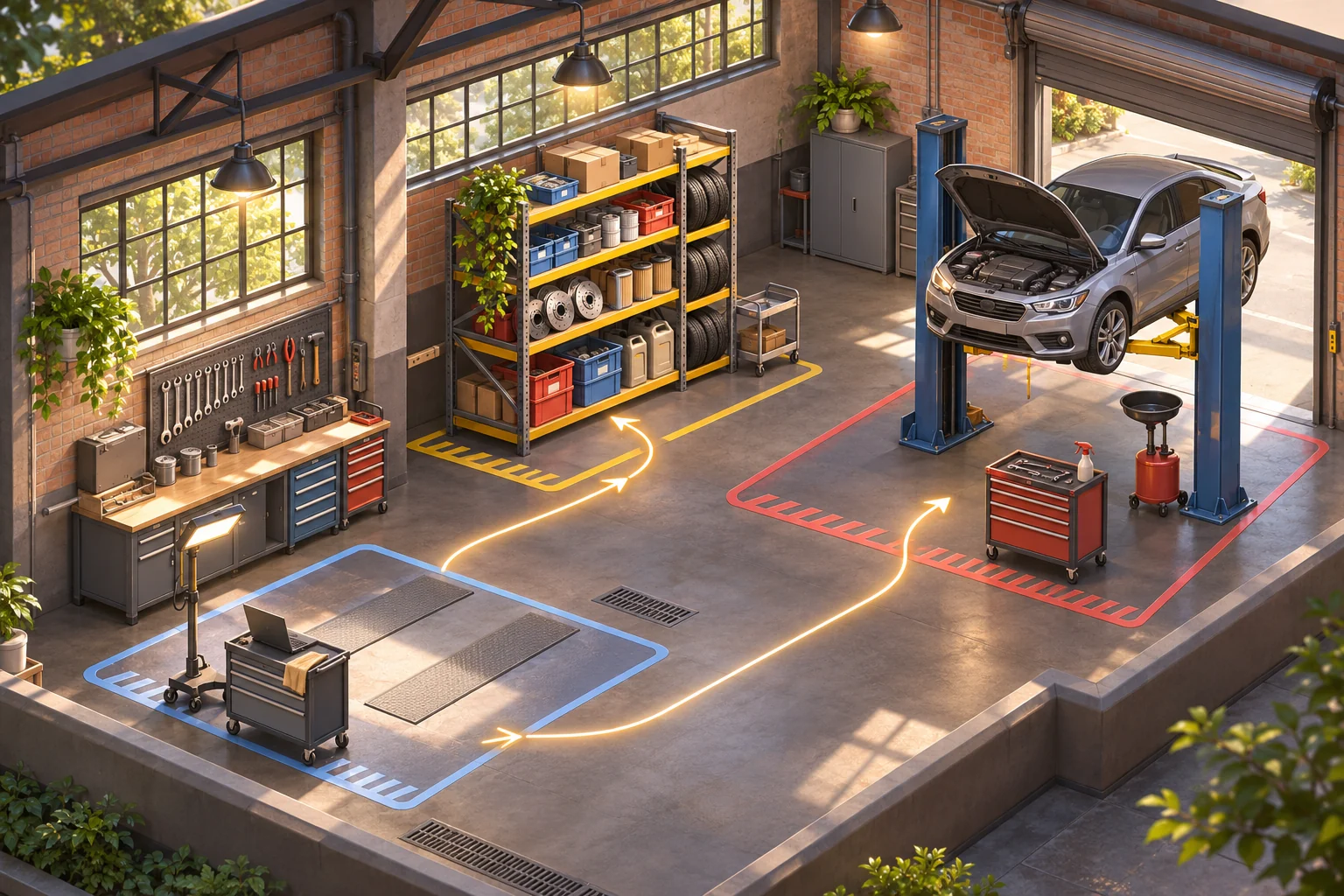
Make the workshop grid readable before adding simulation depth
Represent the shop as a 7×5 grid. Place Inspection at (2,3) and the Lift at (6,3). Mark walkable tiles and station footprints with distinct shapes, and reserve one tile of access beside each station. Use four-direction movement: one step north, south, east or west costs one. For this first model, assume no blocked aisles, traffic or waiting.
Show the repair card’s next station in the world and highlight the route the mechanic will take. If the player moves a rack, preview the new route before confirming. This makes a floor-plan change legible and gives the player a chance to compare the space it occupies with the walking it removes.
Compare the same repair job before and after moving the rack
Replay one order: Inspection at (2,3), then Parts Rack, then Lift at (6,3). With the rack at (3,2), the Inspection-to-Rack distance is |3−2| + |2−3| = 2 steps. Rack-to-Lift is |6−3| + |3−2| = 4, for 6 total steps between stations.
Now move only the rack to (4,3). The first leg is |4−2| + |3−3| = 2 steps; the second is |6−4| + |3−3| = 2. Total: 4 steps, two fewer than before. The worker, car, repair order and clear-grid assumption stay fixed. This is a paper simulation of the routing rule, not a measured result. If you add walls or traffic later, recompute paths with those conditions included.
Prototype one bay, then make capacity depend on real constraints
Build the grid, station footprints, a repair card, one mechanic and the shortest-path preview. Let players move the rack, then replay the same job and inspect both route lengths. Test corner cases such as a station with no accessible tile or a blocked route; explain why the job cannot proceed instead of silently teleporting the worker.
Only after the route comparison reads clearly should you add a second employee, queues, part inventory or vehicle sizes. Those systems can create meaningful tradeoffs: a short path may occupy valuable floor space, while a second bay may create crossing traffic. Keep the route cost visible so business upgrades have an understandable operational effect.
Create Grease & Gear, a car-workshop business simulator where layout changes employee workflows. Begin with a 7×5 grid and one mechanic completing a repair card in order: Inspection at (2,3), Parts Rack, Lift at (6,3). Use four-direction movement and shortest open routes, one step per grid edge. Let the player relocate the rack and preview the route. Include a paper-check scenario: rack (3,2) gives legs of 2 and 4, total 6; rack (4,3) gives legs 2 and 2, total 4. Keep the worker, car, task order and open-grid assumption constant. Add clear path display and edge cases for inaccessible stations; avoid claiming results from playtesting.
SEELE's official page describes a general workflow: generate a playable first version from a prompt, test it in a browser and refine it with follow-up prompts. Use that workflow to inspect whether a player can understand the station route and predict a layout change; Grease & Gear and its rules are fictional design guidance.
Prototype the workshop workflow in SEELE
Frequently asked questions
How can workshop layout affect employee workflow in a simulator?
Give repair tasks an ordered list of stations and make workers travel between them on a visible grid. Moving a station then changes the route, so the player can compare access, floor space and walking cost. State the movement and obstacle rules so the layout effect is predictable.
What should a car workshop simulator prototype include first?
Start with one bay, one worker, one repair order and a few stations. Show the required task order and the shortest route between stations. Let the player move one piece of equipment and compare the same job before adding queues, inventory, multiple employees or vehicle-size constraints.
How do I test whether a workshop layout change matters?
Replay the same order with the same worker and movement rules, changing only one station location. Calculate or display each path leg and total steps. Treat a hand-calculated grid example as a rule check, not as evidence of measured throughput or business performance.