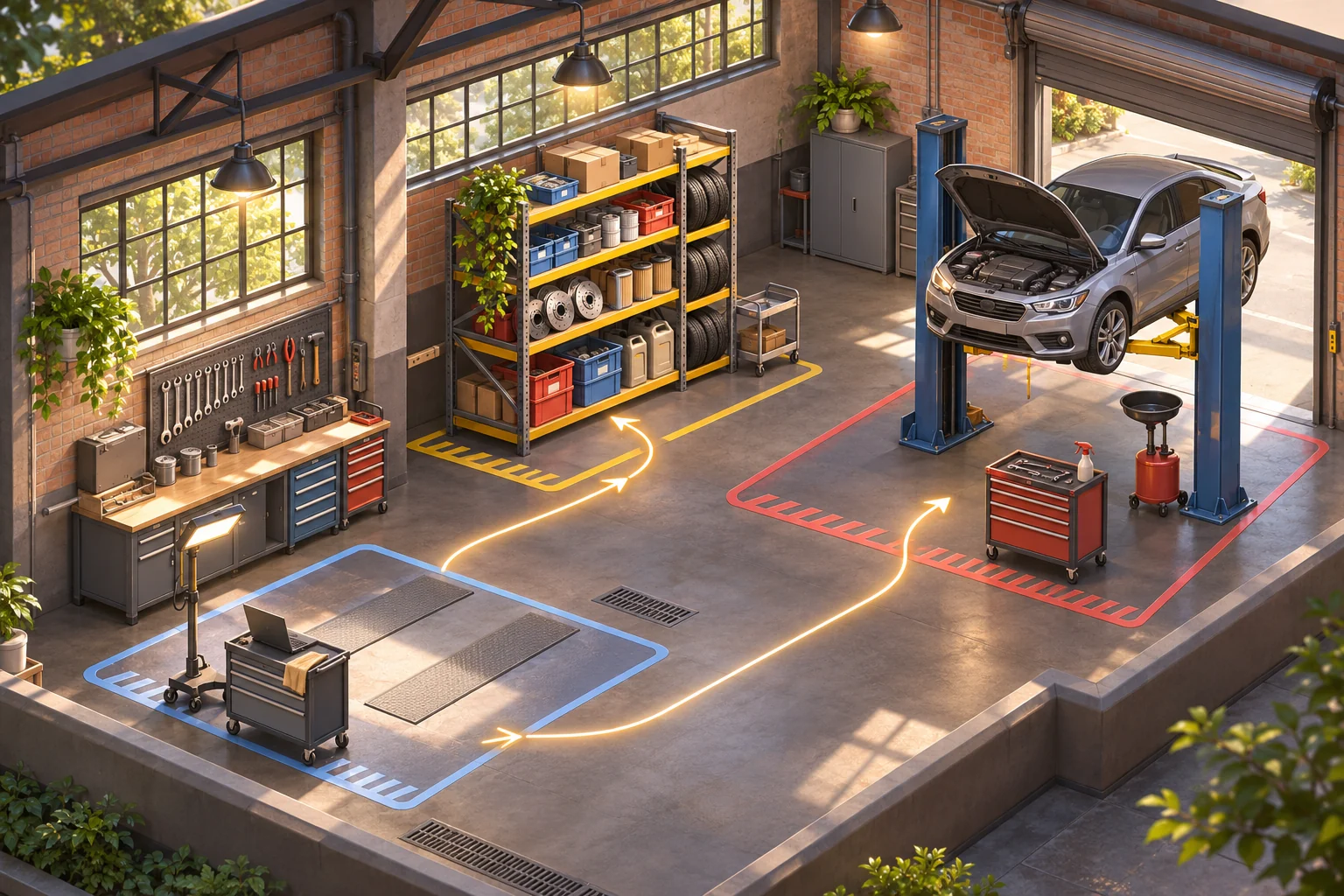
A cafe floor plan becomes a management mechanic when staff must travel between preparation stations, the counter and storage. Rearranging equipment can reduce one trip while creating congestion elsewhere. This gives players a spatial decision that affects service time without adding new recipes or staff types.
Start with one barista, one espresso machine and one pickup counter. Keep the menu, staff speed and customer arrival rate fixed while moving the machine. Compare route distance and completed drink handoffs. The small deterministic model below measures walking time only; it does not simulate queues or customer satisfaction.

Connect station placement to staff travel
Represent each task as a route between stations: retrieve ingredients, prepare the drink and hand it to the counter. Mark the active station and show how many tiles the staff member must walk. Keep walking speed constant so layout changes have a clear effect.
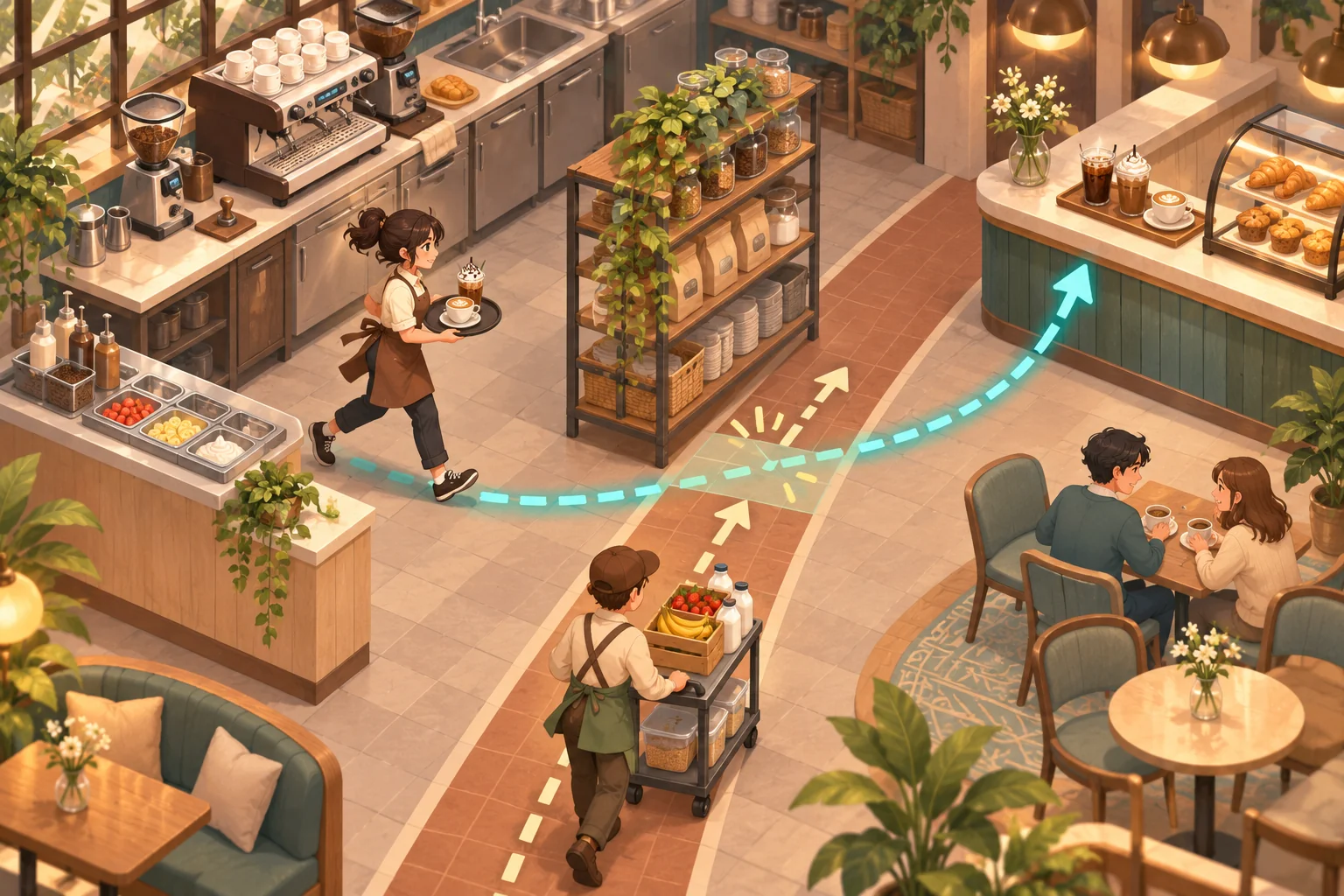
Use a simple grid and one worker before adding multiple staff. A station placed closer to the counter may shorten drink delivery but cross the ingredient lane. Show the crossing so players can see a possible bottleneck instead of hiding it inside a service score.
Measure one workflow at a time. Hold task order, walking speed and customer rate fixed; move only one station. Add staff roles or queue behavior only after players can predict how placement changes travel.
Move one station and keep tasks fixed
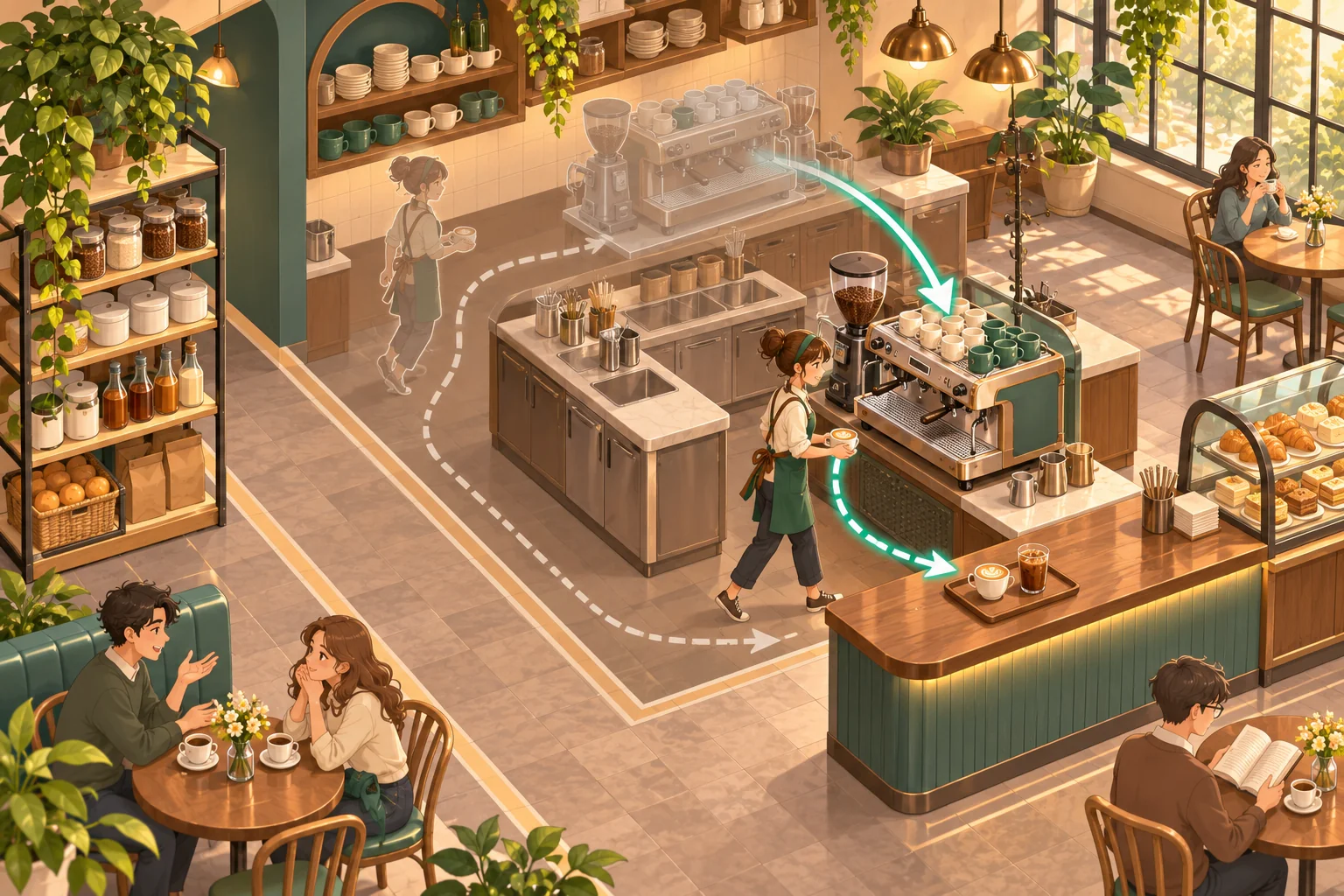
Set walking speed to 2 tiles per second. The current machine-to-counter route is 8 tiles, so a handoff takes 4 seconds of walking. Move the machine 3 tiles closer; the same handoff route is now 5 tiles, or 2.5 seconds.
Keep the shelf, recipe, worker and task sequence unchanged. The layout saves 1.5 seconds per handoff in this model. In the prototype, also check whether the new machine location blocks the ingredient path or creates crossing traffic.
This calculation checks route distance divided by walking speed. It does not test grid pathfinding, worker animation, simultaneous tasks, queue length or service quality.
Ask AI for an inspectable workflow prototype
Describe stations as grid coordinates and task routes as visible paths.
Change one location while keeping worker speed and tasks constant.
Create an original cafe layout prototype with one barista, one ingredient shelf, one espresso machine and one pickup counter. Show the task route between stations on a grid. Walking speed is 2 tiles per second; the initial machine-to-counter path is 8 tiles. Move only the espresso machine 3 tiles closer and show the new route and travel time. Keep recipe, staff and customers fixed. Also highlight any path crossing caused by the new layout; do not add queue simulation yet.
Tune station routes before adding more staff
Layout can create a meaningful cafe-management decision when station placement changes how far staff walk and which lanes they cross. Keep speed and task order fixed while testing one move. After players can read the route tradeoff, introduce queues and multiple workers as separate systems.
Start a workflow-focused cafe prototype with SEELE’s AI game maker
Frequently asked questions
How do I make a layout change measurable?
Show the route between stations and use a fixed walking speed. Compare distance and travel time before and after moving one item. Keep customers, recipe steps and staff unchanged so the difference comes from the layout rather than a hidden change elsewhere.
Should I add queues before station placement works?
Begin with one worker and one task route. Queues add timing and customer behavior that can obscure whether a layout is efficient. Once the player can predict how station placement changes travel, add a small queue and test how it interacts with the same route.
Does route arithmetic prove a layout is better?
No. Shorter walking distance does not guarantee faster service if the new placement causes crossing paths or blocks access to ingredients. The arithmetic checks movement time only; a playable prototype is needed to assess congestion, readability and customer experience. Measure actual prototype playtests before judging the layout.