A large display tank can delight visitors and still make the aquarium harder to maintain. In Blue Current, the same floor tiles determine where keepers can walk, so moving one exhibit changes the route to feeding and filter jobs. The player is arranging a business and a staff path network at the same time.
This fictional aquarium uses a small 5-by-3 floor grid, one keeper, one coral tank, and one blocking display tank. A shift has ten work points. Each tile crossed costs one point and a care task costs two. Put the display in the central service aisle and a round trip to the coral tank costs twelve movement points; move it to the north gallery and the route costs eight. The work-order math makes the layout effect visible before the aquarium grows.

Treat tank placement as part of staff scheduling
Use a five-column by three-row floor grid. The service door is at (0,1), the coral tank at (4,1), and the filter room is next to the coral tank. The keeper walks only through empty service tiles; tanks and walls block movement. Each orthogonal tile step costs one work point. A care job costs two points when the keeper reaches its target. A shift budget is ten points, and a job is completed only if the keeper can travel from the service door to the target, perform the care action, and return to the door within that budget. The display tank is also a solid obstacle. With it at (2,1), the direct aisle is blocked. The shortest available route goes through row 0 or row 2 and is six steps each way: twelve movement points plus two for care, which exceeds the shift. Move that same display tank to (2,0), preserving its exhibit but clearing the middle aisle. The route becomes four steps each way; eight travel plus two care equals the ten-point budget. This deliberately small model isolates one business question: a visually attractive tank location can consume keeper capacity. It does not simulate real animal-care standards, tank chemistry, visitor crowding, or an actual aquarium. Add those only as separate authored systems with their own constraints.
| Element | Rule and result |
|---|---|
| Floor grid | Five columns by three rows; staff move one orthogonal tile per work point. |
| Blocking exhibit | A tank or wall blocks staff pathfinding; it cannot be crossed. |
| Coral care job | Travel to the target, spend 2 work points, then return to the service door. |
| Shift budget | A shift has 10 work points; a job completes only when travel and care fit. |
| Central display at (2,1) | Blocks the direct aisle; shortest round trip is 12 movement points plus 2 care. |
| Display moved to (2,0) | Clears the middle aisle; round trip is 8 movement points plus 2 care, exactly 10. |
Trace one blocked route and one clear aisle
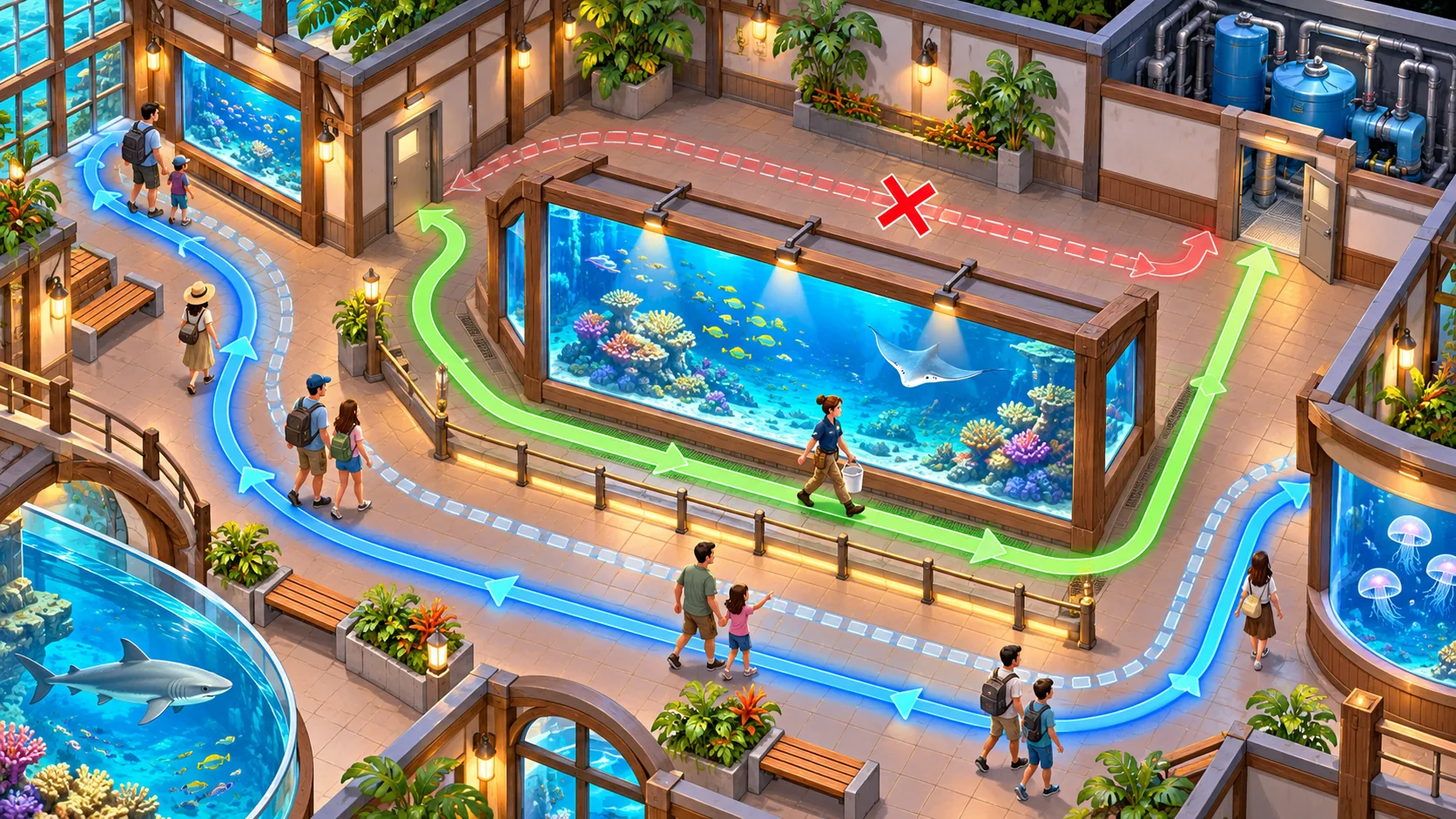
Start on the 5-by-3 grid at service door (0,1), with the coral tank at (4,1), a filter room beside it, and a ten-point shift. First place the solid display tank at (2,1). The keeper cannot cross it, so the shortest path runs one tile up, four across, and one down: six steps to the coral tank, then six back. Add two work points to feed the tank and the job costs fourteen; the shift ends with the care task incomplete. Counterexample layout: move the display to (2,0). The middle aisle is open, so the keeper walks four steps to the coral tank and four back. The same two-point care task costs ten and completes exactly at shift end. Both routes are deterministic on this obstacle grid; the difference comes from exhibit placement, not staff speed or random events.
| Check | Expected result |
|---|---|
| Set display at (2,1) | The direct row-1 path is blocked; shortest trip is 6 steps each way. |
| Add one care job | 12 travel + 2 care = 14 work points; the ten-point shift cannot finish it. |
| Move display to (2,0) | The middle aisle opens; shortest trip is 4 steps each way. |
| Repeat the care job | 8 travel + 2 care = 10; job completes at shift end. |
| Block a route completely | Show the job as unreachable and do not spend care points. |
| Reset the shift | Restore the saved tank layout, keeper location and ten-point budget. |
Ask AI for a small aquarium operations loop
Ask SEELE for one grid-based aquarium floor before adding guests, water chemistry or multiple staff. Specify which tanks block cells, where the keeper starts, the work-point cost of each step and the order of travel, care and return. Compare the two layouts to the hand trace and show the route length before a shift is committed.
Create a local aquarium management prototype called Blue Current. Draw a five-column by three-row floor grid. Service door at (0,1), coral tank at (4,1), filter room beside the tank, one keeper, and one solid display tank. Tanks and walls block movement. Keeper walks orthogonally through empty service tiles; each tile costs one work point. A coral feeding job costs two points and requires the keeper to travel from the door to the tank, perform care, and return. Each shift has ten points. With display tank at (2,1), the direct row is blocked, so the shortest route is six steps each way and the task costs fourteen total; leave it incomplete. Move display to (2,0), clearing the aisle; route is four steps each way and the same job costs ten, so it completes exactly. Show the grid, route cells, path length, work points, task result and reset. Do not claim real animal-care fidelity or simulate unprovided water-quality rules. Keep tank placement, task selection and shift confirmation keyboard-operable without timed input.Show route cost before the shift begins
The first draft let the keeper walk through the display tank and still counted the route as four steps. Treat occupied tank cells as impassable before running pathfinding. Show the shortest reachable route from the service door, count both the trip out and the return, then add care points. If no path exists, leave the job unspent and report it as unreachable.
Replay both display positions on the same grid. Confirm that a central obstacle raises the round-trip cost from eight to twelve, and that moving it to row zero restores the open aisle. Keep staff walking, guest navigation and aquarium water simulation separate until each has its own rules. Godot’s AStarGrid2D and NavigationServer2D documentation can inform a prototype route system, but no engine implementation is included here.

Add tanks only after the keeper can finish care
Keep the floor and one keeper fixed while checking whether display placement changes daily care capacity. The player should be able to see the blocked cell, follow the route, and predict why one layout misses the shift budget while the other completes. After that trace works, add a second tank or a second keeper and compare competing work orders. Do not fold water quality or visitor satisfaction into the same path calculation.
Read Godot AStarGrid2D documentation.
Read Godot NavigationServer2D documentation.
Frequently asked questions
How does room layout change staff work?
Occupied tank and wall cells block the keeper’s route. Moving an exhibit can shorten or lengthen the round trip to a care target, which changes how many tasks fit in a fixed shift. Show path distance and task cost separately so the cause is visible.
Why count the return trip?
A keeper who must return to the service door has spent time on both travel legs. Counting only the outward path overstates shift capacity and can make a blocked layout look more efficient than it is. Include return movement in the work-order total.
Start a local game prototype with SEELE.
What if no route reaches a tank?
Mark the job unreachable, spend no care points, and show the blocked cells that separate the keeper from the target. The layout can then be corrected before a shift is committed. Avoid silently teleporting staff or finishing care through a wall.
Does this model prove real aquarium care is safe?
No. The grid is a fictional workflow prototype with invented travel and task costs. It does not simulate water chemistry, animal health, species requirements, staffing laws or expert husbandry. Treat those as separate researched systems before making real-world claims. It is only a design sketch.