Linked player-built settlements can make an underwater survival world feel larger and more purposeful, but they also touch oxygen, depth limits, travel, storage, power, crafting, and saves. Define what a link actually provides before building the network. Keep the current survival rules in charge, add one connection between two bases, and test local versus shared state on a copy of the project.
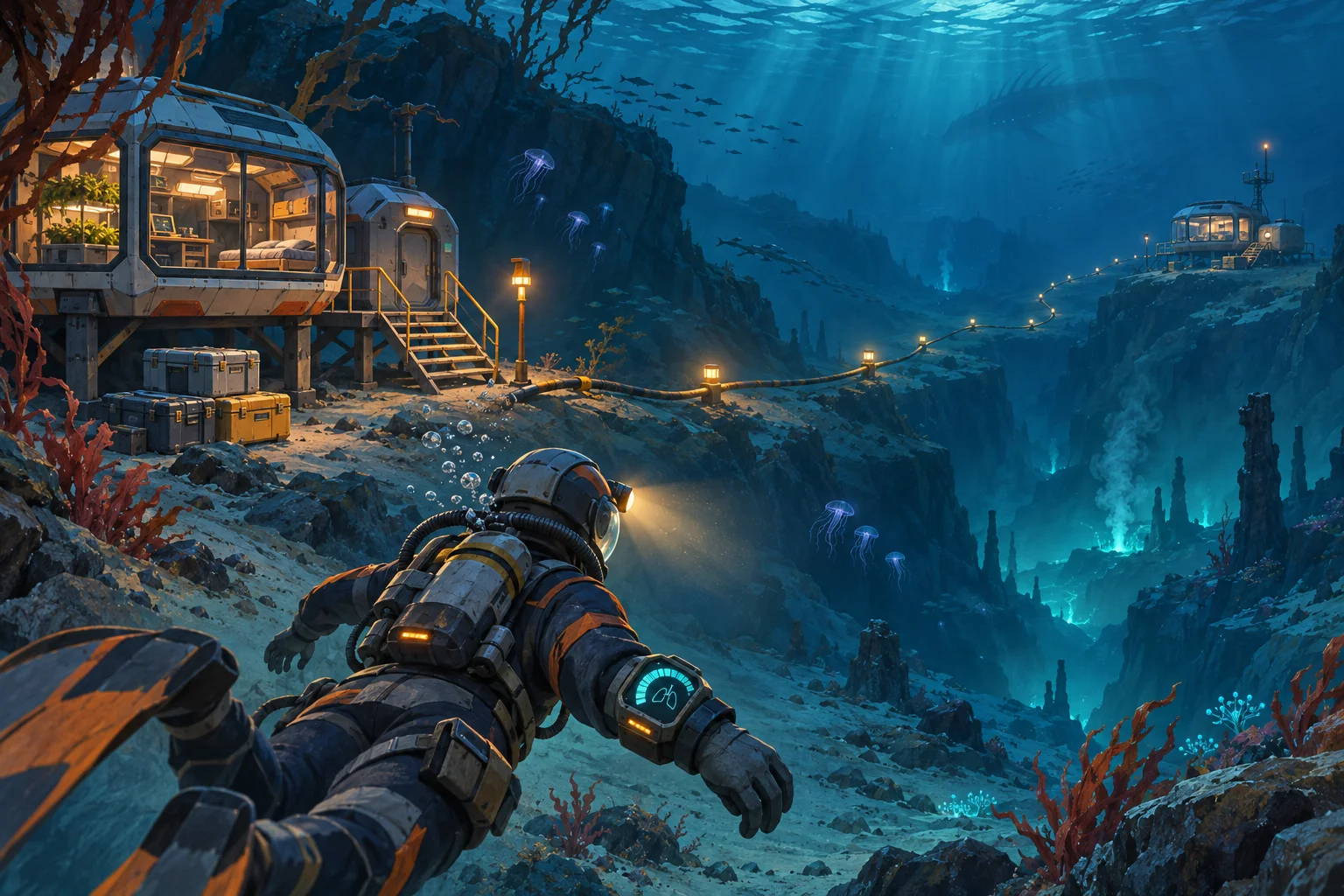
This is a guide to extending an existing game, not a claim that a settlement network has been built. The diver, bases, resources, route, and test outcomes are invented. No project files, save, build, or gameplay were available; the checks below are proposed and unverified.
Define what a connection means
A visual cable can mean several different things: a route the player can swim along, a shared power line, a remote storage link, a transport service, or simply a map marker. Choose which behaviors the network supports and which remain local. If a link can be built or broken, define the conditions and show its current status to the player.
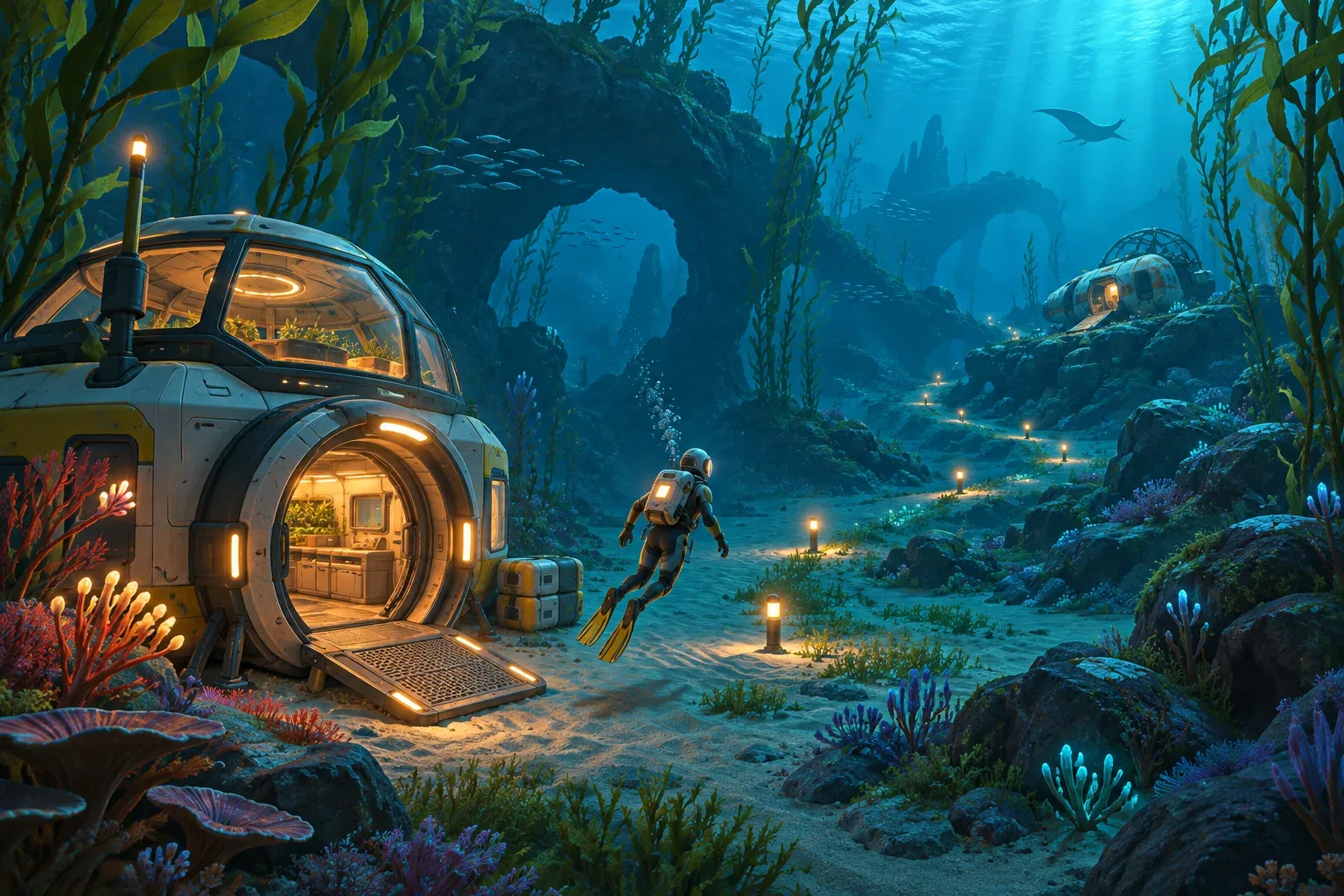
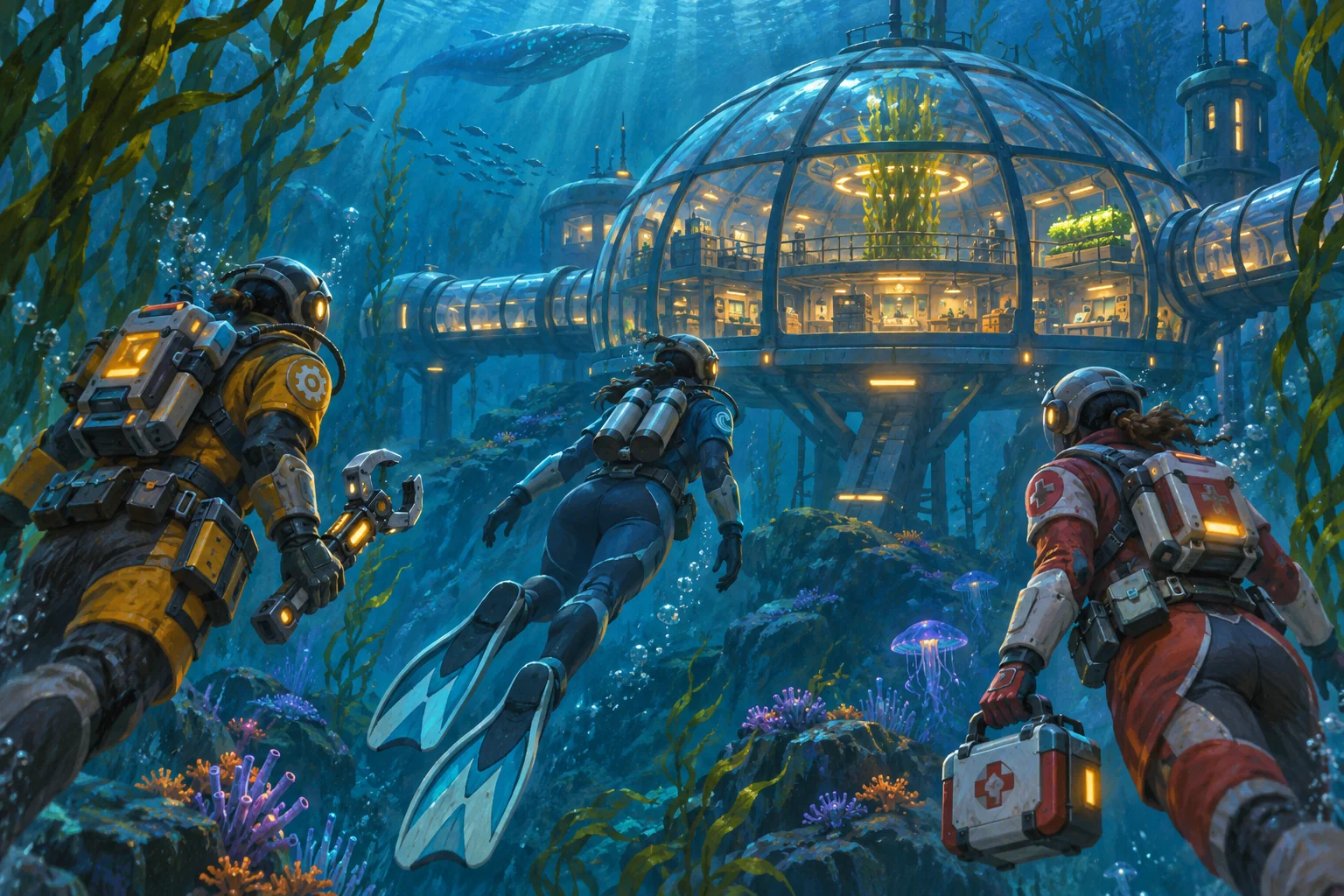
In the fictional Blue Current example, two habitats are connected by a lit travel cable, while each base keeps its own crates. A separate conduit shares power only while both endpoints are active. These are invented design rules, not observations from a real game. The target project may use completely different building or resource systems.
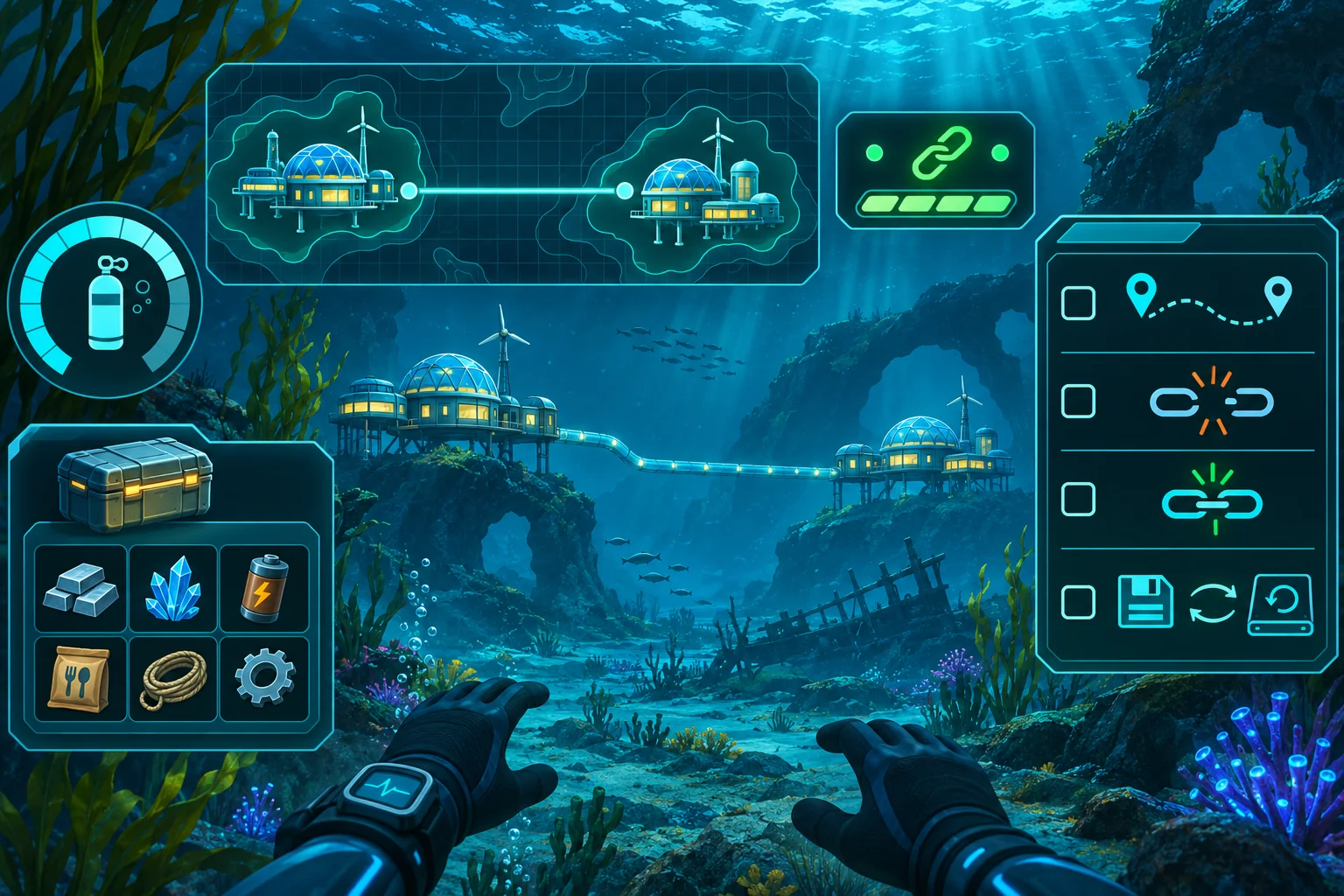
| Network property | Question to answer | Survival loop to protect |
|---|---|---|
| Travel route | Where can the player enter and exit? | Oxygen and depth limits |
| Power link | What works when either base is offline? | Local generator and crafting behavior |
| Storage | Does inventory move or remain at its base? | Scarcity and carrying capacity |
| Ownership | Who can use or alter each base? | Existing player/build permissions |
| Persistence | What survives reload or link loss? | Current save and world progression |
Keep local survival state separate from shared state
Assign stable IDs to settlements and link endpoints. Store each base’s construction stage, local storage, and local services with the base that owns them. Represent a connection as its own record with endpoint IDs and supported services. This avoids treating a map line as proof that every resource is globally accessible.
Keep transient state separate: a diver’s current oxygen, a temporary hazard, a moving creature, or a short-lived power fault may follow the existing simulation rules. The network should not silently refill oxygen or teleport supplies unless that behavior has been explicitly designed. If shared power is available at a remote station, specify its range and failure behavior.
Godot’s stable saving tutorial demonstrates selecting persistent fields and serializing them in one engine-specific example. It does not prescribe an underwater network schema. Its data-path guide documents user:// as a writable location for persistent data in exported Godot projects. These are engine-level references, not evidence that a target game uses Godot or stores settlements in a particular way.
Preserve oxygen, depth, and exploration
A convenient base network can accidentally erase the travel decisions that make an underwater game tense. Keep the current oxygen timer, depth damage or pressure rules, suit upgrades, and route hazards intact. If a settlement offers a refill, make that a clearly defined service at that location rather than a global effect. A player should still plan the trip between bases using the existing mechanics.
Start with two reachable bases and one route. Keep the route within current traversal rules and make its endpoints discoverable. If building the link consumes materials, use the existing crafting validation. Decide what happens if the player builds only one endpoint, dismantles a segment, or loses power midway through a trip. Avoid adding new resource types until the first route works with existing materials.
Plan the smallest network feature
Ask AI to inspect the actual base, inventory, travel, and save files and propose a file-by-file plan before implementation. A narrow first slice might add one settlement ID, one link record, a map connection indicator, and a supported shared service. Keep oxygen calculations, player movement, depth hazards, crafting costs, and old save fields untouched unless project evidence proves a dependency.
Use a file allowlist and review the complete diff. If the plan changes all inventory or world-generation code to support one connection, narrow it. Make a clean commit and copy a save before migration. Keep the link optional so an existing solo base and ordinary exploration remain available if the network feature is removed.
| Feature layer | Potential minimal change | Keep stable by default |
|---|---|---|
| Settlement identity | One stable base ID and local state owner | Existing building and save ownership |
| Link data | Endpoint IDs and enabled services | Player movement and world map |
| Shared service | One power or route behavior | Oxygen, depth, and local crafting |
| UI | Connection status and route indicator | Existing exploration HUD |
| Migration | Default for saves with one base | Legacy inventory and world state |
Test travel, disconnection, and reload
Test the route with the existing oxygen equipment and movement limits. Check both directions and both endpoints. Disable or break the link and verify which services stop, which stored items remain local, and how the player is warned. Save during a stable state, reload, and confirm that construction is neither duplicated nor reset.
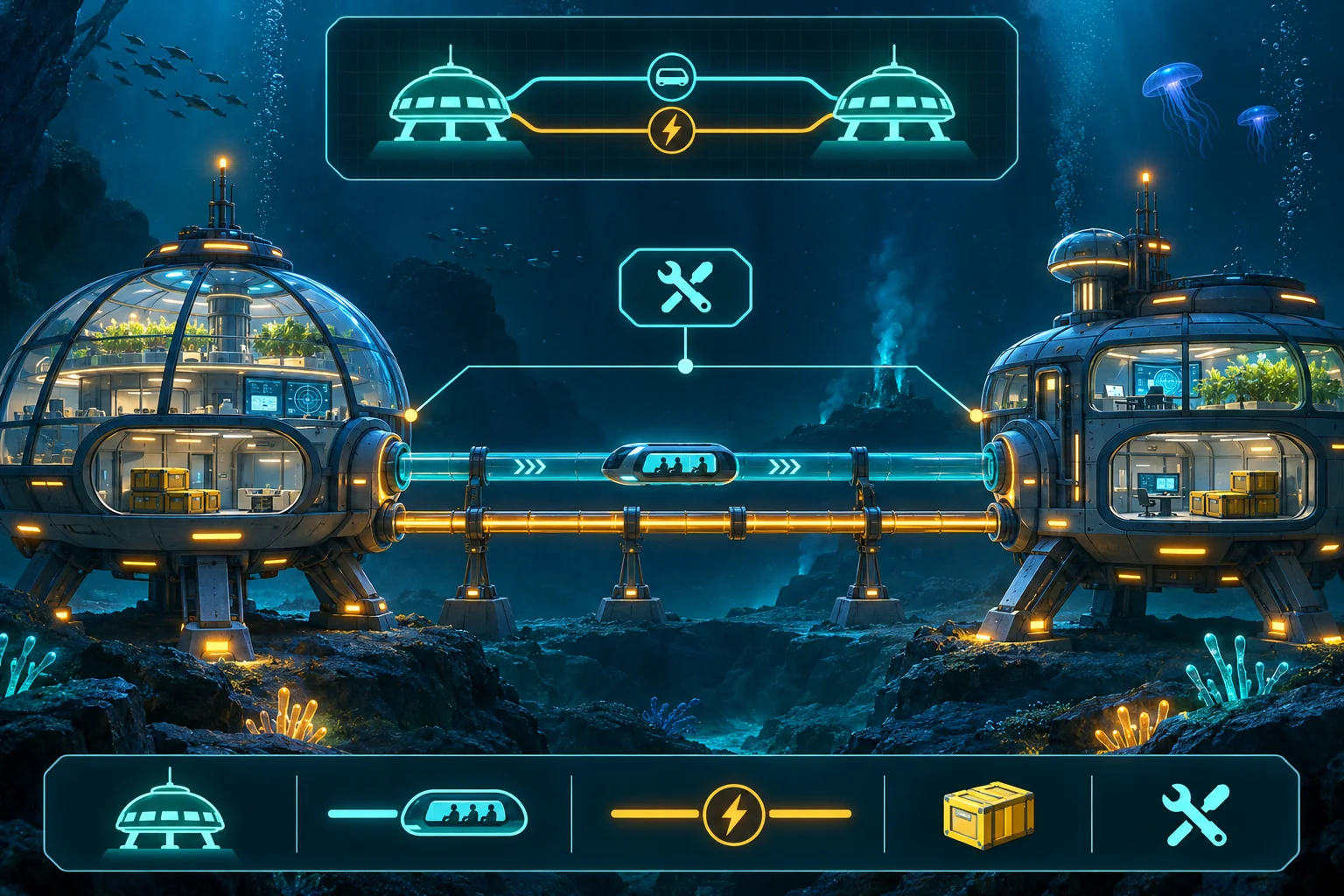
| Proposed check | Action | Evidence to record |
|---|---|---|
| Route traversal | Travel between both bases | Oxygen use, depth and arrival state |
| Local storage | Disconnect the link and inspect crates | Inventory owner and available items |
| Shared service | Disable one endpoint | Power behavior and user feedback |
| Partial build | Build one endpoint or link segment | Allowed actions and safe failure |
| Save/reload | Reload a copy with two linked bases | Stable IDs and no duplicate structures |
| Rollback | Restore the baseline branch | Original single-base survival loop |
This is a test plan, not a test report. Record game version, settlement IDs, route, suit state, oxygen before and after travel, resource ownership, link status, expected result, and actual result. The generated diagram cannot prove that the travel duration or refill behavior preserves the game’s intended pressure.
Plan save compatibility deliberately
Old saves may contain a single player base and no network records. Define what a missing link list means and how the existing base receives a stable ID. Test a copied legacy save through load, save, and reload. Keep the original save unchanged until the new data shape has been verified. Avoid changing the save version globally if a local optional field is sufficient.
To explore a separate underwater survival concept, try SEELE AI Game Maker. It is a concept tool, not an existing-project editor.
Frequently asked questions
What should linked underwater settlements share?
Decide whether settlements share only route information, storage, power, or a transport service. Give each resource a clear owner and connection rule. Avoid making every base globally connected by default if travel, distance, or oxygen management is central to the existing survival loop.
How can I connect bases without removing oxygen pressure?
Keep oxygen use and depth hazards in the existing movement and survival systems. Let a settlement network provide defined services only when the player reaches a valid connection point. Test the route between bases with the current oxygen limits instead of silently refilling resources across the map.
Should disconnected settlements keep working?
Specify what remains local when a connection breaks and what becomes unavailable. A stored item may stay in its base while remote power or transport stops, depending on the project’s rules. Show connection status clearly and test reconnecting without duplicating items or resetting construction.
How should linked settlement state be saved?
Use stable settlement IDs and store only the state the current project treats as durable, such as construction stages and link endpoints. Keep transient visitors or active hazards separate if existing saves do. Test old save copies, network changes, and reload before migrating player data.
Can AI safely add linked bases to my underwater game?
AI can inspect supplied building, travel, resource, and save files, propose a narrow network feature, and draft tests. It cannot verify oxygen balance or duplicate-free transfers without the real project and executed runs. Provide an allowlist, baseline save, ownership rules, and rollback commit.
Connect bases while keeping the ocean challenging
Define what a link provides, keep resource ownership explicit, and connect two settlements through the existing travel and save systems. Preserve oxygen, depth, crafting, and local survival rules. Test connected, disconnected, partial-build, and old-save cases on copies, then keep a clean rollback point. Treat all examples as conceptual until the actual project is exercised.