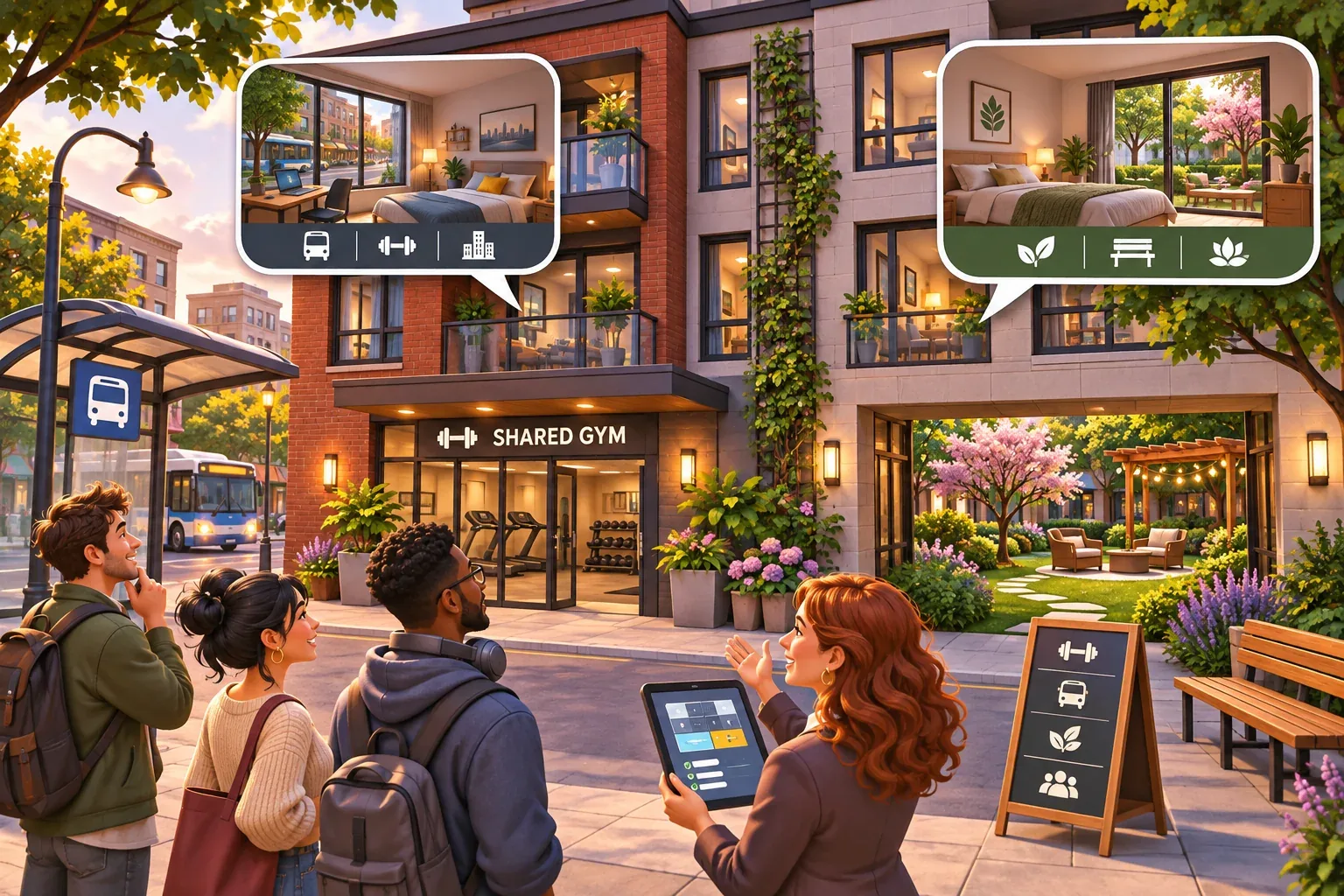
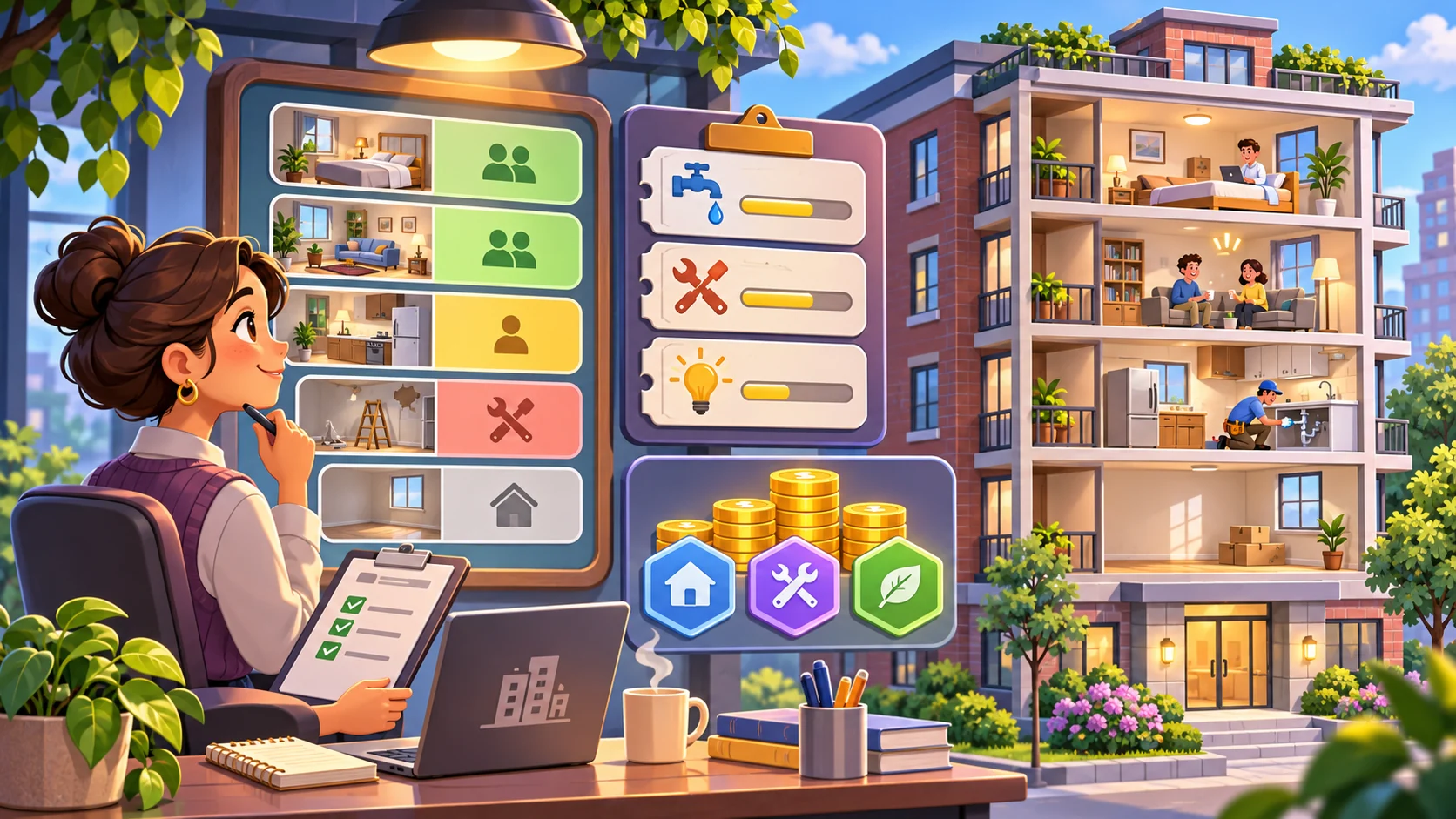
Adding a second property should expand the management game, not duplicate every system that runs the first one. Tenants, maintenance, occupancy, rent, and the calendar need a clear location context, while portfolio-wide services and cash flow need one shared owner.

This guide uses a fictional portfolio to describe the data boundaries. No game, property, or cash-flow simulation was tested. Before asking AI to add connected locations, trace how the existing project creates a property, assigns tenants, schedules repairs, and calculates rent.
Give every location a stable identity
Start with a location ID that survives a display-name change. A property can have authored facts such as unit capacity and service access, plus runtime state such as current tenants, open maintenance jobs, and upgrades. Keep those records distinct so changing a building illustration does not erase the tenants assigned to it.
For the fictional Harbor Row example, a small apartment building and a retail unit occupy separate records. Both can use the current tenant and maintenance systems, but each has its own capacity, rent rules, and repair queue. The portfolio may share a service van or reserve fund. This is a modeling suggestion, not a claim about a real game economy.
| Level | Possible data | Example owner |
|---|---|---|
| Property definition | Location ID, unit count, property type | Authored content |
| Location state | Tenant assignments, repairs, local upgrades | Property runtime record |
| Portfolio | Shared service, cash balance, policy | Portfolio manager |
| Calendar | Rent period, maintenance deadline | Existing time system |
Reuse the tenant and maintenance systems
Pass a property ID into systems that already handle tenant assignment and repair. A lease belongs to one location; a repair references the affected unit or building; occupancy is calculated from the valid tenant records. Do not create a separate rent formula or maintenance queue just because the game now has multiple addresses.
Define tenant transfers as an explicit event. If the game allows a tenant to move, remove the old assignment, validate the new property's capacity, update the tenant record once, and recalculate both locations. Keeping the tenant in both places during the transition can double-count occupancy and rent.
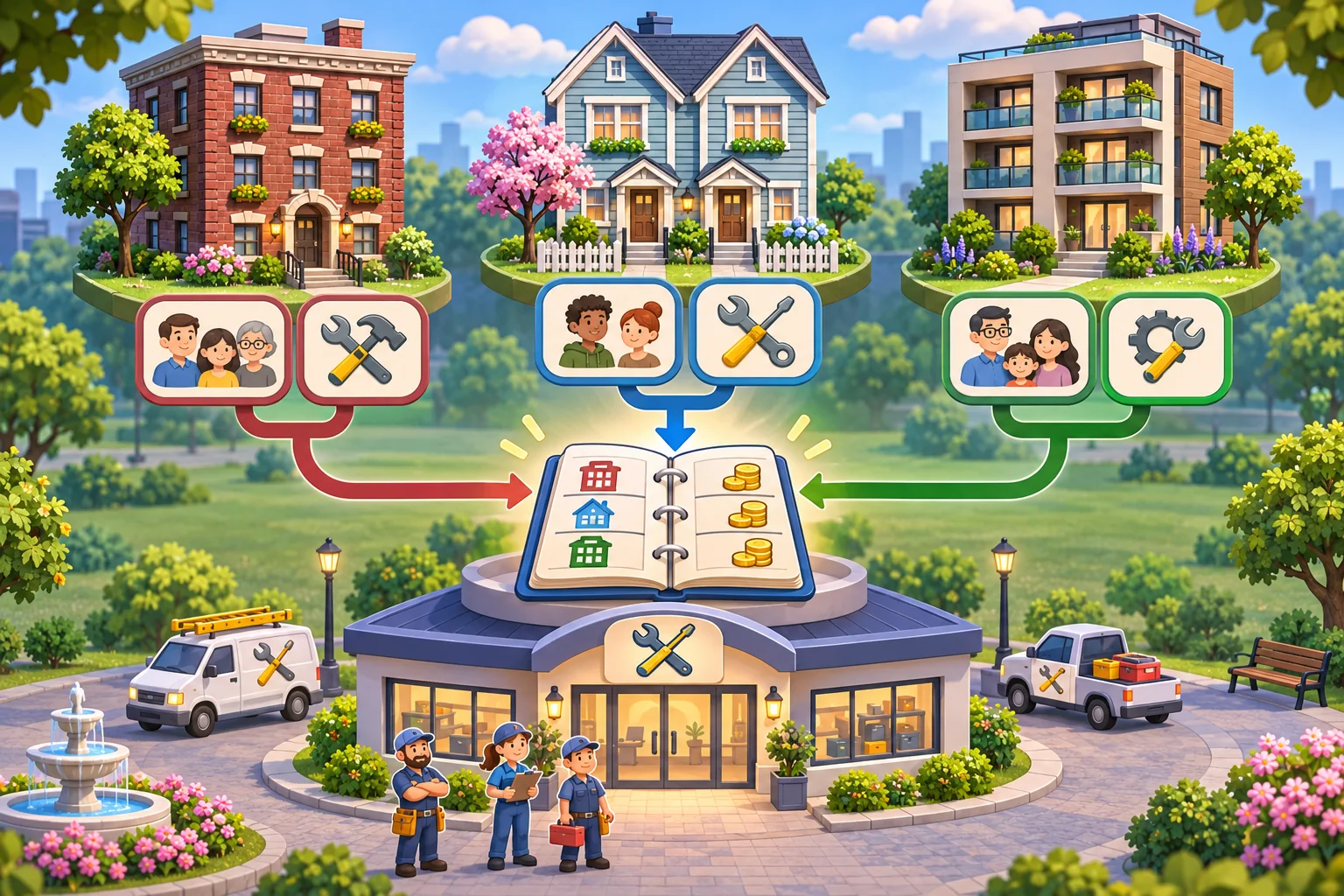
Keep building-specific upgrades in the location record and shared policies in the portfolio record. If an upgrade affects all properties, apply it through the portfolio owner so adding a new location does not forget the rule. Give each upgrade a stable ID to support save migration and localization.
Advance the portfolio through one calendar boundary
Cash flow often depends on time. Decide when rent is charged, repairs consume funds, vacancies begin, and shared services are allocated. Use the game's existing calendar transition so every property is updated for the same period. Separate clocks can charge one location twice or leave a newly added building one month behind.
A portfolio update can follow a clear order: close the period's tenant changes, calculate each property's income and expenses, apply shared service costs, commit the portfolio balance, then refresh the UI and save. The correct order depends on the existing game rules. Write down whether new leases start before or after rent is charged.
Use one finance owner to aggregate data. A building panel can show its own income and repair costs, while the portfolio summary shows the combined balance. If the same cost appears in both views, ensure the summary is derived from the underlying records rather than written as a second independent value.
Model locations as authored data
Follow the current project pipeline for property definitions. Godot's stable documentation describes custom Resources that can be serialized and edited in the Inspector. Its saving tutorial discusses file-based state and JSON tradeoffs. These references help with authored data and persistence choices; they do not prescribe a real-estate model or tenant economy.
Ask AI to propose a migration for older saves that only contain one property. The old home should receive a stable location ID and keep its tenants, rent settings, repairs, and upgrades. Add the portfolio container with safe defaults and test the migration on a duplicate profile before changing the only save.
Ask AI for a narrow, reversible change
A bounded request can say: support multiple property IDs using the existing tenant, maintenance, finance, and calendar systems; preserve current rent and repair rules; keep shared services at portfolio scope; add one new location; list changed files, save fields, migration steps, and rollback instructions.
Review the diff for hidden copies of finance logic, tenant records keyed only by display name, one-property assumptions in UI queries, and calendar loops that still update only the original address. Ask which files own the location list, tenant assignment, repair queue, and portfolio summary.

Verify multiple locations and totals
The cases below are a proposed test plan, not results from the fictional neighborhood.
| Case | Action | What to verify |
|---|---|---|
| Original property | Load an existing one-property save | Tenants, repairs, upgrades, and balance remain intact |
| Second location | Add a new property record | Stable ID and capacity load without duplicating the first |
| Tenant transfer | Move a tenant if supported | Old and new occupancy update once |
| Maintenance | Schedule and resolve one repair | Correct location and cost are recorded |
| Period advance | Advance one calendar period | Income and shared costs apply consistently |
| Save/reload | Save portfolio and reopen | Per-location and aggregate totals agree |
Record project version, location IDs, tenant records, time period, steps, expected and observed totals. Test the target build and a migrated profile. A generated neighborhood diagram can explain relationships; it cannot prove rent calculations or tenant transfers.
Frequently asked questions
What should each property location store?
Give each location a stable ID and keep its tenant assignments, maintenance state, capacity, and property-specific upgrades separate. Shared portfolio cash flow or services can live at the portfolio level if the current game supports that model. Give each property record its own stable location key.
How do I connect several locations without duplicating code?
Have existing tenant and maintenance systems read a location ID as context. Reuse the current rent, repair, and calendar rules rather than copying them into a separate manager for each property. This also keeps the current business rules in one place.
Should tenants move between connected properties automatically?
Only if the game's rules define a transfer. Keep a tenant assigned to one valid location at a time, record the move through the current tenant system, and avoid duplicating rent or occupancy during the transition. The operation should move one tenant record, not clone it.
How can I keep portfolio cash flow consistent?
Use one finance owner that aggregates location-level income and expenses for a committed time period. Check that maintenance costs, vacancies, and tenant changes are applied once when the portfolio advances. Reconcile the total from the same committed period snapshot. Keep period boundaries consistent for every location.
What should I test after adding connected properties?
Test one property, add a second, transfer a tenant if supported, apply maintenance, advance the calendar, save and reload, and compare portfolio totals. Record actual results; a map mockup is not an economic simulation. Keep the location IDs and time period in the review record.
Expand from one trusted property record
First make one existing location use a stable property record without changing its behavior. Then add a second location that reads the same tenant, maintenance, finance, and calendar systems. That sequence gives reviewers a clear comparison and keeps the portfolio's totals traceable.
For a separate browser-playable prototype idea, try SEELE AI Game Maker. This is a separate prototype path, not an existing property-management editor.