Colony incidents become memorable when they connect to conditions players can see and choices they have made. A system can select authored events based on local pressures, then offer readable responses and feedback. RimWorld’s official listing describes a story generator that controls random world events; the incident model in this guide is original design advice for a new game.

Make colony state shape incident selection
An emergent incident feels personal when it connects to something the player has built, neglected, or come to care about. RimWorld’s official Steam listing describes it as a story generator and says it controls random world events. That public framing supports the idea of event-driven stories, but the system recommendations here are original and do not claim to reproduce the reference implementation.
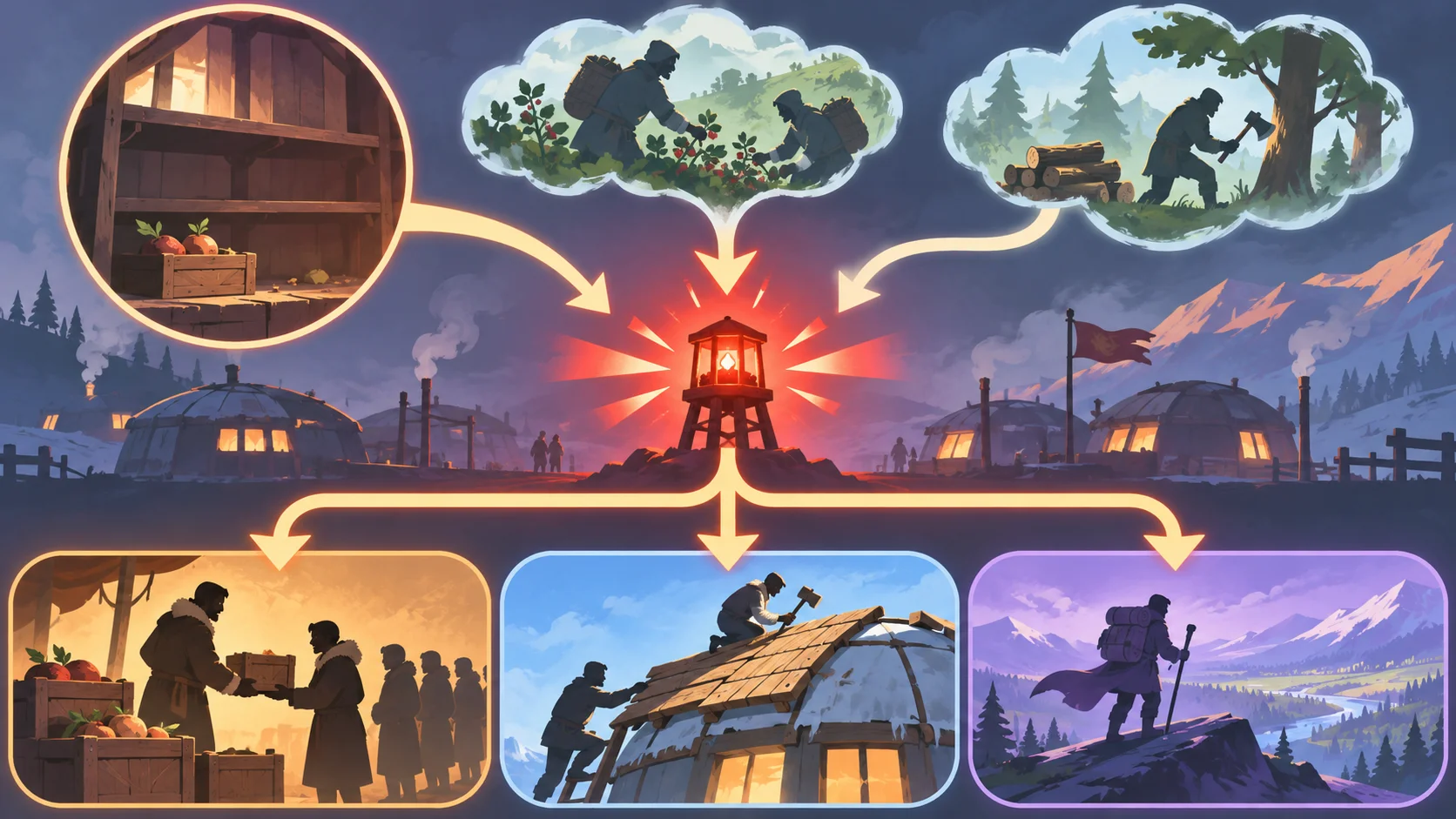
Choose a small set of state signals that incidents can use: resource reserves, construction status, environmental exposure, resident relationships, and recent threats. For each incident, define preconditions and a few eligible variants. A storm can test an exposed crop field, while a supply caravan may arrive when the colony has a need it can actually address. The same event label can resolve differently according to current context.
Do not let every state variable affect every incident. That makes cause and effect difficult to reason about. Give each incident one primary trigger and perhaps one modifier. Document which state mattered, what was eligible, and why the system selected this event. That record will help the team diagnose patterns in playtests.
Connect a trigger to a readable consequence
Players should be able to connect an incident to evidence. A warning about an unstable roof can precede damage during a storm; a shortage can make a visitor’s offer valuable. Use a brief visual or dialogue cue to show the approaching pressure. If the event is completely unforeseeable by design, its consequences should remain limited enough that the player can recover.
Separate the event trigger from its possible responses. Once an incident begins, offer choices that reflect the colony’s resources and layout: prepare a shelter, reroute workers, or accept a controlled loss. The options should not all have identical outcomes with different labels. Show immediate costs and likely benefits, and let the player decide which risk fits their priorities.
After resolution, provide a concise explanation. Mention the condition that caused the change and the choice that affected the result. This feedback turns an event into a lesson and gives players a reason to adjust their colony plan. Avoid retroactive explanations that introduce an unannounced rule.
Preserve player agency during emergencies
An incident can create urgency without freezing the player’s ability to respond. Give a clear time window, an obvious priority, and a practical way to assign attention. If a crisis requires pausing construction or changing schedules, explain the tradeoff. Let players decide which asset or resident matters most instead of automatically protecting one outcome.
Design counterplay at different costs. A prepared store room can reduce a shortage; a repair task can prevent the next storm loss; a relationship can unlock help. Not every response needs to succeed, but the player should understand what effort buys. Failure can still create a story if it changes the situation rather than ending the run without warning.
Balance incidents across the colony’s recent history. A severe event following several crises can feel like punishment, while repeated easy events feel irrelevant. Track pressure and recovery as a sequence, and leave room for the settlement to benefit from good planning. A quiet week or positive visitor can be an authored event too.
Test event sequences for stories and fairness
Test the system over long enough sessions to see combinations, not only individual triggers. Record incident frequency, repeated categories, warning time, player responses, losses, and recovery duration. Look for sequences that repeatedly target the same weakness or arrive before players can finish a reasonable response.
Run adversarial scenarios: a colony with low supplies, a colony with excellent defenses but poor relationships, and one that intentionally ignores a warning. Check whether the incident selector still produces understandable options. Use probability as a tuning tool, but do not expect a percentage to fix a weak consequence or an invisible trigger.
Finally, review the stories players tell after a session. If they describe a chain of decisions and consequences, the incidents are supporting agency. If they only describe bad luck, improve warning, counterplay, or event selection. If they recall no incidents, increase relevance or variation. Keep an event log during development so each adjustment can be linked to observed play rather than intuition alone.

Related guide
For another approach to connected choices and state pressures, see the guide to choice-driven resource balances.
Frequently asked questions
How do you design emergent incidents in a colony sim?
Start with colony conditions that players can observe, such as food reserves, weather exposure, or unresolved relationships. Create incidents with clear prerequisites and outcomes, then let current conditions influence which authored event appears. Test whether players can explain why the event happened and how their choices changed it.
How can random events feel fair?
Signal major risks through a forecast, warning, or visible condition before they cause irreversible loss. Keep an event’s consequences within rules players have already learned, and offer at least one response when action is possible. Surprise can come from timing or combinations without hiding the system entirely.
How do you avoid repeating the same incidents?
Track recent events by category, cause, and consequence, then temporarily reduce the chance of close repeats. Add variety through changing colony context rather than only writing more event names. A familiar storm can matter differently when crops are exposed, supplies are low, or a shelter is unfinished.
Should an incident always create a crisis?
No. Some incidents can offer opportunity, relief, or a relationship change that gives players room to stabilize. A rhythm of pressure and recovery helps major emergencies remain meaningful. Match each event’s intensity to the colony’s recent experience and the player’s ability to respond.
Prototype an incident sequence
Use AI to brainstorm event variants and check edge cases in a state table, then test how incidents feel in the running simulation. Designers should own the trigger rules, warnings, consequences, and recovery paths. Start a game project with Seele.