Resource balances make a sequence of story choices feel connected: each decision shifts pressures that the player will face again later. Define distinct measures, show their likely tradeoffs, and test how they interact across a full run. Reigns’ official listing describes swipe choices and balancing the church, people, army, and treasury; the design model here is an original proposal.
Choose balances that express real pressures
A resource balance system turns individual choices into an ongoing picture of what a community can sustain. Reigns’ official Steam listing describes left/right swipe decisions and a need to maintain balance among the church, people, army, and treasury. Those are public details of that game; the model and tuning advice here are original guidance for a new decision-driven title.
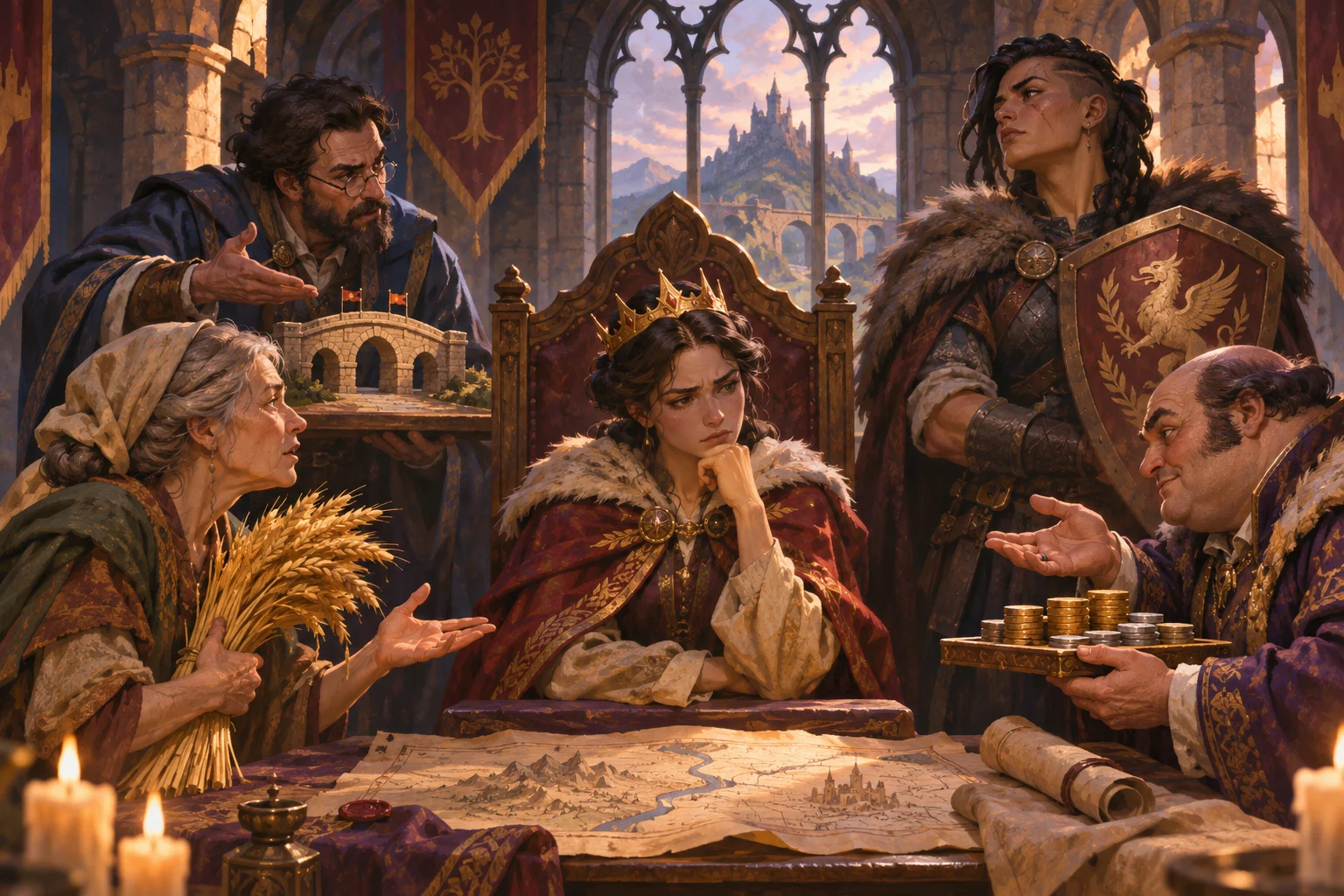
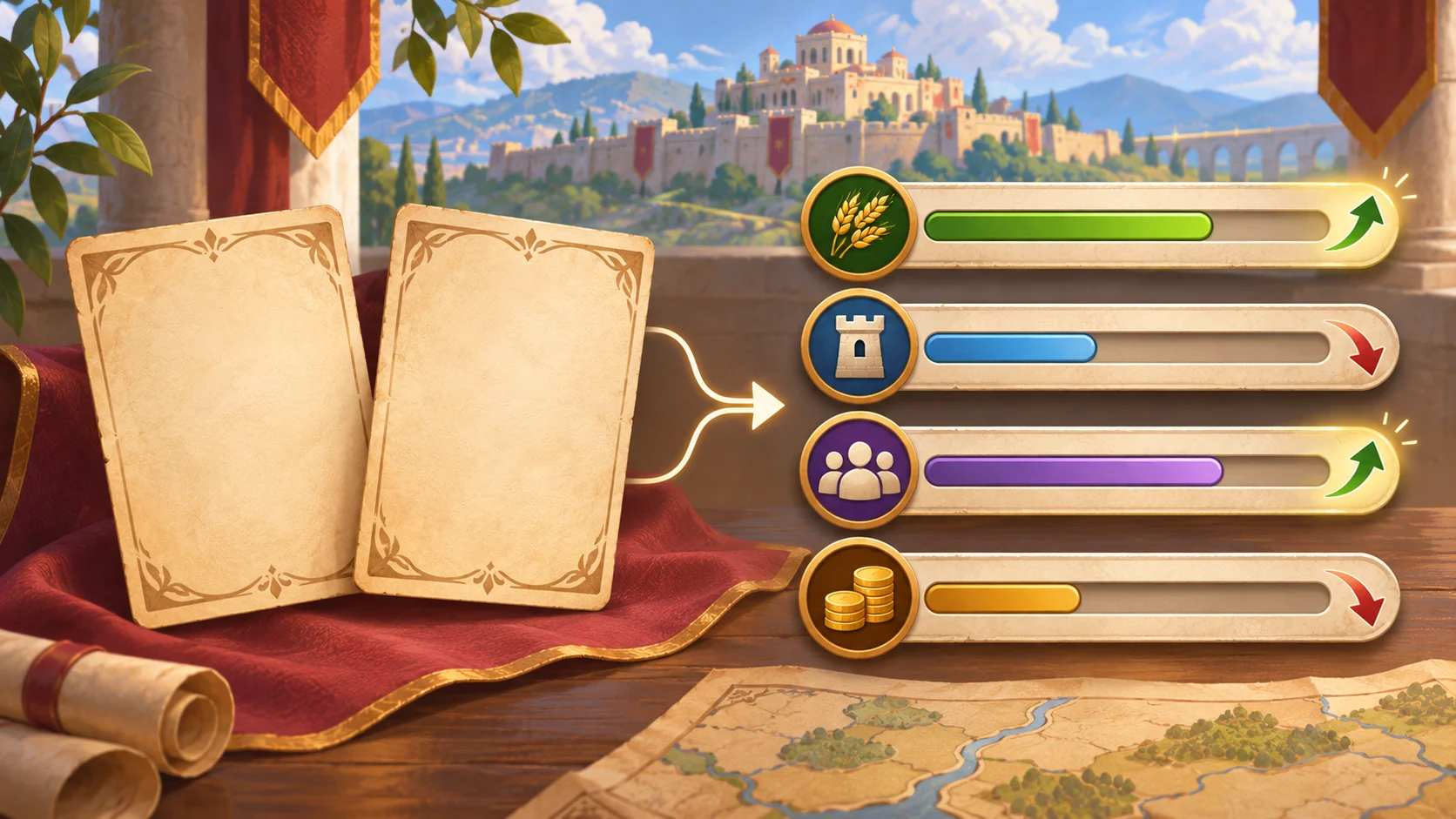
Begin with pressures that matter to your own setting. A small frontier council might track food, security, public trust, and funds; a ship crew might track morale, supplies, hull condition, and time. Each value should describe a distinct condition players can reason about. If two meters rise and fall together and lead to the same outcome, combine them or give them clearly separate roles.
Define the boundaries before writing a large set of choices. What is a comfortable range? What warning appears near a threshold? What happens at the minimum or maximum? Consider whether reaching a limit ends the run, triggers a costly event, or changes the next scenario. A visible state model prevents later narrative decisions from relying on inconsistent exceptions.
Make choice tradeoffs legible
A choice should make its meaningful pressure points understandable. A council may spend funds to repair a bridge, improving safety and commerce while reducing reserves. Show the immediate costs with a short explanation or stable icon language. The player does not need to know every future event, but should understand why the decision affects particular measures.
Use uncertainty as a designed property. A rumor may have an unclear long-term impact, but the immediate risk should still match the established rules. If a consequence depends on hidden state, provide a clue such as a character’s confidence, recent events, or a public warning. Avoid arbitrary shifts that cannot be learned from the game’s feedback.
Keep option comparison lightweight. The player should be able to scan both choices and identify at least one meaningful difference. If a card or dialogue prompt needs a paragraph of system explanation, simplify the decision or make a detailed forecast available on demand. Readability matters especially when choices arrive in quick succession.
Prevent runaway meters and dead ends
A meter can create pressure without making a run unrecoverable too early. Give players some recovery paths, but make them carry a cost. Food might recover through a harvest choice that spends time; security may improve through a patrol that reduces funds; public trust might require keeping a promise over several turns. Recovery feels strategic when it competes with another valid need.
Watch for runaway loops. A low resource can trigger an event that lowers it again, leaving no meaningful action available. A high meter can also become a trap if every positive option pushes it past a dangerous maximum. Model these thresholds in a simple table and simulate sequences that repeatedly favor one measure. Make warnings arrive before the state becomes irreversible.
Use caps, decay, or delayed effects only when they clarify the world. Every extra rule adds explanation and can hide causality. A short event log can show which choice moved a meter and why. When players blame a result on randomness, compare their expectation with the actual sequence and decide whether the forecast, rule, or outcome needs adjustment.
Test varied strategies across a full run
A balance model must survive different player priorities. Test a cautious approach, a generous approach, a security-first approach, and a sequence that intentionally spends one resource. Track turns to first warning, threshold crossings, recovery choices, run length, and repeated option selection. A strategy should have a distinct risk profile rather than reveal a single dominant answer.
Review play sessions by asking what players believed each meter meant, which consequences they predicted, and how they interpreted surprises. If players cannot explain why a state changed, improve the feedback. If one choice is always selected, determine whether its upside is too broad, its cost too mild, or the alternatives too unclear.
Finally, test recovery after a near-failure and evaluate whether the player sees a credible path forward. Endings and failure states should feel connected to accumulated choices. Add content only after the core meter interactions remain legible over several different runs. That keeps narrative variety from masking a balance problem.
Related guide
For a resource loop where collection choices affect construction options, see the guide to survival resource collection.
Frequently asked questions
How do you design resource balances in a choice game?
Choose a few measures that represent pressures players can understand, such as public trust, safety, supplies, or money. Define each measure’s safe range, what raises or lowers it, and what happens at its limits. Write choices so their immediate tradeoffs are visible, then test how the changes accumulate over a complete run.
How many resource meters should a game use?
Use only as many as the player can meaningfully compare while reading a choice. Three or four distinct measures can work when each has a clear identity and consequence, but the right number depends on the pace of the interface. Remove any meter that does not change a decision or reveal a different pressure.
How can choices feel fair when outcomes are uncertain?
Show the likely direction and scale of a consequence even when the exact future result remains uncertain. Keep surprise effects consistent with established rules and provide feedback after they occur. Players should be able to learn from an outcome and make a different informed choice next time.
How do you prevent one resource from dominating?
Review how often each meter reaches a danger threshold, which choices players repeat, and what resource they sacrifice to protect another. Test several strategies rather than a single intended path. If one measure always decides the run, adjust its sensitivity, add credible recovery options, or give other measures stronger consequences.
Prototype your choice model
Use AI to generate alternative choice sequences and surface edge cases, then validate the state changes in a playable build. Designers should own the consequences, warnings, recovery options, and balance values that define the intended experience. Start a game project with Seele.