Environmental tension is a decision problem: the player senses a risk, has incomplete information, and must choose whether to act, wait, or spend a resource. David Szymanski’s official Iron Lung listing describes a confined one-person submarine, limited senses, an incomplete map, proximity sensors, and dread built through restricted perception. Those published details set context only. The tension model below is original guidance for another contained horror game.
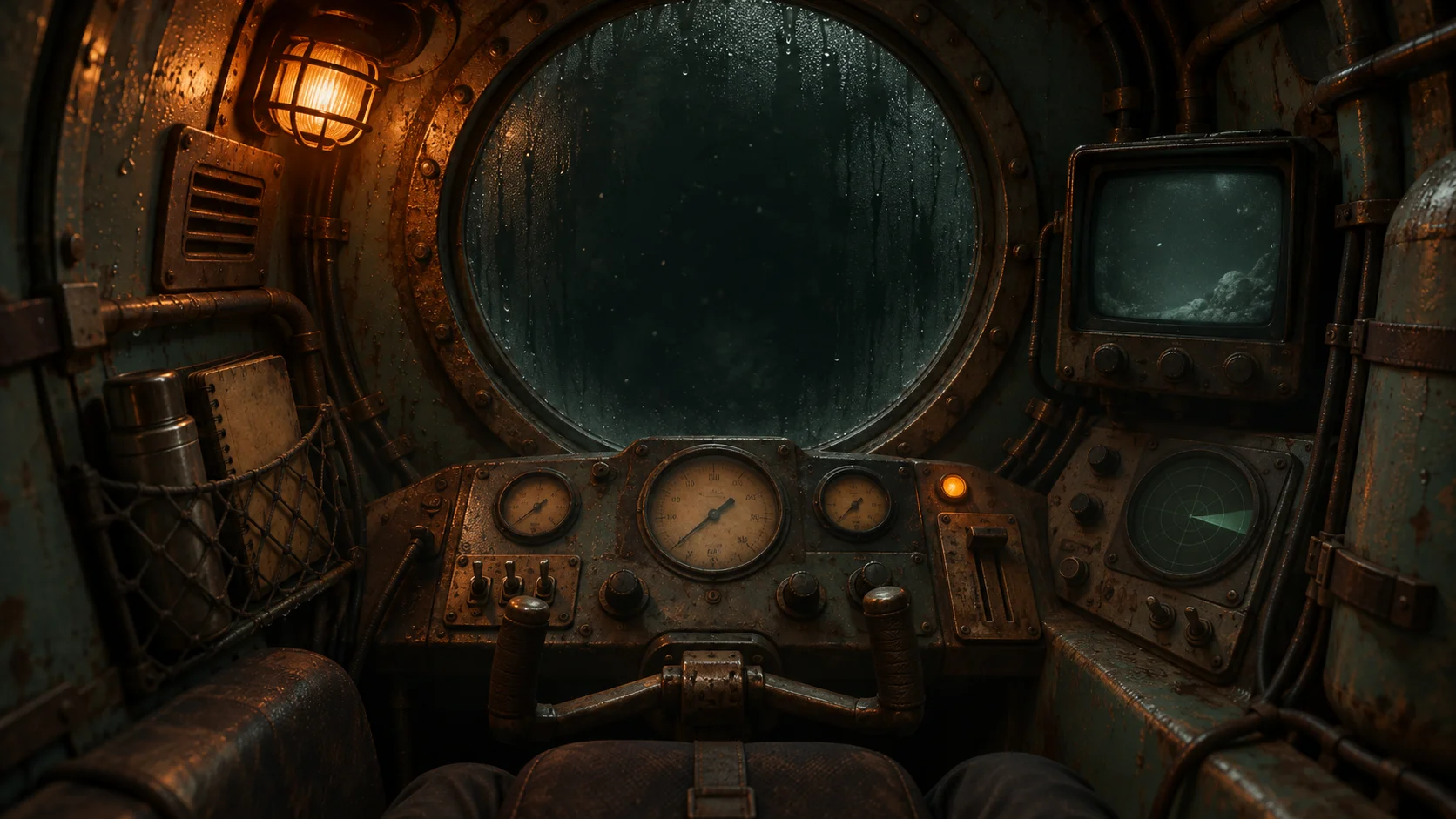
Bound space, visible controls, and unseen threat
Start by listing what the player can perceive and control. A research craft might have a route display, a proximity instrument, a camera, a battery reserve, and one way to change speed. Each element should answer a different question. The route display suggests where the craft is; the sensor estimates nearby movement; the camera gives an imperfect image; the battery determines how often the player can gather evidence.
Make the room legible before making it frightening. Players should know where a control is, what it costs, and what response to expect. They can remain unsure what waits outside. This distinction creates uncertainty about the threat while preserving confidence in the interface. If players cannot tell whether they activated the camera or a light, the resulting anxiety is interface confusion, not designed dread.
Choose a few environmental variables and connect them to actions. A loud motor could improve travel speed but increase an acoustic trace. A camera exposure might reveal a landmark while consuming charge and holding the craft in place. These costs produce tension because players decide what information is worth acquiring.
Turn pressure into a legible tension loop
Use a compact loop: cue, interpretation, action, consequence, recovery. For example, a proximity needle pulses more rapidly; the player can stop the motor, spend a sonar pulse, or continue toward a waypoint. Each response changes time, battery, or certainty. After the action, show enough feedback to help players update their mental model.
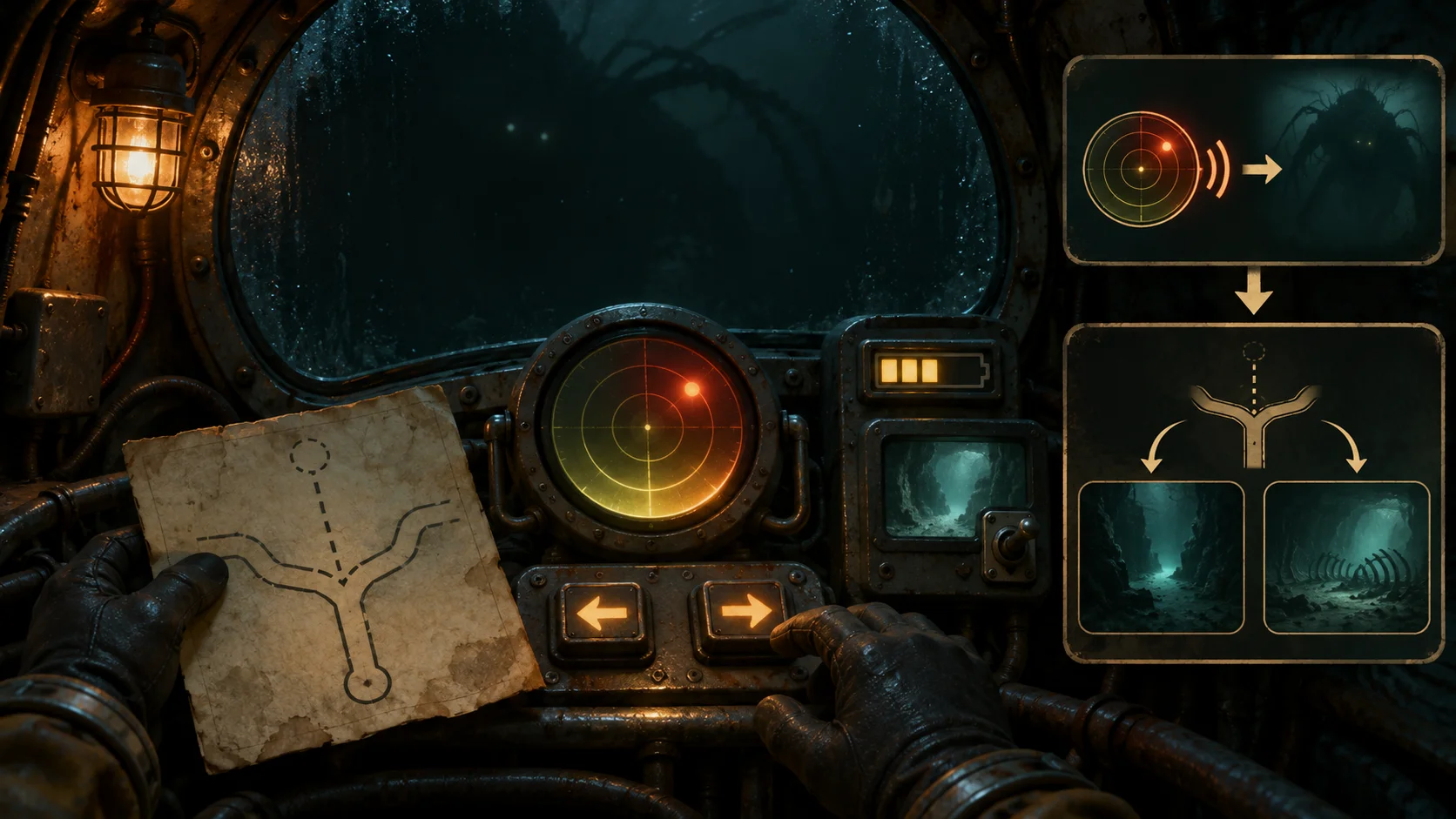
Write the state transitions down before scripting effects. At low proximity, a sensor may produce a slow pulse. At medium proximity, the pulse quickens and the motor vibration becomes stronger. At critical proximity, the player gets a final response window before damage or route loss. Avoid changing the cue meaning across states unless the story clearly signals why.
Give each response a real benefit and cost. Stopping may reduce noise but consume mission time. A sonar pulse may clarify the obstacle but use a limited charge. Continuing may preserve momentum but risk a collision. If one response has no downside, it will become routine; if every response is dangerous, the player may feel that choice is cosmetic.
Make signals learnable without explaining the threat
Separate signal layers. A vibration can indicate proximity; a radio interruption can indicate interference; a change in camera grain can suggest that the image is unreliable. Test these individually before combining them. Give players a low-stakes early moment to see each cue and observe a modest consequence.
Preserve uncertainty in what a signal means, not in whether the signal exists. A faint shape can remain unidentified, but the map marker should still respond predictably to movement. If the image might be a rock or something alive, let the player decide how much risk to take to inspect it. The reveal is stronger when players understand the price of looking.
Use false alarms carefully. If every warning proves harmless, players stop attending. If every warning immediately causes harm, they stop experimenting. A rare ambiguous cue can work when the player has time to compare it with a second source or choose a safe fallback.
Tune a recoverable tension curve
Plan a session as alternating pressure, decision, and release. The player first learns a cue, then faces a harder combination, completes a goal, and gets a short interval to regroup. Recovery does not need to remove danger; it can restore one resource or make the route temporarily easier to read.
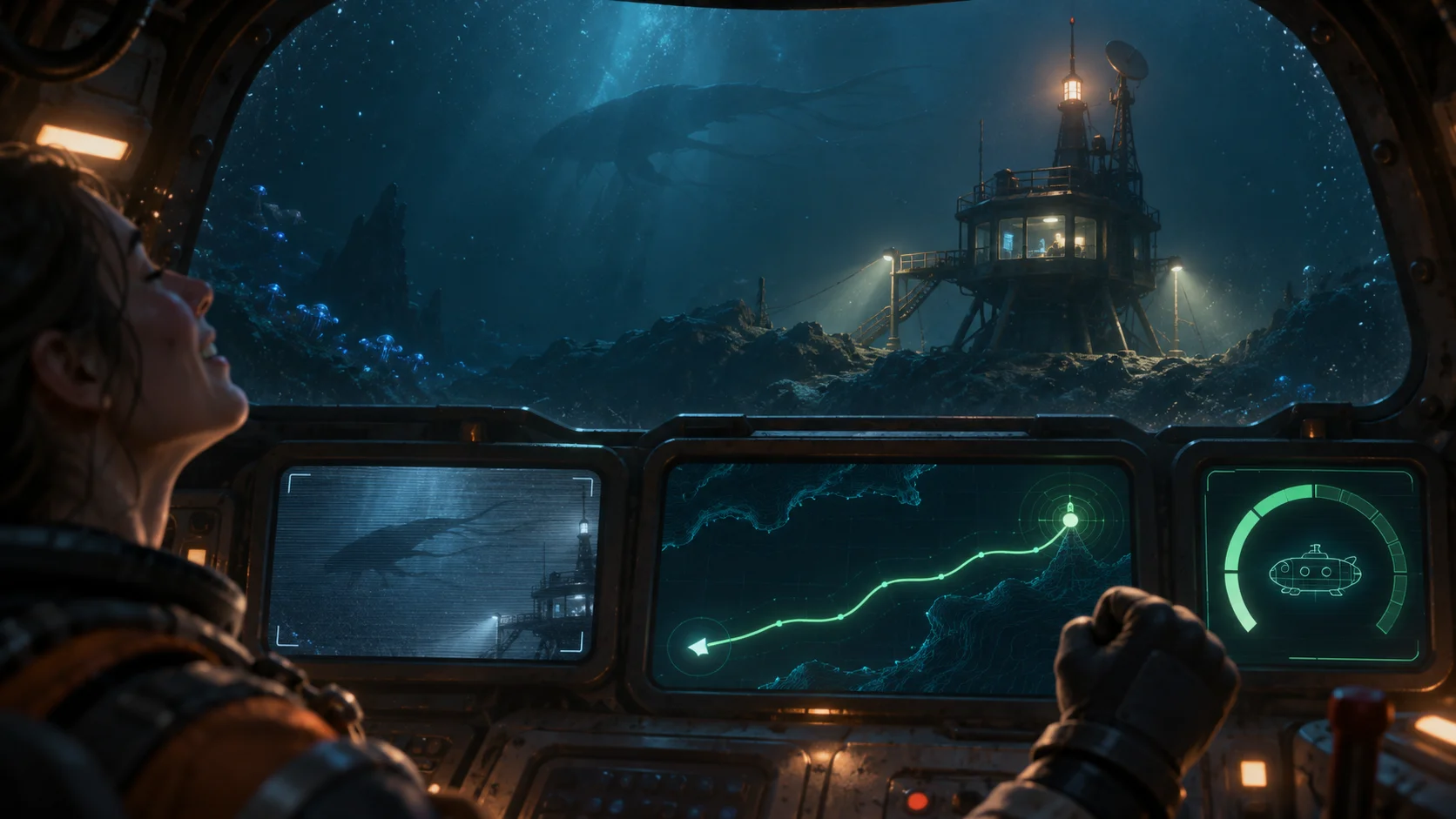
Playtest with people who have not heard the design explanation. Ask them to narrate their interpretation and record the first cue they miss. Note hesitation, unnecessary resource use, failed recoveries, and whether players can explain why a choice worked. A useful target is “uncertain but able to form a plan,” not maximum panic.
Use SEELE AI to draft a contained horror concept, then inspect whether the sensing and resource interactions actually work in play. A generated draft is a starting point, not evidence that a tension system has been implemented correctly. For a related original premise, see the contained-horror design guide. Prototype an original horror game.
FAQ
How do you build environmental tension in a horror game?
Build a repeated sequence of uncertain information, a readable cue, a player choice, and a consequence that can be understood afterward. Keep the core controls consistent and let players learn what a sound or sensor change predicts. Use quiet moments to let them interpret evidence before the next pressure beat.
Can a contained horror game stay tense without frequent attacks?
Yes. Limited visibility, uncertain navigation, resource tradeoffs, and the cost of making noise can sustain attention without constant combat. Vary the pressure with information gaps and difficult choices, then provide quieter intervals where players can plan. A threat feels more present when its signals matter, even if it is not always visible.
How can environmental danger feel fair when information is limited?
Keep signals consistent enough to learn and show which action caused a consequence. A proximity cue might always intensify when an obstacle is nearer, while a separate audio cue may suggest movement. Let players gather information, retreat, or spend a resource to reduce uncertainty. Avoid instant failure from a signal the game has never taught.
What should a horror-game tension playtest measure?
Ask testers to describe what they believed was happening, which cues they noticed, and why they chose each action. Record missed signals, resource use, hesitation, and recovery after a mistake. Measure whether players felt uncertain but informed. Revise cues that are ignored and spikes that produce confusion without an actionable response.