Escape-room clues feel satisfying when each discovery changes what players can infer or do next. Escape Simulator’s official Steam listing describes highly interactive rooms and interactive puzzles. The lighthouse example and clue graph in this article are original design recommendations, not a walkthrough or claim about a particular reference room.
Start from a final inference
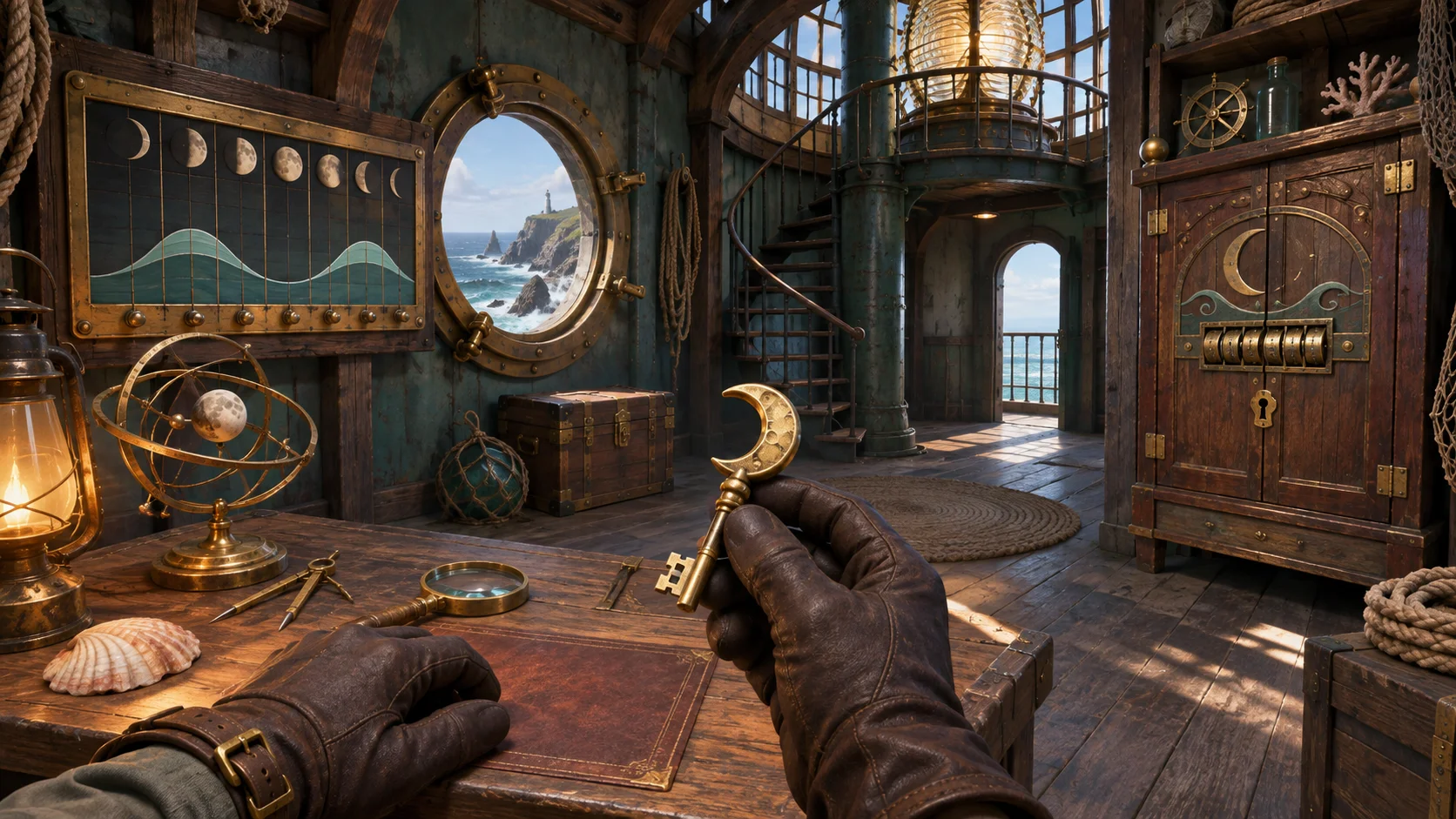
Begin with the action that should resolve the room’s main puzzle. In an original lighthouse room, the player might align a tide dial to open a cabinet. Work backward: what makes the correct tide meaningful, where can the player observe it, and which object can translate that observation into a setting? This reverse plan keeps every clue tied to a result.
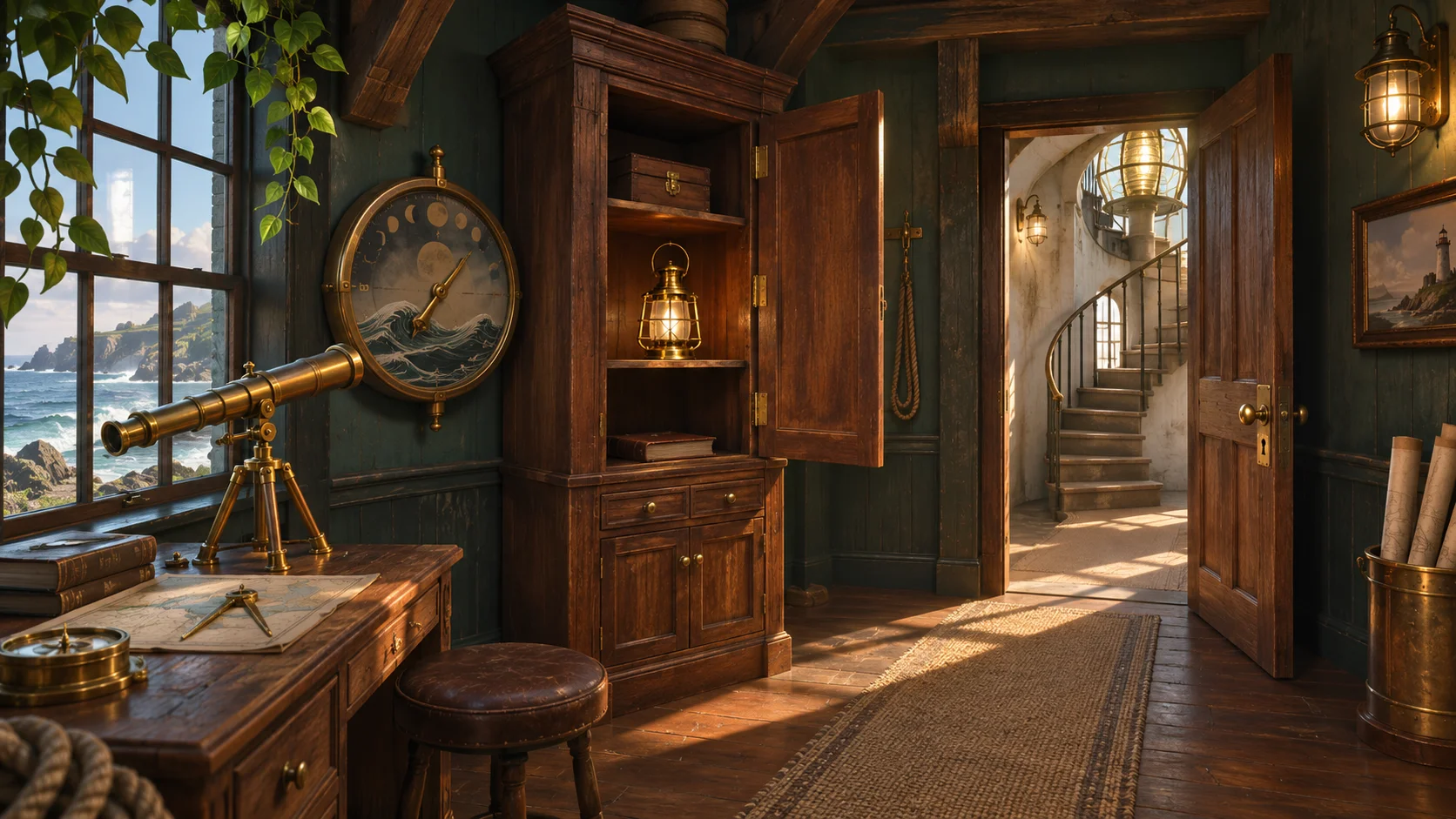
For each clue, write three lines: what the player notices, what they can infer, and what action becomes available. A crescent scratch on a brass key might connect to a moon mark on the tide dial; the dial’s position could then reveal how to orient a cabinet latch. If a clue has no inference or action, it may be atmosphere rather than a required puzzle clue.
Choose how much the room expects players to remember. A short chain can rely on one observation, while a longer puzzle should preserve earlier information in the environment or allow a quick revisit. Do not make players memorize an arbitrary sequence of symbols when the intended challenge is recognizing a relationship.
Build a clue graph with meaningful links
Represent clues and actions as a directed graph. Nodes can include observations, deductions, objects, and mechanisms; an edge states the relationship that lets one support another. Label each edge with its meaning—same shape, points toward, completes a pattern, or changes a state. The graph should show how a player can move from noticing a detail to acting on it.
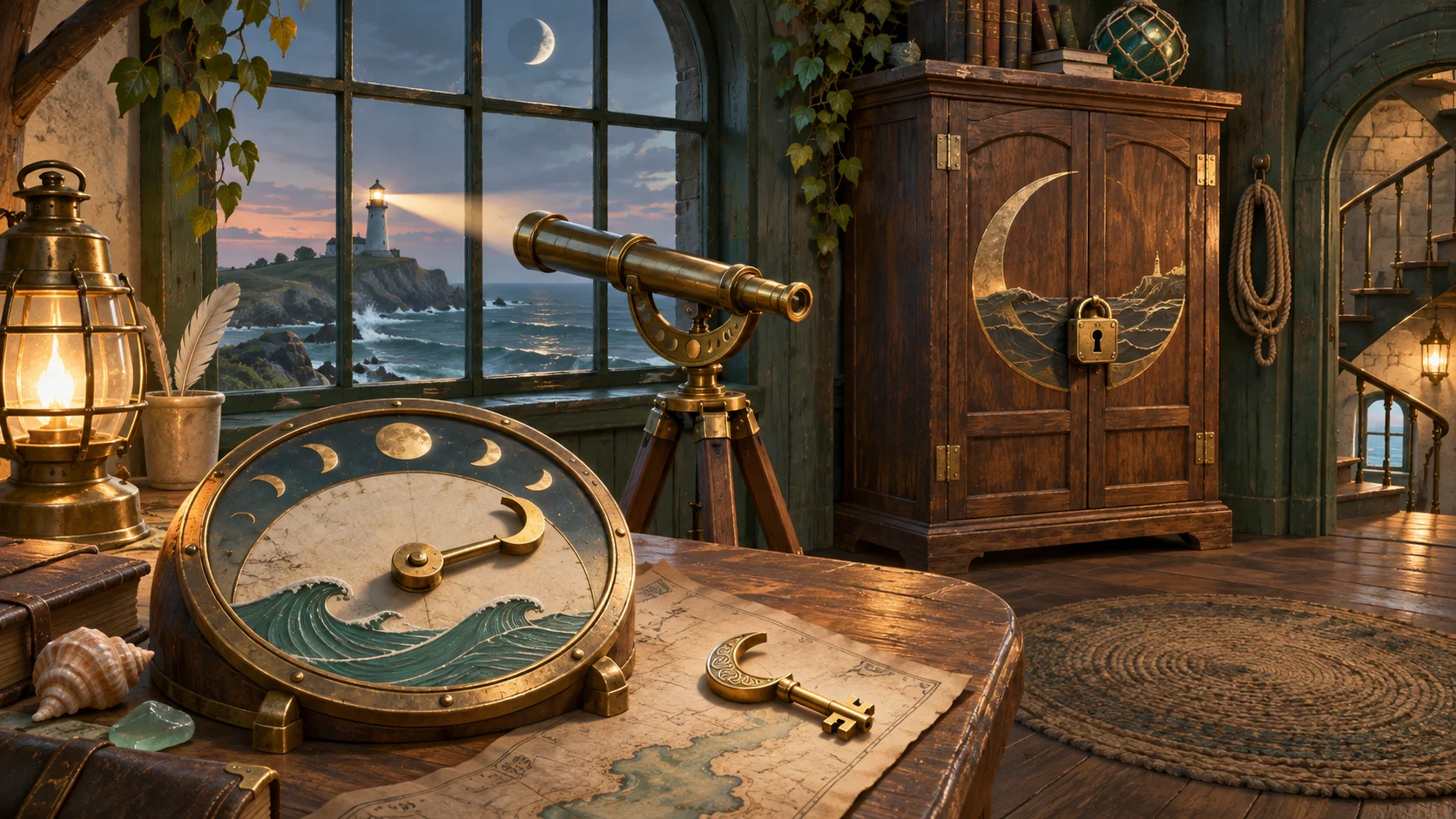
Use more than one kind of connection sparingly. A telescope may reveal the lighthouse beam’s direction; a tide dial may share a crescent shape with a key; a cabinet latch may use that key’s orientation. Each connection should be supported by the room’s visual language. Avoid a chain that depends on a number code with no in-world reason.
Check every node for dead ends. If an observation does not support any deduction, either make it optional atmosphere or connect it meaningfully. If a puzzle action depends on an item the player can miss, add a second route to discover the necessary information.
Protect critical steps from missed clues
Critical deductions benefit from complementary evidence. If the tide dial must point west, the player might see a tide mark on a chart and a beam angle through a porthole. Those clues reinforce the same conclusion but require different observations. Redundancy helps when one clue is obscured or a player interprets its detail differently.
Keep objects recoverable. A unique key should not disappear into a one-time mechanism before all doors that require it are available. Reusable puzzle states need a reset path, and incorrect experimentation should not permanently hide the only useful clue. Test the room in several object orders, including solving a side puzzle first and touching every movable prop.
If the player reaches a wrong state, make recovery legible. A dial can turn back, a latch can reset, or a cabinet can remain open after its contents are taken. Recovery protects the intended reasoning from a softlock caused by experimentation.
Tune discovery and hint progression
Build hints as a ladder. A first nudge can name the relevant room area; a second can point out the shared shape or direction; a third can suggest the specific interaction. Each level should preserve at least one player inference when possible. Hints should follow the clue graph, not invent a connection the room never establishes.
Test with people who did not see the design notes. Record where they look, what they infer, and which unsupported guesses they try. If they miss the same clue, improve its placement, contrast, or relation to the mechanism. If they guess correctly without using the intended evidence, strengthen the connection rather than hiding the answer behind arbitrary steps.
Use SEELE AI’s game-studio capability to begin from a written escape-room concept, then compare the resulting room interactions with the clue graph. Verify that objects can be inspected, the important state changes occur, and recovery works. The capability catalog does not establish any specific clue graph or room-editor behavior.
For explicit state and rule relationships, read the logic-interaction guide. To prototype a room idea, start an original game draft.
FAQ
How do you design interconnected clues for an escape room?
Start with the final inference or action, then list the evidence a player needs to reach it. Connect clues through visible shared details such as shape, location, or function. For each link, write what the player should infer and what that inference enables, then test the chain with someone who has not seen the solution.
How many clues should point to one puzzle?
Use enough evidence to make the intended inference fair, but not so many that every prop becomes noise. Critical steps benefit from two complementary clues that reinforce the same conclusion in different ways. A small room may need only one strong link for a simple lock and more support for a multi-step deduction.
How can designers prevent escape-room softlocks?
Keep essential items recoverable, allow safe resets for reusable mechanisms, and avoid consuming a unique clue object before all dependent actions are available. Test every object order, including skipped steps and incorrect experiments. If the room can enter an unrecoverable state, add a reset affordance or revise the dependency graph.
How should a hint system reveal interconnected clues?
Escalate from an attention cue to a relationship cue and then to a concrete action. First point players toward the relevant area, next highlight the shared feature, and only then suggest how to use it. Keep hints aligned with the actual clue graph so players are not sent toward a connection the room does not support.