Multiple-solution organization puzzles feel fair when players can explain why their arrangement works. A Little to the Left’s official listing describes an organization puzzle with multiple solutions, drag-and-drop interaction, and hints. This guide uses that public context as inspiration; the rules, example, and validation method are original.

Decide what counts as a valid arrangement
Write the acceptance rule before arranging the scene. Consider a level with four keepsakes: a shell, brass key, folded note, and blue glass bead. One valid answer groups objects by material; another orders them from smallest to largest. The arrangement is open-ended, but the visible object traits still make the accepted choices explainable.
Choose whether players must satisfy one displayed rule or all of them. If a card says “group by material,” checking only adjacency may be enough; if it says “group by material, then order by size,” both conditions must hold. State this through the puzzle’s affordances and feedback. Hidden conditions make experimentation feel arbitrary.
Make a rule table with three columns: rule, accepted state, and a plausible near-miss. For “group by material,” shells and glass belong in one family while metal and paper form another; a near-miss places the key with the bead because both are small. The table exposes ambiguous object traits before they become confusing level logic.
Build the object set and solution space
Give every object a few traits the player can actually see: material, size, color, orientation, or a printed mark. Then choose overlapping traits carefully. If every object has a unique material and size, there may be only one obvious solution. If too many traits overlap, the player may see endless arbitrary choices. Start with two useful dimensions and list all layouts your evaluator should accept.
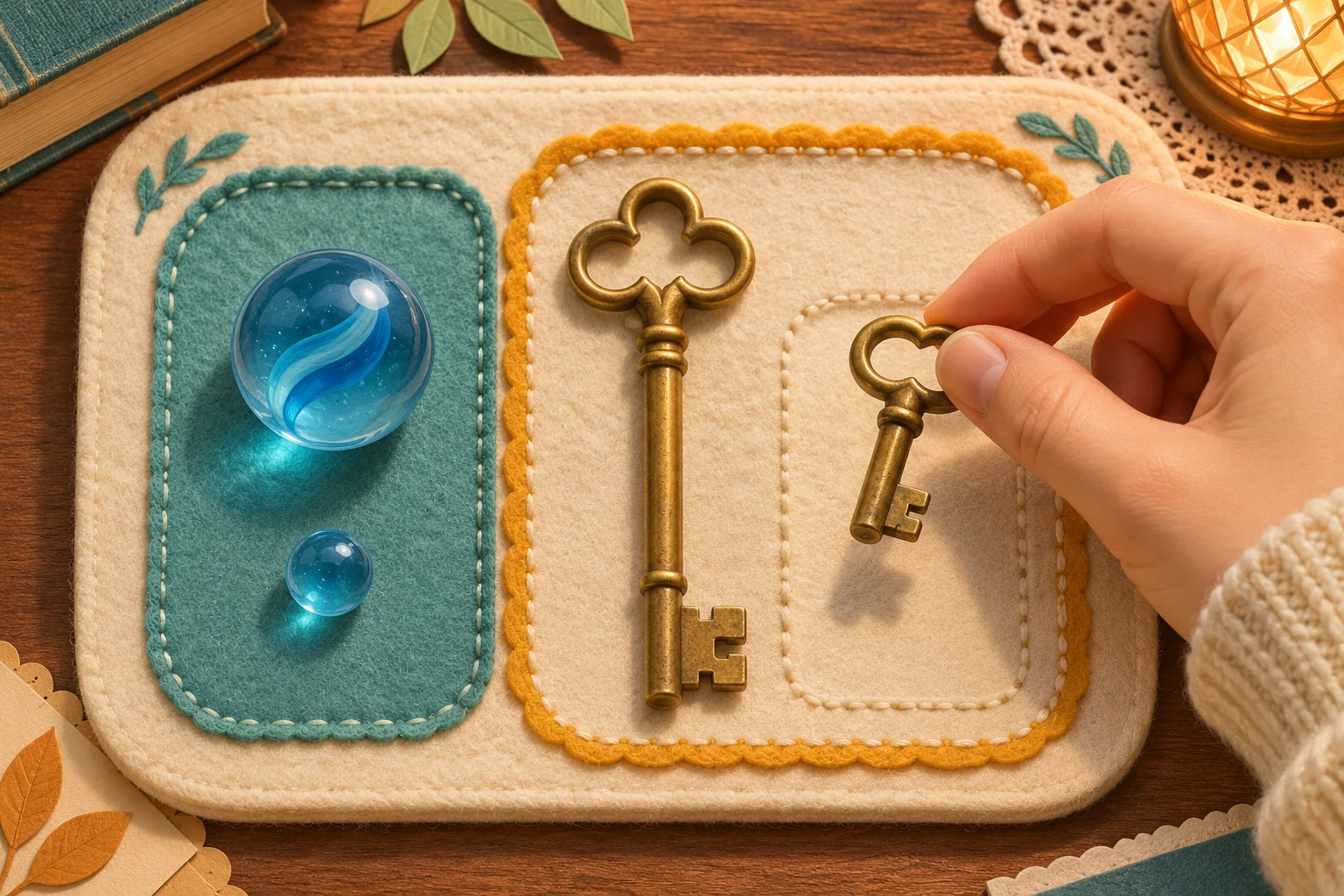
Treat a layout as a set of object positions plus the relationships that matter. For a simple row, store stable object IDs and slot indices, then evaluate predicates such as “material groups are contiguous” or “sizes do not increase.” Avoid tying success to one exact coordinate unless precision is the intended skill. This lets visual polish change without silently changing puzzle rules.
A compact authoring sheet helps: list each object’s visible traits, each rule’s predicate, the accepted combinations, and any excluded state that could look convincing. For example, if both size and color form valid orders, explain which rule is active in the level. The authoring sheet becomes a repeatable level-design tool, not a substitute for observing players.
Teach constraints through interaction
Let movement teach the manipulation, while the scene teaches what to notice. A soft snap can confirm that an item reached a slot without implying correctness. A separate, consistent response can signal that a rule is satisfied. Keep the response legible and reversible so players can compare arrangements rather than fear an irreversible mistake.
Hints should narrow uncertainty in steps. First, point out a trait that matters; next, clarify whether grouping or ordering is expected; only then offer a stronger clue about one relationship. A hint should still leave the placement decision to the player. After each hint, allow rearrangement and preserve the player’s previous work.
Ask a first-time tester to narrate what they believe the puzzle wants. If players infer different rules from the same objects, the scene needs clearer visual hierarchy, not a more forceful fail sound. Test color-only grouping with color-vision settings, and offer shape, material, or pattern cues where color carries essential information.
Score, hint, and validate fairly
Reward rule discovery before optional neatness. The primary success check should accept every intended solution; a secondary flourish can recognize extra alignment or a tidy finish without invalidating a correct layout. This distinction lets players feel clever for finding an alternate arrangement while still giving completionists a reason to refine it.

Build a small QA matrix. Test each accepted state, one near-miss per rule, a layout that satisfies one rule but not another, undo and redo, moving an already placed object, and restarting the level. Record both the arrangement and why the evaluator accepted it. If the acceptance code cannot explain a result in plain language, the level is difficult to maintain and difficult to debug.
Prototype the first level with SEELE AI’s game-studio capability as a way to start from a described game idea. Treat the generated concept as a draft: manually inspect whether the objects, interaction, and alternative states match the rule sheet. Product capability does not establish that a particular evaluator, accessibility option, or puzzle outcome has been implemented.
For another puzzle-design angle, see the environmental puzzle guide. When you are ready to prototype your own concept, start an original game draft.
FAQ
How do you design a puzzle with multiple valid solutions?
Start with a small set of visible constraints and list the arrangements that satisfy them. For example, one layout may group keepsakes by material while another orders them by size. Tell players whether one constraint or every displayed constraint must be met, then test accepted and rejected near-misses so the scoring feels consistent.
How many accepted solutions should a level contain?
Use as many as the object traits can support without making evaluation unclear. A short level may have two distinct arrangements that teach the mechanic, while a later level can combine several constraints. Enumerate the valid states before release and make sure each accepted layout has a readable reason, rather than relying on a large count as a measure of quality.
How can hints support open-ended organization puzzles?
Reveal a remaining rule or point toward a useful object relationship instead of showing the only intended layout. A first hint might identify a shared material; a later hint can clarify whether order matters. Let players continue moving objects after a hint, and check that the hint does not imply an arrangement your evaluator rejects.
How do you test whether a solution feels fair?
Ask players who have not seen the answer to explain the rule they inferred, then record their arrangements and reasoning. Test valid alternatives, plausible near-misses, undo, repeated placement, and accessibility settings. If a rejected layout follows the same visible logic as an accepted one, clarify the rule or broaden the accepted state instead of blaming the player.