Policy decisions let a survival city builder turn daily systems into choices about what kind of community the player wants to lead. A rule may help one group while creating a cost elsewhere, and a sequence of decisions can change how residents respond to hardship. For an original game inspired by Frostpunk, make each policy legible before adoption, connect its effects to city state, and let the player see what changed afterward.

Define the problem a policy addresses
Begin with a situation the player can already recognize: low food reserves, cold homes, tired workers, or a growing need for care. The policy should address that problem and ask the player to accept a cost or risk. When a law appears without context, the choice can feel like an abstract menu. When it responds to a current pressure, players can weigh it against what they know about the city.
Separate the policy’s purpose from its implementation. A rule about work hours might increase labor capacity, but it could also affect rest or public approval. Decide which city variables matter, and keep the first version small enough to explain. If one policy changes a dozen hidden values, the player will have trouble understanding why conditions improved or worsened.
The official Frostpunk Steam page describes laws that regulate daily society, the importance of maintaining hope and contentment, and decisions whose combined effects can lead to unexpected results. This is useful high-level context for policy choices in a survival city. It does not establish exact law effects or thresholds for an original design.
Show tradeoffs before a decision
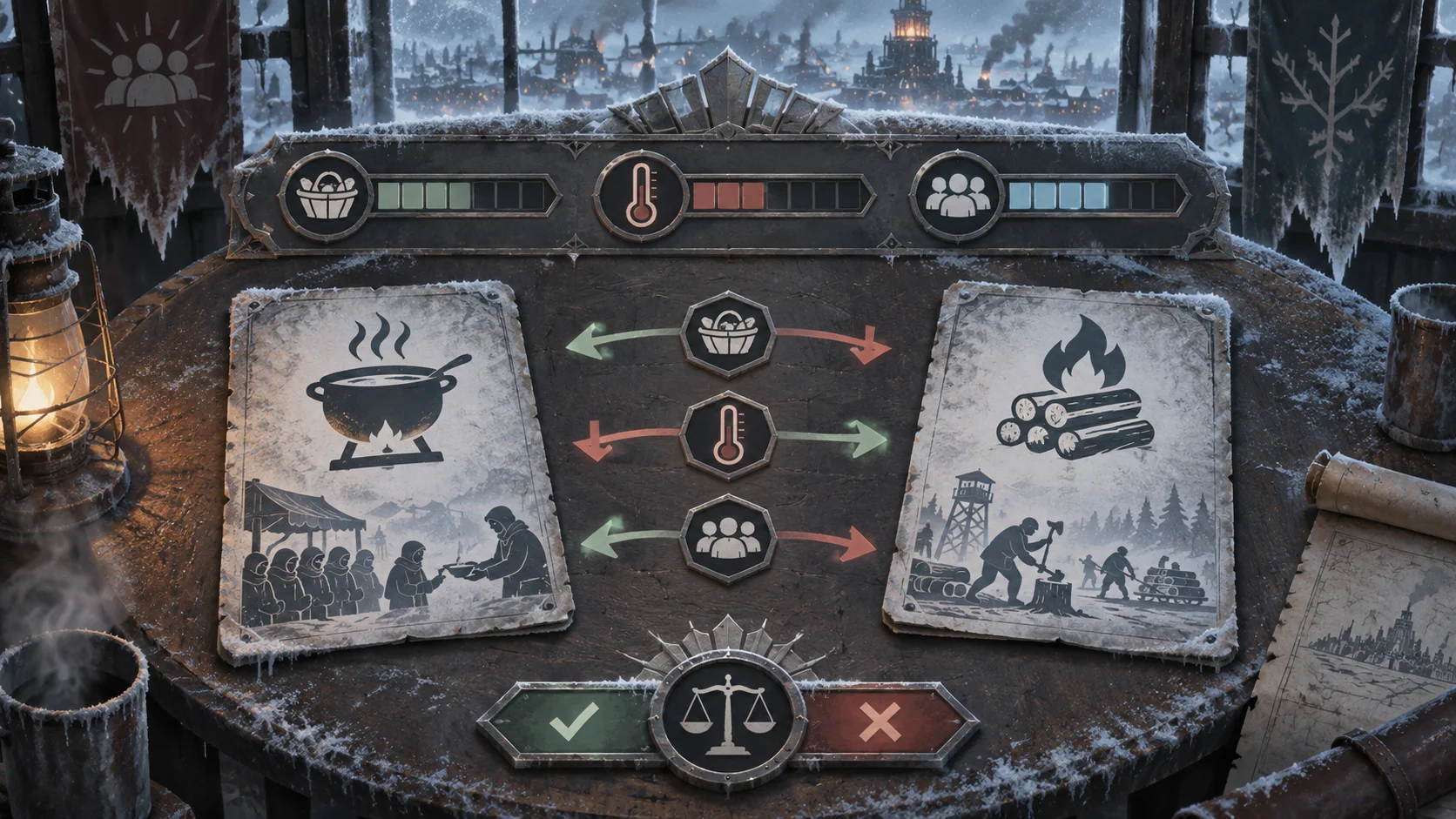
Present options as distinct approaches, not cosmetic variations. One may provide a faster response with a social cost; another may protect residents but consume scarce supplies or time. Describe the immediate effect in concrete terms and identify who is likely to feel it. The player does not need certainty about every future outcome, but they should know the main reason each option might help or hurt.
Keep uncertainty honest. If a policy can create delayed effects, label them as possible or conditional and show what could trigger them. Avoid promising a precise outcome when the simulation contains randomness. A preview might say that shorter shifts reduce available labor while improving recovery, without implying a fixed number if the game does not model one.
Make the decision screen easy to compare. Use a consistent layout for purpose, direct cost, affected groups, and duration. Provide a confirmation step for choices that cannot be reversed, and tell the player whether a policy is temporary, permanent, or replaceable. Distinct icons and plain wording help players focus on the tradeoff instead of decoding the interface.
Connect laws to city state and follow-up
A policy should change something the player can observe. If it affects work, show changes in staffing or production. If it concerns care, show the service available and the people who use it. A small status panel, event summary, or resident response can connect the decision to the city’s current conditions. Without that feedback, a policy may seem to have no effect even when the simulation changed.
Track more than one measure of success. A decision that raises output may also reduce trust or increase strain. Separate material outcomes from social outcomes so the player sees why a seemingly efficient rule may produce new problems. You can represent public response with broad indicators, specific events, or both; choose a level of detail that fits the game’s pace.
Give consequences a timeline. Show immediate changes first, then report delayed effects when they occur. If an outcome depends on continued conditions, explain the dependency: for example, a benefit lasts while a resource remains available. A visible cause-and-effect chain teaches players how the system works and creates room for them to respond before a crisis becomes unavoidable.

Playtest consequences and perceived fairness
Prototype two or three policies around a single city problem. Test them in the same starting conditions and record the player’s expectation before they choose. After the decision, ask what changed and whether the outcome matched the explanation. If players cannot identify which effect came from the policy, improve feedback or reduce overlapping systems before adding more options.
Try cases where the city is healthy, under pressure, or already strained. The same policy may have a different cost depending on available supplies or resident needs. Check that choices remain meaningful in each state. If one option is always dominant, make its cost more tangible or give another option a situation where it is clearly useful.
Also test recovery. A decision can create hardship without ending the player’s ability to act. Provide follow-up choices, alternative services, or a way to change direction if the city deteriorates. Consequences feel fair when players can connect them to earlier decisions and still decide how to respond.
AI can help draft alternative policy wording, stakeholder perspectives, or test scenarios, but the simulation and human playtests determine whether the tradeoffs feel credible. Start with a small, traceable policy set and expand only after you can explain how each rule affects the city. You can use Seele’s AI game maker to form a starting prototype, then revise policy outcomes through playtesting.
Frequently asked questions
What makes a good policy decision in a survival city builder?
A good policy answers a visible city problem, offers distinct approaches, and explains its main costs before adoption. It should affect state players can observe and give them a follow-up path when its consequences create new pressure. Keep the language concrete so players can compare outcomes without guessing at hidden variables.
How should a game show policy consequences?
Show immediate changes in the relevant resources or services, then report delayed outcomes when they occur. Connect the result to the policy and current city conditions so players can see what caused it and decide how to respond. A short event summary can reinforce the link without repeating a long explanation.
Should policies have permanent effects?
Permanent effects can make decisions feel consequential, while temporary rules can support experimentation. State the duration and whether a policy can be replaced before the player commits, then test if the lasting impact fits your game’s pacing. A change option can make persistence consequential without locking players into an opaque failure spiral.
How do you test whether policy choices feel meaningful?
Ask players to predict the cost and likely benefit of each option, then compare those expectations with the outcome. Test multiple city states and check whether each choice has a useful situation rather than one option always winning. Ask players to explain why their chosen option fit the situation and what they would choose next time.