Make the production shortfall visible
Factorio's official site describes building factories and automating production. Brineworks is a separate fictional coastal factory: an extractor supplies Ore, a smelter turns Ore into Ingots, and an assembler makes Parts. Its rates, materials and machines are original, but the flow question is familiar: which stage prevents the line from meeting its target?

Show each station's input, capacity, output and waiting buffer. The extractor supplies 6 Ore per cycle. The smelter processes 2 Ore into 1 Ingot, up to 3 cycles. One assembler can make 2 Parts per cycle, while the target is 3. The line has enough Ingots upstream but cannot finish enough Parts downstream.
Trace throughput from input to final demand
Calculate the maximum output at each stage using the actual recipe and machine capacity. In this example the smelter produces 3 Ingots, but the assembler processes only 2, so 1 Ingot waits in its buffer and the target misses by 1 Part. Upgrading the assembler capacity to 3 removes the queue and meets the target.
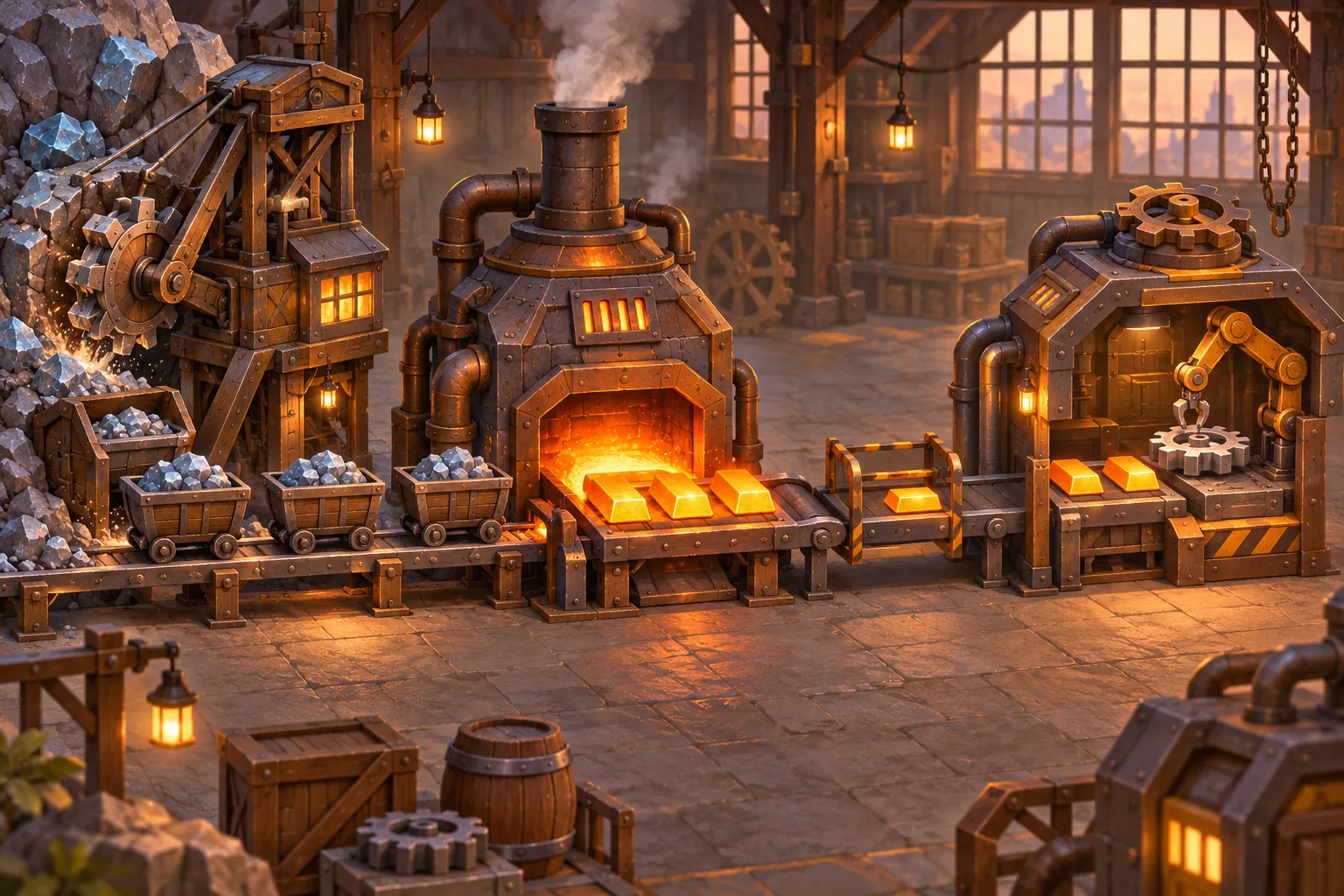
The first iteration blamed the extractor because Ore piled up at the line entrance. Trace each conversion instead: the smelter already provides 3 Ingots, while the assembler caps Parts at 2. The deterministic test records the baseline shortfall, then upgrades only the assembler and confirms 3 Parts with no leftover Ingot. It checks arithmetic, not factory balance or player experience.
Spend upgrades where they increase finished output
Keep the output target visible after the upgrade. If upstream inventory grows while final output stays flat, inspect the next station's capacity before adding more extractors. A second assembler is one option, but show its cost and resulting throughput so the player can compare expansion with storage or recipe changes.

Prototype one short line before scaling the factory
Start with three stations, one recipe per conversion, a target and a visible buffer at every connection. Test the initial shortfall and one capacity upgrade. Factorio supplies broad context for factory automation; Godot Resource can store reusable recipe data, and SEELE AI Game Maker offers a prompt-based entry point. These sources do not validate Brineworks rates.
Create an original factory automation game with an extractor, smelter and assembler. Show input rates, machine capacities, buffers and a finished-part target. Let players identify the bottleneck and compare an upgrade's effect on final throughput. Keep recipes and rates original. Do not claim balance or playtest validation.
Start an original factory prototype in SEELE · Factorio official site
Frequently asked questions
How can a game show where a production bottleneck occurs?
Display recipe input, machine capacity, finished output and the buffer before and after every station. Compare the slowest stage with the production target. In Brineworks, the assembler makes two Parts while the target is three and one Ingot waits, which points to downstream capacity rather than a lack of Ore.
Should players add more extractors when output is low?
First compare flow through each conversion and inspect waiting inventory. If the smelter already supplies enough Ingots but the assembler cannot process them, another extractor increases upstream stock without raising finished output. Test a downstream upgrade and show its cost before expanding the input.
What should a first bottleneck prototype test?
Use a short line with known rates, an output target and a visible buffer. Record the shortfall, change one station's capacity and calculate the new output. A playable factory is still needed to judge cost, pacing and how clearly the bottleneck reads.