Resource cycles make a colony simulation feel interconnected: inputs support production, production creates useful outputs, and byproducts can become either a cost or another resource. An original space-colony game inspired at a high level by Oxygen Not Included can make those flows understandable without eliminating pressure. Model each loop with producers, consumers, storage, and waste, then let players improve it by solving visible bottlenecks.
Map inputs, outputs, and byproducts
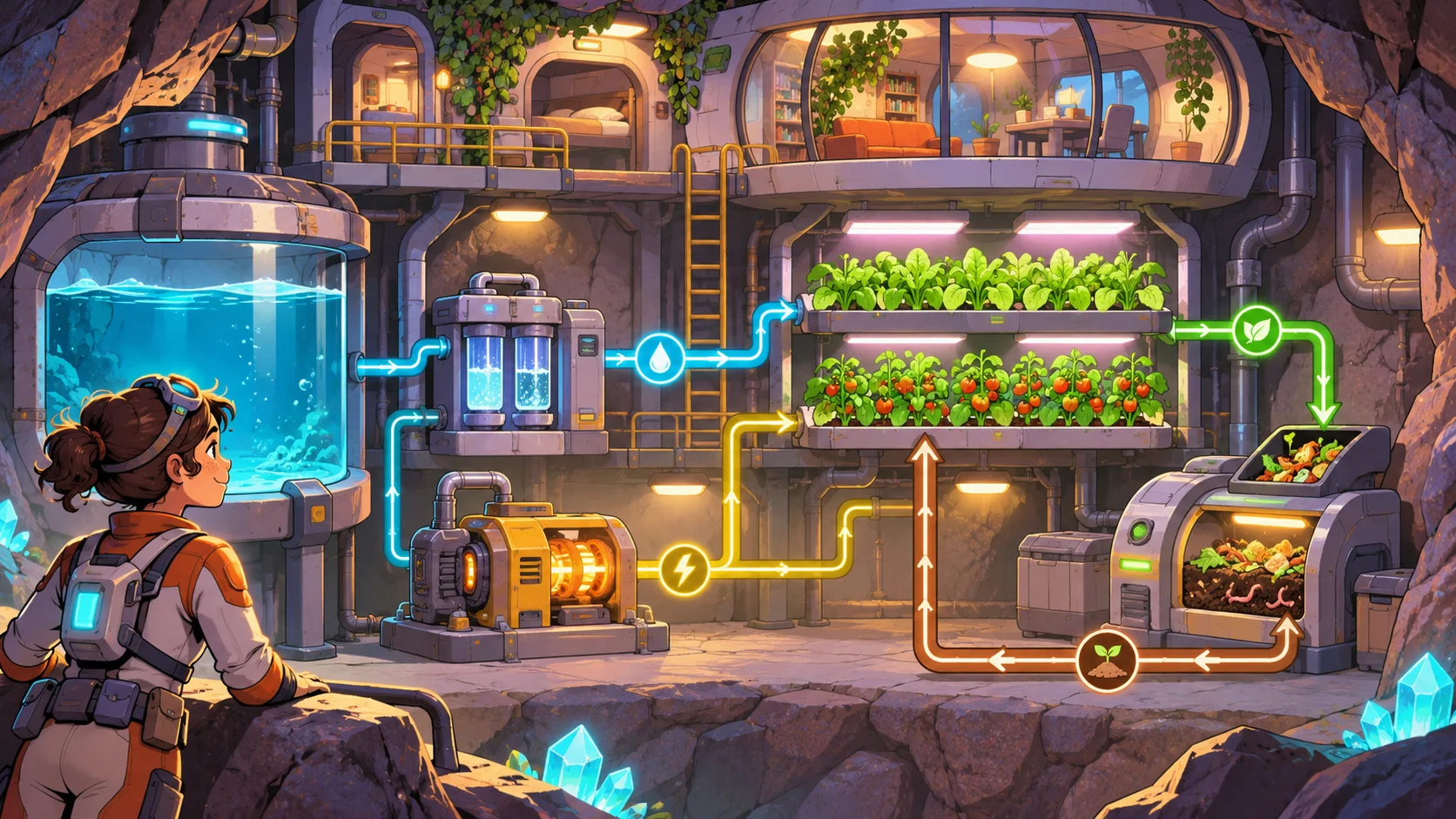
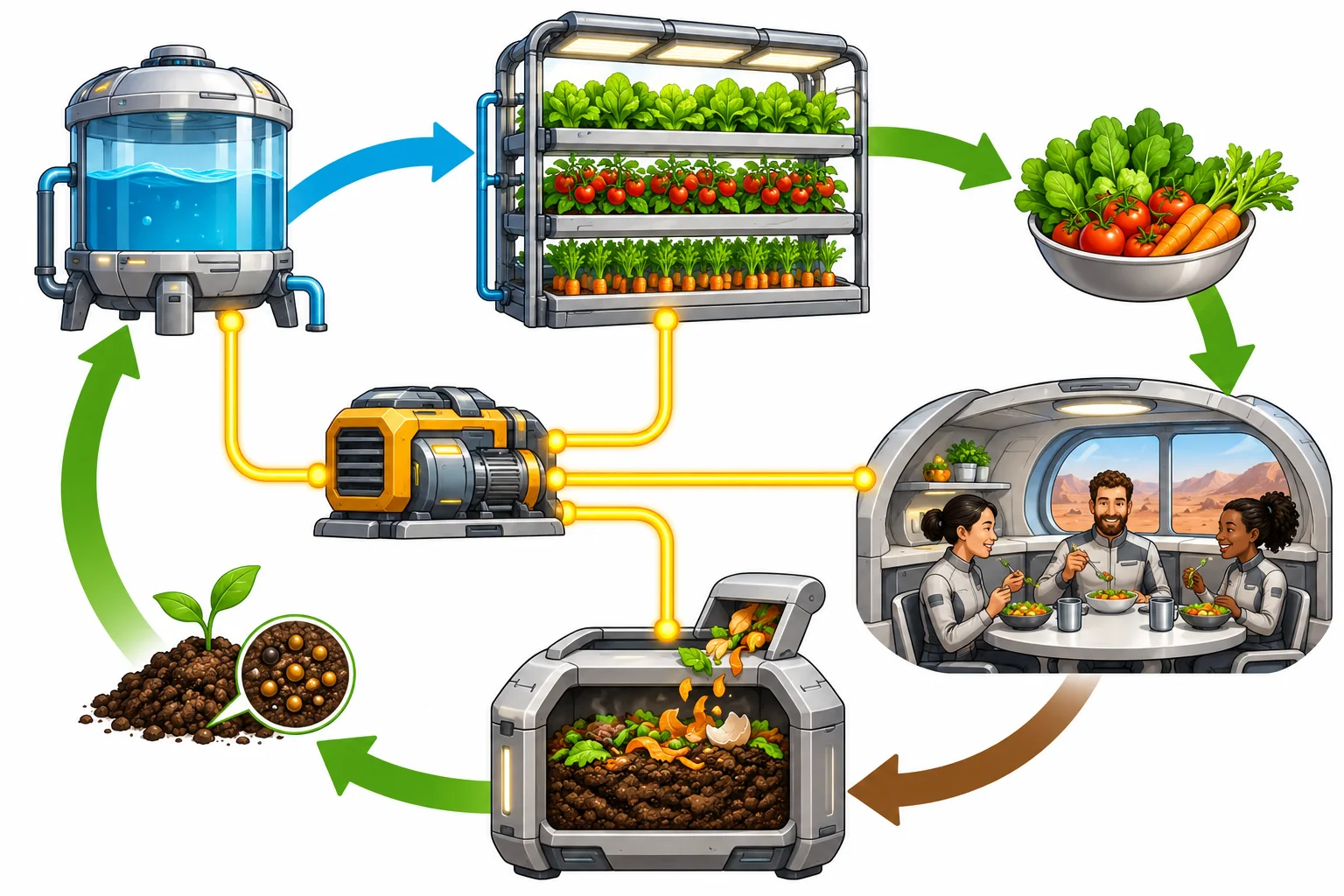
Start with one resource and trace where it comes from, where it goes, and what remains afterward. A crop loop might draw water and power, produce food, and return organic waste to compost. A generator could consume fuel, produce power, and add heat or pollution. Put every input, output, and side effect in the model instead of treating the machine as a magic conversion.
Klei’s official Oxygen Not Included listing describes a colony where oxygen, warmth, and food are scarce, and highlights interlocking gas and liquid systems and recycling. That provides high-level resource-management context only. The crop example and cycle-balancing method here are original design guidance, not a claim about the game’s internal simulation.
Draw the flow as a directed graph. Each node can identify a producer, consumer, storage buffer, or transformation; each connection can show a material, rate, and quality. Mark whether a process requires power, labor, temperature conditions, or an available output space. This exposes dependencies early. If the compost bin is full, the crop loop should not continue as though the byproduct disappeared.
Connect resource loops with visible costs
A cycle should have constraints that give players room to make decisions. Water may be limited by a pump’s output; food may require light and power; recycling may take time or produce heat. If the loop can run forever without a cost, it may remove pressure from the survival problem. Add a meaningful limit rather than an arbitrary cap: machine upkeep, storage capacity, labor scheduling, or a byproduct that needs handling.
Keep conservation rules consistent. If a process consumes ten units and outputs six, explain where the remaining mass or energy goes when the fiction depends on it. If the game abstracts a real process, use a stable rule and communicate the result. Players do not need a scientific simulator in every detail, but they do need a reliable mental model for planning.
Use storage buffers to absorb small mismatches without hiding long-term shortages. A reservoir can carry the colony through a brief pause in production, while a visible low-water warning signals that the system needs attention. Set alert thresholds based on expected consumption so the player has time to act before the whole chain fails.
Make shortages and bottlenecks readable
Show the state of a resource at the places where players make decisions. A pipe can indicate direction and flow; a storage container can show whether it is filling or emptying; an unavailable machine can identify the missing input. Make warnings actionable. “Food low” is less useful than showing that crop growth is stalled because the irrigation line has no water.
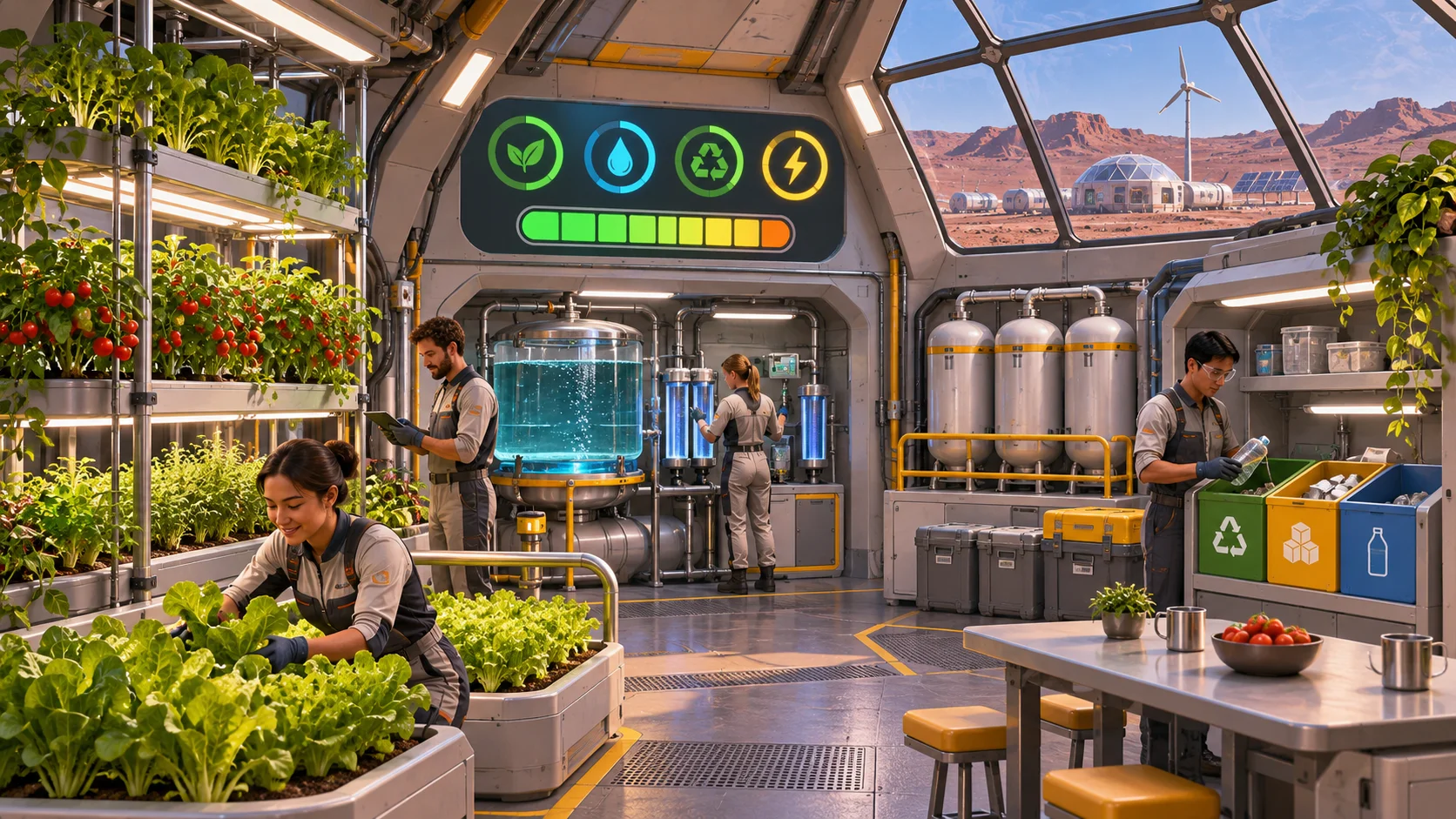
Separate local symptoms from root causes. A dark room may be a power problem; a power shortage may come from fuel depletion; fuel depletion may trace back to an interrupted production chain. Let players inspect enough of the chain to diagnose the issue without requiring a separate spreadsheet. A concise flow overlay or status panel can summarize the same state that the simulation uses.
Give byproducts a visible destination. If waste can be reused, show how it becomes input for another process. If it cannot be reused immediately, it may need storage, disposal, or treatment. This turns “waste nothing” into a planning challenge instead of an invisible bonus that makes every loop strictly beneficial.
Test cycle stability under changing demand
Simulate the loop over time rather than checking a single production step. Test a growing crew, a temporarily disabled machine, a full output container, and a power interruption. Track whether storage rises or falls and whether the player receives a warning early enough to respond. A cycle that works only at one exact population may feel brittle as the colony grows.
Keep small reproducible scenarios for each key loop. Start with empty storage, introduce a shortage, and observe whether the system recovers when the missing input returns. Check for accidental free energy, duplicated materials, deadlocks, and byproducts that accumulate without limit. Then change one rate or capacity at a time and compare the result.
AI can help draft flow diagrams, sample resource tables, or test scenarios for an original colony prototype, but it cannot prove the simulation conserves or recovers correctly. Start a colony-sim prototype with Seele’s AI game maker, then validate the system by running it under varied demand and failure conditions.
Frequently asked questions
How do you design resource cycles in a colony sim?
Trace one resource through producers, consumers, storage, and byproducts. Record the input rate, output rate, and conditions each process needs, then connect the cycle to other systems such as power or labor. Test it over time so shortages and recovery behavior are visible as the colony changes.
What makes a resource loop interesting?
A loop creates choices about capacity, timing, power, storage, or byproduct handling. Players can improve it, but the improvement has a cost or tradeoff that keeps the colony’s needs meaningful. A cycle with no constraint or decision may become background automation rather than engaging management.
How do you prevent infinite resource loops?
Track conservation and give transformations explicit inputs, outputs, and operating costs. Test the loop over time for unintended duplication, unbounded output, or waste that vanishes without a rule. If the design intentionally abstracts a process, make its stable conversion limits clear to players.
How can AI help prototype resource cycles?
Use AI to draft a flow graph, list possible dependencies, or create scenarios for testing bottlenecks. Review the proposed rates against your own simulation rules, then run them in code under changing demand. Generated tables can suggest cases, but runtime checks are needed to verify the cycle behaves correctly.