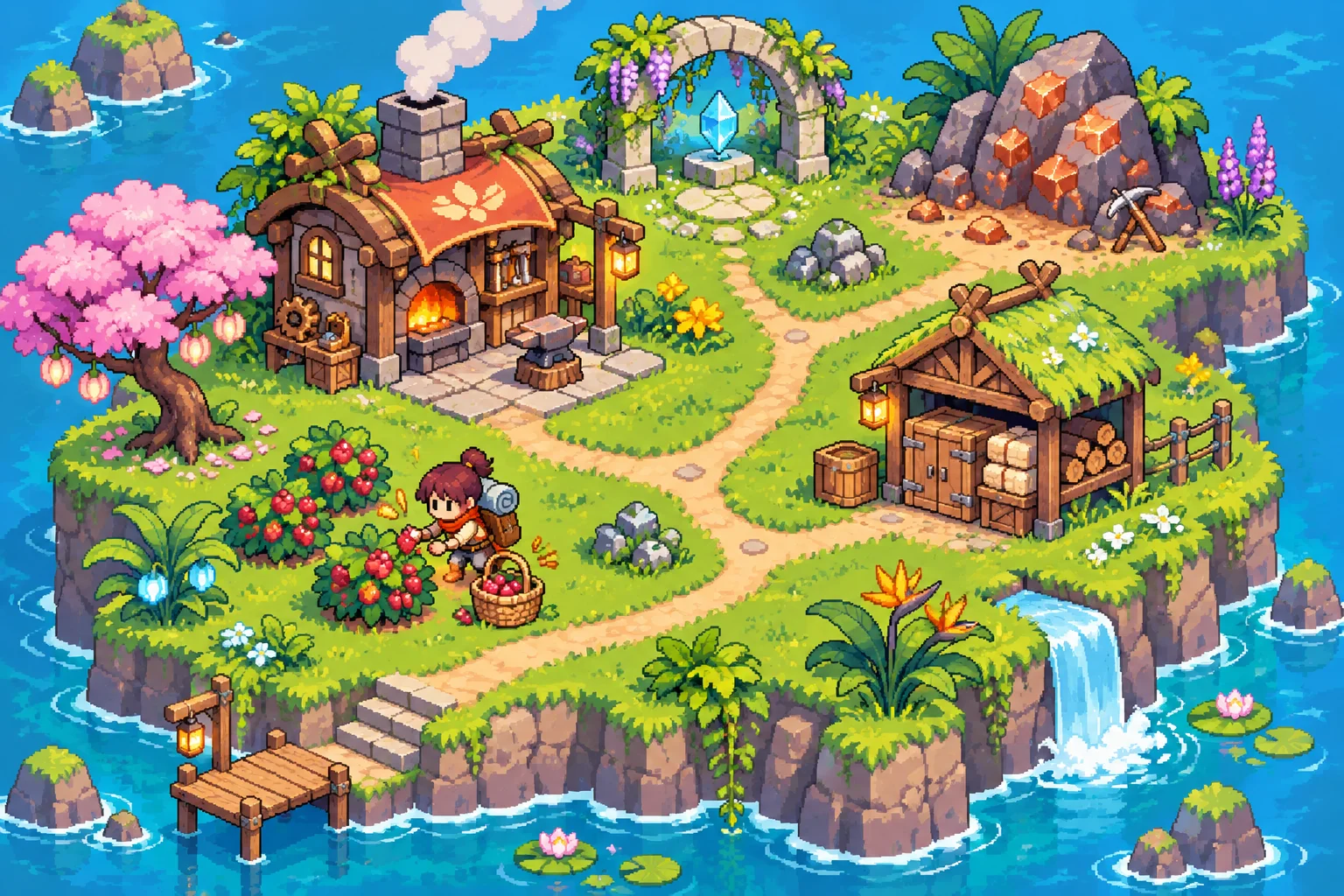
Resource gathering can make exploration feel purposeful: a player spots a deposit, decides whether to spend time collecting it, and carries the result toward a useful goal. For an original exploration crafting game, make that loop easy to read from the tool, the terrain, and the inventory. A useful reference point is Astroneer’s official description of the EXO Tool as a way to dig terrain and scoop up resources. Use that high-level idea as inspiration, then design rules that fit your own world rather than copying a particular tool or resource table.

Define deposits and extraction rules
Start by deciding what the player can collect. A resource might exist as a surface object, a vein inside a rock wall, a patch of loose material, or a plant that can be harvested. Give each type a clear visual cue and a consistent rule. Color, shape, texture, sound, or a tool response can tell players that something is collectible before they spend time trying.
Separate the world object from the resource outcome. Removing a piece of terrain could yield a material, expose a deposit, or open a route. Those are different results, so explain them through animation and feedback. If every rock gives the same generic item, the environment may feel decorative. If every object has a unique hidden rule, gathering becomes guesswork. A small set of recognizable deposit families usually gives players room to learn without requiring a reference manual.
Write a short rule card for each deposit: how it is found, which tool action extracts it, how long extraction takes, what is received, and whether the object changes afterward. Decide whether a deposit is finite, renewable, or merely cosmetic. Keep these rules coherent across similar materials. If a resource can be collected only in a specific condition, show that condition clearly before the player commits.
Make the gathering tool readable and tactile
The tool should communicate its state through what the player sees and hears. A clear target highlight, a short activation animation, a stream of extracted fragments, and a container indicator can make the action understandable without text. When the tool is pointed at an invalid surface, indicate why: the target may be out of range, the tool may need an attachment, or storage may be full. Avoid silent failure that makes players wonder whether input was missed.
Give the action a satisfying cadence. A brief start response can confirm that extraction began; a consistent sound and visible progress can support longer actions; a distinct completion cue can tell the player when to move on. Avoid making every deposit require a long hold. Larger or rarer deposits can justify a deliberate commitment, while common materials should be quick enough that players spend more time exploring than waiting.

Choose whether extraction changes terrain and make that change useful. A shallow mark may show progress without altering traversal. Removing a block may reveal another deposit or create a path. If digging can create hazards or leave awkward holes, add predictable shapes, a fill action, or a way to restore the surface. Test the world after repeated extraction so resource gathering does not break routes or obscure important landmarks.
Connect capacity, storage, and expedition planning
Capacity is part of the gathering decision. A player who can carry everything has little reason to plan; a player who must return after every few seconds may feel interrupted. Tune capacity around the length of an expected outing and the value of different deposits. Tell players how much room remains before a collection action finishes, and make the result of a full container obvious.
Define what happens when storage fills. The tool could stop before collecting, drop overflow into a visible pickup, or allow one final unit before reporting that it is full. Pick one rule and preserve the resource instead of quietly deleting it. If there is a nearby rover, pack, or base container, make transferring items quick and visible. The player should understand where each resource went.
Then connect materials to goals. A resource can unlock a recipe, support a repair, power a device, or help the player reach a new region. Introduce a use before asking players to gather a large quantity. If the material has several uses, let a catalog or discovered recipe show those options after they become relevant. This gives a deposit meaning without forcing players to memorize every crafting combination.

Test resource value and travel friction
Playtest the full round trip: notice a deposit, gather it, manage capacity, return or transfer materials, and spend them on a goal. Observe where players stop to inspect the interface, turn around, or abandon a route. Ask whether they can tell which deposits are worth collecting and what their materials will do. If they collect everything automatically, resource choice may not matter; if they skip most deposits, the cost or reward may be out of balance.
Use a small prototype before adding many materials. Track time spent extracting, time spent traveling, how often players hit capacity, and how many gathered items remain unused. These measures do not decide whether the system is fun, but they can point to friction. Try changing one variable at a time, such as deposit density, container size, extraction time, or recipe demand. Recheck the loop after each adjustment.
System Era’s official Astroneer blog describes the EXO Tool as something used to dig up terrain and scoop up resources. That is a high-level reference for a gathering tool’s role, not a template for exact extraction behavior. For your own game, decide what the player learns from a deposit, what gathering costs, and how the result changes the next expedition. SEELE’s documented game-creation capability can help turn a natural-language concept into a starting point; validate the gathering rules in a playable prototype and refine them through observation.
Frequently asked questions
How do you make resource gathering feel satisfying?
Give the player clear feedback at the start, during extraction, and when collection finishes. Pair a readable target with a distinct sound, visible material movement, and an inventory response. Make the gathered resource useful to a goal the player understands, and keep common actions short enough that exploration remains the focus.
Should gathering change the terrain?
It can, when that change supports the world or player decisions. Removing terrain might reveal a route, expose a deposit, or reshape a safe work area. If deformation creates navigation problems, use predictable shapes, clear limits, or a way to restore the surface. Keep the visual change consistent with the resource result.
How much inventory capacity should a gathering tool have?
Set capacity around the length of an intended expedition and how often you want players to make storage decisions. Test with short and long routes, and observe whether players return because they planned to or because the container filled too quickly. Always show remaining space and preserve overflow in a visible way.
How do you prevent resource gathering from becoming a chore?
Make each resource choice support a clear use, vary the discovery context, and reduce repeated handling that adds no decision. Keep common deposits quick to collect, offer convenient transfer or storage, and avoid requiring large quantities before the player understands the reward. Playtest the entire gathering and return loop, not only the extraction animation.
Prototype a few deposit types, one readable tool, and a clear resource sink. Explore an AI game creation starting point for an original exploration concept.