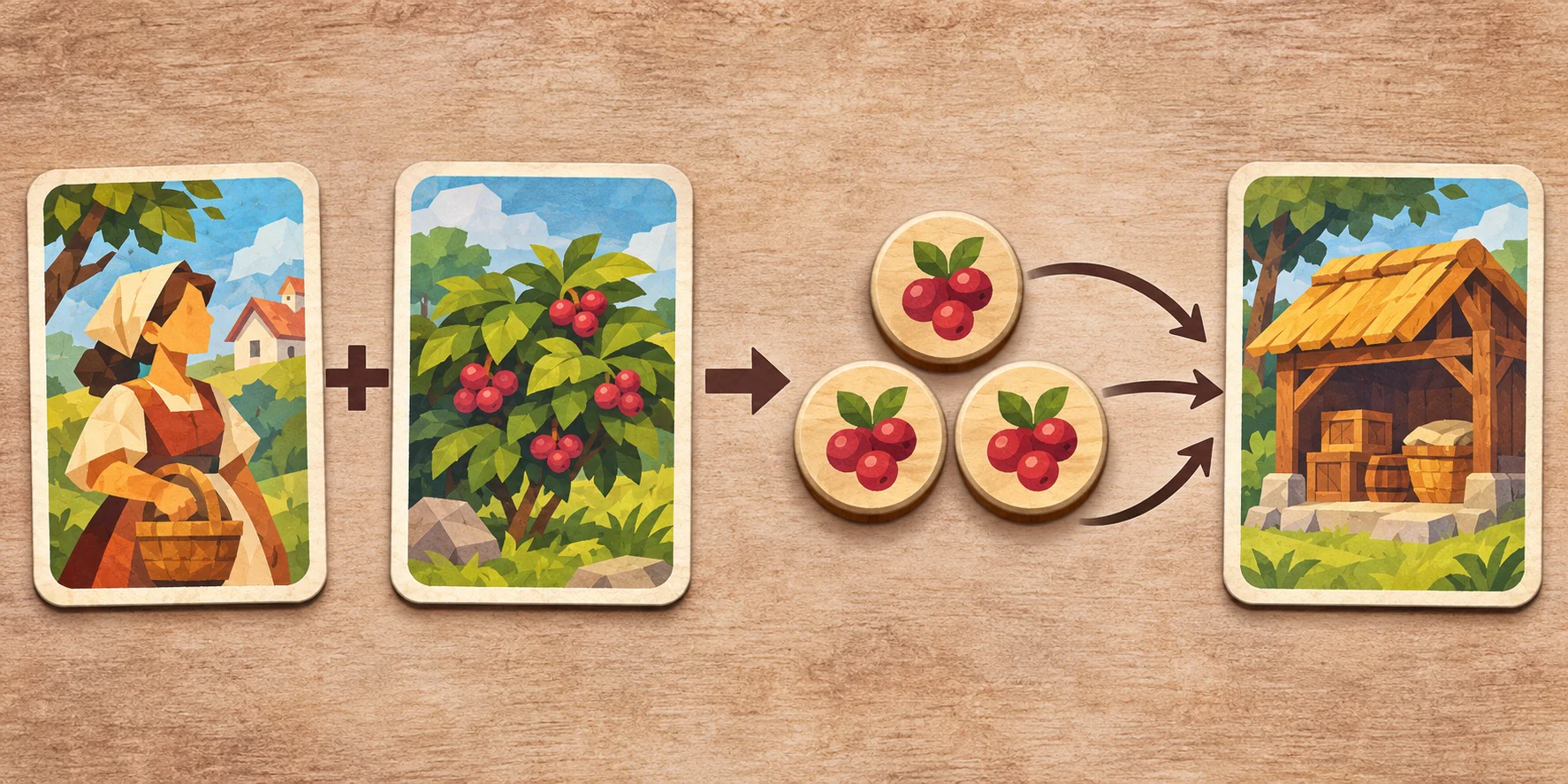
Resource production in a compact village builder should let players see how sources, workers, and recipes turn into useful supplies. Stacklands’ official listing describes stacking cards to collect food and build structures, including an example where a Villager on a Berry Bush produces Berry cards. The design advice below proposes an original system rather than reproducing that game’s rules.
Connect sources and workers to clear outputs
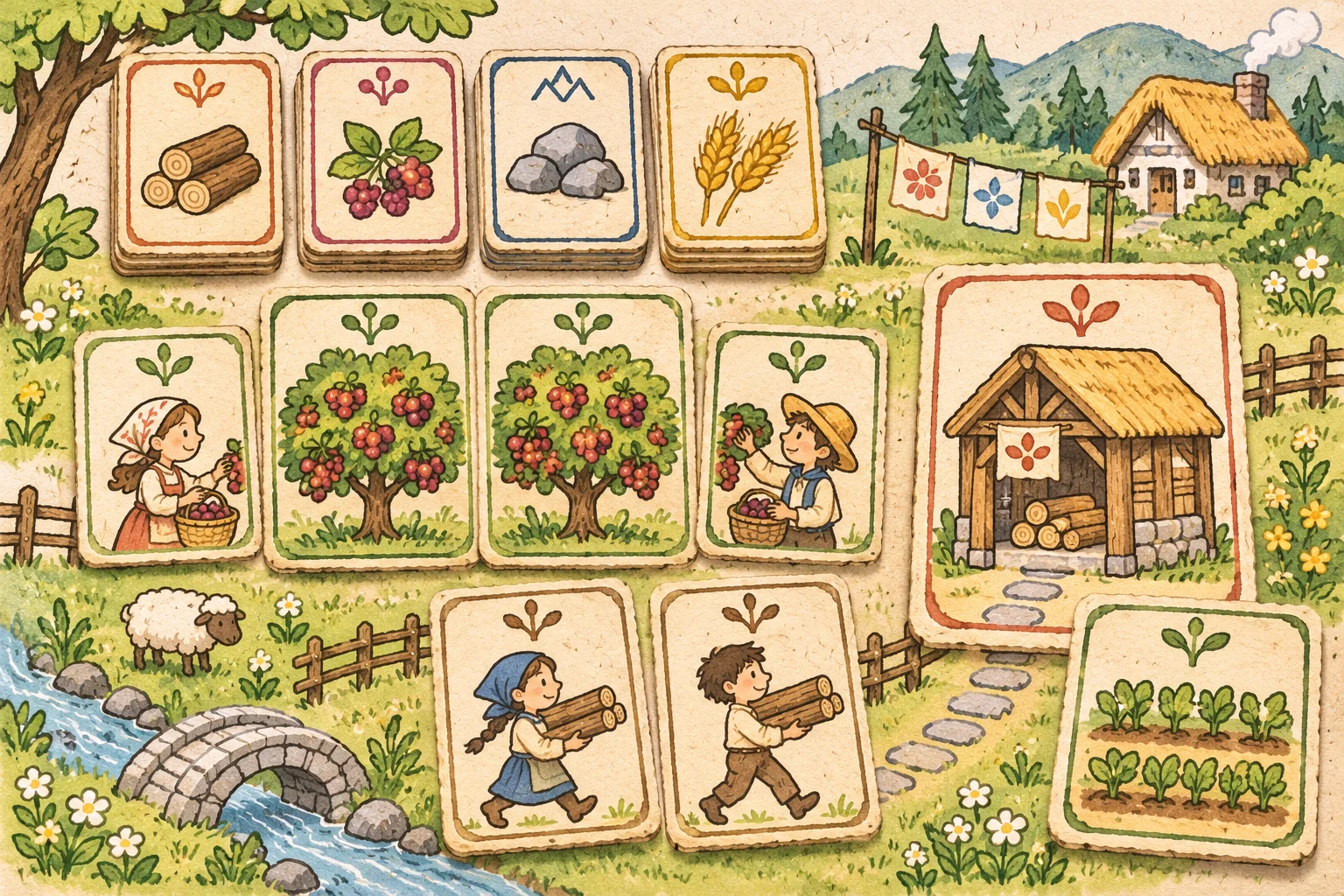
Resource production becomes legible when players can trace an item from source through an action to a useful result. Stacklands’ official Steam listing describes stacking cards to collect food, build structures, and fight creatures, and gives the example of a Villager on a Berry Bush producing Berry cards. That public example is the only reference mechanic discussed here; the proposed production rules are original.
Map each chain with a simple format: input source, agent, action, time, output, and consumer. A berry patch plus a worker might produce food; a workshop and materials might create a tool. The player should see whether the source is available, who is working, and where the result will appear. This makes troubleshooting possible when the chain stalls.
Keep production connected to a village purpose. Food can support population, wood can enable construction, and tools can improve later gathering. If a material has no clear use, remove it or explain the choice it enables. A compact system with purposeful outputs is easier to learn than a large catalog of decorative resources.
Make recipe rules visible before stacking
Players should know what a combination will do before it consumes scarce cards. A recipe preview can show compatible inputs, output, and required time when the player selects a source or places a worker. If discovery is part of the fun, reveal the full rule after the first successful experiment and provide a hint beforehand.
Use distinct visual roles for resources, workers, buildings, and products. Shape and framing can help distinguish them even if the art is viewed at small scale. Do not rely only on color. When a production chain begins, show a clear state such as working, waiting for input, or blocked by storage. These states help players understand what to change.
Explain timing and capacity consistently. If several workers speed up a chain, make the effect visible. If a source has limited stock or a building handles one recipe at a time, show that limit before the player invests. Hidden caps turn a planning puzzle into trial and error.
Balance production, consumption, and storage
A resource chain has to balance how quickly it creates items with how the village uses them. Model the basic flow in a table: current stock, production per cycle, consumption per cycle, and storage capacity. This reveals whether a shortage is caused by insufficient source cards, slow processing, or high demand.
Consumption can create urgency but should leave a response window. If food is used at the end of a day or round, preview the upcoming requirement. Allow the player to pause expansion, assign additional workers, or convert a reserve. The response should fit the game’s scale; a compact card village may not need a separate logistics interface.
Storage is part of production, not an afterthought. Overflow can block a machine or spill items, but players need to see the reason and a practical fix. Storage upgrades can create meaningful tradeoffs if they occupy space or use materials. Keep the relationship between output, demand, and capacity visible in one place.
Test shortages and production priorities
Test production under several starting states: an abundant source, a scarce source, full storage, idle workers, and a sudden increase in demand. Observe whether players identify the cause of a shortage and know which production chain can help. Record how often a chain stalls, output is wasted, or the player produces a resource with no immediate purpose.
Compare single-chain and multi-chain strategies. If one production path always wins, specialize outputs or introduce different constraints so players choose based on their goals. If every chain needs constant attention, reduce repetitive upkeep or let stable processes continue automatically. The player should make decisions about priorities rather than repeatedly restart an obvious recipe.
Finally, test how new recipes change old habits. A new building or resource should open a decision, not make the previous village obsolete without warning. Let players see prerequisites and likely benefits before committing. Update the production map after balancing changes so recipes, UI feedback, and actual outcomes continue to agree.
Related guide
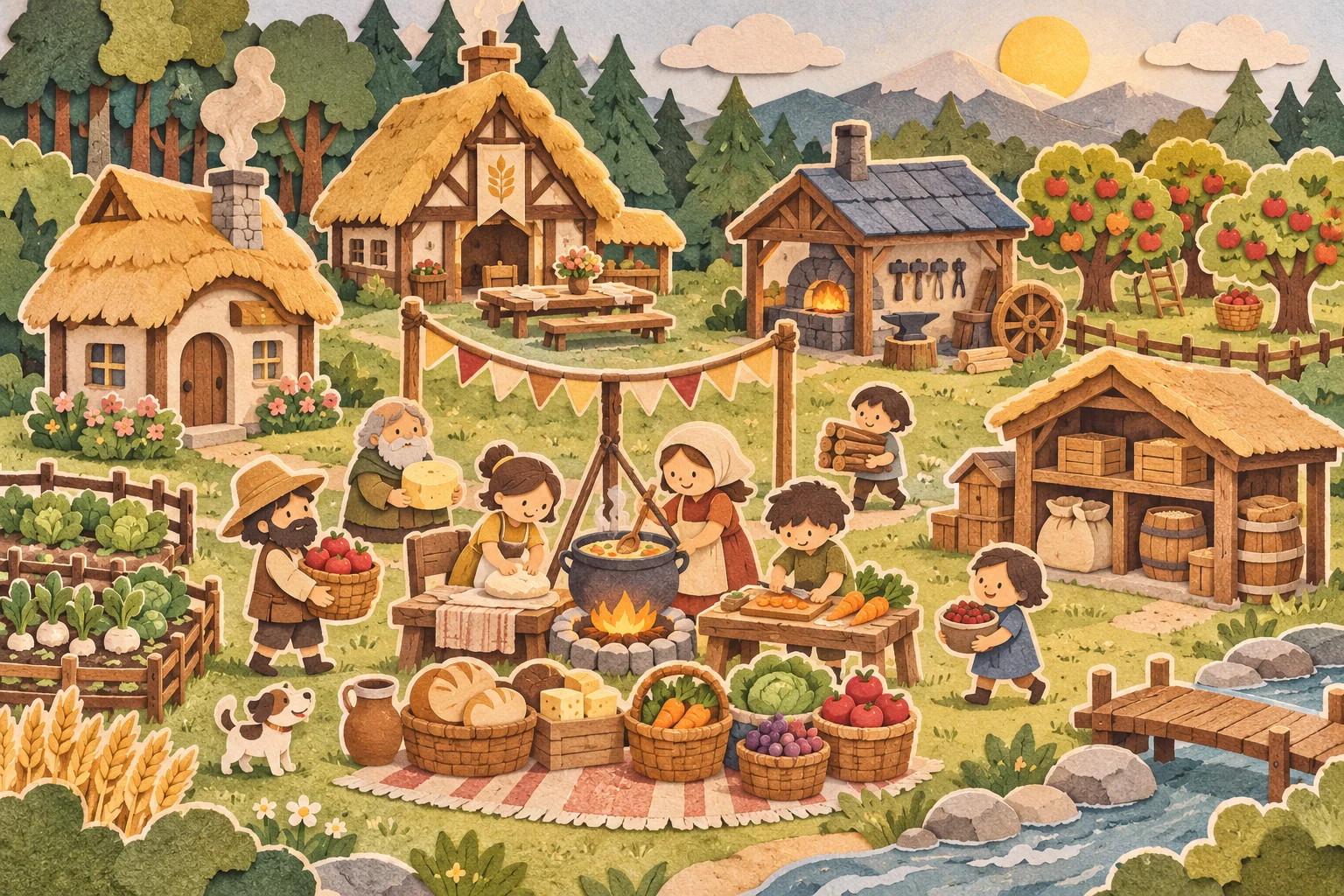
For ways to connect crafting outputs to a larger management loop, see the guide to cozy crafting activities.
Frequently asked questions
How do you design resource production in a card game?
Define each source, worker action, production time, and output as an explicit rule. Make the result appear in a place players can inspect, then connect it to a visible village need. Test whether players can predict the next output before they trigger a chain.
How can players learn production recipes?
Introduce one input-to-output combination at a time and show the required cards before players commit them. Use consistent visual cues for worker, source, and product roles. A reference panel or discovered recipe note can preserve knowledge without requiring players to memorize every combination.
How should resource consumption affect production?
Show recurring needs such as food or fuel before they consume inventory, and explain which production chain can meet them. Consumption creates useful planning when players have time to prepare and more than one viable response. Avoid silently draining a resource that a player cannot replace.
How do you balance automated resource chains?
Measure output per cycle, input availability, storage overflow, and downstream demand. Test both a short chain and a long chain with shared materials. If one combination supplies every need, adjust costs, capacity, or product specialization so production choices remain meaningful.
Prototype a production chain
Use AI to list recipe variants and simulate flow edge cases, then test the actual card interactions with players. Designers should set the input costs, timing, consumption, and recovery rules. Start a game project with Seele.