Risk-based extraction gives a co-op team a meaningful choice: leave with a secure haul or stay longer for a chance at a better one. An original game can make that decision tense without making the outcome feel arbitrary. Show the team what it has collected, the time remaining, the threats it has observed, and the consequences of abandoning or continuing the run. Let communication and preparation shape the choice.
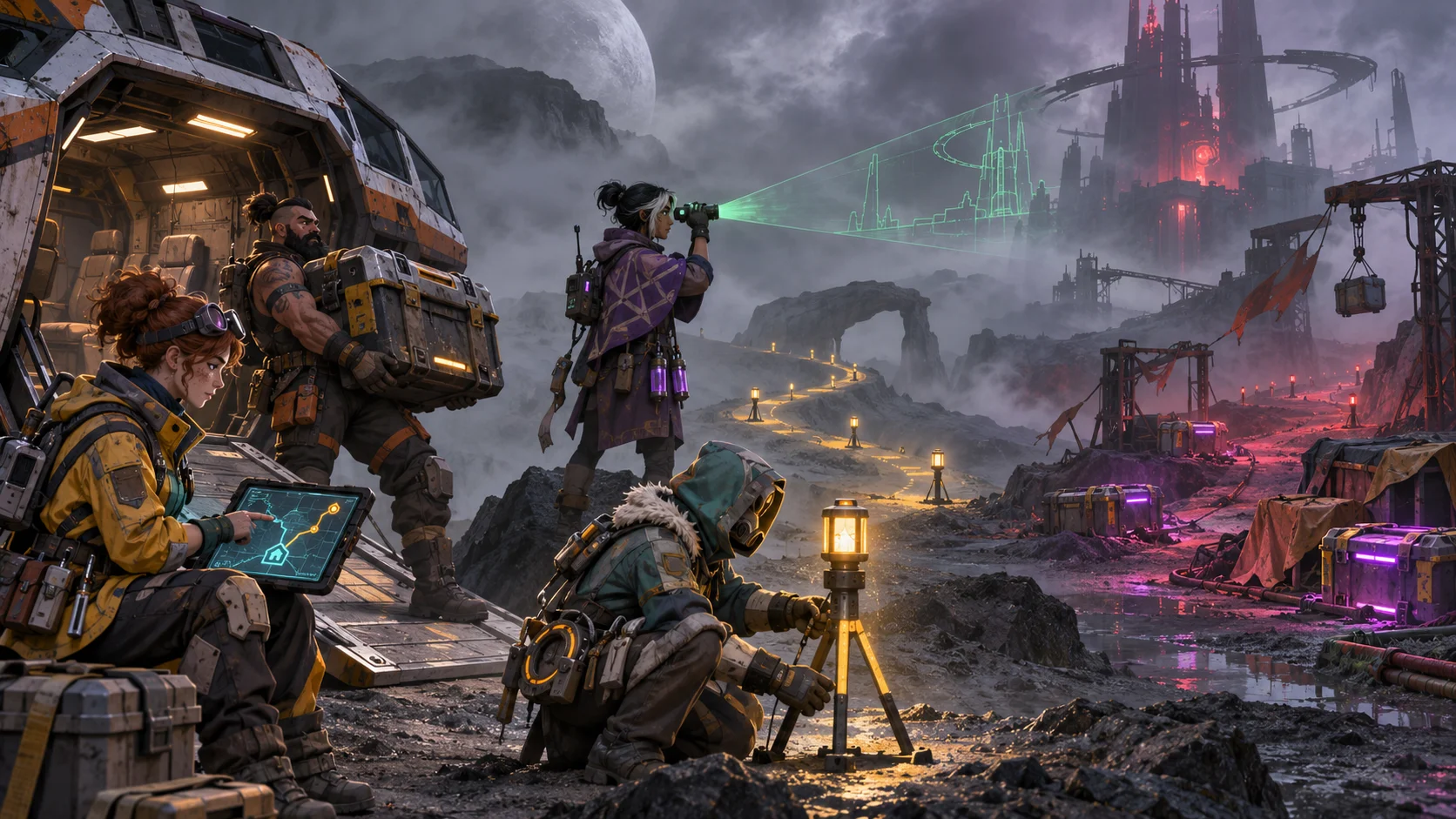
Make the extraction choice visible
Give players a recurring decision point instead of a hidden fail state. At the landing area, establish the return route and a clear extraction action. As the team explores, show what it has secured, what it is carrying, and what will be lost if the group fails to return. A quota or contract can provide long-term pressure, but the immediate choice should still come from the expedition’s current condition.
The official Lethal Company listing describes collecting scrap from abandoned, industrialized moons to meet a profit quota and identifies online co-op. This guide uses that broad premise as context only. Its example meters and team rules are original design recommendations, not claims about Lethal Company’s exact implementation.
Make the state legible without turning every moment into a spreadsheet. A haul display can distinguish secured value from unbanked cargo; a daylight or mission clock can show how much time remains; a danger signal can communicate that the environment is worsening. Use a map marker, visible route, or teammate callout to keep the extraction point findable during a noisy retreat.
Model haul, time, and escalating risk
Model the decision with three inputs: value at risk, cost of time, and expected danger. Value at risk includes both loose cargo and any unbanked progress. Time cost can be a closing weather window, a limited oxygen supply, or a mission deadline. Danger might rise through increasingly active hazards, limited visibility, or more difficult navigation. Choose a small number of signals players can understand and test them together.
Escalation should be predictable enough to support planning. If danger grows after each exploration milestone, teach that rule before players depend on it. If it reacts to noise or carrying a heavy object, show those connections through feedback. Avoid silently increasing enemy strength just because the team is doing well; players need to connect a risk to an action or condition before the tradeoff feels earned.
Keep the resolution rules explicit. Decide what is secured immediately, what is lost on a failed run, and how teammates who are separated can rejoin or contribute. If extraction requires everyone to board, show who remains outside. If one person can trigger departure, communicate that choice to the rest of the crew before it becomes irreversible.
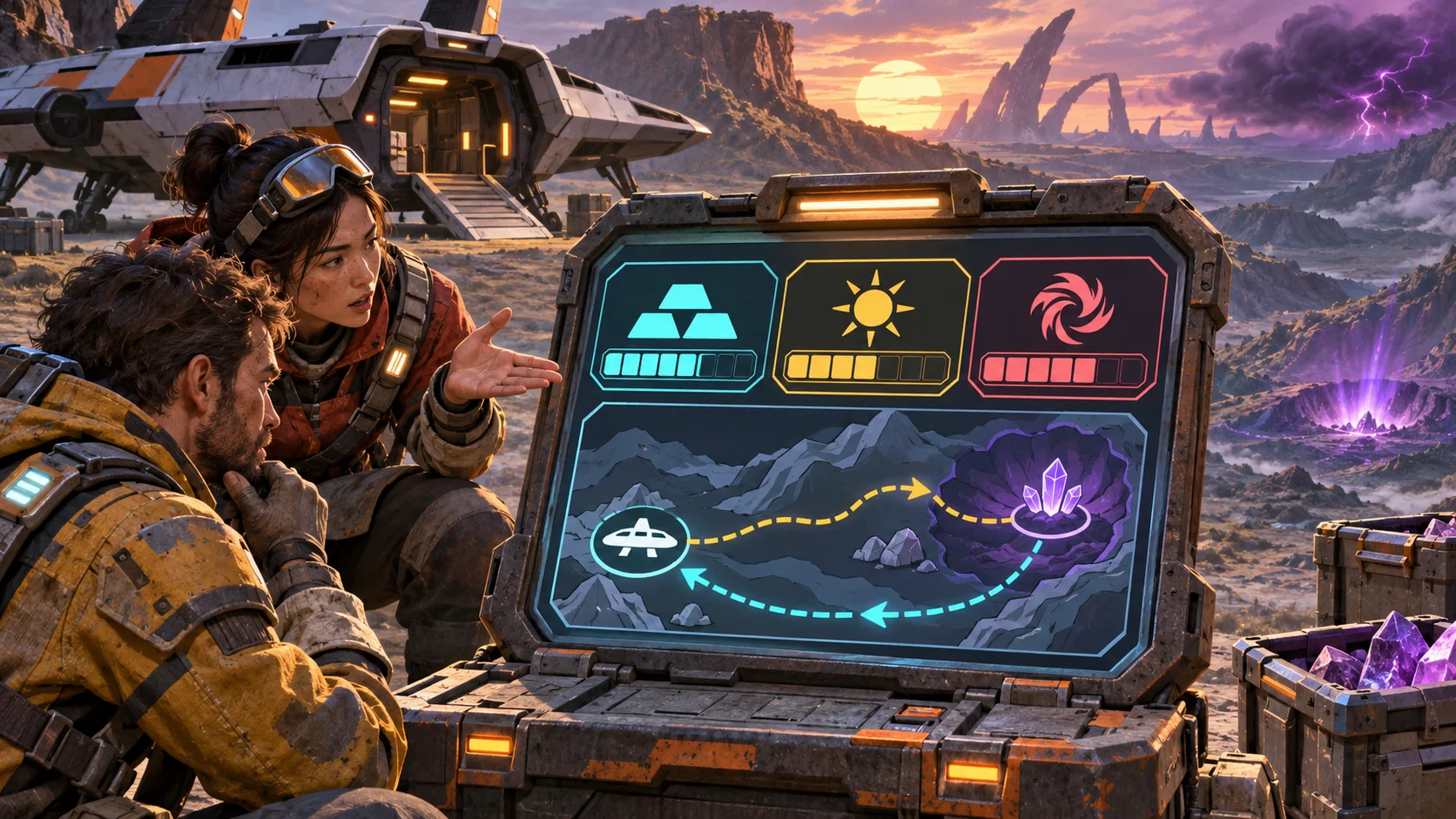
Give the team readable reasons to leave
Players should see how their current haul compares with the likely benefit of staying. A newly discovered room can offer a tempting cache, while a worsening storm or dwindling light raises the cost of reaching it. Offer evidence rather than certainty: a distant noise, a hazard warning, or a route that now takes longer can change the group’s estimate without promising an exact outcome.
Let the team discuss its plan in the world. Shared maps, pings, short callouts, or a teammate carrying an item can create coordination choices. Avoid making the extraction decision depend on a single player having information no one else can see. If a scout spots danger, provide a way to relay it. If the group splits, make the additional risk and the cost of regrouping clear.
Support different levels of caution. A small but secured haul can be a satisfying success when the team retreats at the right time. Deeper exploration can offer a higher payout, but the added risk should be signaled and the payoff should matter. This creates a choice between reliable progress and a larger possible reward, not a punishment for failing to guess the designer’s preferred answer.

Playtest fair risk and recovery
In a playtest, ask the team to state its estimate before it chooses to continue or extract. Then ask what evidence changed that estimate. If players cannot tell whether cargo is banked or still at risk, improve the status display. If everyone stays because leaving feels like failure, adjust the reward and debrief language so a safe return can count as a useful decision.
Test several team behaviors: a cautious group, an overconfident group, players who split up, and a team with one person carrying most of the cargo. Check that a single mistake does not erase an unreasonable amount of progress. Consider partial recovery, shared rescue tools, or a shorter route back after a teammate falls behind. These options preserve tension while giving players a chance to respond to setbacks.
AI can help draft a simple risk model, alternative mission events, or a prototype specification, but it cannot establish how pressure feels to a real team. Start an original co-op prototype with Seele’s AI game maker, then observe whether players understand the signals and feel ownership of the extraction call.
Frequently asked questions
How do you design risk-based extraction?
Show the team’s current haul, remaining time, known danger, and the route to safety. Make the cost of leaving and the possible benefit of staying understandable, then allow players to communicate and act on that information. Test whether different choices can produce satisfying outcomes rather than making one option always correct.
What makes an extraction decision feel fair?
Players need clear signals about what is at risk and consistent rules for banking progress, abandoning cargo, and returning to safety. Danger can remain uncertain, but it should respond to conditions the team can observe or learn. Avoid hidden penalties that turn a reasonable choice into a surprise loss.
How can a team compare loot with danger?
Show secured and unbanked value separately, then pair it with a readable clock, route, and danger cues. Let the team know what might be gained by continuing without guaranteeing the result. The choice becomes easier to discuss when everyone can see the same state and understand what remains uncertain.
How should extraction work in a co-op prototype?
Define who must reach the extraction point, how the team confirms departure, and which resources are secured when the mission ends. Give separated players a way to coordinate and make irreversible departure clear. Playtest with teams that split up or lose cargo so the rules stay understandable under pressure.