Round targets create a decision before the player commits cards or resources. A reliable target can protect steady progress; a riskier one can offer a stronger reward in exchange for a real chance of failure. For an original card roguelike, make both options understandable and connect them to the player’s current build. Balatro’s official store description frames it as a poker-inspired roguelike deck builder about building synergies. That is useful genre context, but your round rules should be designed for your own card game.

Set a clear baseline target
Start with a target players can understand without a calculator. State what must be achieved, how many actions or turns remain, and what happens if the target is missed. The baseline should test the build and hand choices while leaving room for recovery. If the normal target feels impossible without a lucky draw, the optional risk layer will not feel like a choice.
Define a predictable round rhythm. The game might show the target, let the player inspect their hand, and then offer a decision to stay on the standard route or accept an additional challenge. Keep the order stable. Players should know whether they are choosing a target before or after seeing the tools and resources available for that round.
Make progress legible throughout play. Show the current score or progress, the remaining actions, and the gap to the target. When the player uses a card that changes scoring, explain the change in context. Risk depends on uncertainty, but it should not depend on hidden arithmetic or unclear state.
Offer a visible risk and reward choice
A high-risk target needs a cost, a reward, and a failure consequence. The cost might be spending a limited resource, giving up a safe bonus, or accepting a more demanding target. The reward could be extra currency, a choice of upgrades, or a route advantage. Failure might forfeit the stake or consume a recovery resource. Tell players what can be lost before they accept the challenge.
Make the difference meaningful. A risky target that offers a tiny bonus will be ignored; a reward so powerful that players feel forced to take it makes the safe path a trap. Compare the rewards against the next decisions they enable. If the riskier route consistently accelerates the run without meaningful downside, adjust either its cost or its success conditions.
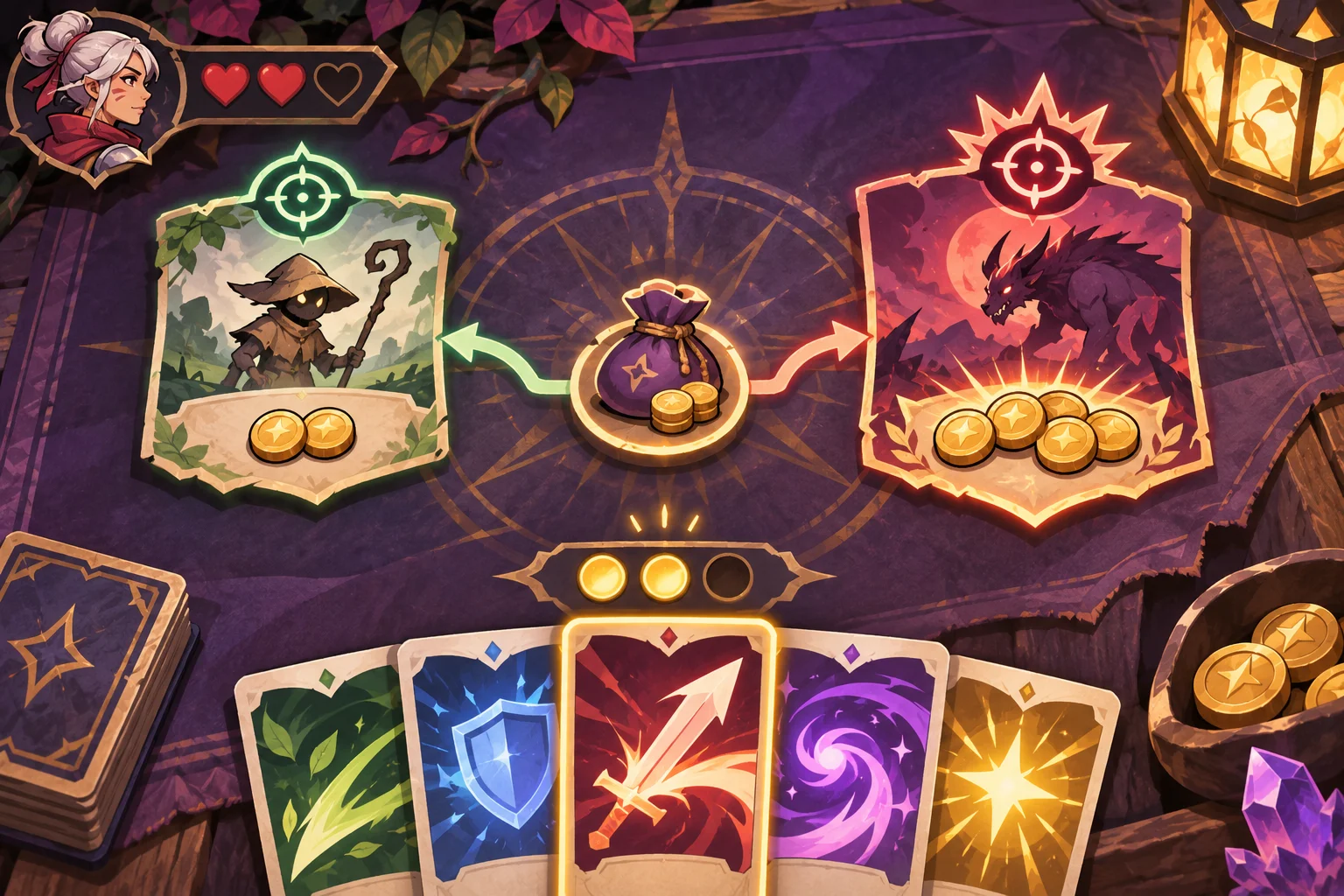
Offer the choice at a useful moment. Players should have enough information to estimate their odds, but the decision should still ask them to commit. If they choose before seeing their build or hand, make the uncertainty part of the challenge and keep the reward fair. If they choose after seeing their current setup, let the target respond to a real decision rather than simply offering a larger number.
Connect round targets to build state
Target difficulty can interact with the player’s tools, card synergies, and remaining resources. A build that scores through repeated small effects may handle a different challenge than one built around a single high-impact play. Avoid changing the target based only on a broad label such as “strong build.” Instead, identify the specific capability a challenge tests and show players why it fits.
Keep adaptation predictable. A target might ask for a certain number of plays, reward a particular suit or card type, or limit a resource the player has relied on. Use clear rules that let players plan around the challenge. If the game quietly raises the target whenever the player becomes stronger, improvements can feel like they do not matter.
Test the challenge with several builds and run states. Check a build with strong synergies, one with inconsistent draws, and one that has spent much of its recovery resource. Look for situations where one option is always correct. If the player can identify a risk only after taking it, improve the preview or change the timing of the choice.

Tune difficulty through playtests
Prototype a short run with a standard target, one optional high-risk target, and a small set of rewards. Ask players to explain their choice before they start the round. Note whether they understood the stake, estimated their chances, and could describe what would happen on failure. After the round, ask whether the reward felt worth the risk even when they succeeded.
Record acceptance rate, success rate, resources spent, and how often players regret a choice. These numbers are evidence for a design question, not goals to optimize in isolation. If almost everyone accepts the challenge, the reward may dominate or the cost may be too low. If almost nobody accepts it, the target may look unattainable or its downside may be too severe. Compare experienced and new players because they may read the odds differently.
Review failed attempts carefully. A failure should teach a player something about their build, the target, or their resource plan. If they cannot tell why they lost, improve the progress display and explain which actions mattered. If success feels automatic once the build is understood, add variety to challenge conditions instead of simply inflating target values.
Steam’s official Balatro listing describes a poker-inspired roguelike deck builder built around synergies. That high-level description does not prescribe how another game should set targets or rewards. Use your own prototype to decide how risk interacts with card choices, resources, and run progression. SEELE’s documented game-creation capability can help turn a natural-language concept into a starting point; playtest the round decision and tune it from observed player choices.
Frequently asked questions
How do risk-based round targets work?
They offer a player a choice between a more reliable goal and a more demanding goal with a stronger potential reward. State the target, cost, reward, and failure consequence before the player commits. Let the player use visible information about their current build to judge whether the challenge fits their plan.
How should a high-risk target reward the player?
Reward success with something that changes future options, such as a valuable upgrade choice, a useful resource, or a route advantage. Compare its value with the possible loss and the safe alternative. If the reward is always essential, the challenge can feel mandatory; if it has little impact, players may never consider it.
Can round targets adapt to a player build?
Yes, if the adaptation follows a clear rule and tests an identifiable capability. A challenge might interact with the player’s available actions, resource use, or build synergies. Explain the condition and test it across different builds. Avoid quietly increasing difficulty whenever a player performs well, which can make progress feel invisible.
How do you prevent optional targets from feeling mandatory?
Keep the standard route viable and make the risky reward valuable without gating all meaningful progression behind it. Show the downside clearly, and ask players whether they felt free to decline. If most players accept only because they fear falling behind, reduce the pressure or make the safe route more rewarding.
Prototype one safe target and one optional challenge, then observe whether players can explain the tradeoff. Explore an AI game creation starting point for an original card roguelike.