A skill check can reveal what a character is good at, what they notice, and how they approach a difficult moment. In a narrative RPG, the result should shape the scene instead of acting like a simple pass-or-fail gate. Disco Elysium’s official Steam listing describes mixing and matching 24 different skills. Use that as high-level context for a skill-forward role-playing game, then make the rules and outcomes fit your own story.

Connect checks to character identity
Start with a short list of skills that represent different ways of understanding or acting in the world. A perceptive character might notice a detail, a persuasive one might change the tone of a conversation, and a practical one might find a physical solution. Each skill should offer a distinct lens rather than a synonym for the same success.
Decide where a skill can enter a scene. A check may appear when the player examines an object, questions a person, or chooses a risky action. Make the trigger depend on meaningful context. If a skill interrupts every conversation, it can feel like noise; if it appears only once, players may not see how their character’s abilities matter.
Show why a skill is relevant. A short cue can connect it to evidence, a character’s behavior, or a prior choice. The player does not need to know every hidden variable, but should understand what kind of approach they are choosing. A skill can suggest a perspective without forcing the player to follow it.
Make stakes and odds understandable
Before a check, let players see the action at risk and what success might change. A conversation might reveal a lead, improve a relationship, or unlock a later question. A physical attempt might use time, consume a tool, or attract attention. The cost should be specific enough for players to make a choice.
Decide how much probability information to show. Some games display a precise chance, while others use a broad signal such as low, even, or favorable. Either approach can work if it is consistent and helps players understand uncertainty. Avoid presenting a precise percentage that hides important modifiers or gives a false sense of control.
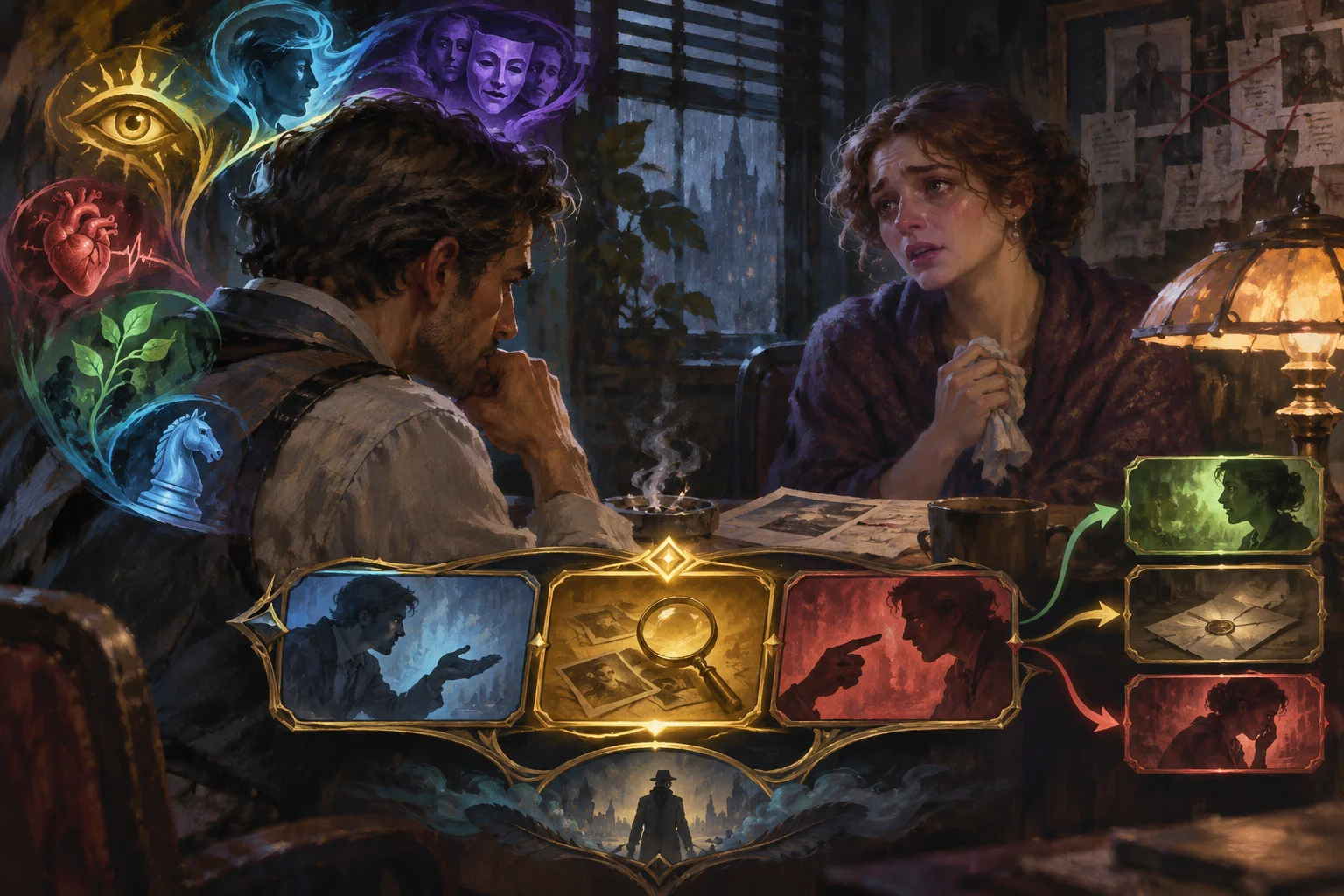
Give the player control over when to commit. A check can be optional, or it can be a deliberate action the player chooses from a list. If a check happens automatically, provide enough context for the player to understand why it occurred. Do not trigger a high-stakes roll from an incidental click when a confirmation step would make the decision clearer.
Write failure as a meaningful outcome
Failure can change the scene without ending the story. A character may learn something incomplete, lose an opportunity, spend time, or create a new problem. The result should follow from the attempted action and leave the player with a next step. A failed attempt that only says “nothing happens” often feels like a dead end.
Use different consequence types. A failed social approach might make someone defensive; a failed search might expose the player to danger; a failed repair might damage a useful object. Make consequences proportionate to the stakes you established. If the only consequence is a worse score, players may reload repeatedly to avoid it, weakening the narrative.

Keep the story moving through alternate routes. A success might reveal a clean clue, while a failure reveals a contradictory detail or creates a new source to investigate. Both paths can lead to the next scene, but with different relationships, costs, or information. This gives choices consequence without requiring every failed roll to stop the campaign.
Playtest dialogue and retry flow
Prototype a small scene with two skills, a visible decision, and different consequences for success and failure. Ask players to describe what each option means before they choose. If they cannot explain why a skill applies or what they might risk, improve the cue or revise the choice. Check that the scene still makes sense when players pick either outcome.
Observe whether players retry a check, avoid a skill because its chance seems low, or reload immediately after failure. These behaviors may show that failure carries too much cost, the probability display is unclear, or the scene has only one acceptable outcome. Make retries explicit: decide whether a check can be attempted again, what must change first, and whether the second attempt has a new cost.
Review the narrative voice of each skill. A skill can comment on evidence or propose an interpretation, but it should not replace the player’s agency. Let players accept, ignore, or question that perspective. Test whether different character builds reveal different useful information without making a single build necessary to understand the main plot.
The official Disco Elysium listing supports a narrow reference to a game with many distinct skills. Your own narrative RPG should define its skill categories and check consequences independently. SEELE’s documented game-creation capability can help start from a natural-language RPG idea; prototype a short conversation with two outcome branches and refine it after observing how players read the stakes.
Frequently asked questions
How do skill-driven checks work in a narrative RPG?
A check connects a character capability to an uncertain action, such as noticing evidence, influencing someone, or attempting a risky task. Show why the skill applies, what is at stake, and how the outcome can change the scene. Make the result reflect the character’s approach rather than only awarding a number.
Should a failed check block the story?
Usually keep a path forward, even if failure changes the information, relationship, cost, or next opportunity. A hard block can work when it is clearly signaled and has a deliberate purpose, but frequent blockers encourage reloads. Test whether players understand what they can do after a failed attempt.
When should players see a check probability?
Show probability when it helps players make an informed decision and fits the tone of your game. A numeric chance can be useful when rolls are a central system; a descriptive range can preserve uncertainty. Keep the information consistent and explain major modifiers that affect the result.
How do you make different skills feel distinct?
Give each skill a unique way to interpret or act on the scene. One might reveal a clue, another change a conversation, and another offer a practical solution. Test the same scene with different builds and confirm that each skill adds useful perspective without making one build mandatory.
Prototype a conversation where both success and failure lead to distinct next steps. Explore an AI game creation starting point for an original narrative RPG.