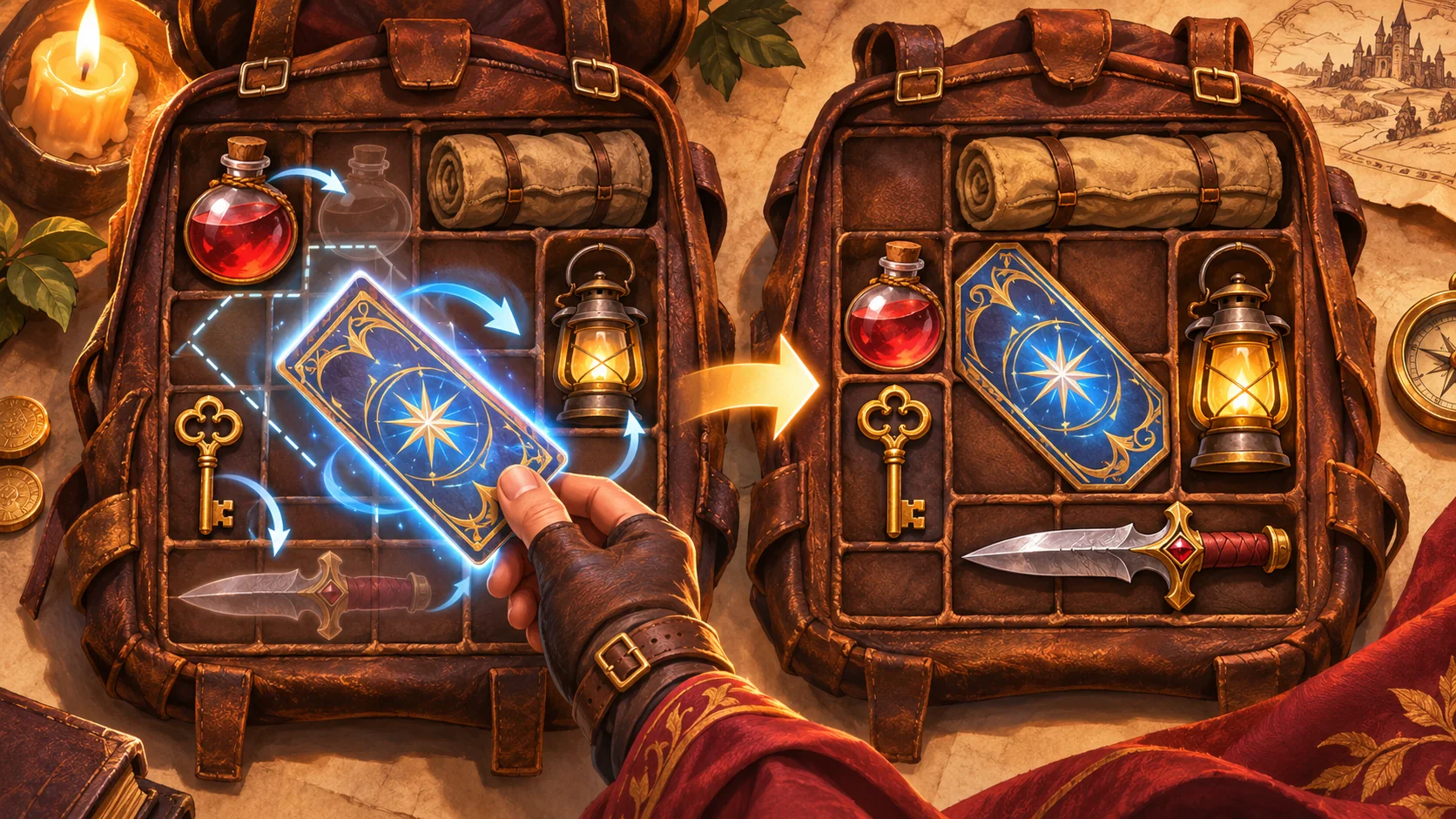
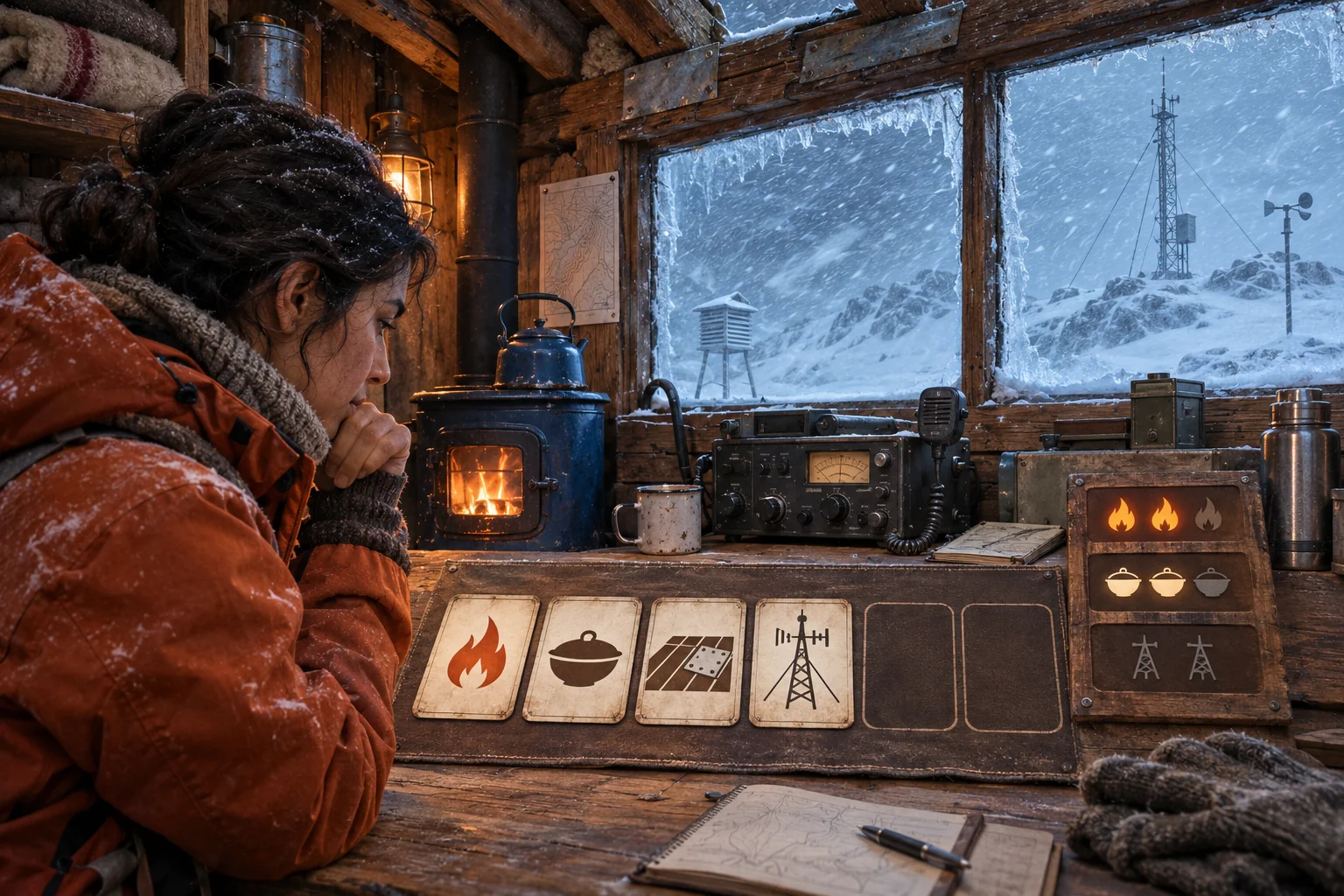
After an avalanche, the trail to the pass is buried. You have three nights to cross it, and every card you carry occupies a square in your backpack. A ration beside a cup can stretch farther. A tarp on the outside of the pack can shield you from a storm. The layout is part of your survival plan.
White Mile is a fictional, three-day card survival design. Start with warmth 3 of 4, food 3 of 4, and resolve 3 of 3. Each dusk costs one warmth and one food. A storm costs one additional warmth unless your Tarp sits in an outer cell. When warmth or food reaches zero, lose one resolve. At zero resolve, the run ends. Reach the pass after day three to win.
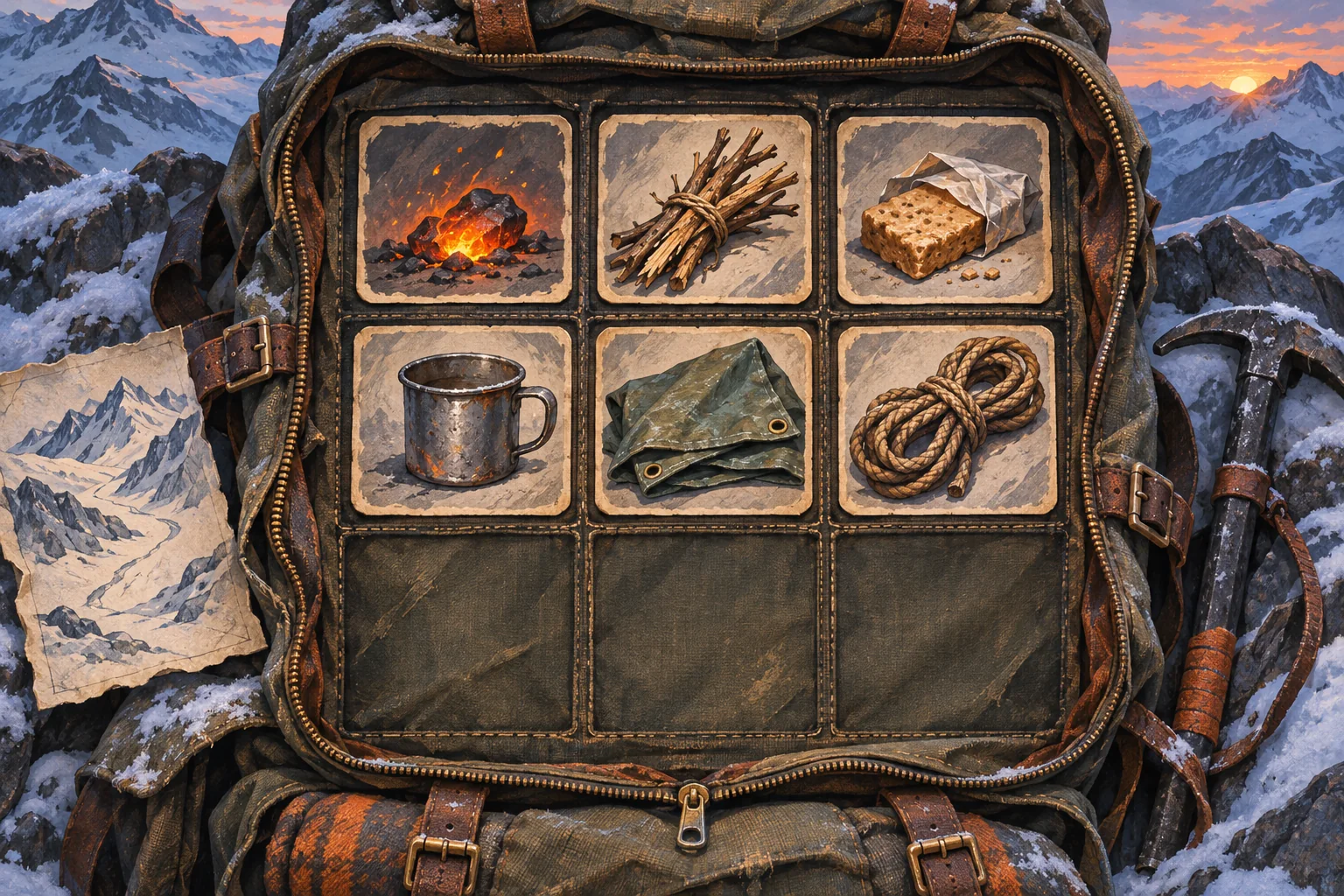
Make the backpack your strategy board
Use a 3×3 backpack with six one-cell item cards: Ember, Kindling, Ration, Cup, Tarp, and Rope. You may rearrange once before dusk, then use at most one item. Ember restores two warmth if it touches Kindling, otherwise one; exhaust Ember until dawn after use. Ration restores two food if it touches Cup, otherwise one; discard Ration. Tarp cancels a storm's extra warmth loss while it occupies an outer cell and cannot be consumed. Rope can be discarded from an outer cell to restore one resolve. Cap warmth and food at four and resolve at three. After the action, dusk removes one warmth and one food, then an unshielded storm removes one more warmth. Each need at zero removes one resolve.
| Item or condition | Board rule and result |
|---|---|
| Ember | Touching Kindling restores 2 warmth; otherwise restore 1. Exhaust Ember until dawn after use. |
| Ration | Touching Cup restores 2 food; otherwise restore 1. Discard Ration after use. |
| Tarp | While on any outer cell, cancel the extra warmth loss from a storm. It stays in the bag. |
| Rope | If placed on an outer cell, discard it to restore 1 resolve. |
| Dusk | Lose 1 warmth and 1 food. An unshielded storm also removes 1 warmth. A need at 0 removes 1 resolve. |
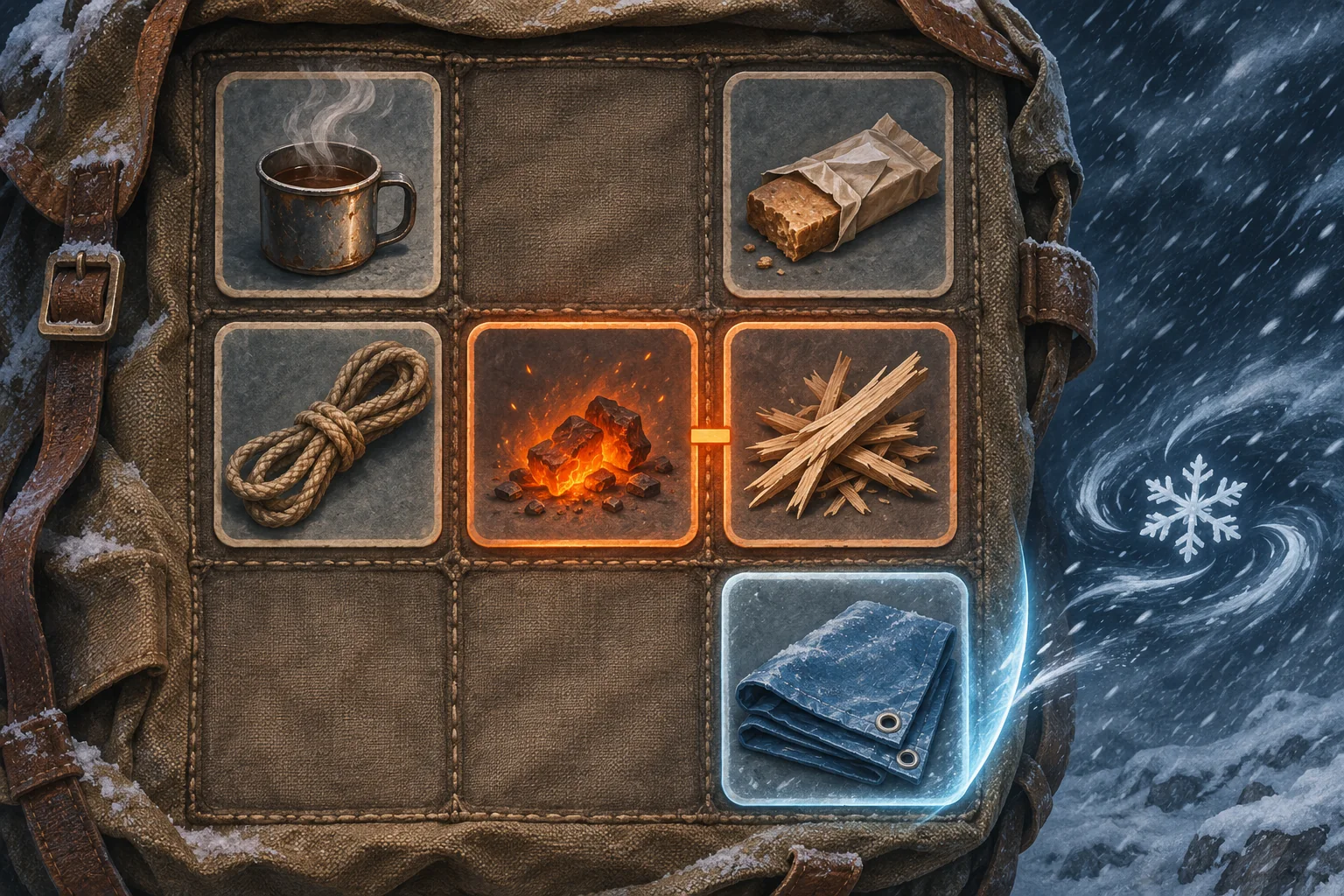
Trace three nights and one costly layout
Start at W3/F3/R3 with Ember beside Kindling, Ration beside Cup, and Tarp on the edge. On a clear first day, Ember raises warmth to its cap of 4; dusk leaves W3/F2/R3. On a stormy second day, the edge Tarp blocks extra cold. Ration raises food from 2 to 4, then dusk leaves W2/F3/R3. On the third storm, use Ember and keep the Tarp at the edge: dusk ends at W3/F2/R3, so you reach the pass. Move Tarp to the center before that storm and warmth falls one extra point. The changed arrangement has a visible cost.
| Check | Expected result |
|---|---|
| Place Ember away from Kindling | Using Ember restores only 1 warmth; Ember is exhausted until dawn. |
| Move Ember beside Kindling before dusk | Using it restores 2 warmth, capped at 4. |
| Use Ration beside Cup | Food rises by 2, capped at 4, before dusk removes 1. |
| Leave Tarp on an outer cell in a storm | The storm's extra warmth loss is canceled. |
| Move Tarp into the center | The extra storm loss applies. |
| Restart after a failed run | Tracks, starting cards, card positions, and the day deck return to their authored state. |
Give AI a clear survival loop
Ask SEELE to draft the grid, track display, and dusk sequence as one small local prototype. Include the adjacency checks and exact order of effects in the prompt. Compare the local result against the written trace before adding new supplies or random events.
Create a local survival card prototype called White Mile. Show warmth (max 4), food (max 4), resolve (max 3), a 3x3 backpack, and a three-day route. Begin W3/F3/R3. Put six one-cell item cards in the bag: Ember, Kindling, Ration, Cup, Tarp, Rope. Allow one rearrangement before dusk and at most one item action. Ember restores 2 warmth when edge-adjacent to Kindling, otherwise 1, then is exhausted until dawn. Ration restores 2 food when edge-adjacent to Cup, otherwise 1, then is discarded. A Tarp on any outer cell cancels the extra warmth loss on storm days and cannot be consumed. Rope on an outer cell can be discarded to restore 1 resolve. Cap tracks at their maxima. After the item action, dusk removes 1 warmth and 1 food; an unshielded storm removes 1 more warmth. Each need at zero removes 1 resolve. Resolve at zero ends the run. The player wins by reaching the pass after day three. Add a reset. Show the current grid, weather, action order, and exact track changes. Make all inventory actions keyboard-operable without timed key presses.Show adjacency and weather together
The first draft applied the storm penalty before checking the tarp, making its outer-cell position irrelevant. Move weather resolution after the inventory action, and evaluate the Tarp's current cell at that moment. In the status panel, show the one normal dusk loss and the separate storm loss so a player can see which effect was canceled.
Replay the written route with the Tarp at the edge and in the center. Verify adjacency by shared sides only, not diagonal corners, and check the warmth/food caps before dusk. If this becomes a web prototype, expose selection, rearrangement, and use as keyboard actions; W3C's keyboard guidance is a useful reference, not a conformance claim.

Add supplies after the base route works
Keep the first route fixed while checking whether the backpack layout creates a real tradeoff. The player should be able to explain why the Ember pair, ration pair, and tarp position mattered on a particular night. Once the trace is stable, add one new item card or a second weather pattern, then repeat the same checks. A broader inventory-management guide can help you explore adjacency without losing the survival loop.
Read the inventory-management roguelike guide.
Start a local game prototype with SEELE.
Frequently asked questions
How many cards should fit in the starting backpack?
Start with a 3×3 grid and a few item cards that interact through clear edge adjacency. The six-card White Mile example leaves open cells for a new supply while making layout matter. Add more cards only after players can read the board and predict each item's effect.
Does diagonal contact count as adjacency?
No. In this design, cards must share a side; touching at a corner does not activate Ember or Ration bonuses. State the rule beside the board and show the affected pair. If you later add diagonal links, make them a distinct rule and test them separately.
Read W3C's keyboard accessibility guidance.
How can a storm challenge the inventory plan?
Give the storm a predictable extra warmth loss, then let a Tarp on an outer cell cancel it. The player must reserve a useful edge position instead of treating every square alike. Test both the protected and unprotected layout so the status change is easy to see.
What should reset restore?
Restore the starting tracks, six cards and their initial positions, the three-day weather sequence, and the day counter. Clear any discarded or exhausted items. Check reset after both success and resolve reaching zero so no previous run can change the next trace.