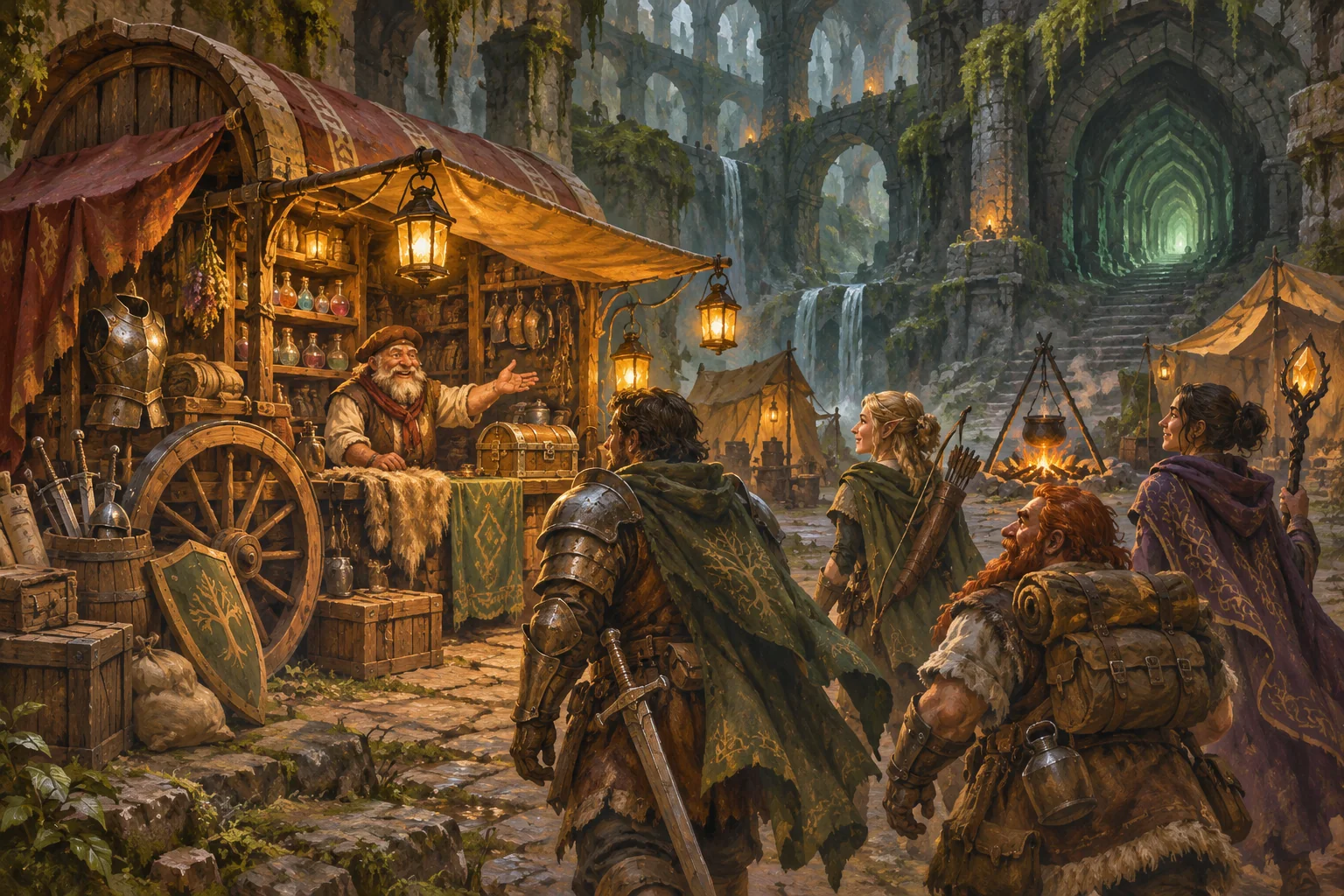
A traveling shop can be more than a place to buy potions between quests. In The Wandering Ledger, the wagon is the party’s home, workshop and route-planning table. The three adventurers share one skill library, and any of them can equip any item. Attribute thresholds and gear tags open actions, so players build roles through choices instead of selecting a permanent class.
Each journey links two settlements. Before departure, the player stocks the wagon, shifts gear between heroes, trains one skill and chooses a route. The destination changes which goods the shop can buy and sell. A flexible party can adapt at the wagon, but its limited supplies and cargo space make preparation matter.
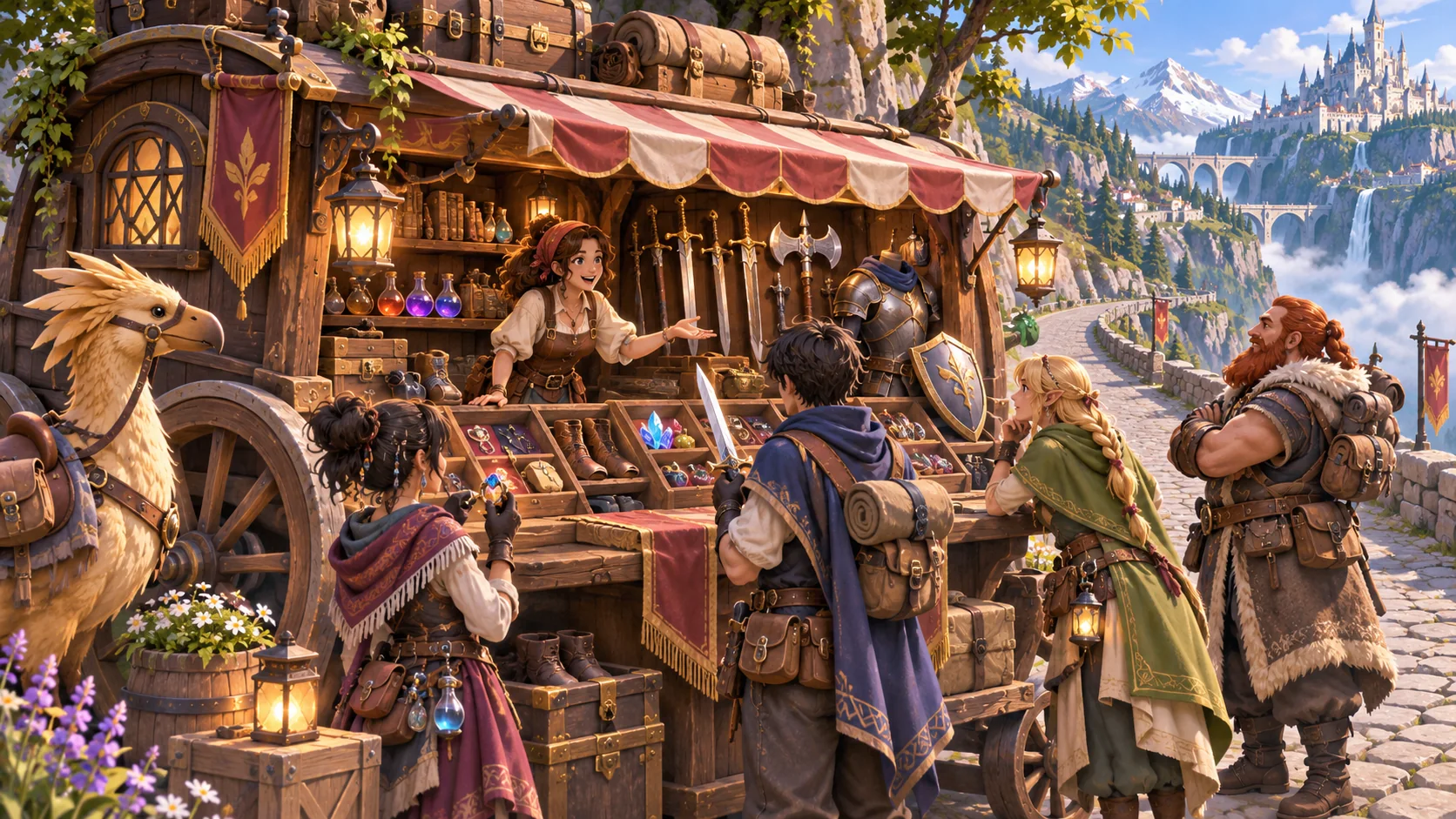
Make the wagon the party’s main base
Build a compact classless RPG prototype named The Wandering Ledger. The party has three heroes and a traveling shop wagon that is always the main safe base. There are no character classes, class-exclusive equipment or permanent role assignments. Every hero has Might, Wit and Agility, starting at 1 each, plus 4 health. On each level-up, add 1 point to one attribute. The shared skill library contains Brace (Might 2, reduce the next physical hit by 1), Field Mend (Wit 2, restore 2 health to one ally, once per rest), and Quickstep (Agility 2, avoid one hazard on a route). A hero can use a skill only while meeting its listed threshold. Each hero has two equipment slots. Any hero may equip any item; equipment changes stats or grants a named skill but does not change the hero’s class because none exists. The wagon carries at most 6 goods and 3 supply tokens. At a settlement, the player may buy or sell one item, move any gear among heroes, train one skill if its threshold is met, and choose the next connected route. A route costs 1 supply token. Arriving at a new settlement restores 1 supply token up to 3, opens that town’s fixed shop inventory, and allows one safe rest. A rest restores all party health and resets Field Mend uses. If the wagon has no supply token, the party cannot depart until it trades for a supply token or completes a town task that grants one. The first prototype has three settlements in a line: Reed Market, Glass Pass and Lantern Quay. Reed Market sells a Rope Harness (+1 Agility) and a Brass Buckler (+1 Might); Glass Pass sells a Weather Cloak (+1 Wit) and a Trail Kit that grants Quickstep; Lantern Quay sells a Medicinal Case that grants Field Mend. Begin in Reed Market with one supply token, 2 coins, Rope Harness in stock and no other items. A hero may equip only two items, an item can be equipped by only one hero at a time, and unequipping returns it to the wagon. Use fixed inventories and prices in this prototype; no random stock, hidden class gates, skill resets, or automatic role assignment. Show attribute totals, skill eligibility, inventory capacity, supply tokens, route options and the reason each unavailable action is blocked.
| System | Prototype rule |
|---|---|
| Party | 3 heroes; no classes or class-locked gear; each starts with 1 Might, 1 Wit, 1 Agility and 4 health. |
| Growth | Each level-up grants 1 point assigned to one attribute; skill thresholds are checked against current totals. |
| Shared skills | Brace: Might 2, reduce next physical hit by 1. Field Mend: Wit 2, heal 2 once per rest. Quickstep: Agility 2, avoid one route hazard. |
| Equipment | 2 slots per hero; any hero may equip any item; each item can belong to only one hero at a time. |
| Wagon | Main safe base with 6 goods capacity and 3 supply tokens maximum; gear can be moved between heroes here. |
| Settlement turn | Buy or sell one item, rearrange gear, train one eligible skill and choose a connected route. |
| Travel and rest | A route costs 1 supply; arrival restores 1 supply up to 3, opens the town inventory and permits one safe rest. |
| Starting route | Reed Market → Glass Pass → Lantern Quay; each shop has the fixed stock named in the rules. |
| Blocked travel | At 0 supply, departure is unavailable until a trade or town task grants supply. |
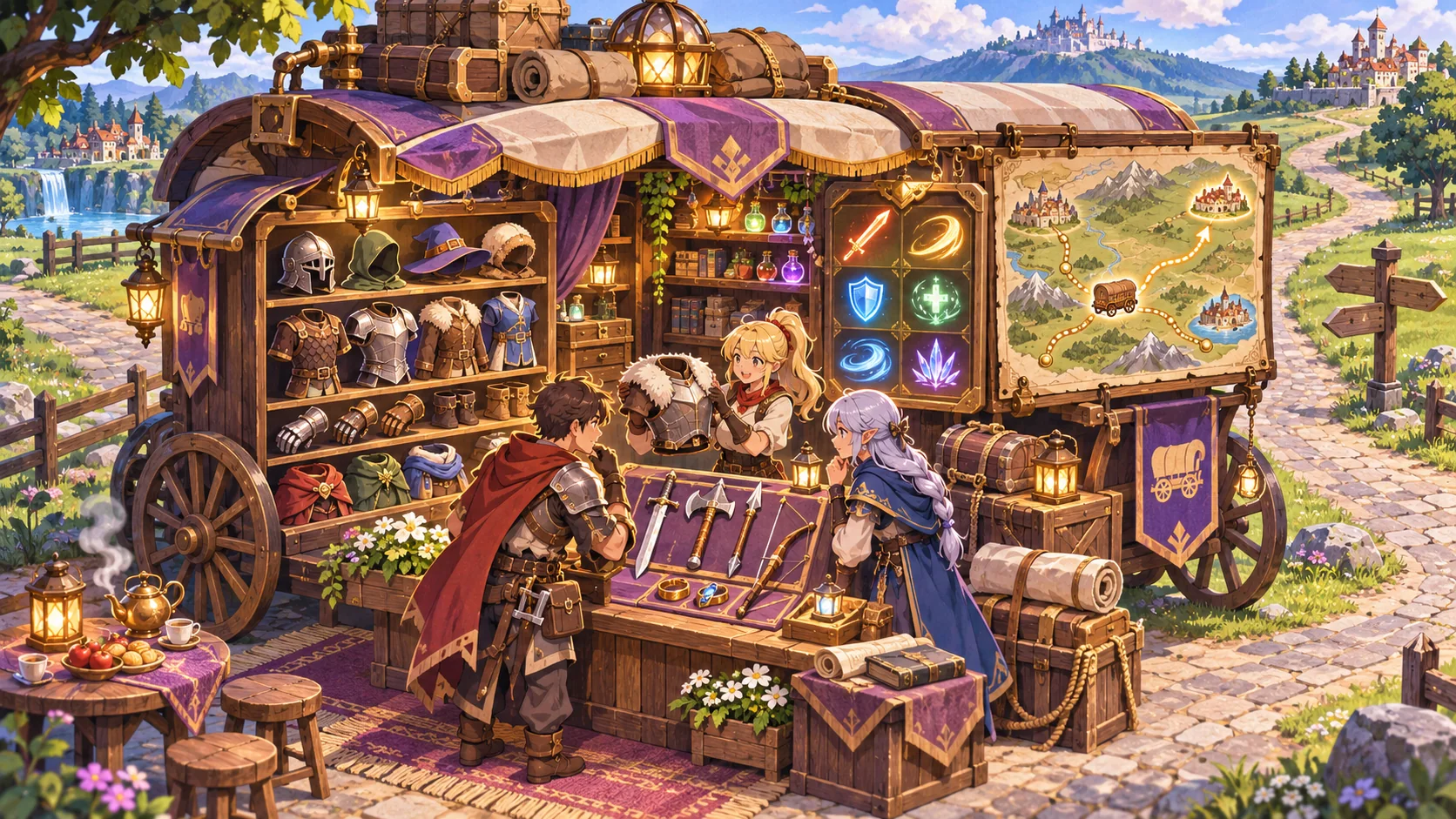
Set rules for shared skills and equipment
Example authored scenario: Mira has Might 1, Wit 1, Agility 1; Ivo has Might 1, Wit 1, Agility 1; Sen has the same starting values. Reed Market begins with 2 coins, one supply and a Rope Harness in stock. The player buys the Harness for 1 coin and equips it on Sen, raising Agility to 2; Sen can now train Quickstep from the shared library. The party takes the route to Glass Pass, spending its only supply. Arrival restores one supply, so the wagon again has one token. At Glass Pass, the player moves the Harness to Mira, which removes Quickstep eligibility from Sen and makes Mira eligible; skill access follows the current attribute total and is not permanently learned or erased. The player can buy the Trail Kit if it fits the remaining wagon capacity; it grants Quickstep as an item skill while equipped. The trip demonstrates one classless role change caused by gear transfer, plus a meaningful supply decision. These are authored rules and arithmetic examples, not a playable or user test.
| Event | Expected state |
|---|---|
| Start in Reed Market | 3 heroes at 1/1/1 attributes; wagon has 2 coins, 1 supply and 6 empty goods slots. |
| Buy Rope Harness | Coins become 1; stock decreases by one; the harness occupies one wagon slot. |
| Equip on Sen | Harness leaves wagon inventory; Sen Agility becomes 2 and Quickstep becomes eligible. |
| Depart for Glass Pass | Supply becomes 0; route transition is allowed because the party had 1 token. |
| Arrive at Glass Pass | Supply restores to 1; Glass Pass inventory opens; party may rest once. |
| Move Harness to Mira | Sen returns to Agility 1; Mira reaches Agility 2 and becomes eligible for Quickstep. |
| No-supply guard | If supply is 0 after a route, disable further departure until trade or town task grants supply. |
Trace one trip from shop stock to a new build
Ask the generator for one small route and state the invariants explicitly. Keep skill access tied to current attribute totals, make gear transferable only at the wagon, and show why route and inventory actions are available or blocked.
Create a compact fantasy RPG prototype called The Wandering Ledger. The party has three heroes and a traveling shop wagon that is always its main safe base. There are no classes, permanent roles or class-locked items. Each hero starts with Might 1, Wit 1, Agility 1 and 4 health. Each level-up adds 1 point to one attribute. The shared skill library is Brace (Might 2: reduce the next physical hit by 1), Field Mend (Wit 2: heal one ally by 2 once per rest), and Quickstep (Agility 2: avoid one route hazard). Skills are available only while the hero meets the current threshold. Each hero has two equipment slots; any hero may equip any item, and one item cannot be equipped by two heroes at once. The wagon has 6 goods slots and at most 3 supply tokens. The wagon is where the player buys or sells one item, rearranges gear, trains one eligible skill, chooses a connected route and rests. Each route costs 1 supply. Arrival restores 1 supply up to 3, opens the destination's fixed shop stock and permits one safe rest; rest restores party health and resets Field Mend uses. Start in Reed Market with 2 coins, 1 supply and a Rope Harness (+1 Agility) for sale at 1 coin. The route connects Reed Market to Glass Pass to Lantern Quay. Glass Pass sells a Weather Cloak (+1 Wit) and a Trail Kit that grants Quickstep. Lantern Quay sells a Medicinal Case that grants Field Mend. At 0 supply, block departure until a town task or trade grants supply. Show a sample trip where the player buys and transfers the Harness so a different hero qualifies for Quickstep. Display attributes, skill eligibility, inventory, supply, route options and blocked-action reasons. Use fixed prices and inventories. Do not add random stock, class gates, hidden requirements, automatic roles or skill resets. This is a design specification, not a claim that a playable build or user test exists.Prompt AI to prototype the classless loop
An early draft treated learned skills like permanent class abilities. That made gear transfer cosmetic, so the final rule checks each skill against the hero’s current attribute total. Moving a stat item can change who qualifies, and the interface must explain why.
The travel loop also needed a hard supply rule. Each road costs one token and arrival restores one, capped at three; a party at zero cannot leave until it finds a trade or town task. This makes the wagon’s inventory and settlement choices part of the core loop rather than an extra shop screen.
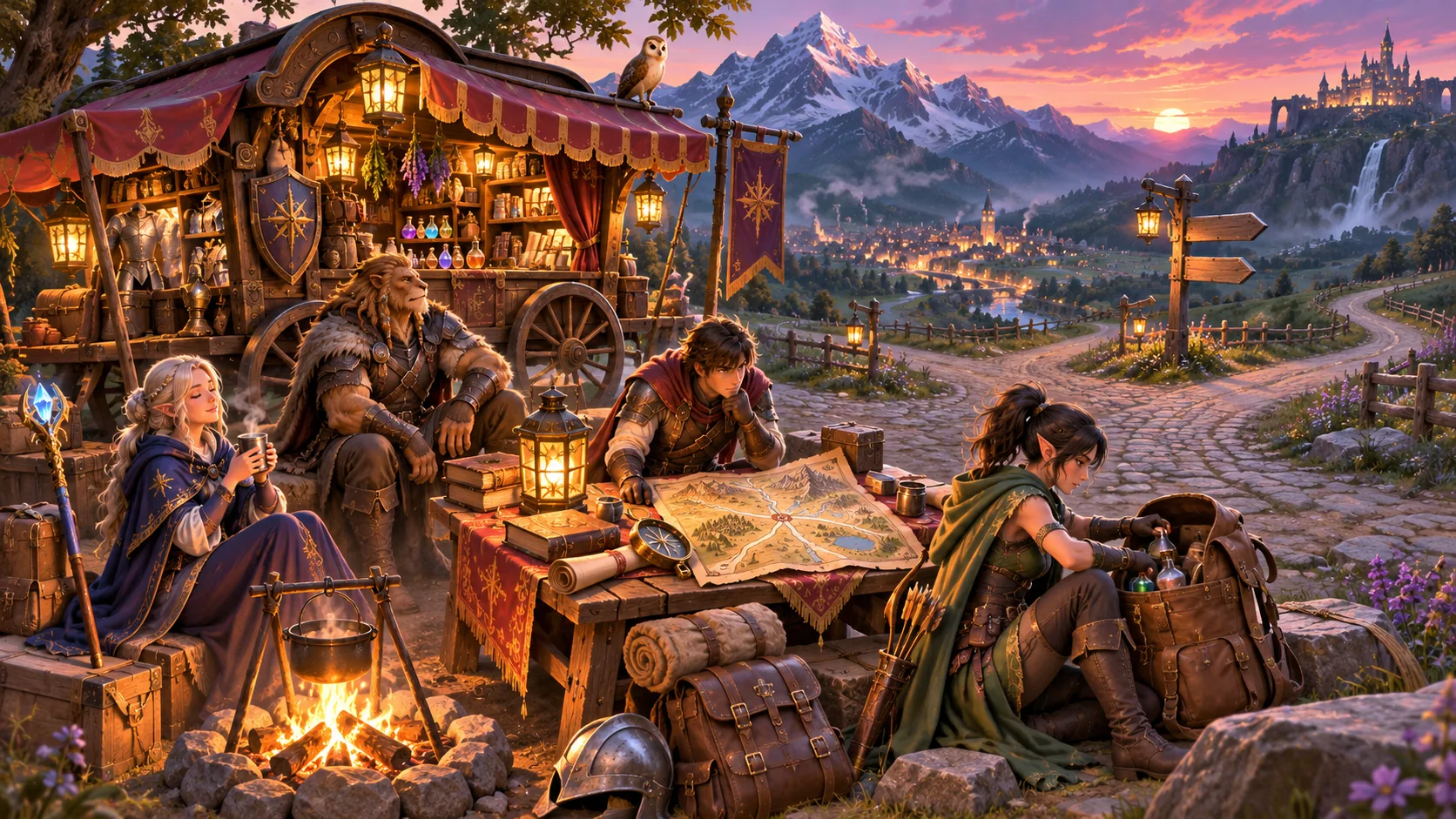
Revise an unclear gear rule
Prototype the wagon screen and one settlement transition first. Check that every gear transfer updates attributes and skill eligibility, and that a route cannot consume unavailable supplies. Then add the second town inventory and a single hazard that Quickstep can avoid. All examples here are an authored local design trace; they are not observed balance results, playable testing or user research.
Read the related job-system RPG design guide.
Try the SEELE AI game maker workflow.
Frequently asked questions
Is the traveling shop just a menu between quests?
No. The wagon is the party’s safe home, shop, gear transfer point, training space, resting place and route-selection screen. Its limited goods capacity and supply tokens determine which preparations and journeys the player can actually make. A route is chosen at the wagon and its supplies limit how often the party may travel.
How does this RPG avoid fixed classes?
All heroes use the same skill library and can equip any item. Current attribute thresholds create temporary skill eligibility; they do not assign a permanent class or restrict equipment by character. A player can change party roles through training and transferable gear. Show these requirements beside each hero so the player understands why a skill is available or locked.
Check Godot's official Resource reference.
Can a skill disappear when gear is moved?
Skill eligibility is based on current attributes. If an item transfer lowers a hero below a threshold, that hero cannot use the skill until the total meets it again. The example treats this as access, not permanent learning progress, and asks the interface to show the requirement.
Has the traveling-shop system been playtested?
No. The route, items, thresholds and state trace are authored design inputs. This package does not claim a playable build, browser test, user test or measured balance result. Treat the values as a small prototype specification that still needs implementation and playtesting.