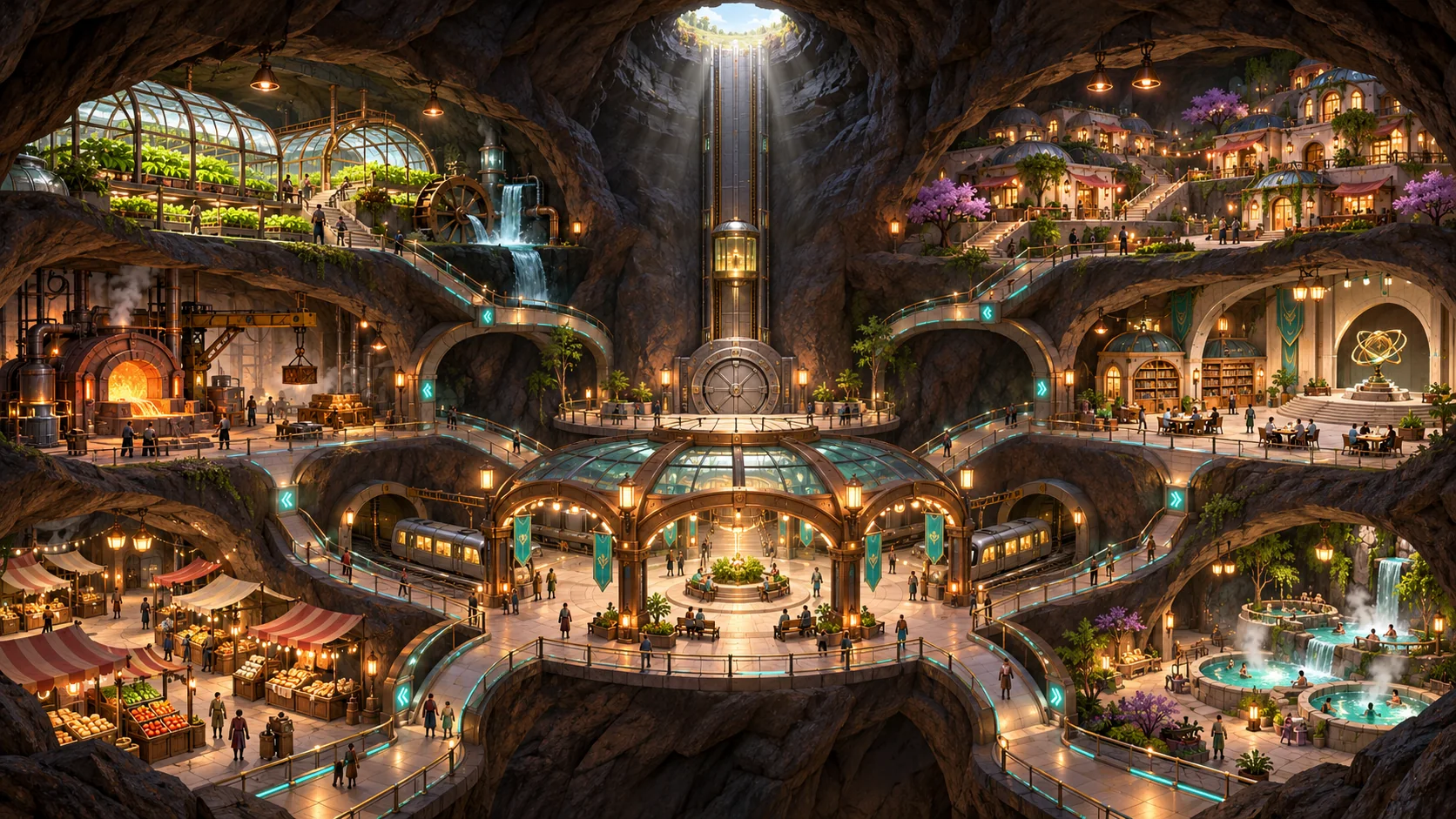
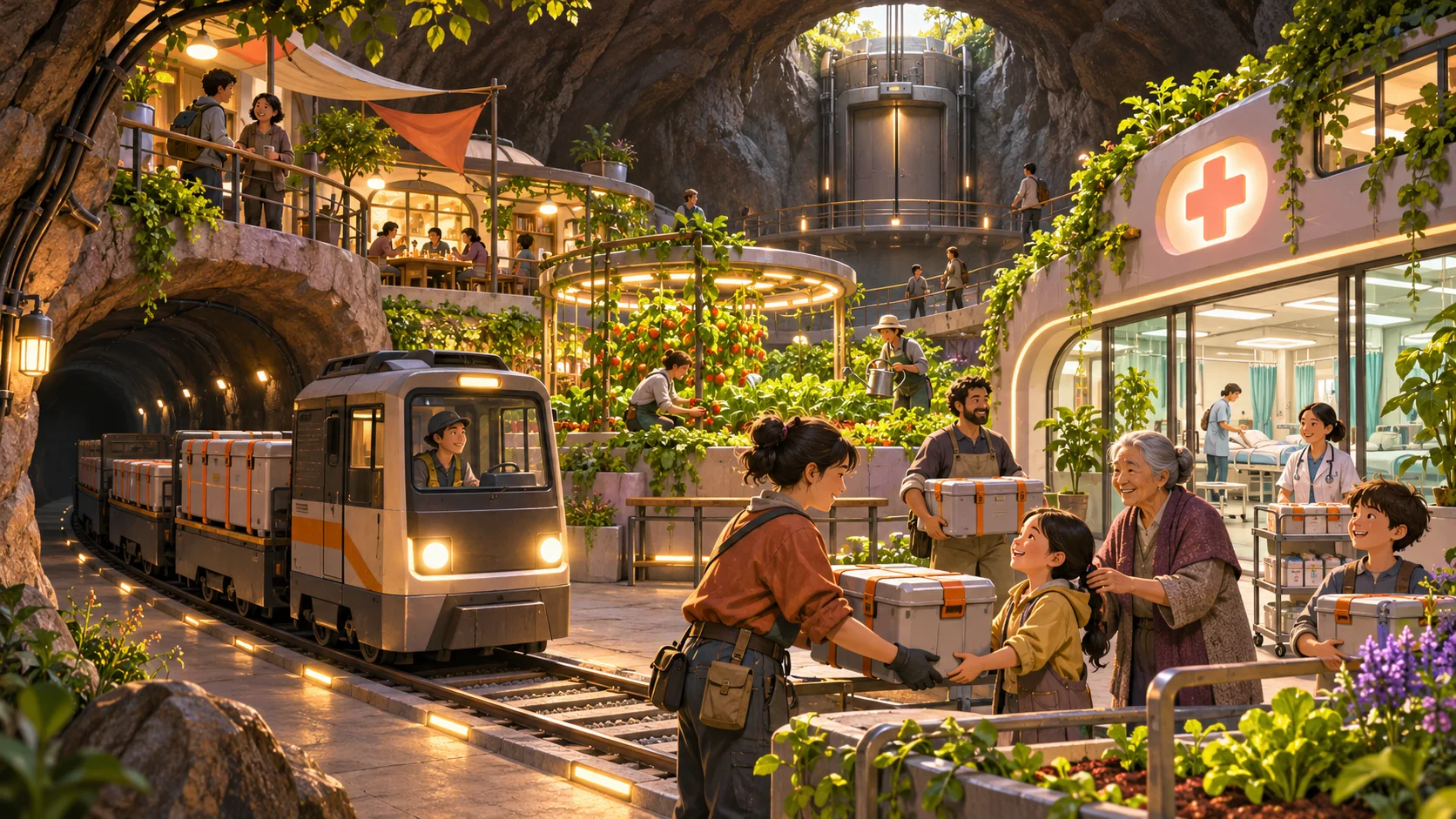
In Underline Commons, the city can reach the surface only at hour 0 and hour 4. Each opening admits one sealed supply crate, while a single electric train carries cargo and residents through the underground network. A Junction platform limits service to two passengers at once, so a third commuter waits and loses comfort until the next train arrives.
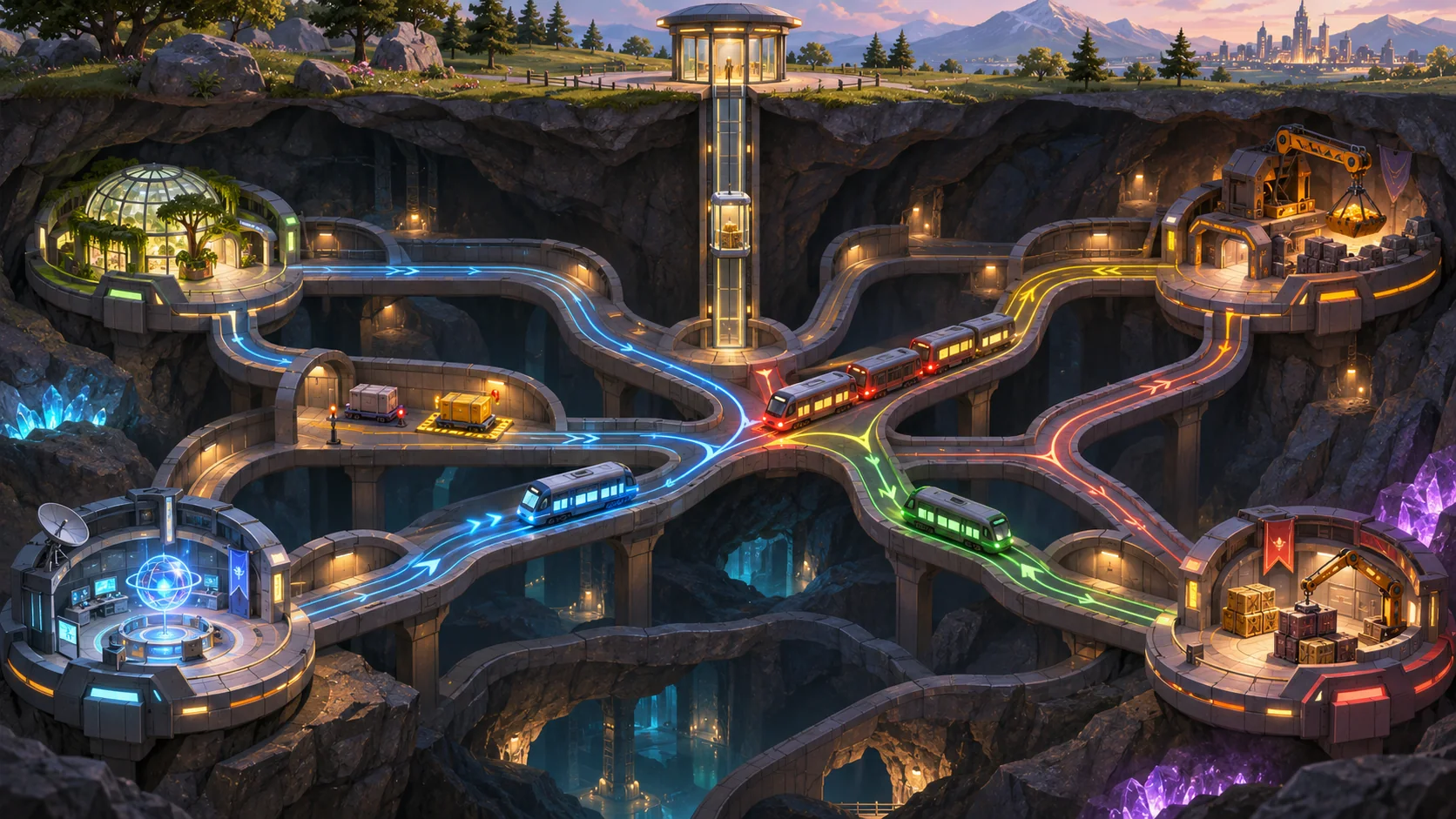
The starter map has four stations—Surface Lift, Junction, Clinic and Garden—and three track edges. The clinic needs medicine by hour 5; the Garden needs a seed crate by hour 9; three clinic workers must arrive by hour 5. One train can carry one crate and two passengers. A replayable eight-turn route meets both deadlines while making queue cost visible.
Make scarce access shape the transit network
Build Underline Commons as a turn-based transit planner with one-hour turns and a 12-hour service day. The Surface Lift opens at hour 0 and hour 4 only; each opening adds exactly one assigned crate to its intake buffer, and a missed crate cannot be imported later. The four stations are Surface Lift (L), Junction (J), Clinic (C) and Garden (G), connected by L–J, J–C and J–G. One electric train starts at L, moves one edge per turn, and carries at most one crate plus two passengers. Three clinic workers wait at J from hour 1 and must arrive by hour 5. The Clinic needs one medicine crate by hour 5; the Garden needs one seed crate by hour 9. At each departure, board up to two waiting passengers; every passenger-turn left waiting costs one comfort, and the settlement begins with 10 comfort. Import medicine at hour 0 and seeds at hour 4. Delivering medicine and seeds by their deadlines, delivering all three workers by hour 5, and finishing with comfort at least 8 clears the scenario. Show the surface calendar, station graph, train location, crate buffer, passenger queue, arrival estimates and comfort changes. Restart resets all state.
| System | Prototype rule |
|---|---|
| Service day | Twelve one-hour turns; all deliveries resolve at station arrival. |
| Surface access | Lift opens only at hours 0 and 4. Each opening admits one assigned crate into an intake buffer. |
| Network | Surface Lift–Junction–Clinic and Junction–Garden; Junction is the only branch. |
| Train | One train; one edge per turn; one crate slot and two passenger seats. |
| Passengers | Three clinic workers queue at Junction from hour 1; all must arrive by hour 5. |
| Queue cost | Each passenger-turn spent waiting reduces comfort by 1; start at 10. |
| Medicine | Import at hour 0; deliver to Clinic by hour 5. |
| Seeds | Import at hour 4; deliver to Garden by hour 9. |
| Clear | Both crates delivered, all workers arrive by their deadline, and comfort remains at least 8. |
| Display | Show surface windows, queue size, train position, cargo, route ETA, deadlines and comfort. |
| Restart | Restore the initial service day, empty route and original demand. |
Set surface windows, capacity and deadlines
At hour 0 the Surface Lift opens and the medicine crate enters its buffer; the train is at L. Turn 1 moves L→J, arriving at hour 1. Three clinic workers are now queued at J. On turn 2, the train boards two workers and moves J→C; the medicine is delivered at hour 2, before its hour-5 deadline. One worker stays in the Junction queue. Turn 3 sends the train C→J, arriving at hour 3. At hour 4, the second surface window stores the seed crate at L. The train is at J for turn 4: the third worker boards and rides J→C, arriving at the Clinic at hour 4; the queue has cost two passenger-turns, so comfort falls from 10 to 8. Turn 5 returns C→J; turn 6 moves J→L; turn 7 loads seeds and moves L→J; turn 8 moves J→G and delivers the seeds at hour 8, before the hour-9 deadline. All workers and both crates arrive, and comfort ends at 8. This is an authored state trace, not a playable or user test.
| Turn | Expected network state |
|---|---|
| 0 · Surface window 1 | Medicine crate enters Lift buffer; train starts at L. |
| 1 · L→J | Train reaches Junction; three clinic workers are waiting. |
| 2 · J→C | Two workers board; medicine arrives at Clinic by hour 2. One worker remains queued. |
| 3 · C→J | Train returns toward the queue. |
| 4 · J→C | Third worker boards; seed crate enters Lift buffer; comfort drops 10→8. |
| 5 · C→J | Clinic run complete; train returns to Junction. |
| 6 · J→L | Train reaches Lift for the second crate. |
| 7 · L→J | Seeds travel on the shared line. |
| 8 · J→G | Seeds arrive by hour 8; all clear conditions pass. |
Trace the eight-turn delivery plan
Ask the generator to model the surface lift as a timed, one-crate intake rather than a second train route. Keep station travel, passenger boarding, cargo delivery and queue comfort in the same turn log so a deadline cannot be met by teleporting a resource.
Create a deterministic transport-network prototype called Underline Commons. Use a 12-hour service day with stations Surface Lift (L), Junction (J), Clinic (C) and Garden (G), connected L–J, J–C and J–G. The single electric train starts at L, moves one edge per turn and can carry one crate and two passengers. The lift opens only at hour 0 and hour 4 and stores one assigned crate at each opening. Three clinic workers wait at J from hour 1 and must reach C by hour 5. Medicine imported at hour 0 must reach C by hour 5. Seeds imported at hour 4 must reach G by hour 9. Each passenger-turn left in the queue costs 1 comfort; start with 10, and require at least 8 to clear. Replay this order: L→J, board two workers and carry medicine J→C, return C→J, board the last worker and carry J→C at hour 4, return to L, then take seeds L→J→G. Show the queue, train location, cargo, station arrivals, lift windows, deadlines and comfort. Do not invent extra access windows or stations. Include restart.Prompt AI to build the transport prototype
The first timetable treated the lift as if supplies could enter whenever the train reached the surface. That erased the central constraint. The revised plan has two fixed intake windows and a buffer at the Lift, so the route must return before seeds can leave. A two-seat passenger limit also makes the Junction queue a measurable cost: one worker waits two turns, reducing comfort from 10 to 8. This is a design revision in the authored specification, not a measured playtest.
Revise the timetable around passenger queues
Implement the station graph and one-edge-per-turn movement first. Then add the lift calendar, cargo buffer and two-seat boarding rule. Replay all eight turns and check that the medicine arrives at hour 2, the final worker at hour 4, and seeds at hour 8. A graph pathfinder can suggest routes, but the prototype must still apply the lift windows, train capacity and passenger queue rules. Use SEELE’s logistics loop guide for shipment state and Godot AStar2D for graph-based route queries. Use SEELE AI Game Maker to turn the brief into a starting build.
Read SEELE’s logistics and shipment loop guide.
Review Godot’s official AStar2D route reference.
Frequently asked questions
How does limited surface access affect the route?
New cargo can enter only when the Surface Lift opens at hour 0 or hour 4, and each window admits one crate. The train must travel back to the Lift to pick up the second supply, so the calendar changes the route order as well as the delivery deadline.
How do passenger queues create congestion?
The shared train has only two passenger seats. Three clinic workers are waiting at Junction, so one waits while the train makes the medicine run. Each waiting passenger-turn costs one comfort, making the delay visible in the same route log as cargo arrival.
Can the train carry supplies and commuters together?
Yes. The prototype gives the train one crate slot and two passenger seats, so it can deliver medicine while carrying two workers. It cannot exceed either limit. If a delivery or passenger deadline cannot fit, the game should show the missed deadline rather than quietly adding capacity.
Has Underline Commons been playtested?
No. The stations, lift windows, cargo types, worker demand, capacity, comfort costs and eight-turn route are authored prototype specifications. This package does not claim an implemented simulation, browser test, user test or measured balance. Its local previews are static HTML and the outcome is an authored state trace.