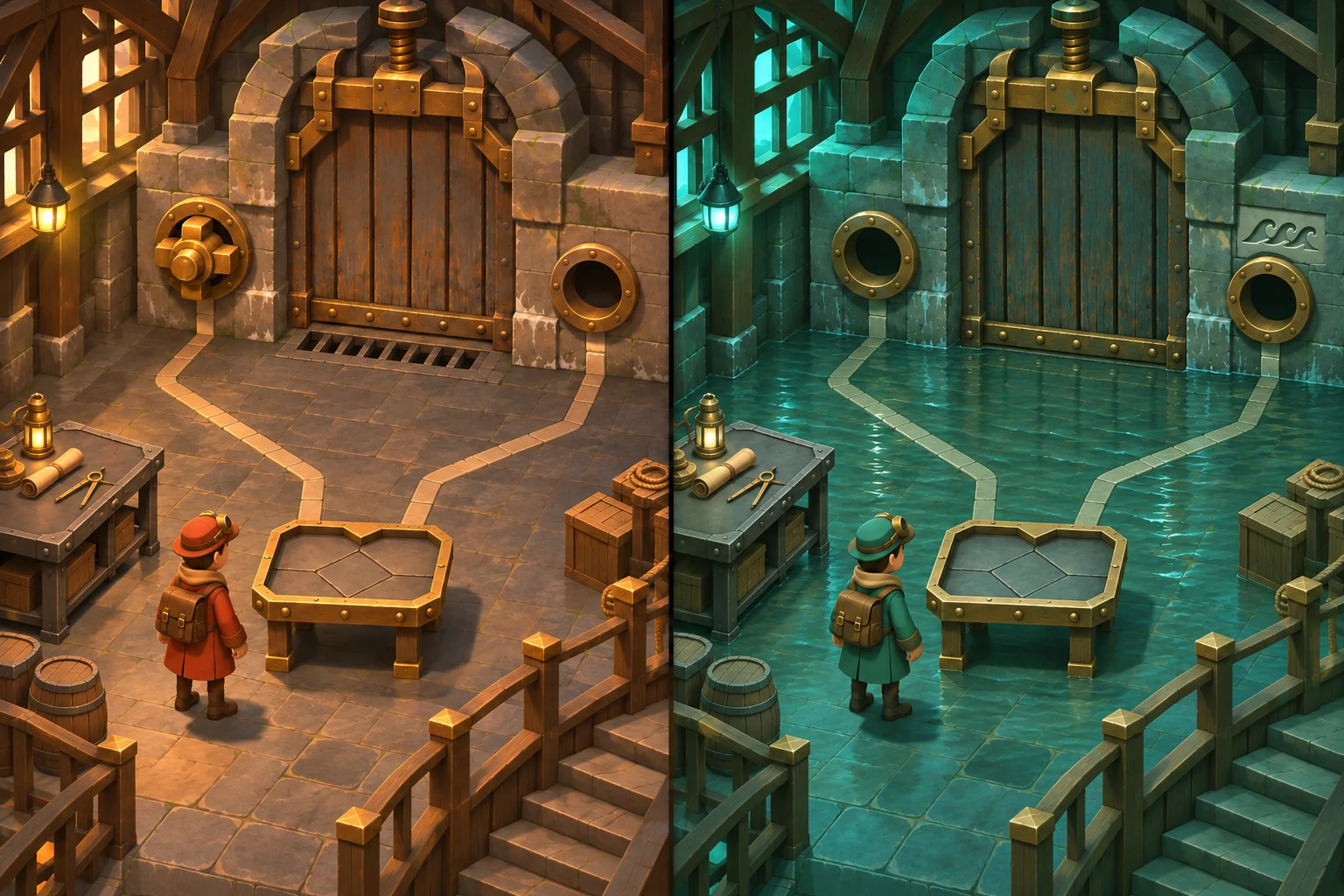
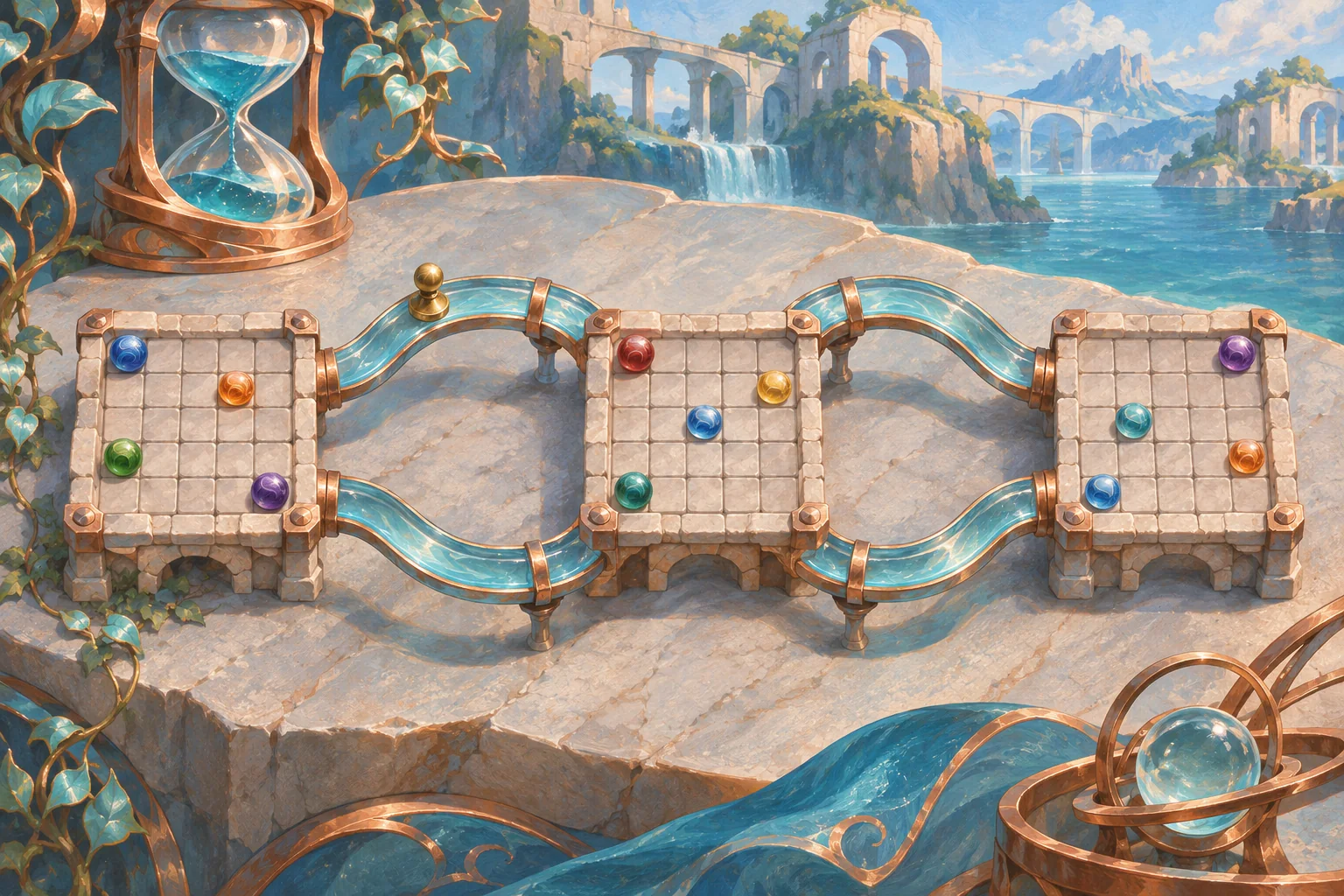
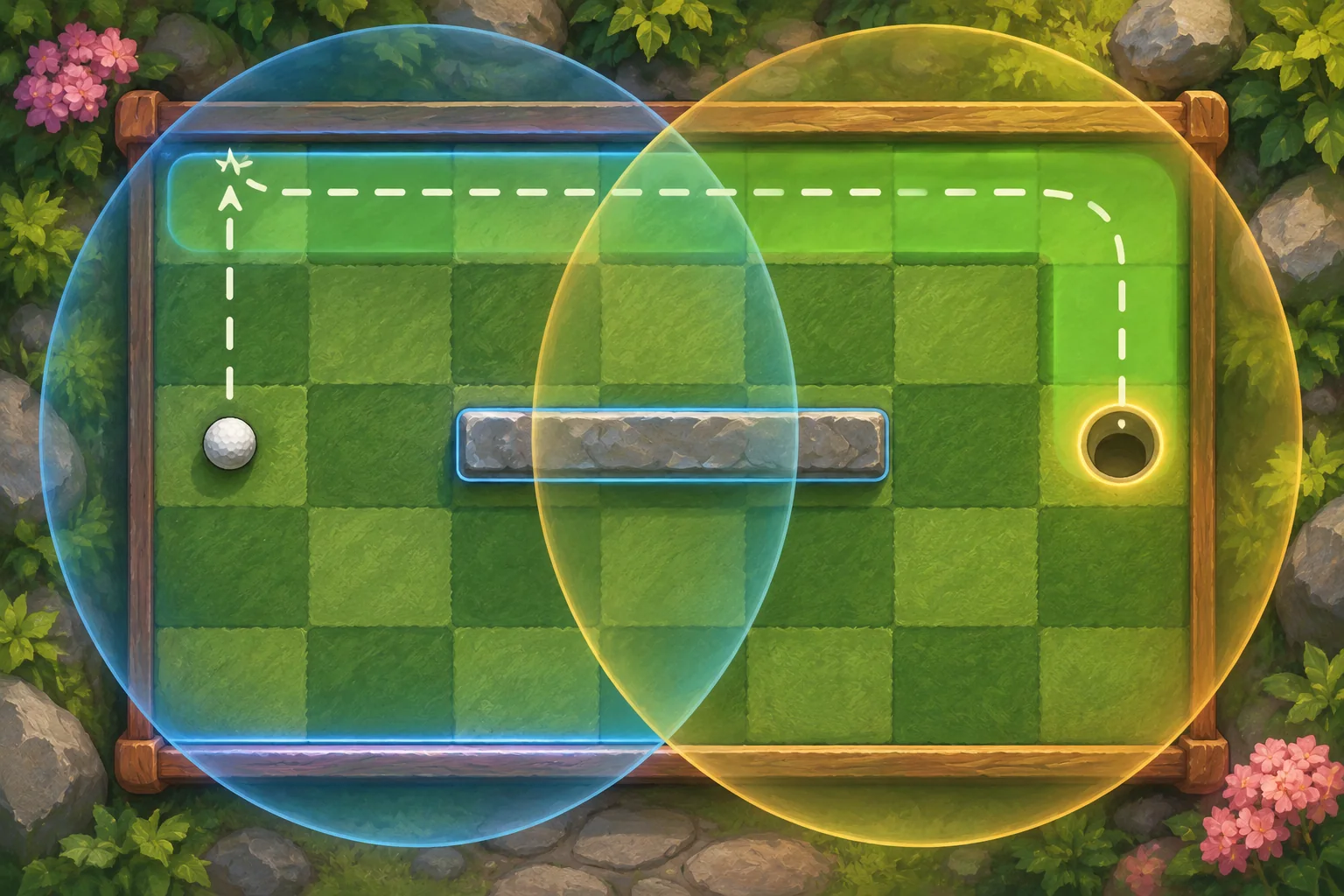
Two players can share one mini-golf room without seeing the same clues. In Twin Lens Fairway, one view reveals the rails and blockers while the other reveals the cup and a safe-lane overlay. Both players see the same ball coordinates, and every solid object belongs to one shared course. The difference is what each player can inspect before a shot, not which physics rules apply.
This fictional prototype uses one 7-by-5 room, a single ball, and a three-stroke goal. The Rail View spots the blocker at (4,3) but cannot see the cup at (7,3). The Cup View sees the goal and a suggested lane, but not the blocker. Players communicate and alternate shot control after the ball stops. Their challenge is to combine partial information into one route without turning a hidden obstacle into a second collision world.
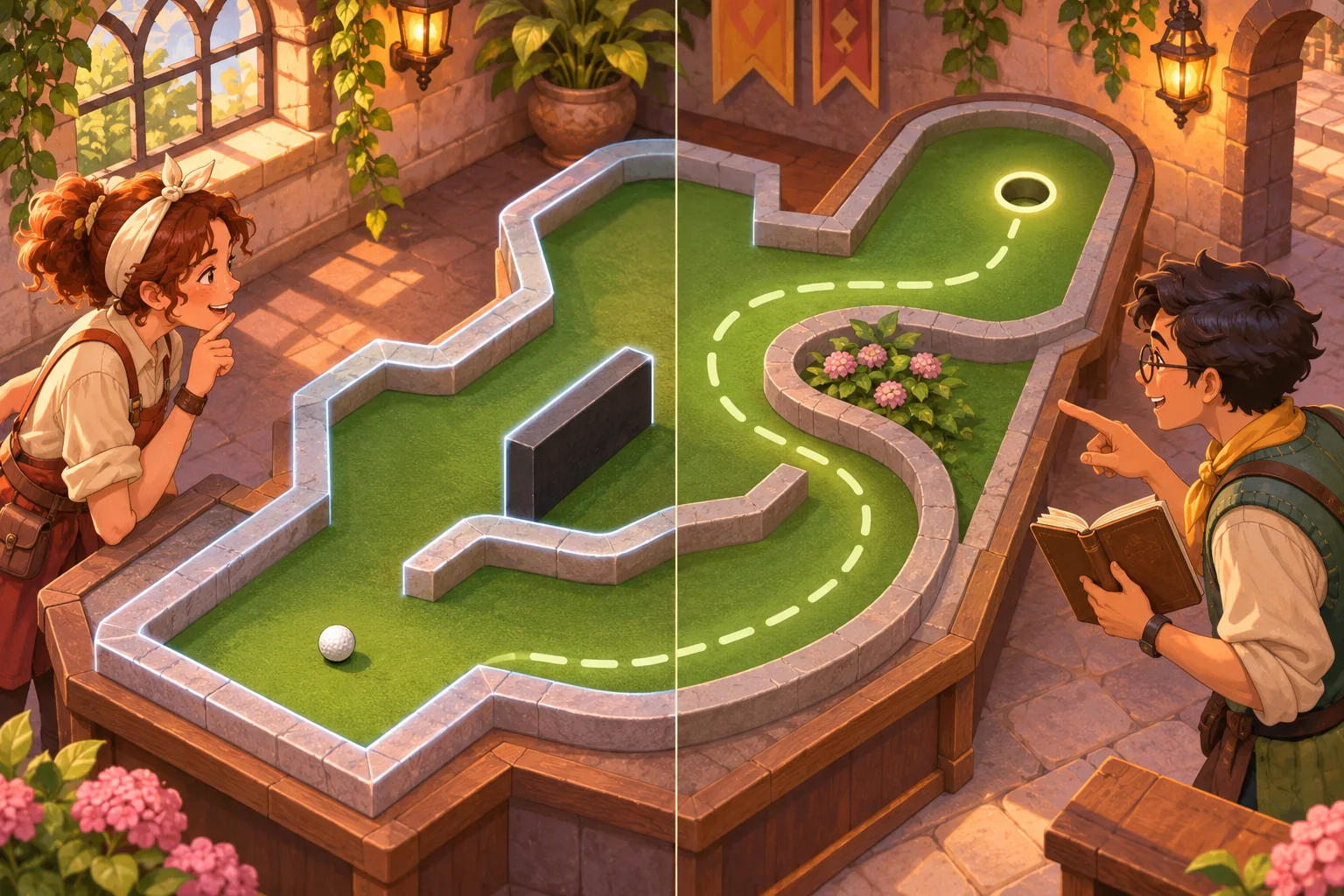
Give each player a different view of one room
Use a 7-by-5 tile room. The ball starts at (1,3), the cup is at (7,3), the solid blocker occupies (4,3), and the north and south rails sit at y=1 and y=5. The Rail View shows the rails and blockers but hides the cup. The Cup View shows the cup and a safe-lane overlay but hides blockers. Both views show the shared ball and coordinates; hidden objects remain physically solid. On a turn, choose one of eight headings and power from 1 to 4. Each step moves one tile, including diagonals. If a step would leave the board, reflect the heading component at that edge, move one tile in the reflected direction, and spend one power. If the next tile is blocked, stop on the last safe tile and clear remaining power. Sink only when the stroke ends on the cup with zero power. Alternate players after each stopped shot. Sink within three strokes.
| Rule | Shared result |
|---|---|
| Rail View | Shows edge rails and blockers; the cup stays hidden. |
| Cup View | Shows the cup and safe-lane overlay; blockers stay hidden. |
| Shared room | Both views use one ball position, coordinate grid, and collision map. |
| Shot | Choose one of 8 headings and power 1–4; every tile step costs one power. |
| Bank | At an edge, reflect the offending heading component, move one tile, and spend one power. |
| Blocker and cup | A blocker stops the ball before entry. The cup captures only at the end of a stroke with zero power. |
| Turn and finish | Players alternate after the ball stops. Sink in 3 strokes or fewer; reset restores the tee and first player. |
Set the shared shot and collision rules
Start at (1,3), aiming for the cup at (7,3). Stroke 1: the Rail View player chooses northeast with power 3. The ball visits (2,2), then (3,1). The next northeast step would leave the north edge, so the vertical direction reflects and the ball lands at (4,2), spending its last power. Stroke 2: the Cup View player chooses southeast with power 2 and reaches (5,3), then (6,4). Stroke 3: the Rail View player aims northeast with power 1 and ends at (7,3), sinking in three strokes. The direct east shot is not safe: with power 4 from the tee, it reaches (2,3), (3,3), then stops before the blocker at (4,3). A separate northeast power-2 check from (6,4) enters the cup with power left, so it does not sink; it banks off the east edge and ends at (6,2). This is a hand-calculated rules trace, not a playable test.
| Check | Expected result |
|---|---|
| Stroke 1: northeast, power 3 from (1,3) | (2,2) → (3,1) → bank to (4,2); still not sunk. |
| Stroke 2: southeast, power 2 from (4,2) | (5,3) → (6,4); second player has the turn. |
| Stroke 3: northeast, power 1 from (6,4) | Ends at (7,3) with zero power; sink at the 3-stroke limit. |
| Direct east, power 4 from the tee | Stops at (3,3) before the blocker; remaining power clears. |
| Northeast, power 2 from (6,4) | Enters the cup with power left, does not sink, then banks to (6,2). |
| Try to shoot while the ball is moving | Ignore the input; do not spend another stroke or change the path. |
| Reset after a sink | Return one ball to (1,3), restore both views, clear strokes, and give the first turn to Rail View. |
Trace a cooperative route to the cup
Ask SEELE for one small co-op room with two information views and a shared, inspectable state. Keep the view overlays separate from collision logic: a hidden blocker must still stop the ball. Require a debug coordinate readout so the written route can be compared with each resolved step.
Create a local two-player cooperative mini-golf prototype called Twin Lens Fairway. Build one 7-by-5 tile room. Set x=1..7 from west to east and y=1..5 from north to south. Place one shared ball at (1,3), the cup at (7,3), a solid blocker at (4,3), and bankable boundary rails along y=1 and y=5. Player A's Rail View reveals rails and blockers but hides the cup. Player B's Cup View reveals the cup and a suggested safe lane but hides blockers. Both views must show the same ball position, coordinates, and one underlying collision map; changing views must never change collision results. Alternate shot control after each stopped shot. On a turn, choose one of eight compass headings and integer power 1..4. Each step moves one tile; a diagonal also costs one power. If the next tile would leave the board, reflect the offending heading component at that boundary, move one tile in the reflected direction, and spend one power. If a blocker occupies the next tile, stop on the last safe tile and clear remaining power. The cup captures only if a stroke ends on (7,3) with zero power left. Ignore shot inputs while the ball is moving. The co-op goal is to sink within three strokes. Add a deterministic reset to the tee with zero strokes, both views restored, and Rail View first. Show ball coordinates, active player, heading, power, collisions, and stroke count. Make view switching, aiming, launch, and reset operable with keyboard controls without timed key presses.Ask AI to keep information and physics separate
The first rule draft captured the ball as soon as it entered the cup tile. Hand-checking a northeast power-2 shot from (6,4) shows that the ball can enter (7,3) with power remaining and continue past it. Change capture to require the stroke to end on the cup with zero power, then show the reflected path and stopped coordinate. This is a proposed rules revision based on an offline trace, not a test of a generated game.
Replay the three-stroke co-op route and the direct blocked shot. Confirm that both players see the same ball coordinate, that hidden blockers still collide, that the role changes only after a stopped shot, and that the cup rejects a pass with power remaining. The W3C keyboard guidance can inform control design; this article does not claim conformance.
Revise one rule after a hand-calculated overshoot
Keep the first room to one ball, one blocker, two partial views, and one cup. The co-op loop works when players can explain what their view reveals, combine that information, and predict the shared collision result before the shot. Once the written trace is stable, add a second hole or one new obstacle family and update the route checks before expanding the course.
Read the mini-golf bank-shot guide.
Start a local prototype with SEELE.
Frequently asked questions
How can two players see different versions of one room?
Give each view a different information overlay while keeping one shared coordinate grid and collision map. One player may see blockers and rails; the other sees the cup and a suggested lane. The hidden information changes what a player knows, not what the ball collides with.
Should each view have its own physics?
Not for this first prototype. Separate collision worlds would make the same ball position produce conflicting outcomes. Keep one physical room and let each player's view reveal only part of its layout. Add phase-specific geometry later only if switching worlds is an explicit mechanic.
Read W3C's keyboard accessibility guidance.
How do I make a bank shot easy to check?
Write the board bounds, heading, power, and reflection order. In this model, a boundary reflection changes the offending direction component, moves one tile, and spends one power. Show the coordinate after every step so both players can compare the route.
What should reset restore?
Return the ball to (1,3), clear the stroke count and motion state, restore both information views, and set Rail View as the first player. Test the same route after reset to confirm the hidden blocker and cup have not moved.