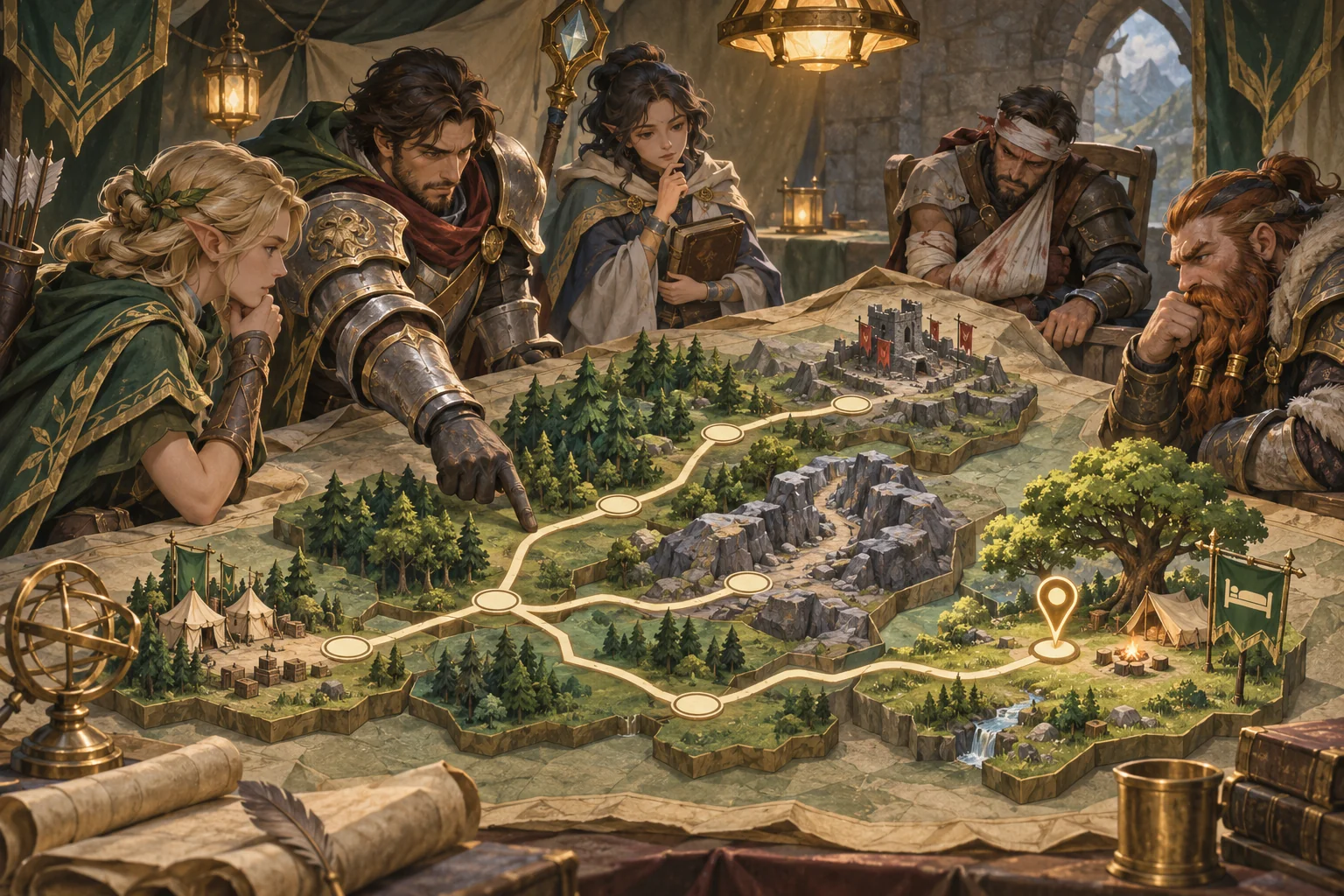
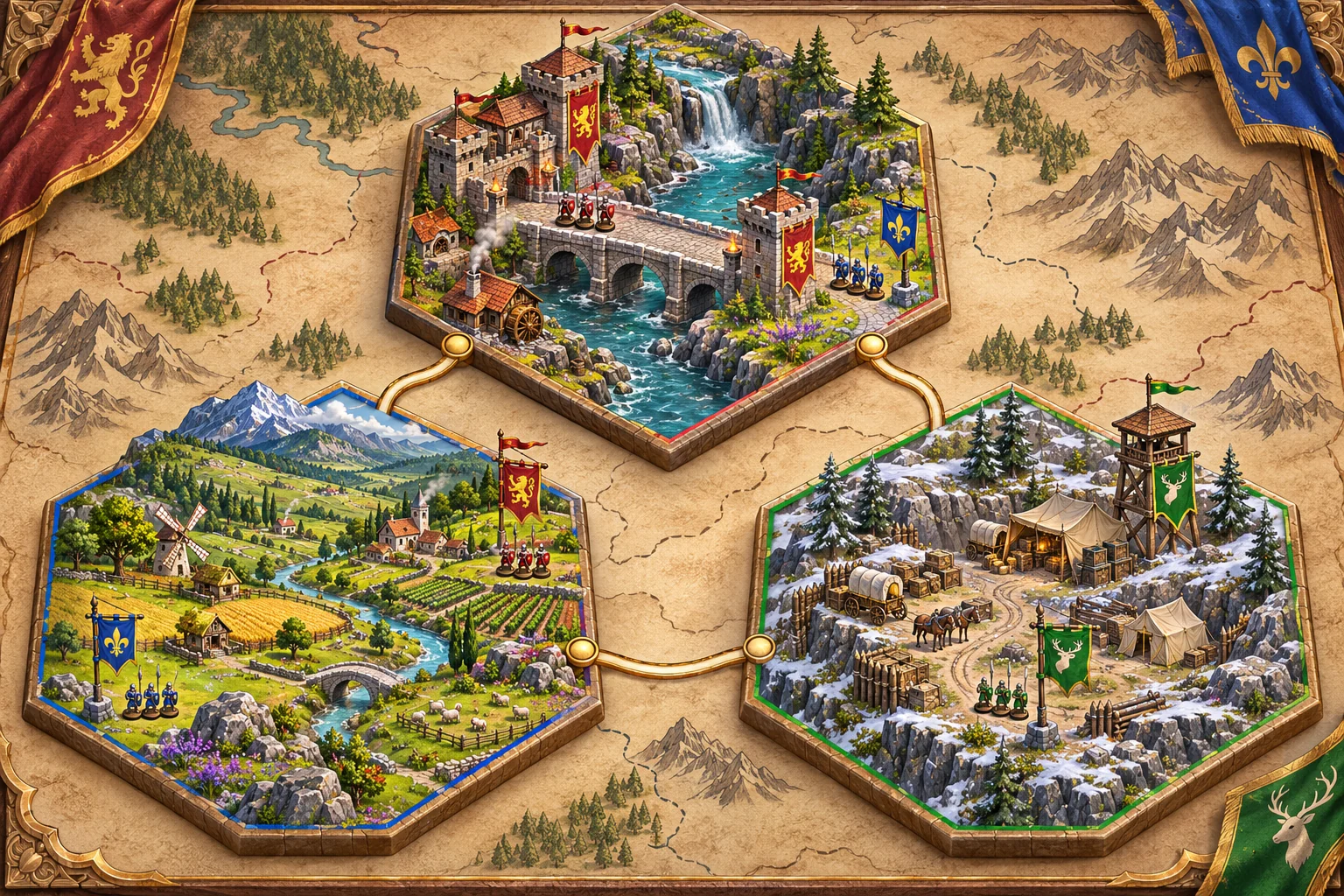
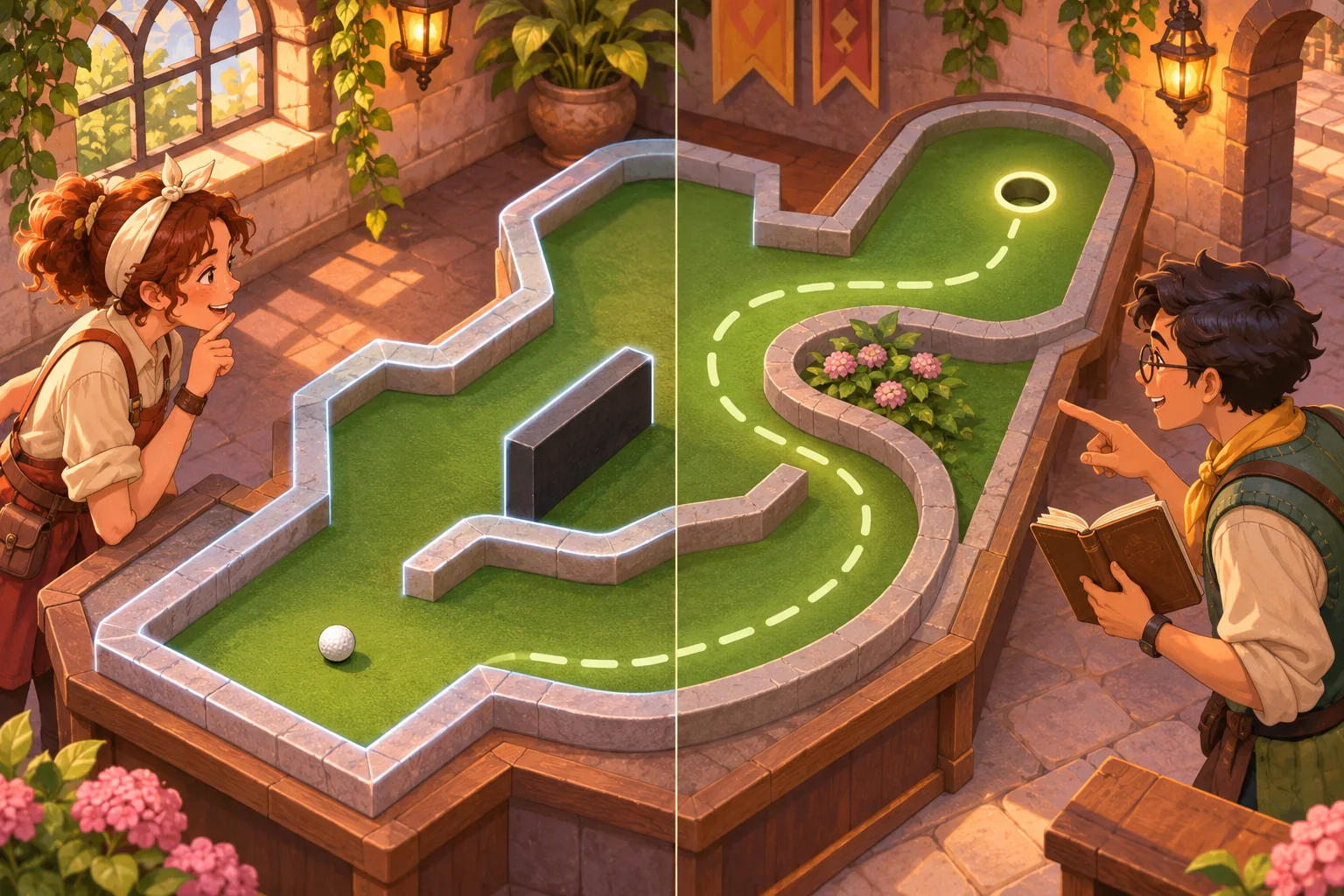
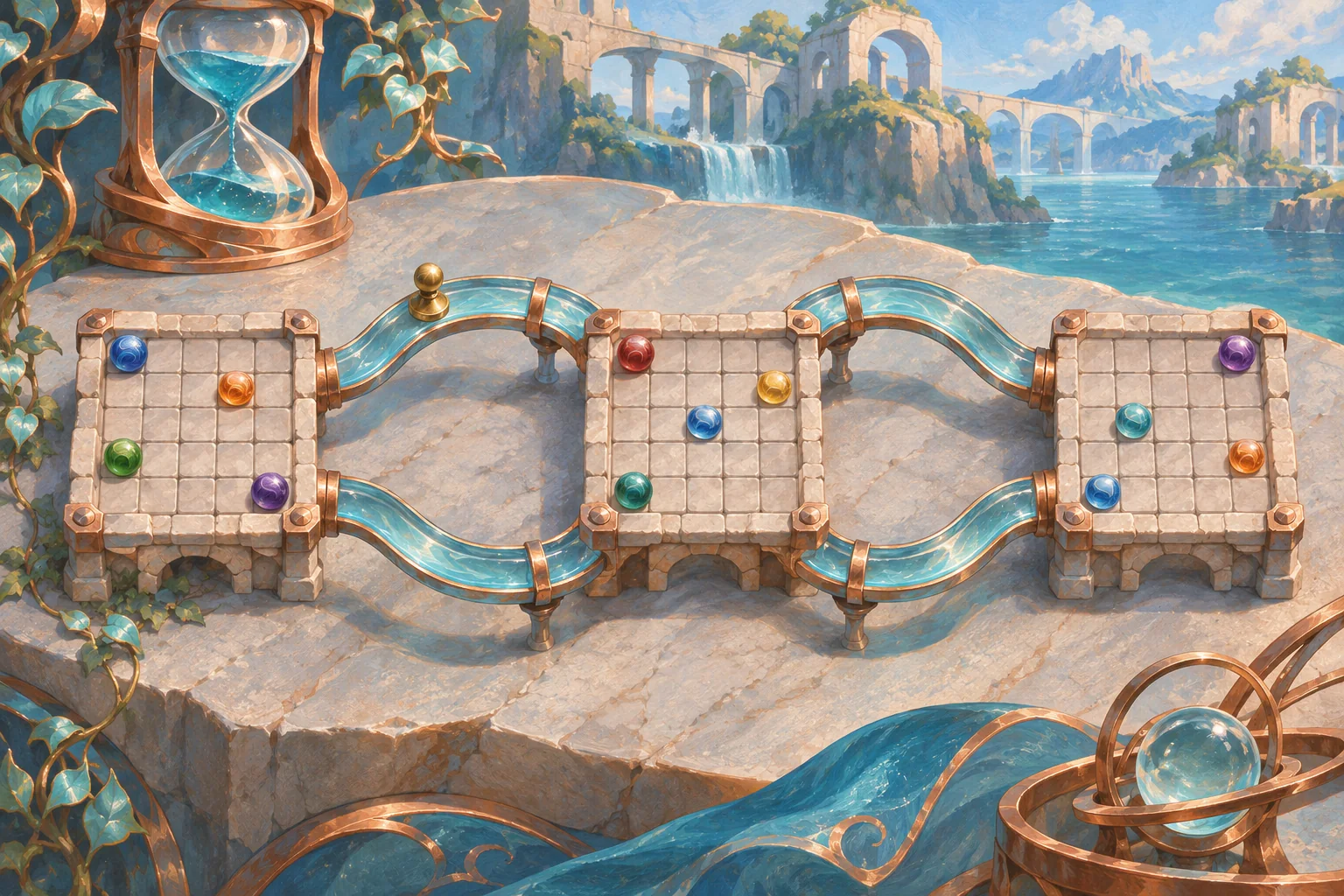
A marble battle can end in seconds. A campaign needs each small arena to change what comes next. In Tideglass Circuit, the route is visible as three linked 5×5 arenas. A winner chooses an upper or lower connector; that choice sets the entry lane in the next fight, and one branch awards a Brass marker for the finale.
Tideglass Circuit is a fictional design exercise. Each arena pits a Sprinter against an Anchor. Both roll toward the opposite gate, but their speeds differ. Resolve their movement together, check for a shared cell or crossed edge, apply collision damage once, then freeze both for the rest of that beat. This order keeps the map readable and the campaign state testable.
Connect each small arena to a campaign route
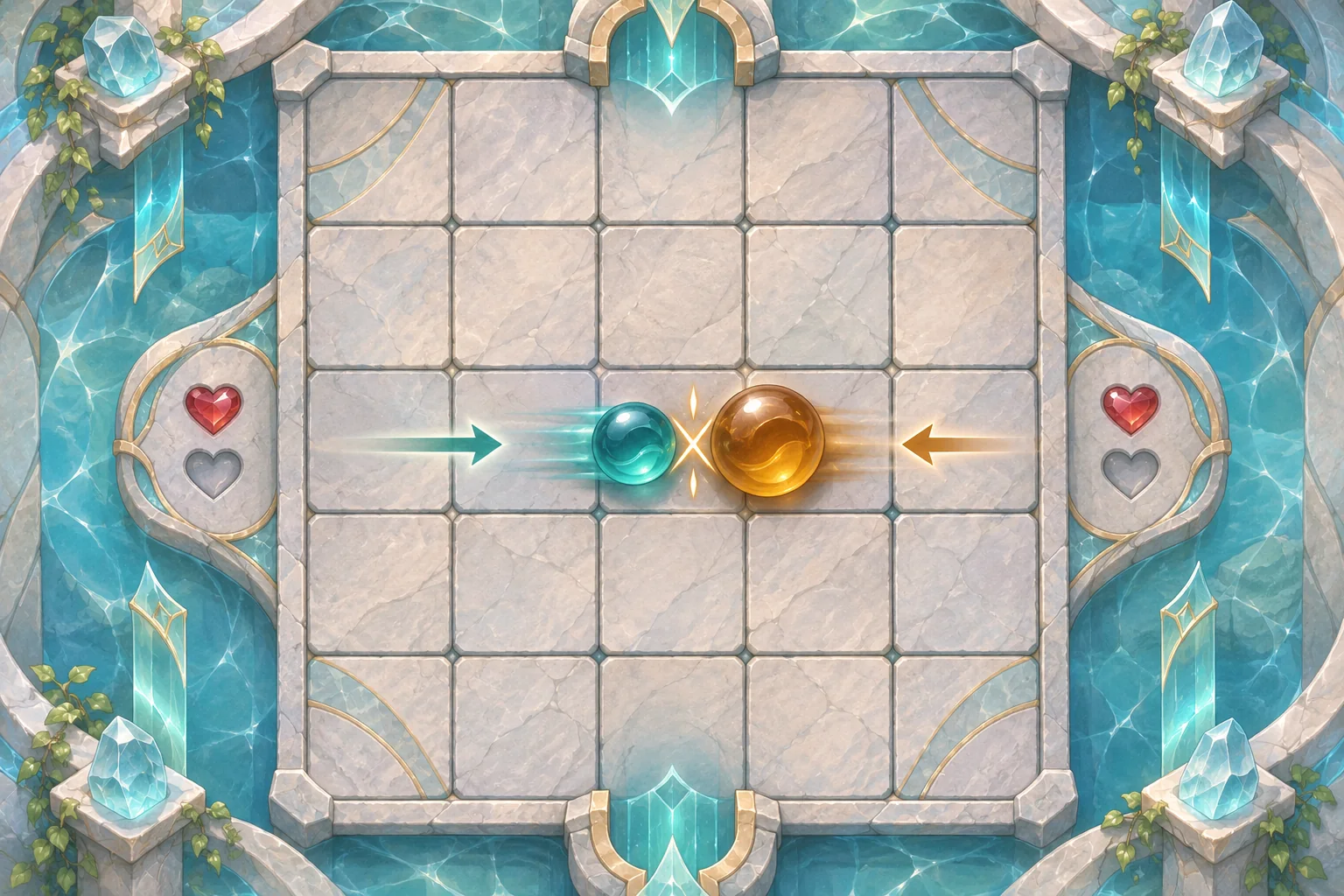
Each 5×5 arena has upper, middle, and lower west entry gates, each with an east exit on the same row. The Sprinter starts with 2 health and moves two cells per beat; the Anchor has 2 health and moves one. They move simultaneously toward opposite gates. After movement, check whether they occupy the same or edge-adjacent cell, or crossed the same edge. Either collision costs each marble 1 health and stuns both for the rest of that beat. A marble at zero health is knocked out. The first to reach a gate wins. If neither wins by beat 6, record a draw. After arena 1, choose an upper or lower connector to arena 2; upper awards a Brass marker. After arena 2, choose the connector that sets arena 3's entry lane. Brass adds one cell to the Sprinter's movement on arena 3's first beat.
| Beat or route rule | Expected result |
|---|---|
| Movement | Both marbles move at once toward the opposite gate: Sprinter 2 cells, Anchor 1. |
| Collision | Same cell or crossed edge costs each marble 1 health; both stop until the next beat. |
| Knockout | A marble with 0 health is removed. The remaining marble may continue to a gate. |
| Route connector | Upper or lower connector determines the next arena's entry lane; arena 1 upper also awards Brass. |
| Brass | On arena 3's first beat, Sprinter moves 1 extra cell. |
| Beat cap | A fight with no gate arrival or knockout by beat 6 is a draw. |
Settle a collision one beat at a time
Start on the middle lane: Sprinter at x0 and Anchor at x4, each with 2 health. On beat 1, Sprinter reaches x2 while Anchor reaches x3. They end on edge-adjacent cells, so each falls to 1 health and both stop for the rest of the beat. On beat 2, Sprinter moves to x4 and reaches the east gate; Anchor moves back to x2. Sprinter wins. Choose the upper connector after arena 1 to enter arena 2's upper gate and collect Brass. Choose the lower connector after arena 2 to start arena 3 in the lower lane. The Brass marker grants the Sprinter one additional cell on arena 3's first beat. A repeated collision event for beat 1 must not remove health again.
| Check | Expected result |
|---|---|
| Resolve beat 1 movement | Sprinter x2, Anchor x3; crossed edge; health becomes 1 each; both stunned. |
| Receive the beat-1 collision twice | Only the first event reduces health. |
| Resolve beat 2 | Sprinter reaches x4 gate; Anchor reaches x2; Sprinter wins. |
| Choose the upper connector from arena 1 | Arena 2 starts at its upper west gate and the player receives Brass. |
| Choose the lower connector from arena 2 | Arena 3 starts at its lower west gate. |
| Apply Brass in arena 3 | Sprinter moves one cell farther on beat 1 only. |
| Reach beat 6 without a gate or knockout | Report a draw and keep the recorded campaign route. |
| Reset | Restore the route choices, health, lane, marker, and beat order to the authored start. |
Ask AI for a deterministic battle loop
Ask SEELE to draft one arena and a three-node route as a local prototype. Put movement, collision, stun, and connector transfers in the same prompt. Before adding more marbles, compare its beat log and route state against the paper trace.
Create a local marble auto-battler called Tideglass Circuit. Show three connected 5x5 arenas and a visible upper/lower campaign connector between them. Each arena has upper, middle, and lower west entry gates, each with an east exit on the same row. In a fight, a Sprinter starts with 2 health and moves 2 cells per beat; an Anchor starts with 2 health and moves 1. Both move simultaneously toward the opposite gate. After movement, detect same-cell or edge-adjacent or crossed-edge collisions. Each collision removes 1 health from both marbles and stuns them for the rest of that beat. A marble at zero health is knocked out; the first marble to reach a gate wins. Cap a fight at 6 beats and call it a draw if neither reaches a gate. After arena 1, let the winner choose upper or lower connector to arena 2; upper awards a Brass marker. After arena 2, the chosen connector sets arena 3's entry lane. Brass lets Sprinter move one extra cell on arena 3's first beat. Log beat, positions, health, collision event ID, lane, route choice, and reward. A duplicate event ID must not apply damage twice. Add reset. Keep the rules deterministic and show state changes clearly. Make route and reset actions keyboard-operable without timed key presses.Show gates, lanes, and a carried reward
The first draft counted two marbles that crossed the same edge as a miss because their destination cells differed. Treat reversed traversal of the same edge during one beat as a collision. Store a unique beat event ID before applying damage so a repeated callback cannot reduce health twice. Keep both marbles stunned for that beat; resume movement on the next one.
Replay the trace through all three arena transitions. Confirm that upper and lower connectors select the intended next entry lanes, Brass is awarded only on the upper branch from arena 1, and its extra cell applies only on arena 3 beat 1. Keep a visible campaign log. Keyboard-operable route selection follows W3C's keyboard guidance as a design reference, not a conformance claim.
Expand the map graph after the trace works
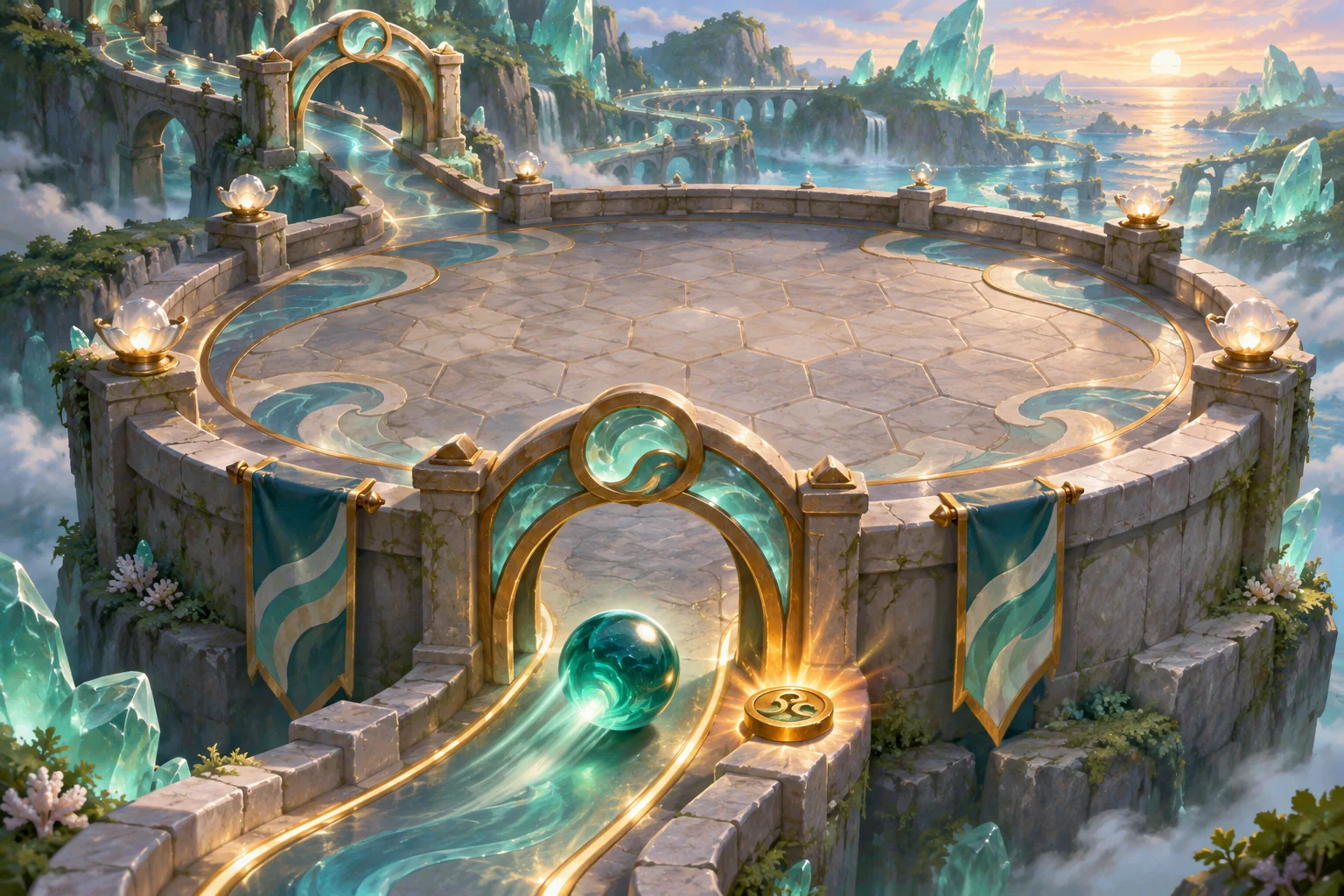
Keep the three-map route fixed while validating collisions and connector state. A useful first check is whether a player can predict the next entry lane and explain why Brass changes the finale. Once the beat log matches the paper trace, add one arena shape or another marble ability and update the trace. The related automatic-battle guide can help you compare item and unit triggers without obscuring the map campaign.
Read the inventory auto-battler guide.
Start a local marble prototype with SEELE.
Frequently asked questions
How many maps should the first campaign use?
Start with three small arenas and a clear connector between each one. That is enough to show how an exit choice changes the following entry lane and how one reward can carry forward. Add more nodes only after players can read the route and the campaign log without confusion.
Should marble movement be simultaneous or turn-based?
Choose one model and keep it consistent. This example resolves both movement paths together, then checks destination cells and crossed edges. A visible beat log makes the order inspectable. If you prefer alternating turns, define initiative and tie cases separately rather than mixing the two timing rules.
Read W3C's keyboard accessibility guidance.
How do I prevent duplicate collision damage?
Give each collision a stable identifier based on arena, beat, and edge or cell. Before applying damage, check that identifier against the resolved event list. Replaying the same event should leave health unchanged. Test both a shared destination and two marbles crossing the same edge in opposite directions.
What should a route connector preserve?
At minimum, store the next arena, entry lane, chosen branch, and any reward carried forward. Show this state before the next fight begins. Reset should clear the route and marker as well as marble health, so the same campaign trace can run again from its authored start.