In fictional Emberwild, two players gather materials for one shared shelter while exploring connected regions that advance at different local rates. The forest runs at 2.0x and the cavern at 0.5x relative to real elapsed time. Each resource task needs 60 local seconds. Keep both players, task thresholds, region factors, and a 120-second observation window fixed. Compare what is ready at 60 and 120 real seconds, and report both local clocks, gathered resources, and whether the shared shelter can be crafted. The slower region can delay the team's objective even after the forest task is complete.
Give each connected region its own clock
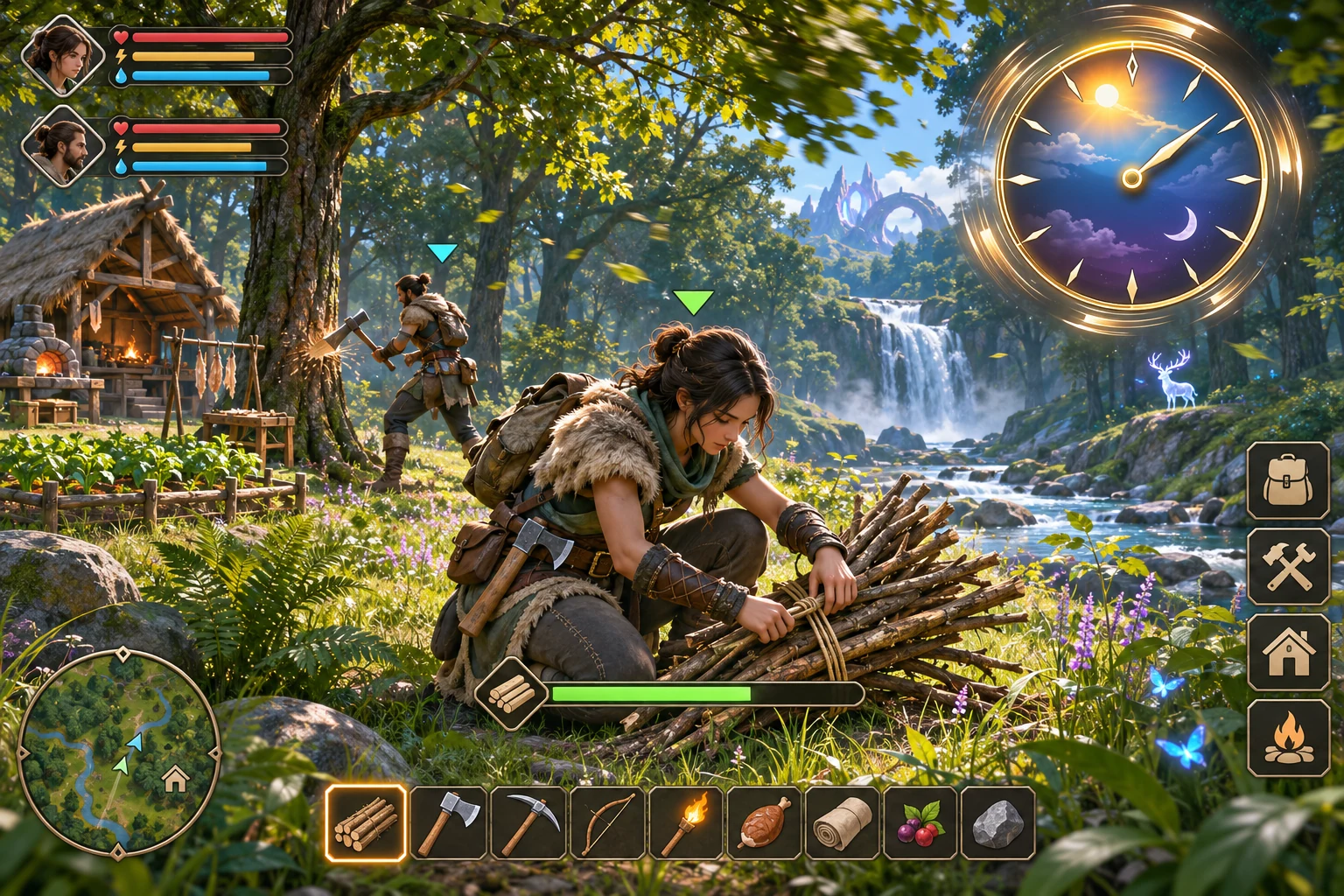
Set the Emberwild forest to a 2.0 time factor and the crystal cavern to 0.5. For every real second that passes, advance the forest's local clock by two seconds and the cavern's by half a second. Show a distinct local-time indicator in each region so players can understand why plants, hazards, or gathering tasks progress at different rates.
Keep region time separate from the real elapsed timer used by the test. A region-local accumulator can apply its own rate without changing the whole game. Godot's Timer documentation explains that timers follow Engine.time_scale unless configured to ignore it; that global setting does not itself provide independent clocks for separate regions.

Let players gather in parallel at different rates
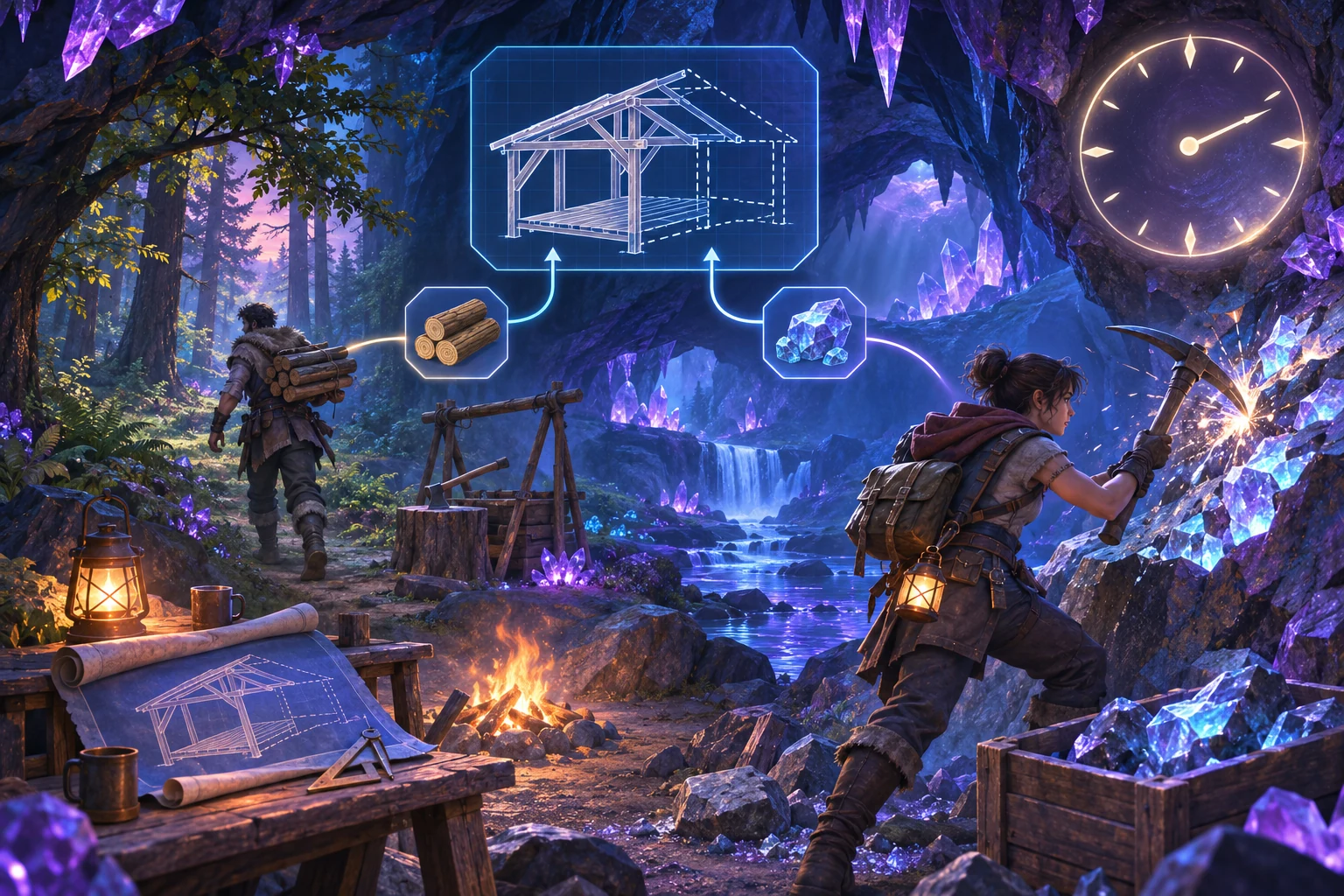
Assign one player to collect wood in the forest and the other to mine ore in the cavern. Each task completes after 60 local seconds in its region. With the selected factors, the forest task finishes after 30 real seconds, while the cavern task needs 120 real seconds. Keep task thresholds and resource quantities identical so the difference comes only from local time.
Give each player a progress indicator in local time and show the shared resource inventory to both. The faster player can finish early, help plan the shelter, or wait; do not silently speed up the cavern to match them. This exposes the coordination tradeoff created by different regional clocks.
Check when both resources unlock the shelter
At 60 real seconds, the forest has advanced 120 local seconds and wood is ready. The cavern has advanced 30 local seconds, so ore is still in progress and the shared shelter cannot be crafted. At 120 real seconds, forest time is 240 local seconds and cavern time is 60; both required resources are ready and the shelter becomes available.
Report real elapsed time, each region's local time, wood state, ore state, and shelter availability at both checkpoints. This fixed fixture shows that a slower region can gate a shared objective. Emberwild and these timings are fictional; the test checks only the stated clock and task arithmetic, not whether this pacing is fun for every co-op group.
Give the AI a fixed two-clock co-op test
Create a two-player survival crafting game in fictional Emberwild. Use a forest region with a 2.0 local-time factor and a crystal cavern with a 0.5 factor, both measured against real elapsed time. One player gathers wood in the forest and the other mines ore in the cavern. Each task requires 60 local seconds. Both resources are needed for one shared shelter. Keep players, factors, task thresholds, and a 120-real-second test window fixed. Report each region's local time, resource state, and shelter availability at 60 and 120 real seconds.
At 60 real seconds, verify forest 120 local seconds with wood ready and cavern 30 local seconds with ore pending; the shelter stays locked. At 120 real seconds, verify forest 240 and cavern 60 local seconds, both resources ready, and shelter unlocked. Do not change task thresholds or region factors.
FAQ
How can different regions run at different time scales?
Give each region its own local-time accumulator and advance it by elapsed real time multiplied by that region's factor. Keep a separate real-time clock for shared deadlines and tests, then show players which clock controls each task. This separation also keeps shared deadlines consistent.
How do different clocks affect cooperative survival crafting?
Players can make progress at different rates while working toward shared materials. A fast region may finish early, but a slow region can hold up the team objective. Show local progress and shared inventory so the delay is understandable and players can coordinate. Show who is waiting and why.
What should a test of regional time scales measure?
Fix the region factors, player tasks, local-time thresholds, and real-time checkpoints. Record each region's local time, task completion, shared resource state, and objective availability at every checkpoint. This reveals whether the slower region gates the team goal as designed. across both regions.