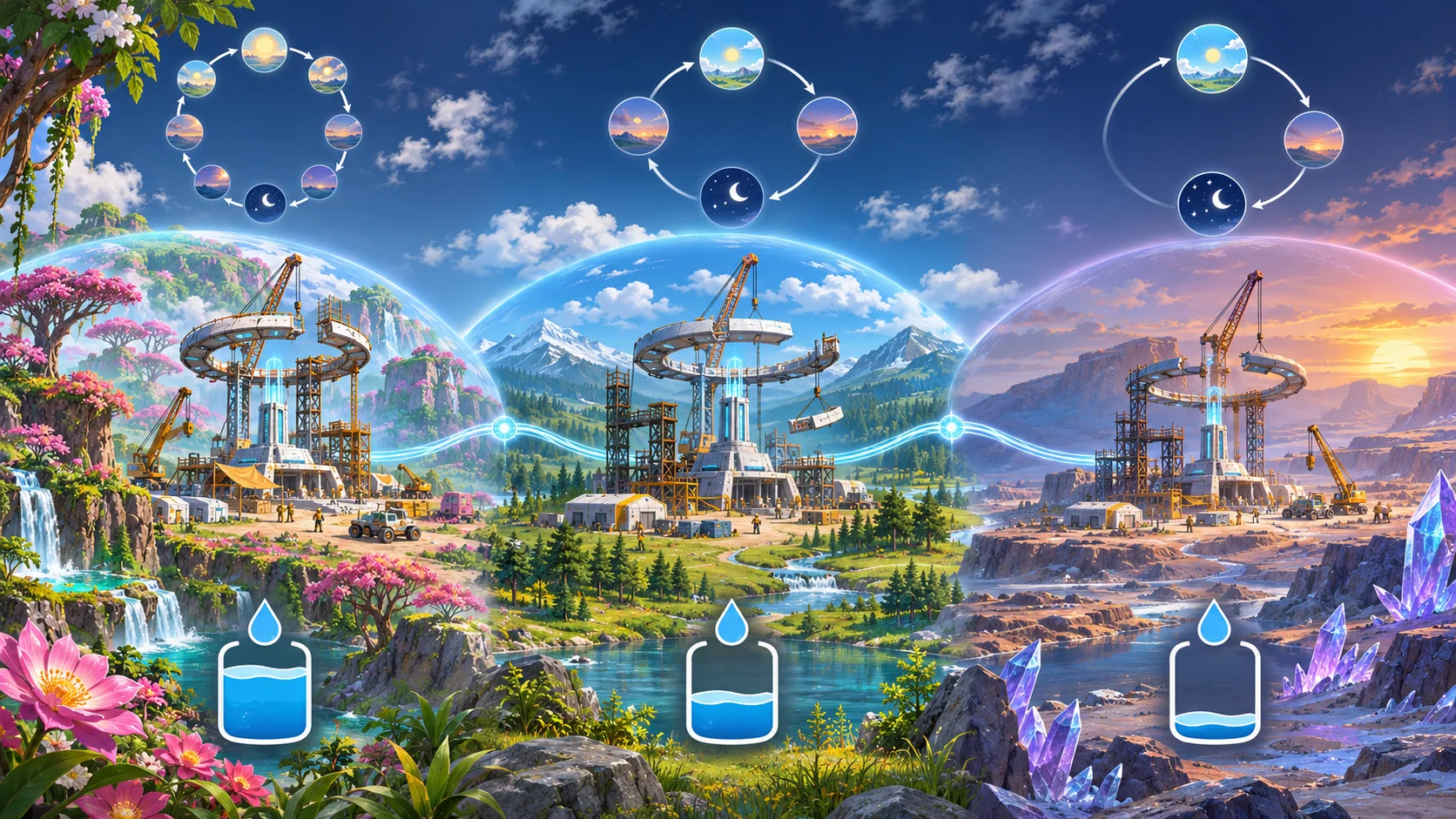
In Chrono Bloom, one world hour advances three regions at different rates. Solglass Basin runs at 2× speed, Fenveil Wetlands at 1×, and Pale Shelf at 0.5×. Construction progress, water use and storm forecasts follow each region’s local clock, so the player has to plan across several timelines at once.
The opening campaign has nine units of power and one Atmospheric Relay to build in each region. A Relay takes two local hours, costs three power and raises stability by 20. The first storm arrives at local hour four. Building in fast, normal, then slow time protects all three regions before their first storms.

Make each regional clock change the plan
Create Chrono Bloom as a turn-based terraforming campaign. One global turn equals one world hour, and the player may issue one command at the start of each turn. Solglass Basin runs at 2 local hours per world hour, Fenveil Wetlands at 1, and Pale Shelf at 0.5. All regional clocks advance together after the command. Each region starts at stability 60 and water 4. Build one Atmospheric Relay in each region: it costs 3 power, takes 2 local hours, consumes 1 water per local hour while under construction, then raises stability by 20 and prevents storm damage. The campaign starts with 9 power. Each region’s first storm arrives when its local clock reaches hour 4; an unprotected storm removes 20 stability. If a storm threshold and project completion happen on the same update, resolve the storm before completing the project. Win when all regions are at stability 80 or more after their first storm. Reset restores clocks, stability, water, power and projects. Show world time beside each local clock, project progress in local hours, water use, power cost, storm forecast and the result of each tick.
| System | Prototype rule |
|---|---|
| Global turn | One turn is one world hour; issue one command at its start, then advance every regional clock. |
| Solglass Basin | 2 local hours per world hour; stability 60; water 4. |
| Fenveil Wetlands | 1 local hour per world hour; stability 60; water 4. |
| Pale Shelf | 0.5 local hours per world hour; stability 60; water 4. |
| Atmospheric Relay | One per region; costs 3 power; takes 2 local hours; uses 1 water per local hour while building. |
| Completion | A completed Relay raises regional stability by 20 and protects that region from storm damage. |
| Storm deadline | Each region’s first storm arrives at local hour 4 and removes 20 stability if no Relay is active. |
| Event ordering | Advance local clocks and project work; at a storm threshold, resolve the storm before a project completing on that same update. |
| Power budget | Start with 9 power; a build command spends 3 and is rejected if power is insufficient. |
| Command limit | Build at most one Relay per global turn; all regions continue advancing while the player chooses. |
| Win | After each region’s first storm, all three must have stability of at least 80. |
| Reset | Restore world and local clocks to 0, stability 60, water 4 per region, power 9 and no active projects. |
| Interface | Display world hour, each local clock and scale, Relay progress, water, stability, storm forecast and command result. |
Define local time, construction and storm rules
Start at world hour 0 with all local clocks at 0, stability 60 and water 4 in each region. Build the Solglass Relay first: spend 3 power (9→6). During the first world hour, Solglass advances 2 local hours, consumes 2 water and completes the Relay; stability becomes 80, water 2. At world hour 1, build the Fenveil Relay: power 6→3. By world hour 2, Fenveil’s local clock reads 2 and its Relay has progressed for 1 local hour since construction began, with 1 hour remaining; Solglass reaches local hour 4 and its first storm is blocked by the active Relay. At world hour 2, build the Pale Shelf Relay: power 3→0. Fenveil completes by world hour 3 after 2 local hours, using 2 water; Pale Shelf advances at 0.5 local hour per world hour. Fenveil reaches its first storm at world hour 4 with the Relay active. Pale Shelf’s Relay completes at world hour 6 after 2 local hours and uses 2 water. Its first storm arrives at world hour 8, when the Relay is active. All three regions finish at stability 80 with 2 water remaining each. This is an authored state trace, not a playable or user test.
| World time and command | Expected regional state |
|---|---|
| 0 · Build Solglass Relay | Power 9→6; project begins in the 2× region. |
| 1 · Build Fenveil Relay | Solglass Relay completed at local hour 2; stability 80, water 2; power 6→3. |
| 2 · Solglass storm | Solglass reaches local hour 4; Relay blocks the first storm. Fenveil project has 1 local hour left. |
| 2 · Build Pale Shelf Relay | Power 3→0; slow-region project starts. |
| 3 · Fenveil completes | Fenveil Relay completes after 2 local hours; stability 80, water 2. |
| 4 · Fenveil storm | Fenveil reaches local hour 4; active Relay blocks the first storm. |
| 6 · Pale Shelf completes | Two local construction hours have elapsed; stability 80, water 2. |
| 8 · Pale Shelf storm | Pale Shelf reaches local hour 4; active Relay blocks the first storm. |
| Clear | All regions finish at stability 80; no power remains. |
Trace the first three relay projects
Tell the generator to store one world clock and a separate accumulated local clock for each region. Construction, water use and storm deadlines must all read the regional clock. Add a tick log that shows clock updates, project progress, resource costs and storm resolution order.
Create a turn-based terraforming campaign called Chrono Bloom. One global turn is one world hour. At the start of each turn accept one command, then advance all regional clocks together. Solglass Basin runs at 2 local hours per world hour, Fenveil Wetlands at 1, and Pale Shelf at 0.5. Each region starts with stability 60 and water 4. A regional Atmospheric Relay costs 3 power, takes 2 local hours and consumes 1 water per local hour while building. On completion it adds 20 stability and protects the region from storm damage. Start with 9 power and build at most one Relay per world turn. Each region’s first storm is forecast for local hour 4 and removes 20 stability if unprotected. If a storm threshold and construction completion occur on the same update, resolve the storm first. Win when all three regions have stability at least 80 after their first storm. Reset the full campaign. Display world time, local clocks and scales, project progress, water, stability, storm forecast and power. Include a replay log for this sequence: Solglass at world 0, Fenveil at 1, Pale Shelf at 2; all three Relays complete before their first storm.Prompt AI to build the terraforming campaign
The first schedule draft used one shared project timer, so a Relay appeared to build at the same speed everywhere even though the region clocks differed. The revised model gives each region its own accumulated local time and makes construction, water use and storm deadlines read that clock. The storm-before-completion tie rule also makes deadline outcomes reproducible. This is a design revision in the authored specification, not a measured playtest.

Revise the event order at storm deadlines
Build the global turn loop and local clock accumulators first. Replay the three Relay orders and compare project progress, water and storm timing at each tick. If using Godot, Engine.time_scale changes the speed of the game clock and delta-driven systems globally; independent regional timelines need separate local accumulators. Use the SEELE 4X guide for campaign resource pacing and the AI Game Maker for the prototype brief.
Review SEELE’s small-scale 4X strategy guide.
Read Godot’s official Engine time-scale reference.
Frequently asked questions
Why not change the whole game speed for each region?
A single global speed setting would advance every region together at one rate. Chrono Bloom needs several rates at the same time, so each region keeps its own accumulated local clock while the world clock remains the shared turn counter. That makes forecasts and project deadlines comparable.
Does construction also run at the regional time scale?
Yes. A Relay takes two local hours, and the region’s scale determines how many world turns that requires. The same local hours drive its water use, so the fast region finishes sooner but consumes water across its accelerated project time.
What happens if a storm and a Relay finish on the same tick?
The storm resolves first. If the Relay is not already active when the regional clock reaches the threshold, stability drops by 20 before construction can complete. The fixed event order makes a deadline tie visible and consistent instead of depending on frame timing.
Has Chrono Bloom been tested as a playable simulation?
No. The region scales, construction costs, stability values, storm schedule and turn trace are authored prototype specifications. This package does not claim an implemented simulation, browser test, user test or measured balance. Its local previews are static HTML and the outcome is an authored state trace.