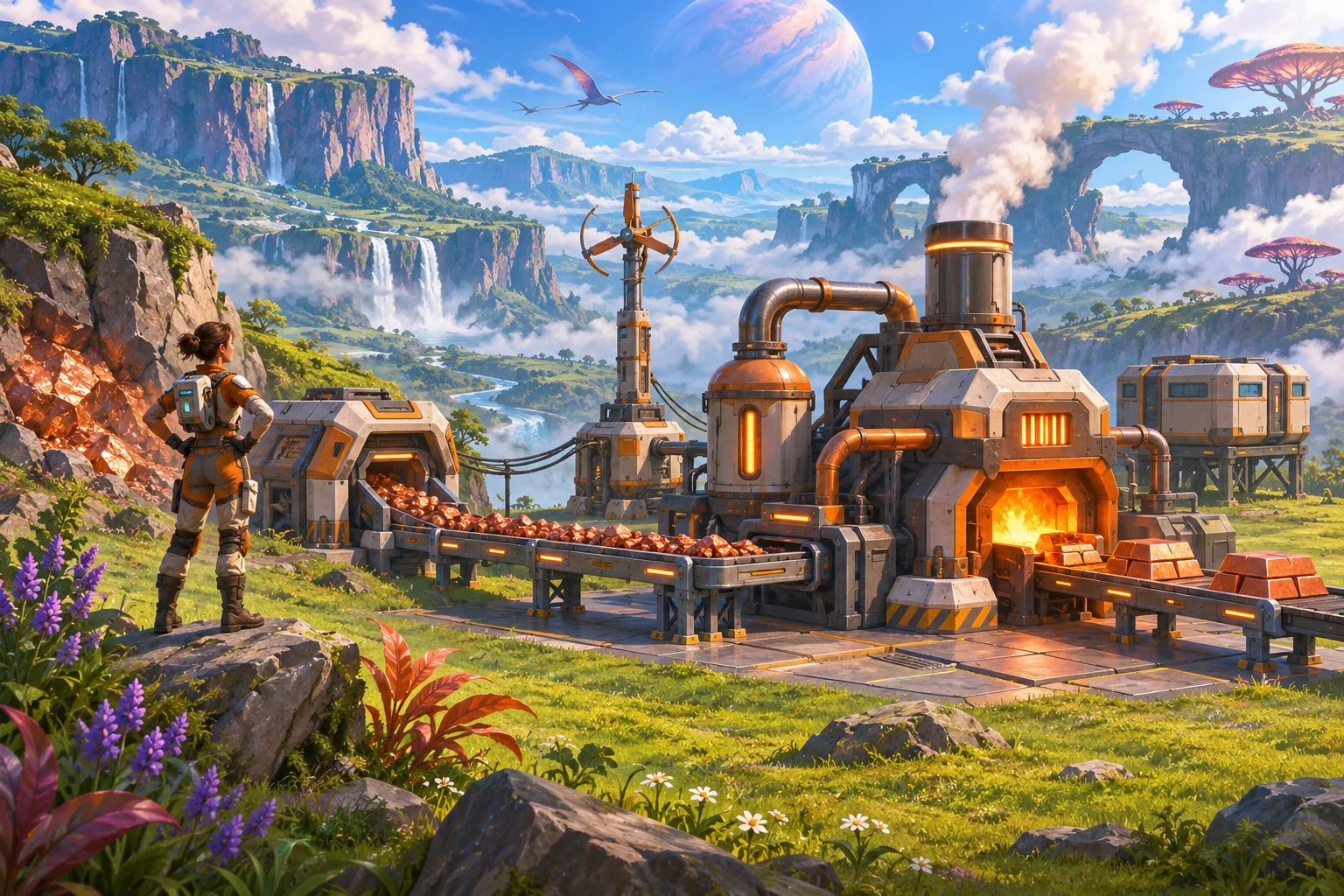
At Splitclock Foundry, the quarry moves at one cycle per world tick while the glassworks runs three cycles. If both machines advance once and draw from the same invisible stock, the faster region is underused and players cannot tell where the missing throughput went. Make the boundary between regions visible: the quarry prepares a batch, the buffer records it, and the fast machines consume that batch on their own clock.
Make regional time a production choice
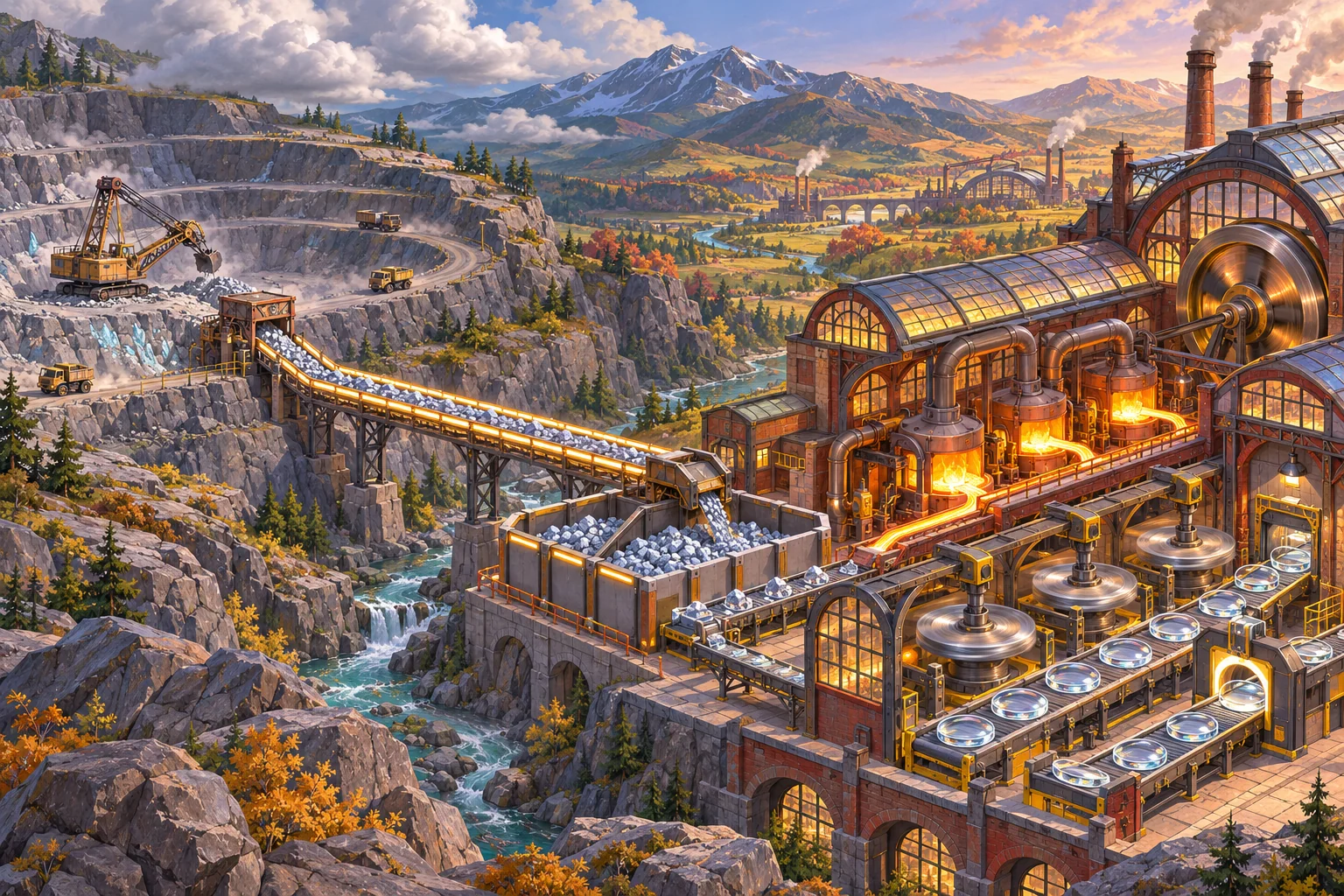
Use fictional prototype rates: one quarry cycle yields three ore at the end of a world tick; the glassworks gets three local cycles and consumes one ore to make one lens each cycle. The rates are chosen to make the timing rule easy to inspect, not to model a real factory.
| Region | Local cycles per world tick | Rule |
|---|---|---|
| Stonecut Quarry | 1 | Add 3 ore to the transfer buffer at the boundary |
| Prism Glassworks | 3 | Each cycle consumes 1 buffered ore and makes 1 lens |
| Transfer buffer | Shared | Holds material between clock domains |
Show the world tick and each regional clock separately. Resolve the slow-region batch at the boundary, then run the fast region's three cycles against the updated buffer. Display ore before and after every transfer so players can see whether a shortage comes from production, scheduling or consumption.
Treat the buffer as the clock boundary
The buffer is the contract between regions. It should have a visible capacity, current stock and a simple rule for overflow. If it is full, pause quarry output or store the excess in an explicitly named overflow bin; never discard it silently. If the fast region lacks ore, pause its remaining cycles without making stock negative.
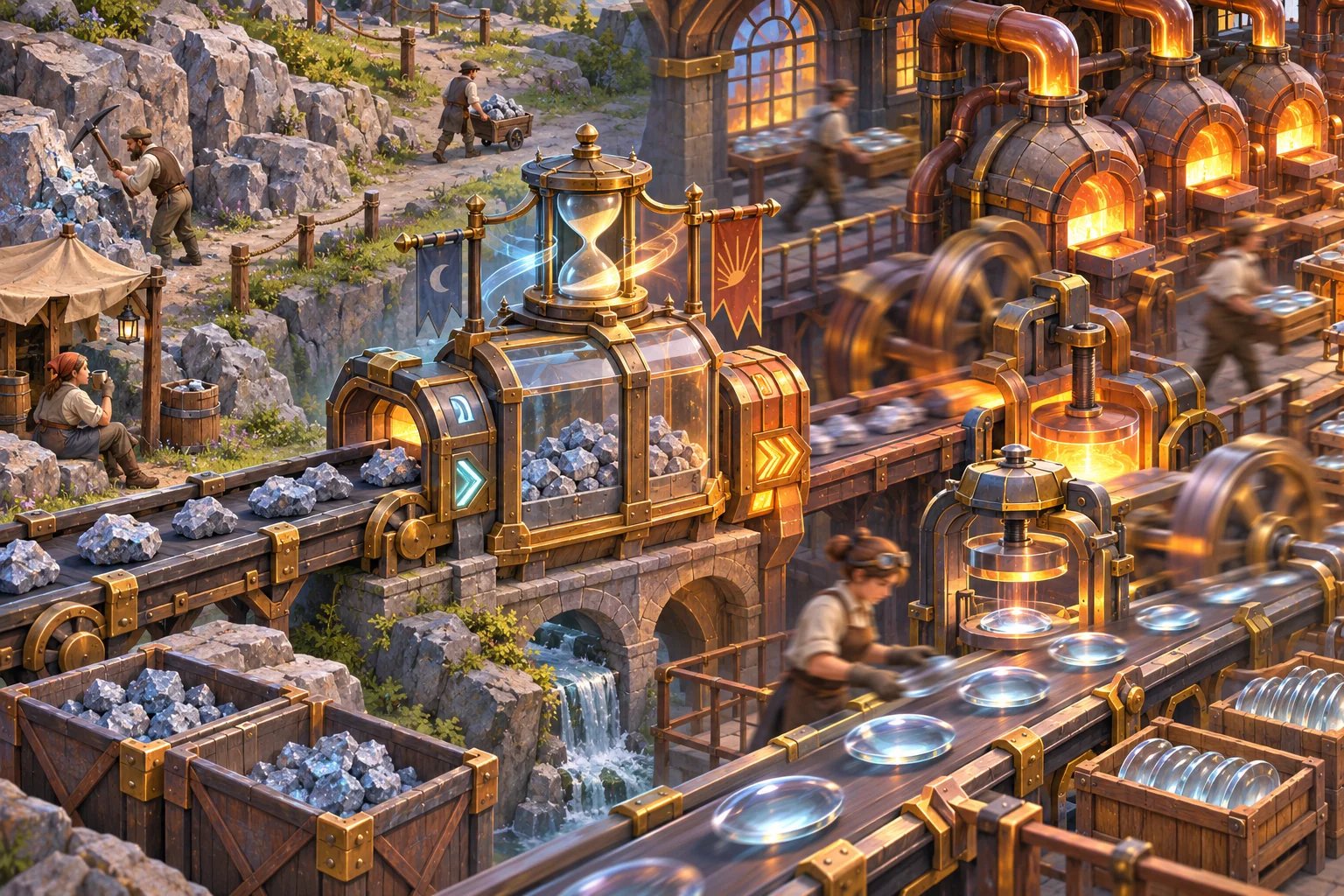
Keep each machine's local cycle count visible. Pausing one region should not advance its clock, and a global pause should freeze both. Make transfers atomic at the world-tick boundary so the fast machines cannot consume a batch before it arrives or count it twice.
Replay one world tick with fixed stock
The local scheduler replay started with an empty buffer. A naive global one-cycle rule advanced the quarry once and the glassworks once, producing one ore and one lens. The revised boundary rule produced three ore, then ran three glassworks cycles; the result was three lenses and an empty buffer. A second case with one extra starting ore finished with one ore left, without creating negative stock.
| One world tick | Naive shared cycle | Boundary-ordered clocks |
|---|---|---|
| Quarry cycles | 1 | 1 |
| Glassworks cycles | 1 | 3 |
| Ore produced / lenses made | 1 / 1 | 3 / 3 |
The deterministic local model checks cycle counts and inventory arithmetic only. It is not a playable factory or a performance test. After the clock boundary reads clearly, test storage limits, machine pauses and player-facing speed controls in a running prototype.

Start with two clock domains
Ask an AI game maker for one slow source region, one fast processing region and one visible buffer. Keep rates fixed and add a step control that advances exactly one world tick. Once the player can predict the stock change, add another recipe or region without hiding the transfer order.
Create Splitclock Foundry, a factory-automation prototype with two regions. Stonecut Quarry runs one cycle per world tick and adds a batch of 3 ore to a shared boundary buffer. Prism Glassworks runs 3 cycles per world tick; each cycle consumes 1 ore and produces 1 lens. At each world-tick boundary, resolve quarry output first, then the three glassworks cycles. Show both local clocks, buffer stock and each transfer. Pause a machine when inputs are missing, preserve leftover stock and prevent negative inventory. Add a single-step control and reset for the same starting state.
Start a factory automation prototype in SEELE
Frequently asked questions
How do I keep different regional clocks understandable?
Show the world tick beside each local cycle counter, and animate or list each boundary transfer. Players should be able to predict what one world tick will do before pressing step. Keep the first prototype to two regions and fixed speeds; add speed controls only after the transfer order is clear.
What happens when the fast region runs out of ore?
Pause its remaining cycles and leave the inventory unchanged. Explain whether the next batch arrives at the next world-tick boundary, and show the buffer stock. Do not borrow material from a future tick or run a partial recipe unless that behavior is an explicit, tested rule.
Should a full buffer stop the quarry?
Pick and display one overflow policy. The quarry can pause until space is available, or route excess to a named overflow store with its own capacity. Replay a full-buffer case to confirm that material is neither lost nor duplicated when clocks meet at the boundary.