Introduction
A community challenge game gives a defined group a shared goal, visible progress and a way to reflect on what happened. The design should make participation optional and roles clear without assuming that every group has the same time, access or resources. Start with a fictional neighborhood challenge and an editable organizer template.
This guide uses Maple Lane, an invented community scenario for a friendly park-path challenge. The people, location, tasks and participation data are fictional. No real organizer, community event or outcome was used or tested, and the game does not provide civic, safety or environmental advice.
Define the group and shared objective
State who the activity is for, what everyone is trying to complete and how long the game lasts. Keep the objective concrete, such as visiting three fictional checkpoints and recording optional observations. Avoid using personal data or implying that the activity measures a real community’s success.
Prompt 1 — organizer brief
Design a fictional community challenge game for Maple Lane organizers. A small group can choose optional tasks at three invented park-path checkpoints and finish with a shared reflection. Define intended participants, objective, time boundary, roles, opt-in participation, group progress, completion and reset. List assumptions and untested interactions. Do not use real locations or claim community outcomes.
The brief should explain what counts as completion and what happens if a participant skips a task. Make sure the group can finish without every person taking part in every activity.
Make checkpoints and participation options visible
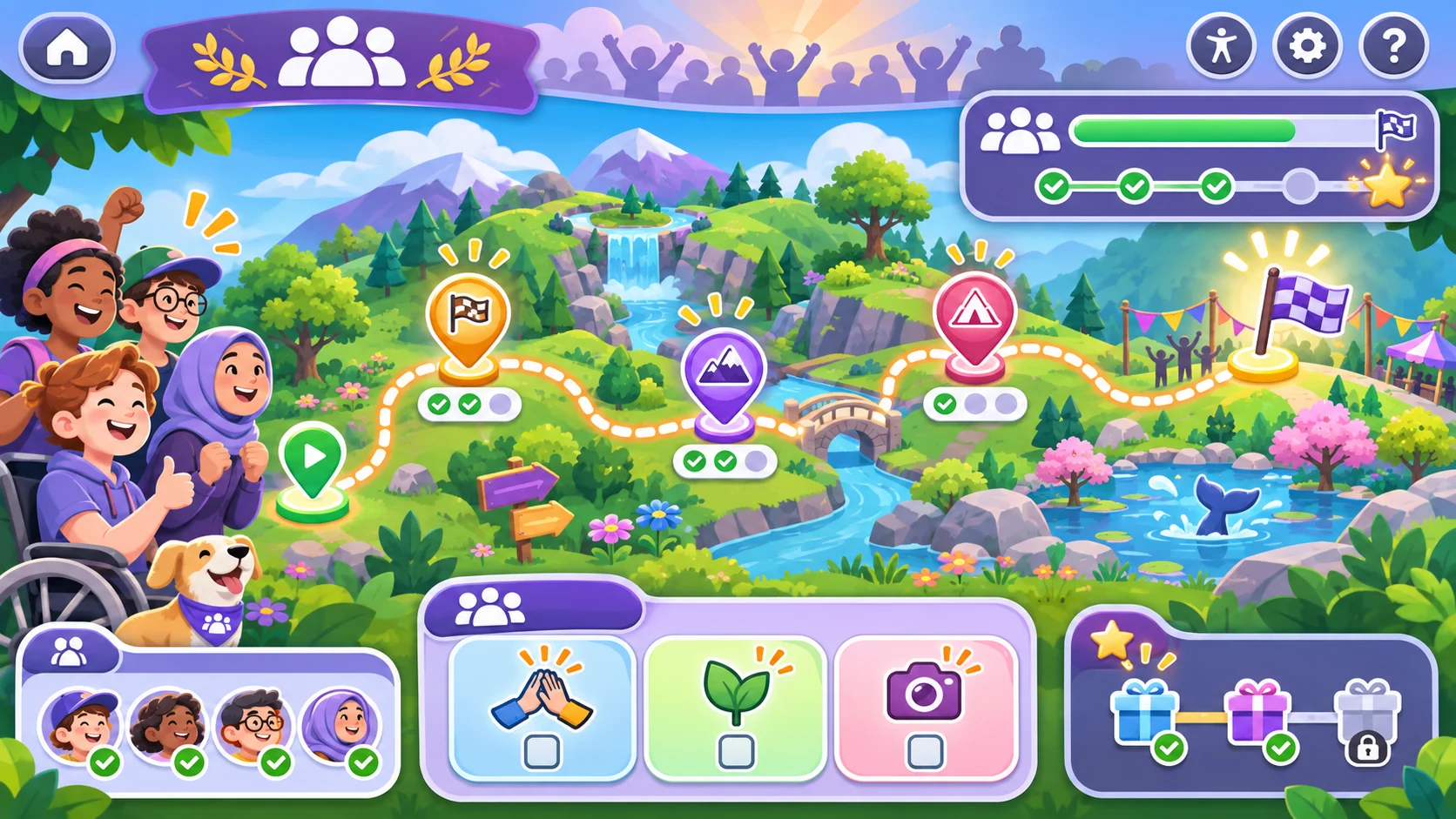
A route view can show the start, checkpoints, optional tasks and finish. Mark each task as optional or required and provide an alternate route or skip control. Use invented map art, not a real venue layout or accessibility assessment.
Prompt 2 — checkpoint map
Create a fictional Maple Lane challenge map with a start point, three invented checkpoints, optional task cards and a finish area. Show completed, available and skipped states with a plain legend. Include a skip option that does not block group completion. Treat the map as concept art, not a real route or safety plan.
| Challenge state | Game meaning | Organizer cue |
|---|---|---|
| Available | The group can choose the task | Show the task and time estimate as placeholders |
| Complete | The group records completion | Update shared progress without naming participants |
| Skipped | The group chooses not to do it | Keep the overall activity usable |
| Reflection | The group shares a takeaway | Make speaking or passing an option |
These are fictional interface states, not rules for real events.
Give participants different ways to contribute
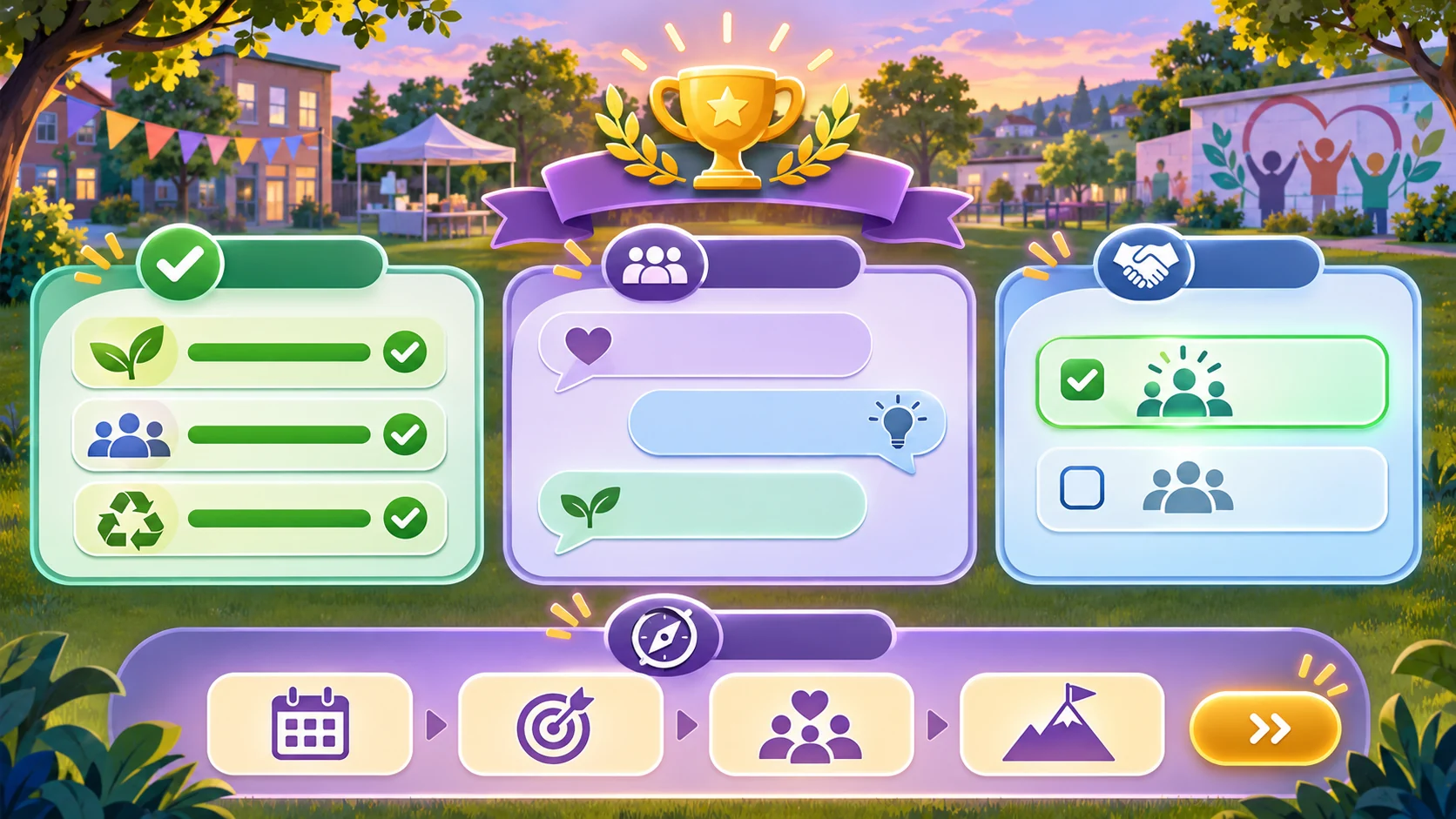
A shared challenge can offer roles such as navigator, note-taker or timekeeper. Let participants switch roles or pass. Do not require public rankings or personal disclosures. State whether the game stores anything; a local prototype can use temporary group choices and no participant accounts.
Prompt 3 — roles and group progress
Define three optional Maple Lane roles: navigator, note-taker and timekeeper. Explain how someone can switch or pass, how group progress updates and how the prototype avoids individual ranking or personal-data collection. Keep the roles fictional and suitable for a local demo.
A useful progress view shows the group objective and next option rather than singling out who contributed most. If the group disagrees, allow a facilitator to pause or choose another task.
Add challenge cards and reflection
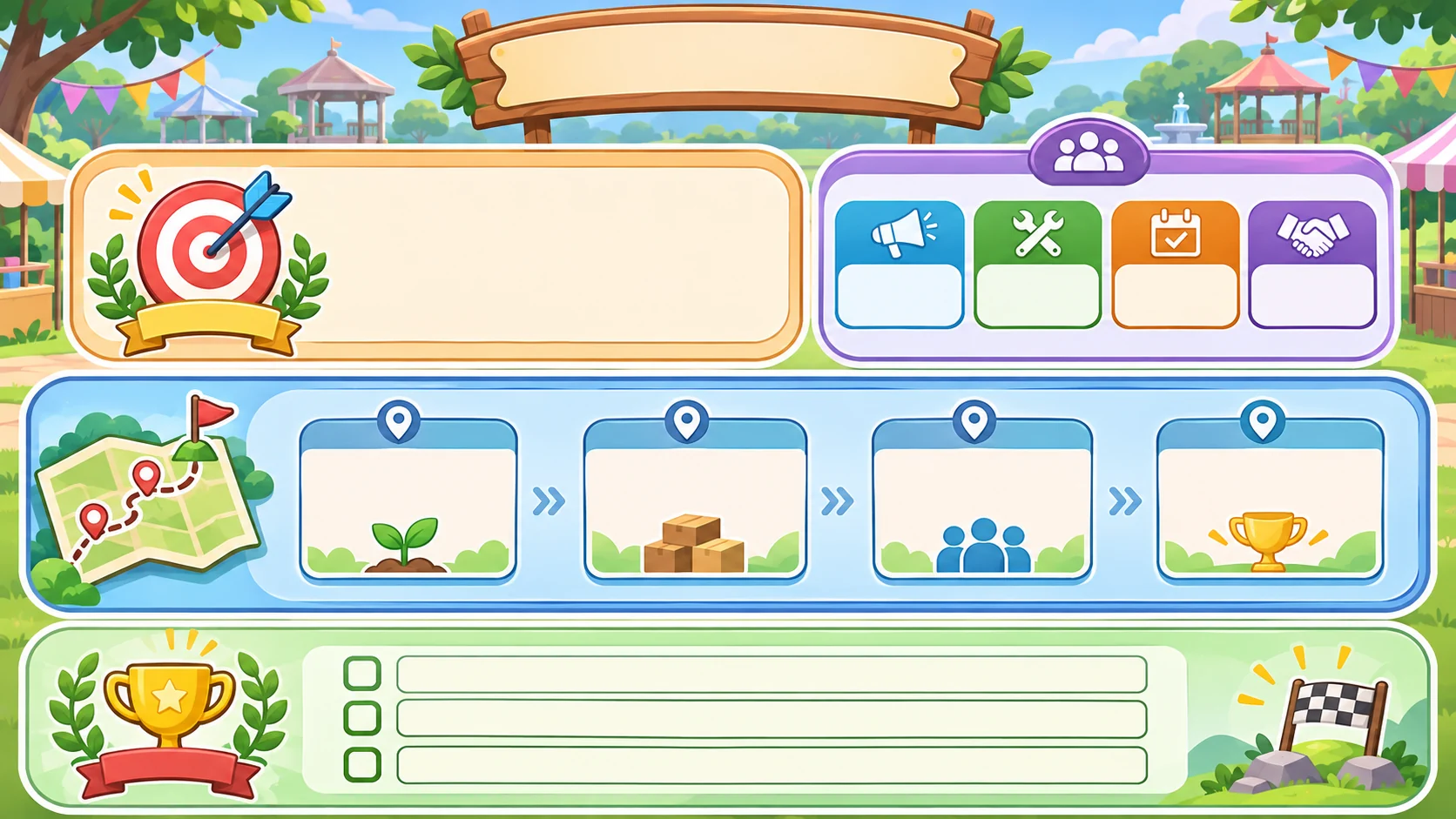
Each checkpoint can offer a short task and one reflection prompt. Keep activities fictional and low-stakes in the prototype. If organizers adapt the concept to a real event, they need to define appropriate local permissions and conditions themselves; the game is not a substitute for that planning.
Prompt 4 — checkpoint cards
Draft three fictional Maple Lane checkpoint cards. Each includes an optional group task, a completion state, a pass/skip option and one reflection question. Keep all tasks generic and illustrative; avoid instructions that could be mistaken for real safety, cleanup or environmental guidance.
The debrief should ask what the group learned about the activity design, what was missing and which task should change. It should not turn fictional game counts into evidence of community impact.
Provide an editable organizer template
An organizer needs to replace the objective, group description, checkpoints, optional tasks, roles, time boundary and reflection questions. Keep the data model simple and make the fictional-data label explicit.
{
  "challengeName": "Maple Lane — fictional organizer demo",
  "sharedObjective": "Choose optional tasks at three invented checkpoints and reflect together",
  "participants": "small fictional group; no accounts",
  "timeLimitMinutes": 20,
  "roles": ["navigator", "note-taker", "timekeeper"],
  "checkpoints": [
    {"id": "one", "task": "notice a color pattern", "optional": true},
    {"id": "two", "task": "choose a route symbol", "optional": true},
    {"id": "three", "task": "share one design reflection", "optional": true}
  ],
  "skipAllowed": true,
  "dataLabel": "fictional local example; no real event or impact data"
}
Change the objective, tasks, roles and time boundary for another fictional scenario. For a real activity, adapt it with the group and relevant local review rather than treating this example as a ready event plan.
Request a small playable challenge slice
A first build could include one map, three task cards, group progress, optional roles, skip controls, reflection prompts and reset. Specify what must work: choose a task, mark it complete or skip, see group progress and finish with a debrief. A route illustration alone is not a playable challenge.
Prompt 5 — first playable group challenge
Build a small fictional Maple Lane challenge with a start, three optional checkpoint cards, role selection that can be skipped, shared progress, reflection prompt, completion state and reset. Avoid individual rankings and personal-data collection. At handoff, list working interactions, static screens and untested assumptions. Do not claim community impact or real event readiness.
No playable game or community event was tested for this article.
Prompt 6 — simulated organizer customization
Adapt the template to a fictional “Cedar Square Story Walk” with three invented story checkpoints and an optional group reflection. Change the objective, task cards and debrief while preserving the opt-in and skip states. Label the scenario fictional. This is a local simulated customization, not a real organizer project.
This example shows which fields an organizer can edit. It is not based on a real community event.
Prompt 7 — observed-output review
Review the running local challenge prototype for objective visibility, task selection, optional roles, skip behavior, shared progress, reflection, completion and reset. Mark each present, missing or unclear from observed interactions. Record concise evidence and one smallest next change. Do not claim inclusivity, safety or community outcomes without appropriate real review.
Fictional challenge snapshot
| Field | Maple Lane example |
|---|---|
| Objective | Choose optional tasks at three invented checkpoints |
| Participation | Roles can be switched, skipped or passed |
| Progress | Shared group state without individual ranking |
| Debrief | Reflect on design assumptions and missing options |
| Evidence | Fictional template only; no community event or impact test |
The snapshot gives an organizer a structure to edit. It is not a recommendation for a real event.
Conclusion
A community challenge game should make the shared objective, optional tasks, participation choices and group progress easy to understand. Maple Lane and Cedar Square Story Walk are fictional; no real event, community or outcome was tested. Use an editable template to define the group’s own goal, then review the activity with participants before using it in a real setting.
You can take a scoped concept into the Free AI game maker, then compare the result with the review checklist.
FAQ
What should a community challenge game for organizers include?
Set a shared objective, optional tasks, clear roles, group progress, skip choices and a debrief.
How can a challenge game support optional participation?
Make tasks skippable, let people pass or switch roles and avoid making one participant’s input block the group.
Can game progress prove a community outcome?
No. A game counter is an in-game state and does not establish real community impact.
What belongs in an editable community challenge template?
Include the objective, group, checkpoints, task options, time boundary, roles and reflection prompts.
Does a map mockup prove a challenge is ready for a real event?
No. Review the activity with the intended participants and relevant local organizers before using it in a real setting.