Start your detective game with a question the player can answer by combining clues. In this fictional harbor archive, a brass tide gauge has disappeared from a locked display. The player can inspect three sources, then name a suspect and cite the facts that support the conclusion. Finding every clue fills the notebook. Closing the case requires using those clues.
Keep the first case in one room. Give each clue a different job and decide what the game should say when the player makes an unsupported guess. You can work out the evidence before you ask AI to build the scene. That gives you a reference for checking whether the room, notebook, and conclusion screen agree.
Write the case rules before placing the clues
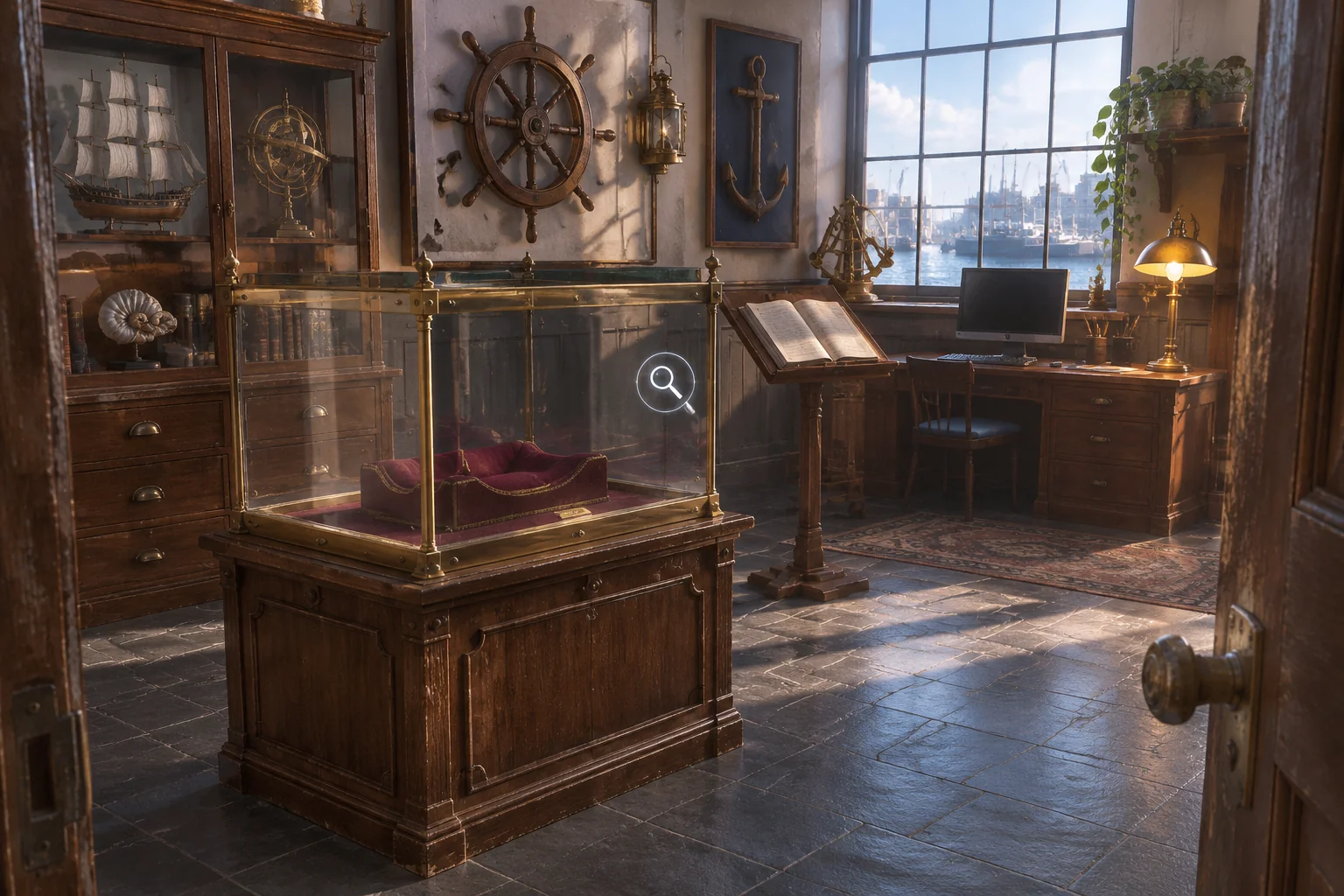
The player needs to work out who took the gauge between 14:00 and 14:10. The case briefing names three suspects: Mira the conservator, Devon the courier, and Noor the attendant. In this puzzle, the case is intact, it opens only with a working registered key, and nobody can borrow or copy a key. Only the three suspects could access the archive.
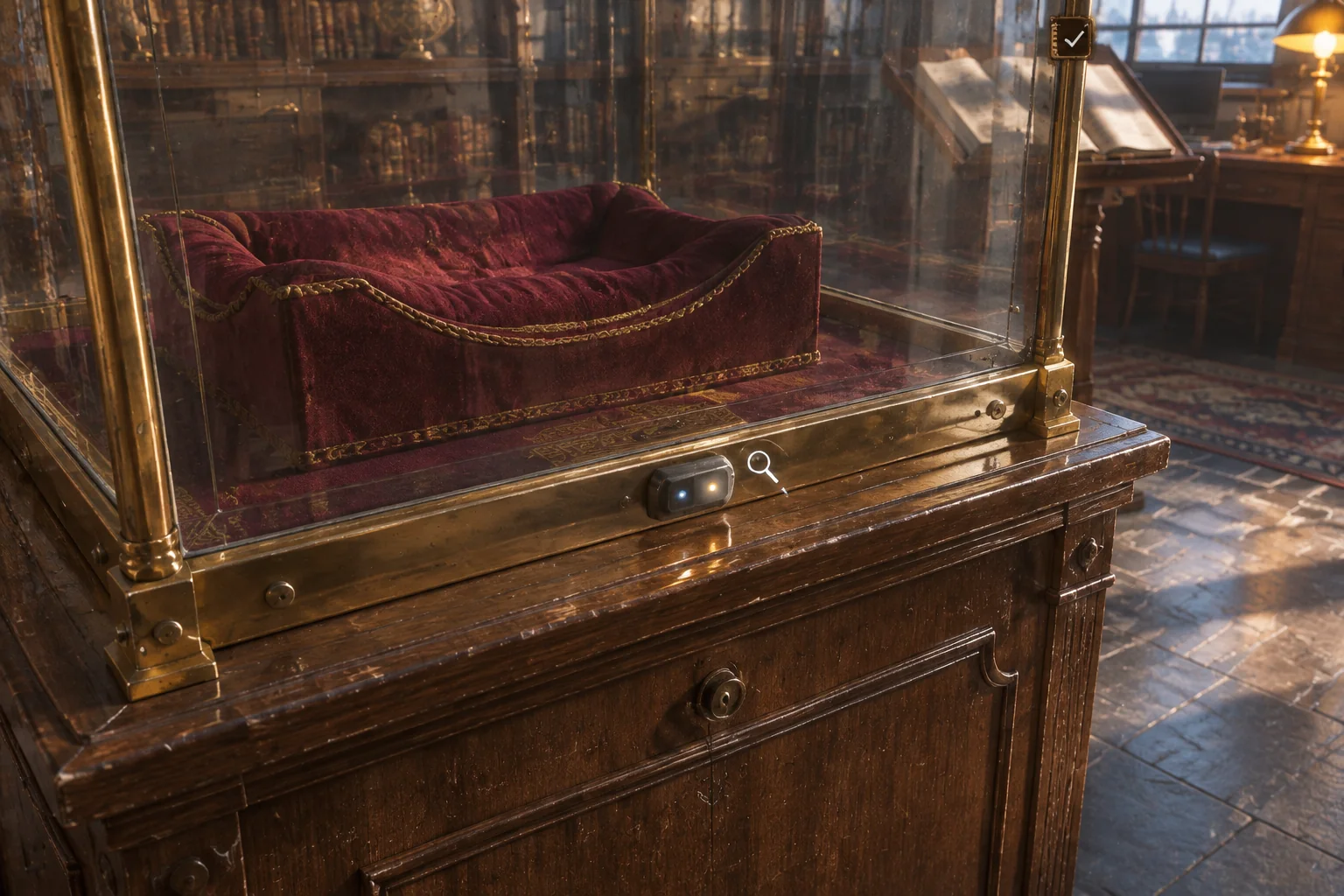
Place the sensor log at the display, the key ledger on a stand, and a dock attendance record on the office terminal. Make each object selectable and use a notebook entry to confirm that the player collected its evidence. Let them reopen a source to reread it. Keep one entry per evidence ID even if the same object is inspected twice.
Give each clue a specific job
| Evidence | What the player finds | What it contributes |
|---|---|---|
| E1, display sensor log | The gauge was lifted from its cradle at 14:06. | Sets the exact removal time. |
| E2, key ledger | Mira and Devon had the only working keys throughout the 14:00–14:10 window. | Rules out Noor, who could enter the room but could not open the case. |
| E3, dock attendance record | Devon was at the staffed dock continuously from 14:04 to 14:08. | Rules out Devon once the player knows the gauge was removed at 14:06. |
Mira is the only suspect who fits all three facts. Try removing a clue to see why the set matters. Without the sensor log, Devon could have taken the gauge outside the four-minute dock interval. Without the key ledger, Noor is still possible. Without the dock record, either key holder could have done it. If a clue can be dropped without changing what the player can conclude, decide whether it belongs in the required set.
Check the citations before checking the suspect
Keep the case open while the player explores. In the notebook, let them pin discovered entries in any order. The deduction screen takes one suspect and the pinned evidence as citations. Collecting an entry makes it available to pin, and pinning makes it available to submit. The game closes the case only after an explicit submission with the right suspect and all three valid citations.
| Submission | Expected response | Case state |
|---|---|---|
| Mira with E1 and E2 | Ask for the missing location evidence without revealing the culprit. | Open |
| Noor with E1, E2, and E3 | Point to the access conflict in the key ledger. | Open |
| Devon with E1, E2, and E3 | Point to the exact removal time and Devon’s overlapping dock record. | Open |
| Mira with E1, E2, and E3 | Accept the conclusion and show how access and timing rule out the other suspects. | Solved |
Evaluate citations first, even if a suspect would eventually be wrong. For example, if the player picks Noor with only E1 and E2 pinned, ask for the location evidence before showing the access conflict. Keep the notebook and pins after an incomplete or incorrect submission so the player can reconsider without repeating the search.
Ask AI to build the case around fixed facts
SEELE’s AI game creator offers a starting point for building a browser-game concept from an original story. Give it the room, exact evidence, and expected responses. Leave furniture layout and presentation open, while keeping the clue logic fixed. Then compare the generated draft with the submission table.
Build a small first-person browser detective game in one harbor archive.
A brass tide gauge disappeared from an intact locked case between
14:00 and 14:10. The suspects are Mira, Devon, and Noor. Only these
three can enter. Only a registered key opens the case. Keys cannot be
borrowed or copied. State these rules in the case briefing.

Put these sources in the room. Keep their facts fixed:
E1, display sensor log: The gauge was lifted at 14:06.
E2, key ledger: Mira and Devon had the only working keys throughout
the 14:00–14:10 window.
E3, terminal dock record: Devon was at the dock continuously from
14:04 to 14:08, away from the archive.

Let players inspect in any order, reopen records, and pin discovered
clues in a case notebook. Store one entry per ID. Submitting a conclusion
requires selecting a suspect and citing the pinned clues.

Evaluate citations first. If any required ID is missing, tell the
player the missing evidence category and leave the case open.
With all three valid citations, show an access conflict for Noor
and a timing conflict for Devon. Preserve all state after those
incorrect submissions. Accept Mira with all three citations and show
the reasoning. Restart clears the evidence, pins, and outcome.
On the first pass, inspect the terminal, ledger, and display in that order. Reopen the terminal and confirm the notebook still contains three distinct entries. Pin only two and submit, then add the third and try each suspect. After a successful conclusion, restart and verify that the notebook and pins are empty and the case is open again. The guide to checking an AI game in small steps shows how to request a focused change when one check fails.
Change one cue if a clue gets overlooked
Suppose players can see the terminal from the entrance but only get an inspection icon when they approach the desk. Try showing the terminal icon from the entrance too. Leave the inspection range, camera, and clue text alone. The player still has to walk to the desk and inspect it to collect E3.
Use the same marked starting position for both layouts. In the baseline, the case and ledger icons are visible there, giving the player two cues. In the revised design, the terminal adds a third. That tells you what the interface should show. When you build both versions, record which source a new player checks first and whether they miss the terminal. An icon can be visible and still blend into the room.
Finish one deduction before adding more suspects
Build the archive case, try an incomplete citation set, and make sure the game can explain a wrong conclusion without resetting the search. When the clues work in any order and only the supported conclusion succeeds, you have a pattern for writing another case. Start your detective game prototype with SEELE’s AI game creator and keep the evidence matrix nearby when you check the first draft.
Frequently asked questions
Can I include optional clues?
Yes. An optional clue can explain a motive or give context for a suspect without deciding the case. Try the deduction without it to make sure the required facts still lead to one answer. Keep optional details out of the list of citations the game requires to close the case.
What should happen if a player inspects the same object twice?
Open the existing entry again so the player can reread it. Keep the original evidence ID, and leave its pinned or unpinned state as it was. This lets the player return to a source without inflating the notebook count or accidentally changing a conclusion they are preparing.
How much should the game reveal after a wrong answer?
Show the conflict the submitted evidence exposes. If the player chose a suspect whose location clashes with the removal time, point to the two records they cited. Leave the suspect choice open so they can compare the remaining options and make the next inference themselves.
When should I add a second room?
Add one when you can describe what new action it gives the player. A second room might let them check a witness statement against another object or trace a route between locations. Verify that the case still works in different discovery orders before requiring players to travel farther.