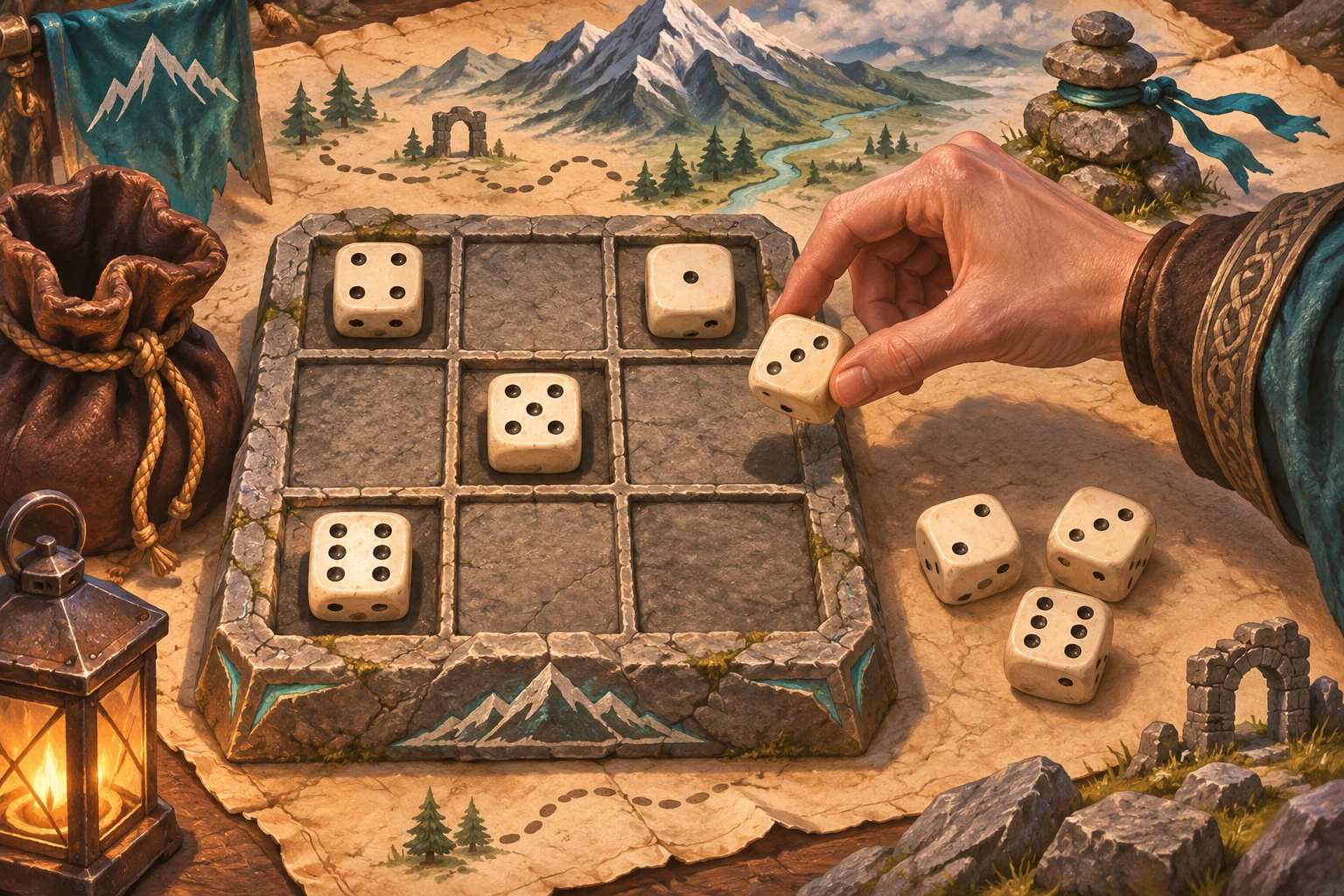
In the run-based game Cairnfall, each chamber is a 3×3 board waiting for dice. Roll three dice, choose one to place, and decide whether to build a same-value neighbor pair or finish a row. The board is not just a container for scores: every placement changes the value of future positions, and a single die can connect two scoring patterns.
Start with a small set of readable rules: matching orthogonal neighbors score, ascending rows earn a line bonus, and a limited set of tools can modify one die before placement. Then replay the same chamber with a fixed sequence of rolls. A paper test can show whether players face real tradeoffs between a local combo and a line goal before you build a larger roguelike.
Make each board position matter to more than one score
Use a 3×3 board and six-sided dice with values one through six. After rolling three dice, place one die into an empty cell; the other two go to the discard tray. A run begins with three reroll tokens. Spend one before placement to reroll a single die, or use a once-per-chamber chisel to change one die by plus or minus one. Keep the board visible while choosing so the player can see the immediate neighbors and the unfinished rows.
Score each orthogonally adjacent pair with the same value for 4 points. Diagonals do not count. A completed row earns 3 points if its values rise left to right, and a completed column earns 3 if its values rise top to bottom. A die in the center can join four pairs and sits in both a row and column, so it has more potential but is also harder to place well. State the rules beside the board rather than hiding them in a tutorial.
Let upgrades change placement choices instead of only adding points
Give each die a small upgrade that changes how its value interacts with the board. A prism die may count as either its rolled value or one lower when scoring a matching pair. A weighted die can be set to four before a chamber, but cannot be rerolled. A compass charm could award a one-time swap of two adjacent dice after placement. Keep upgrades scarce so each one creates a decision instead of turning every board into a guaranteed combo.
Separate permanent run upgrades from chamber tools. A permanent die modification should change future rolls, while a chisel or swap is consumed in one chamber. Show the exact score preview before committing a placement and explain which neighbors or lines contribute. If the player cannot tell why a move scored, spatial rules will feel arbitrary even when the arithmetic is correct.

Compare two scoring rules on the same filled board
Use this completed board to check arithmetic: top row 4–5–6, middle row 2–2–5, bottom row 1–3–4. Under the base rule, the center two is adjacent to the left two and scores one matching pair for 4 points. The top and bottom rows rise left to right and score 3 each. No column rises from top to bottom, and diagonals add nothing.
Now test an iteration that raises the matching-pair value from 4 to 6 while keeping line bonuses at 3. The same board scores 12, so a player has more reason to place a second two beside the center, even if doing so blocks a rising row. This is a paper-simulated comparison, not a built-game result. In a playtest, track final score, unused rerolls, filled cells and the number of placements where the player chose a line over a pair. If one rule dominates, tune its reward or add a clear cost.

Prompt a compact dice-board prototype before adding a full run
Build the board, roll selection, placement preview and scoring summary first. Add one chamber reset and a fixed sequence of rolls so you can compare changes without random differences. Only after the spatial choices read clearly should you add branching rooms, rewards or more die types.
Create a compact dice-building roguelike prototype called Cairnfall. Show a 3x3 board and roll three six-sided dice; the player places one die in an empty cell and discards the other two. Give three reroll tokens per run and a once-per-chamber chisel that changes one die by plus or minus one. Score 4 points per orthogonally adjacent equal-value pair, 3 points for each completed row ascending left to right, and 3 points for each completed column ascending top to bottom. Diagonals do not score. Show a score preview with the exact pairs and lines counted. Add a resettable fixed-roll test and compare pair values of 4 and 6 on the same completed board. Track score, rerolls, filled cells and line-versus-pair placements.
SEELE's official AI Game Maker page describes creating a playable first version from a prompt, testing it in a browser and refining it with follow-up prompts. Use that general workflow to inspect board placement and score explanations; Cairnfall and its rules are fictional design guidance.
Build the dice-board roguelike in SEELE
Frequently asked questions
How do spatial scoring rules work in a dice-building roguelike?
Give dice value through nearby cells and completed lines. For example, equal orthogonal neighbors can score a pair bonus while ascending rows earn points. Keep diagonal rules explicit, show a score preview, and make each placement change the options left on the board.
How can I make dice upgrades affect strategy?
Let an upgrade change values, rerolls or how a die matches nearby cells. A prism that counts as one lower can open a pair, while a fixed weighted die trades flexibility for planning. Keep powerful modifiers limited so placement still matters.
What should I measure in a first spatial scoring test?
Replay a fixed sequence and record total score, filled cells, unused rerolls and choices between pairs and lines. Compare one scoring change at a time on the same board. If players cannot explain a score, improve the preview before adding more rules.