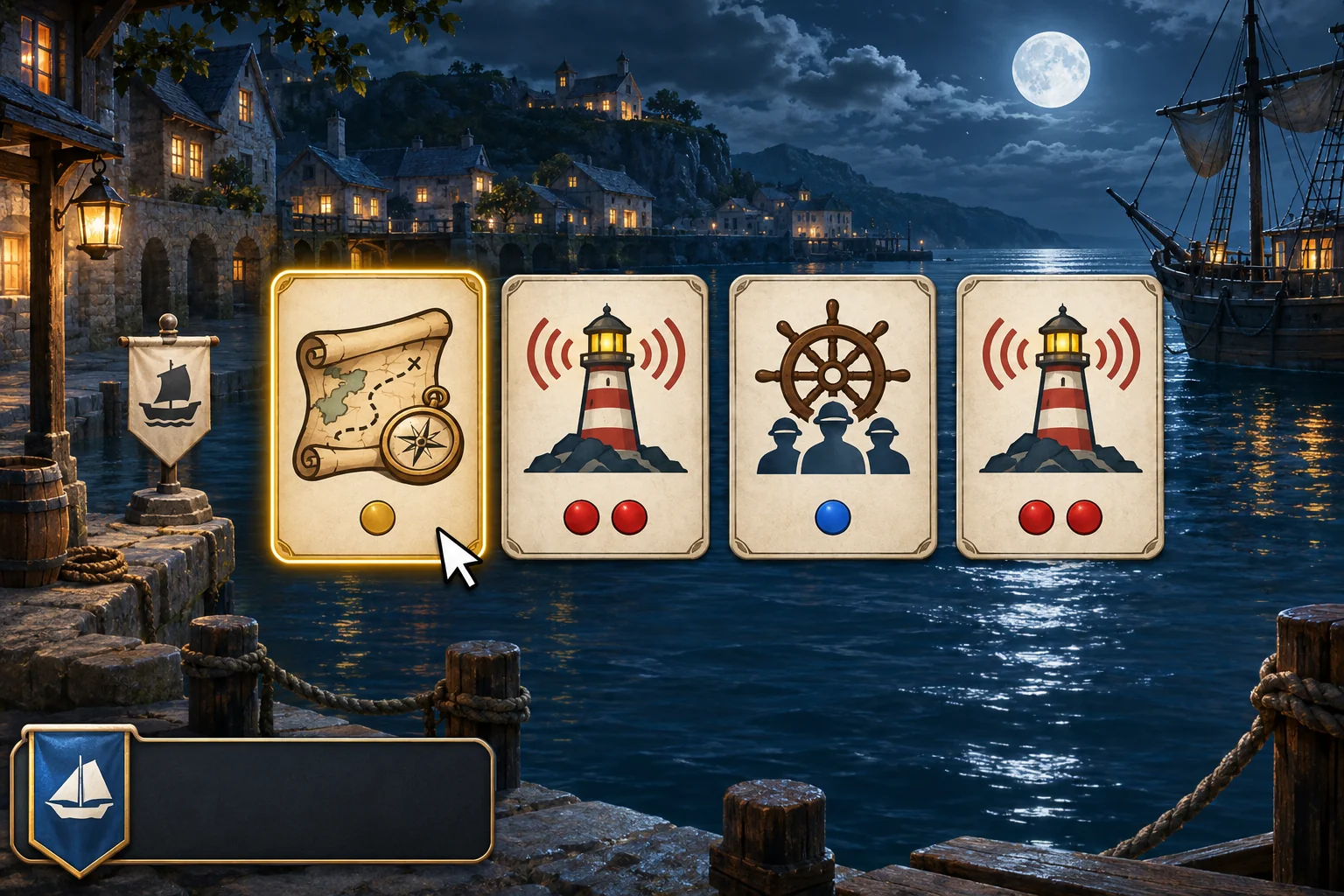
In a board-changing drafting game, a card can reshape the scoring space before anyone claims points. In the fictional solo game Tidewheel, the player sees three cards and chooses one: rotate a row, turn a 2×2 block or swap neighboring tiles. Each row is a circular current track, so a row rotation moves all three terrain tiles and wraps the end tile to the start.
After the draft, score one point for each orthogonally adjacent pair of matching terrain. The same offer can improve one region while breaking another, so the player must read the whole board before choosing. Start with a small 3×3 tide wheel and one fixed example board; compare its links before and after a single drafted card.
Make the limited offer change the board before scoring
Show three cards from a shared offer: Row Current, Block Turn and Neighbor Swap. The player drafts one card, resolves its layout change, then scores matching terrain edges. Discard the other two and reveal a new offer next round. The choice is limited, but its effect is public before it is taken.
Use three terrain types—Reef, Shoal and Deep—and a 3×3 board. Rows are circular current tracks: Row Current rotates one chosen row one cell to the right, wrapping the last tile to the first position. Block Turn rotates a chosen 2×2 area clockwise. Neighbor Swap exchanges two orthogonally adjacent tiles. Diagonals never count for scoring.

Give each layout card a distinct spatial tradeoff
Row Current changes three positions at once and can connect a long run, but it may carry a useful tile away from the player’s preferred area. Block Turn affects only four cells, letting the player tune a corner without moving the whole row. Neighbor Swap is precise, but can make just one local connection. Show ghost previews for all three choices before the player drafts.
Keep the terrain symbols attached to their tiles when they move. Score one point per matching orthogonal edge after the layout action; a tile can contribute to more than one edge. This makes a compact cluster more valuable, while preventing diagonal patterns from looking connected when they do not score.
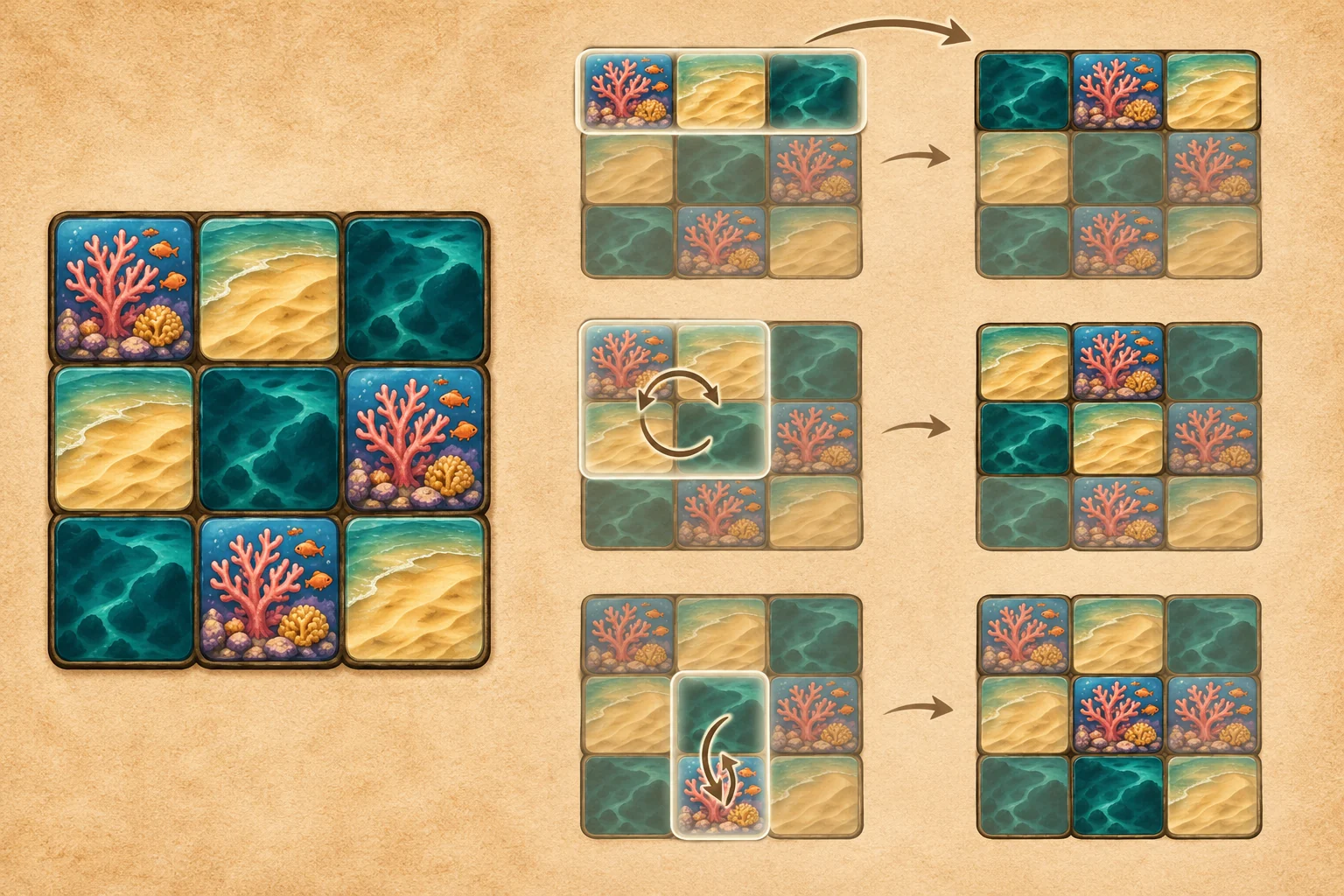
Replay one offer on the same board to check its effect
Use this 3×3 board: top row Reef–Reef–Deep, middle row Shoal–Reef–Shoal, bottom row Shoal–Shoal–Reef. Before a draft, it contains four matching orthogonal edges: two Reef edges and two Shoal edges. Deep has no matching neighbor. Record four points as the starting layout.
Now draft Row Current for the middle row and rotate it right. The board becomes Reef–Reef–Deep / Shoal–Shoal–Reef / Shoal–Shoal–Reef. It has six matching edges: two Reef and four Shoal, for two additional points. The move improves the Shoal cluster without increasing the Reef links. This is a paper-simulated comparison, not a built-game measurement. In playtests, track score, terrain links changed and how often each card is passed over. If one layout action dominates, tune its affected area or offer frequency.
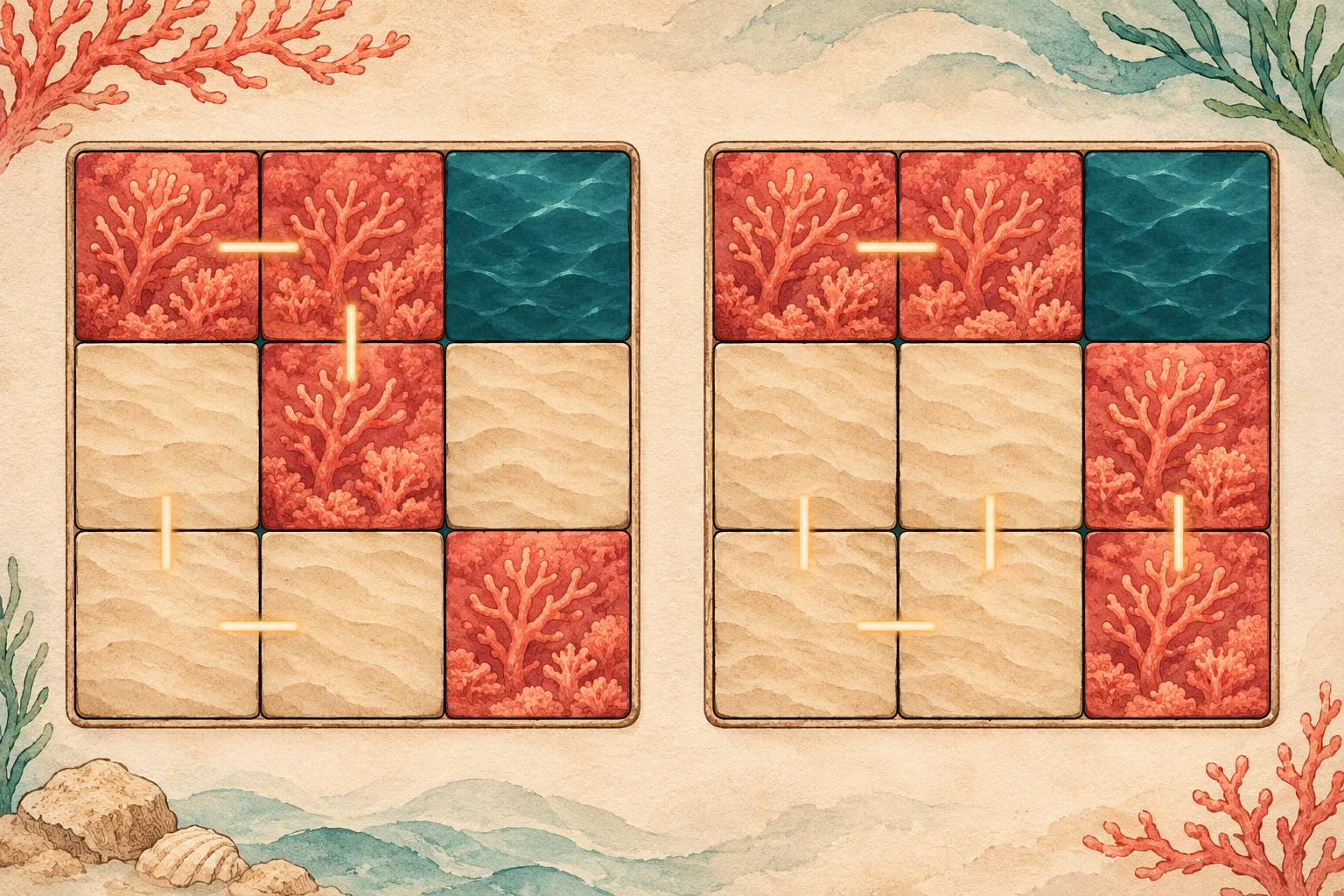
Prototype the draft preview before adding more terrain
Build the offer, card preview, row and block transformations, and edge scoring before adding extra terrain types. Add a resettable board with a fixed three-card offer so players can compare choices under the same conditions. Expand the deck only after the layout changes and scoring links are easy to follow.
Create a compact solo drafting card game called Tidewheel. Show a 3×3 board with Reef, Shoal and Deep tiles. Each row is a circular current track. Reveal a three-card offer: Row Current rotates one selected row one cell right with wraparound; Block Turn rotates a selected 2×2 area clockwise; Neighbor Swap exchanges two orthogonally adjacent tiles. The player drafts one card, applies its layout change, then scores one point per matching orthogonal terrain edge; diagonals do not count. Tiles keep their terrain when moved, and a tile can contribute to multiple edges. Discard the other two cards and reveal a new offer next round. Show ghost previews and exact score changes before drafting. Add a resettable example board and compare its matching-edge score before and after Row Current on the middle row. Track total score, links changed and cards passed over.
SEELE's official AI Game Maker page describes creating a playable first version from a prompt, testing it in a browser and refining it with follow-up prompts. Use that general workflow to inspect draft previews, board transformations and scoring links; Tidewheel and its rules are fictional design guidance.
Build the board-changing drafting game in SEELE
Frequently asked questions
How do cards change a board in a drafting game?
Let drafted cards rearrange tiles before scoring. A row rotation can shift three spaces, a block turn can change a corner and a swap can adjust one local connection. Show the resulting board and score preview before the player commits to a limited offer.
How can I make a drafting offer strategic?
Offer a small set of visible cards with different spatial effects, then make the player choose one and discard the rest. Each choice should improve one part of the board while possibly weakening another. Preview how each card changes scoring links.
What should I measure in a board-changing draft test?
Replay the same board and offer, then record total score, terrain links changed and cards passed over. Compare each layout action under the same conditions. If one card is always drafted, tune its affected area, frequency or scoring interaction, then replay the same test to check the change.