Introduction
A digital escape-room prototype lets an escape-room designer inspect clue order, dependencies, hint timing and completion states before investing in a full build. Its purpose is to make the intended player journey visible. A prototype does not establish that a room is safe, accessible, solvable or enjoyable; those questions need appropriate review and real playtesting.
This guide uses Aster Observatory, a fictional, screen-based mystery about restoring a star chart. The sample room, puzzle logic and designer scenario are invented for illustration. No real venue, physical room or playable prototype was tested.
Choose a bounded mystery and audience
Start with one player promise, an audience, a session length and an ending. A compact digital slice might ask players to align three celestial symbols, discover a sequence and unlock a final cabinet. Limit the first pass to a few connected puzzles so every clue can be traced to a state change.
Prompt 1 — prototype brief
Create a fictional, screen-based escape-room prototype called Aster Observatory for a small team of players. Define the audience, session target, opening story, objective, start state, completion state and reset. Scope three connected puzzles and list assumptions that need designer review. Do not imply this is a tested physical room.
Write the intended answer path in plain language. If a player can reach the finale without finding a required clue, mark that branch as an intentional alternate route or a design gap.
Map clue dependencies and room states
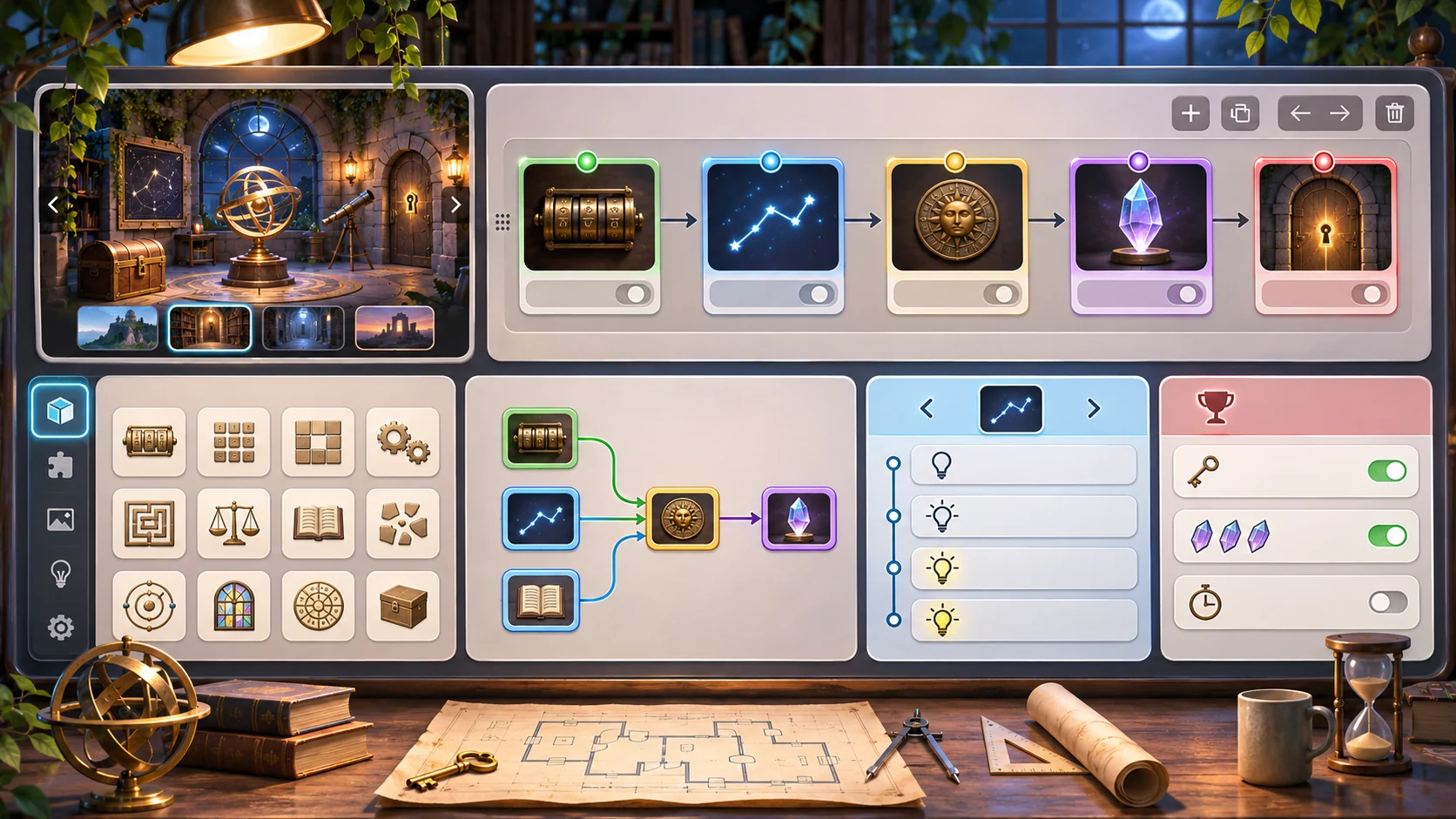
Represent each puzzle as an input, action, success condition and output. Connect outputs to the next puzzle, and identify whether each clue is mandatory, optional or a hint. This makes dead ends easier to spot and supports deliberate alternate paths.
Prompt 2 — clue graph
For Aster Observatory, map three fictional puzzles: a star-chart alignment reveals a constellation, the constellation selects a three-symbol cabinet code, and the cabinet releases a lens for the final telescope. For each node, state prerequisites, player-visible clue, accepted action, success state, output and recovery/reset behavior. Mark any single-point dependency.
| Puzzle | Visible clue | Player action | Success output |
|---|---|---|---|
| Star chart | Three marked stars and a symbol key | Align the marked stars | Reveals a constellation name |
| Cabinet code | Constellation symbols in a journal | Enter three symbols | Releases the telescope lens |
| Telescope | Lens and a marked sky position | Place lens and align the scope | Restores the chart and completes the story |
The table is a fictional design example, not a verified solution. A graph should show what happens after an incorrect answer, a repeated action and a reset.
Design feedback for correct and incorrect actions
A digital prototype needs clear feedback when an action succeeds, fails or is incomplete. Preserve the clue in view when an answer is wrong, avoid revealing the full solution too early, and let the designer inspect the state that blocked progress.
Prompt 3 — interaction states
Specify the star-chart interaction as a small state machine: initial clue, selectable stars, valid alignment, incorrect alignment, success output and reset. Describe the visual and text feedback for each state. Keep the puzzle fictional and avoid claiming the interaction has been playtested.
A useful interaction can communicate what changed without telling players what to do next. For example, a correct alignment can illuminate the constellation while leaving the next cabinet code to be inferred from a separate clue.
Add a progressive hint ladder

Hints should support recovery without making the answer jump from hidden to obvious. Draft a gentle nudge, a stronger direction and a near-solution hint for each bottleneck. Decide when a hint becomes available and whether the prototype records hint use for the designer.
Prompt 4 — hint ladder
Write three progressive hints for the fictional star-chart puzzle: a nudge toward the marked stars, a direction to compare their positions with the symbol key, and a near-solution explanation. State the trigger for each hint and what information it reveals. Keep the final answer separate from the first hint.
Make the template editable
The JSON below keeps story, puzzle dependencies, success conditions, hints and reset behavior in structured fields. A designer can replace the fiction and puzzle content while preserving the review checklist. It is a local planning artifact, not a functioning game engine or tested room.
{
  "prototypeName": "Aster Observatory — fictional screen-based room",
  "audience": "small cooperative team; illustrative only",
  "sessionTargetMinutes": 20,
  "objective": "restore the fictional star chart",
  "startState": "observatory lights are dim; chart is visible",
  "puzzles": [
    {
      "id": "star-chart",
      "requires": [],
      "clue": "three marked stars and a symbol key",
      "action": "align the marked stars",
      "successCondition": "alignment matches the authored pattern",
      "output": "reveal constellation name",
      "hints": ["inspect the marked stars", "compare their positions with the key", "align the three marked points"],
      "reset": "restore the initial chart state"
    },
    {
      "id": "cabinet-code",
      "requires": ["star-chart"],
      "clue": "constellation symbols in the journal",
      "action": "enter three symbols",
      "successCondition": "symbol sequence matches the fictional code",
      "output": "release the telescope lens",
      "hints": ["look for a sequence", "use the journal order", "enter the three constellation symbols"],
      "reset": "clear the entered code; retain discovered clues"
    },
    {
      "id": "telescope-finale",
      "requires": ["cabinet-code"],
      "clue": "released lens and marked sky position",
      "action": "place lens and align telescope",
      "successCondition": "scope points to the authored position",
      "output": "show completion state",
      "hints": ["the lens changes what is visible", "compare the marked sky position", "place the lens, then align to the mark"],
      "reset": "return all puzzles to the authored start state"
    }
  ],
  "completionState": "fictional chart restored; show end screen and replay option",
  "reviewNotes": ["fictional sample", "not playtested", "verify every dependency and alternate path"]
}
Before using a template, replace the sample audience, clues, answer validation and hint timing. Keep a note of any requirement that a visual prototype cannot represent, such as physical prop handling or venue operations.
Request a small playable digital slice
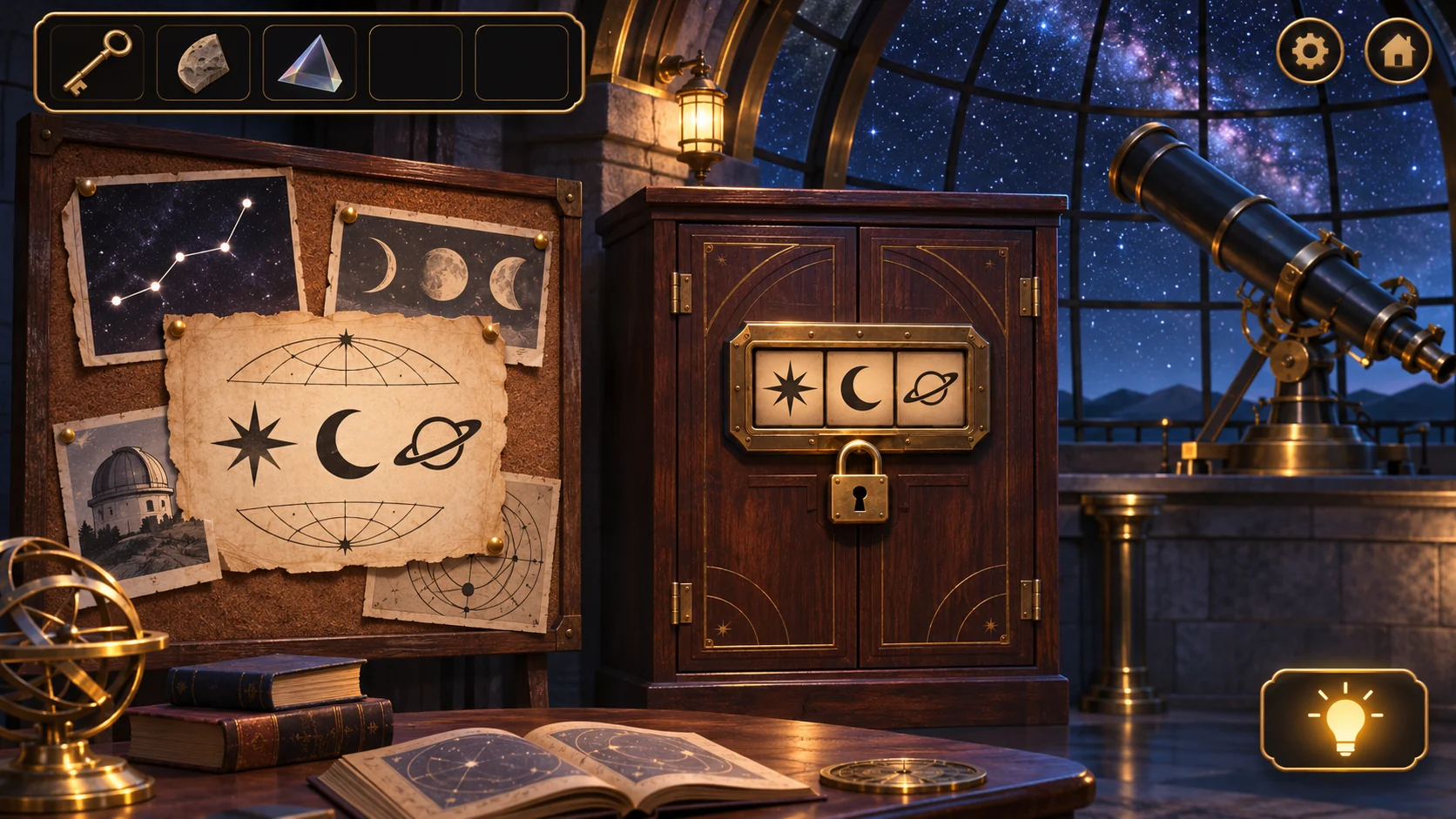
A first digital slice can include a room overview, clickable clue objects, three puzzle states, hint controls, a progress indicator, completion screen and reset. Ask the builder to implement the state transitions and expose a simple debug view so a designer can inspect prerequisites and outputs.
Prompt 5 — first playable slice
Build a small fictional screen-based Aster Observatory prototype with three clue interactions, prerequisite checks, correct and incorrect feedback, a progressive hint control, visible completion state and reset. Include a designer view of puzzle dependencies. Report which interactions actually work, which are static and which rules remain unverified. Do not call it a tested escape room.
A static mockup can communicate layout but cannot demonstrate interaction. Keep that distinction in the handoff so a later review does not mistake a picture for a playable build.
Simulate a customization and inspect the output
For a sample customization, imagine adapting the same structure to The Glasshouse Signal, another invented, screen-based mystery about decoding a greenhouse weather station. Replace the story, clues, dependencies and hint wording, then inspect whether each puzzle still has a visible clue, a clear action and a recoverable state. This is a fictional design exercise, not a real client project.
Prompt 6 — fictional designer customization
Adapt the Aster Observatory schema for a fictional screen-based escape-room concept called The Glasshouse Signal. Create three original puzzles about a greenhouse weather station, with clue dependencies, success conditions, progressive hints, recovery and reset. Label the scenario fictional and untested; preserve editable fields and identify assumptions for a real designer to decide.
Prompt 7 — local review checklist
Review the local prototype against its authored brief. For each puzzle, record whether the clue is visible, prerequisites are met, correct and incorrect actions produce feedback, hints progress gradually, reset works and completion is reachable. Use observed local behavior only; mark unavailable interactions as not tested. Do not infer safety, accessibility, solvability or player enjoyment from a mockup.
Fictional walkthrough snapshot
| Checkpoint | Intended observation | Evidence boundary |
|---|---|---|
| Start | Players can see the star chart and opening objective | Invented screen concept |
| Middle | A chart output is required before the cabinet accepts a code | Defined in the example template only |
| Recovery | Hints reveal increasing detail; reset returns authored states | No interaction was run |
| Ending | Telescope alignment displays a completion state | Fictional success condition |
Use the snapshot to plan a review session. It does not report an observed playthrough.
Conclusion
A useful digital escape-room prototype makes clue dependencies, feedback, hints, recovery and completion inspectable. Start with a bounded mystery, keep the puzzle graph editable and label assumptions for review. Aster Observatory and The Glasshouse Signal are fictional examples; no real venue or playable prototype was tested. Review the implemented interactions and run appropriate playtests before making claims about player experience.
You can take a scoped concept into the Free AI game maker, then compare the result with the editable puzzle checklist.
FAQ
What should a digital escape-room prototype include?
Include an objective, visible clues, puzzle dependencies, correct and incorrect feedback, hints, recovery, completion and reset states.
How do designers map escape-room puzzle dependencies?
List each puzzle’s prerequisites, clue, player action, success condition and output, then connect outputs to dependent puzzles.
Can AI make a playable escape-room prototype?
AI can help draft a prototype or its structure, but whether the interactions work must be checked in the resulting build.
Does a digital prototype prove a physical room is safe or solvable?
No. A digital concept cannot establish physical safety or player solvability. Appropriate reviews and playtests are still needed.
How should hints be designed in an escape-room prototype?
Use a progressive ladder that starts with a nudge, adds direction and reveals a near-solution only later.