Underroot Farm has one freight lift and a brief surface window each day. The platform holds four cargo slots shared in both directions. A player might send seed trays down, bring tools up or use the same trip to return produce for sale. Mushroom beds keep growing underground, but sun-loving crops depend on what fits through the lift. The central farming loop is therefore a daily logistics choice, not just a cave setting.
Make surface access change the day plan
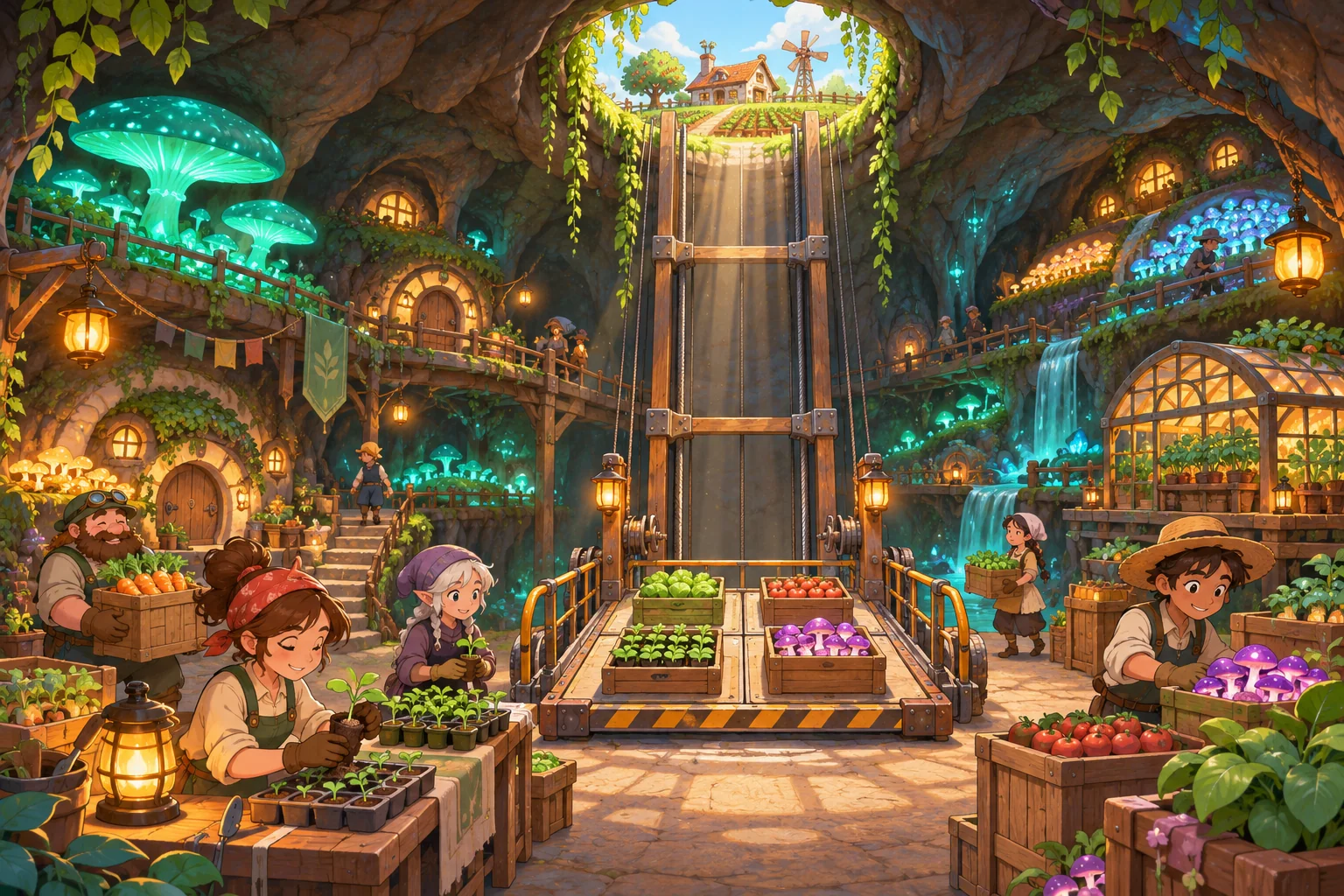
Keep the first prototype to one surface plot, one underground village, one lift and three cargo types: seedlings, tools and produce. For a sample day, prepare three seedling trays and two produce crates. There are five items competing for four slots, so the player cannot move everything at once.
| Cargo | Direction | Why it competes for a slot |
|---|---|---|
| Seedling tray | Down to the farm | Starts a sun-loving crop |
| Tool crate | Either way | Enables planting or repairs |
| Produce crate | Up to the surface | Can be sold during the market window |
Show the access window, lift capacity and item count before confirming a trip. Underground mushrooms can continue on their own crop timer; do not make every plant stop merely because the lift is closed. This distinction gives players a real choice about which crops depend on scarce surface access.
Treat each lift trip as shared capacity
Count cargo in both directions against the same four slots. A trip carrying three seedling trays down and two produce crates up is five items, so one must wait. If the surface window closes before departure, preserve every item in its original inventory and mark the transfer as deferred. Do not partially remove a crate or silently reset the lift count.

Make the player choose which item to postpone and show the consequence: a planting may wait a day, a sale may miss the market, while underground crops continue growing. Keep the decision reversible until the lift departs. A clear manifest and countdown help the player understand why each cargo slot matters.
Replay one day with the same cargo
The local rules replay started with three seedling trays and two produce crates. An unlimited-transfer version moved all five. The revised rule accepted four and kept the fifth item in inventory. When the access window was closed, none moved; at the next open window, the deferred items remained available to choose again. This verifies capacity and timing behavior, not crop growth, market pricing or a playable farm.
| Scenario | Unlimited transfer | Four-slot lift rule |
|---|---|---|
| Five items, window open | All 5 move | 4 move; 1 waits |
| Three items, window closed | Transfer can proceed | 0 move; all wait |
| Next window opens | No deferred state | Waiting items can be selected |
Choose one consistent definition for a “slot,” such as one crate or one tray. If tools occupy more space, state their slot cost in the manifest and replay the same cases. Avoid changing cargo weight and lift capacity together in the first experiment.

Start with one lift and one growing week
Ask an AI game maker for a seven-day farming prototype with a visible lift manifest, a daily access window and separate crop timers. Start with one surface crop and one underground mushroom. Add a market day only after players can plan a full week of transfers and explain what remains behind.
Create Underroot Farm, a farming simulation about an underground community with limited surface access. Use one lift with four shared cargo slots and one short open window each day. Cargo includes seedling trays, tool crates and produce crates; count items in both directions against the same capacity. If the window is closed, defer the trip and preserve the cargo. Let underground mushrooms continue growing on their own timer while sun-loving crops depend on surface access. Show the manifest, remaining window, next market day and the consequence of postponing an item. Add a reset for the same sample day.
Start a farming simulation prototype in SEELE
Frequently asked questions
Should all crops stop growing when the lift closes?
No. Keep underground crops on their own timer so the access limit affects only the crops and goods that depend on the surface. This makes the constraint legible instead of turning a closed lift into a global pause. Show the distinct timers and let players compare which planting plan needs the next trip.
What happens to cargo that does not fit?
Keep it in its original inventory and show that it is waiting for a later trip. Let the player choose which four items travel before departure, then preserve the rest if the window closes. Do not delete overflow or count one crate as both delivered and still waiting.
When should I add market prices and seasons?
After the lift schedule is understandable with fixed cargo and a simple crop timer. Introduce one variable at a time, then replay the same week to see whether it creates a planning decision. If prices, weather and lift capacity all change together, it becomes hard to tell which rule caused a missed harvest or sale.