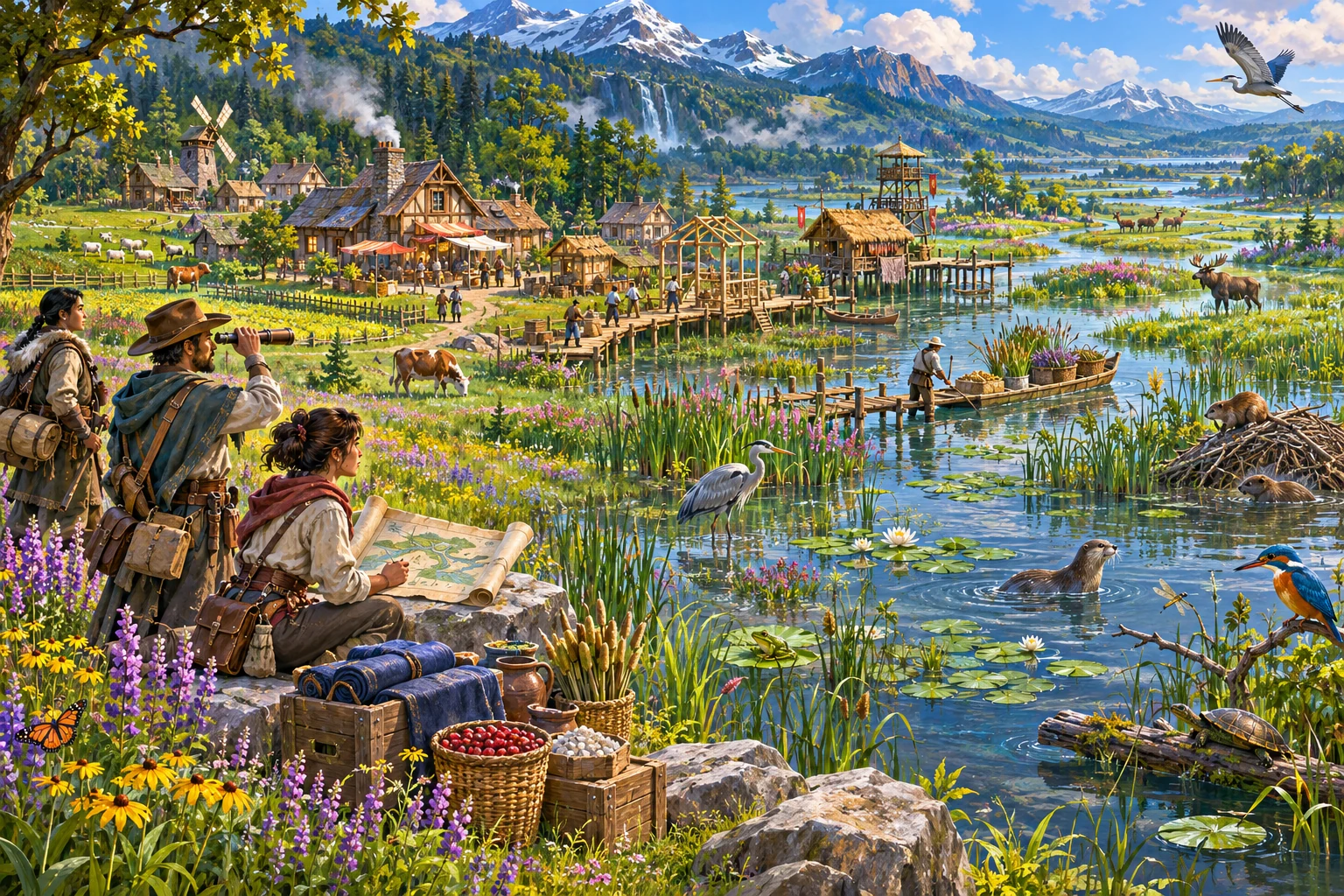
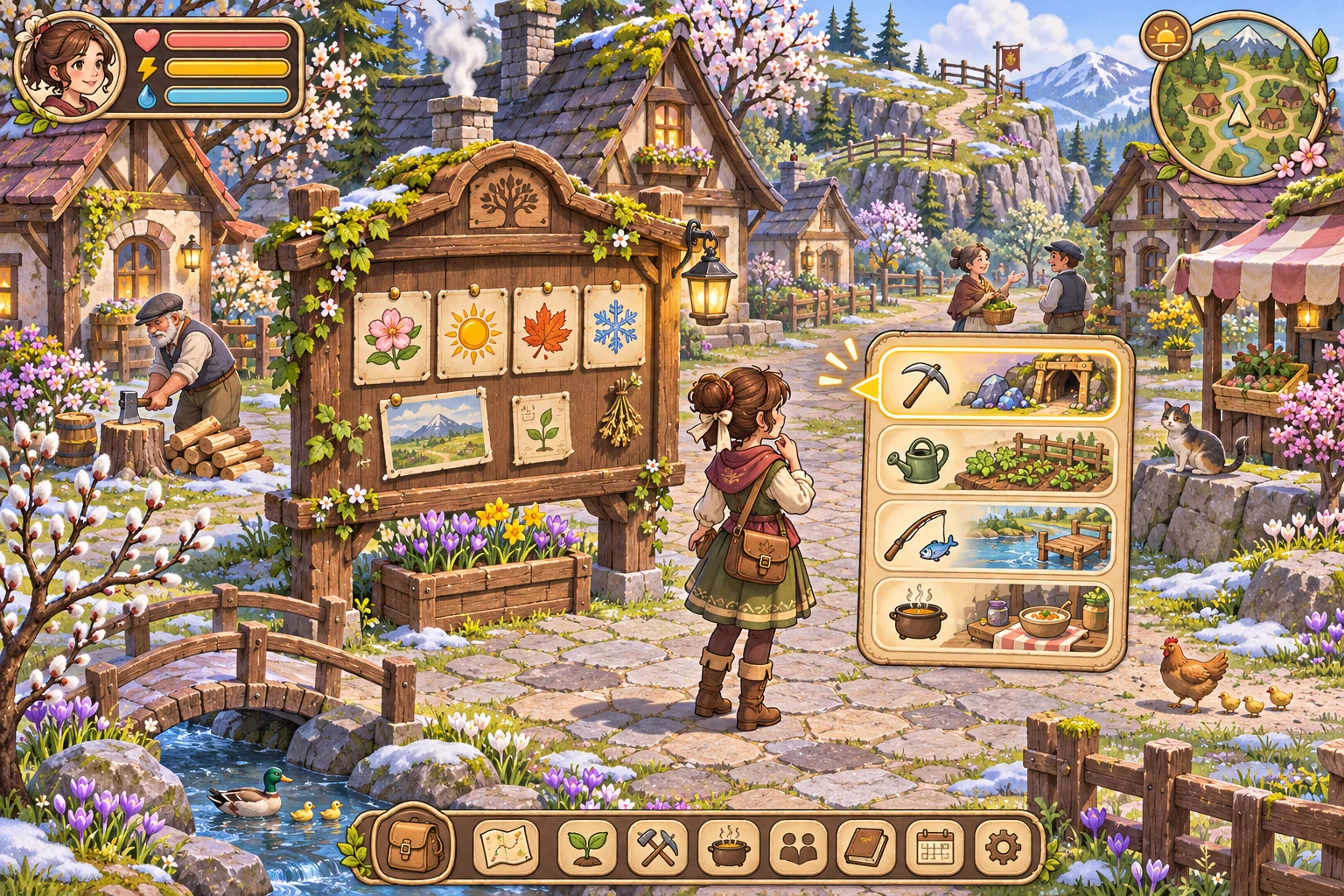
A small ecosystem feels more connected when every community depends on the landscape and on one another. In Mosswater Basin, the Reedbank catches fish, the Sunridge grows fruit, and the Claybend makes pottery. None produces the other goods. The player schedules two trade routes on a winding river, then adjusts one shared sluice to keep boats moving without draining the wetland.
The daily loop is plan, trade, observe, and restore. Each village makes two crates of its specialty per day and consumes one crate of a different good. A route carries two crates across one river leg. Water level changes which legs are navigable, while opening the sluice can expose nesting reeds. The player succeeds by completing three community requests and keeping wetland health above zero through seven days.
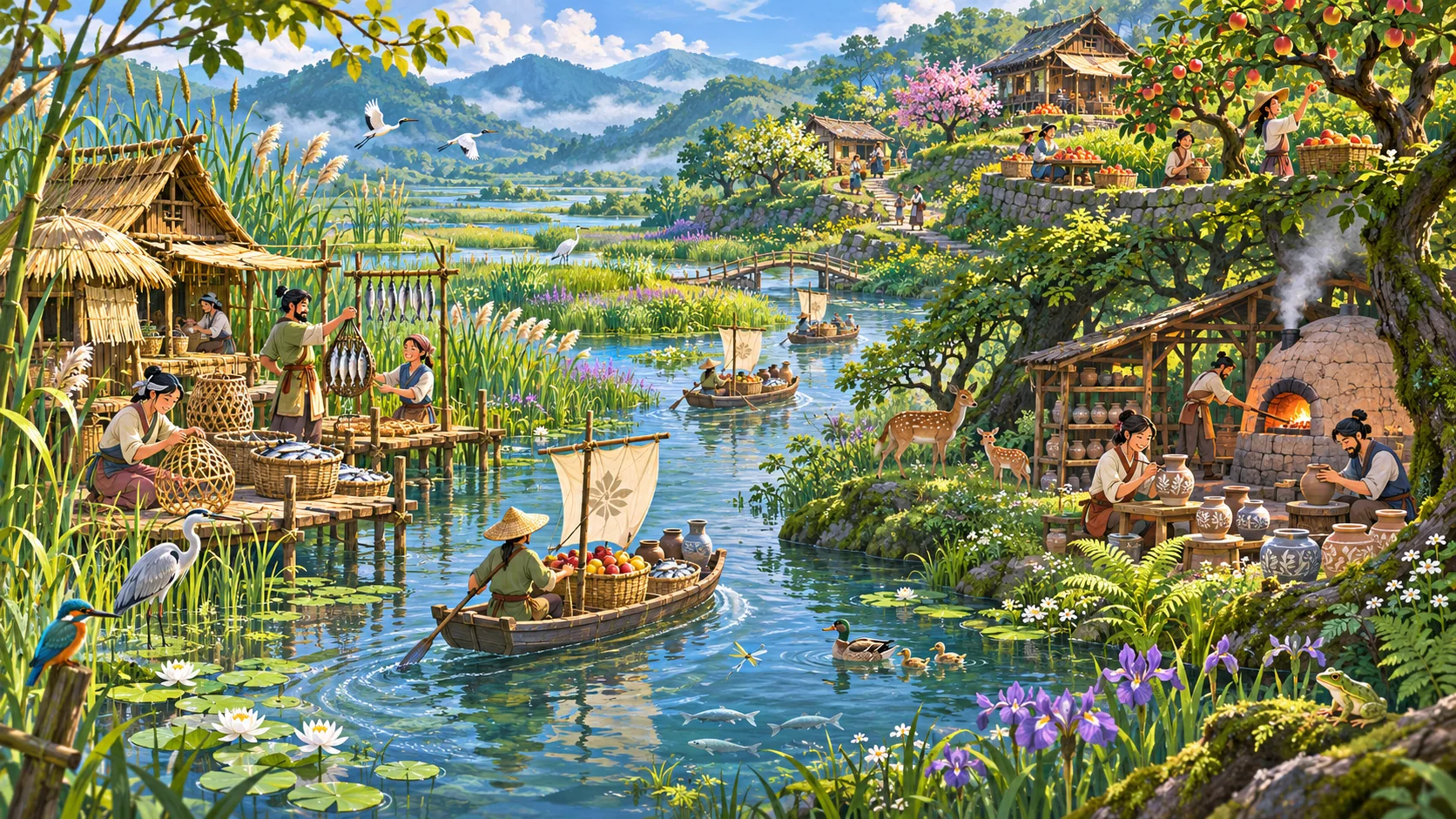
Give each habitat a needed specialty
Build three settlements around one wetland basin. Reedbank produces two fish crates per day, Sunridge produces two fruit crates per day, and Claybend produces two pottery crates per day. Each consumes one crate of a different good per day: Reedbank needs pottery, Sunridge needs fish, and Claybend needs fruit. Each settlement starts with two crates of its own good and zero imported goods. Before each day, the player sets two directed river routes, each between neighboring settlements. A route can carry at most two crates in a day, and a good can only be sent if the source has stock after local production and the destination has not already received its daily need. Goods delivered are consumed at day end. Any delivered extra crate stays in destination storage, capped at four; production beyond the cap is lost. The river has three legs and a water gauge from zero to four. At level two or three, all legs carry two crates. At level one, only the lower two legs are navigable and each carries one crate. At level zero, boats do not move. At level four, all legs are navigable and carry two crates, but nesting reeds flood and wetland health drops by one that day. The player may open the sluice before trading to raise water by one, up to four. If the player holds it, water falls by one at day end, to a minimum of zero. Wetland health starts at five; it increases by one at day end when water is level two or three, falls by one at level zero or four, and never exceeds five or drops below zero. Each request has a cumulative delivery counter that increments when a matching crate reaches its settlement, before day-end consumption. The game ends in ecological failure at zero health. Complete three requests by day seven: deliver two fish to Sunridge, two fruit to Claybend, and two pottery to Reedbank. Victory requires all requests completed and wetland health above zero at the end of day seven. The player may change routes and sluice choice every day; there are no random disasters, hidden production rules, or extra goods.
| System | Expected behavior |
|---|---|
| Specialists | Reedbank makes 2 fish/day; Sunridge 2 fruit/day; Claybend 2 pottery/day. Each consumes a different imported good. |
| Trade routes | Set two directed neighboring-settlement routes each day. Each navigable leg has a capacity defined by the water level. |
| Stock | Daily production occurs before trade; local need and imports resolve at day end; storage caps at 4 crates. |
| Water level | 0–4 gauge. Levels 2–3: all legs, 2 crates each; level 1: lower two legs, 1 crate each; level 0: no boats; level 4: all legs, 2 crates each. |
| Sluice and habitat | Opening raises water by 1 before trade. Holding lowers it by 1 at day end. Level 0 or 4 costs 1 habitat; level 2 or 3 restores 1. |
| Requests | By day 7, deliver 2 fish to Sunridge, 2 fruit to Claybend, and 2 pottery to Reedbank. |
| End states | Wetland health starts at 5 and must remain above 0. Victory requires all three requests by end of day 7. |
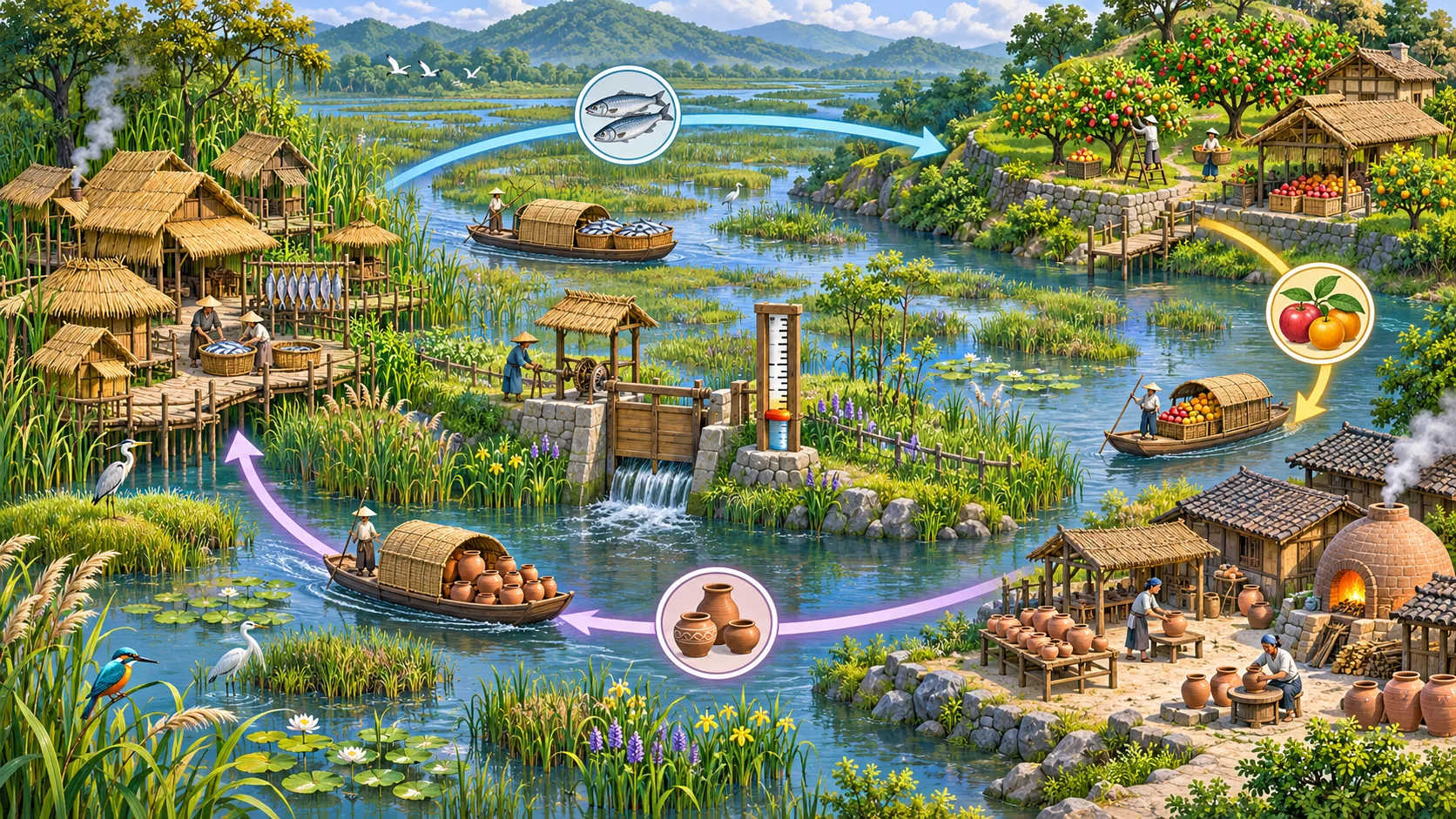
Model trade routes and shared water
Start day one with water at level two and wetland health at five. Reedbank and Sunridge neighbor each other on the upper river; Claybend connects through the lower leg. The player routes two fish crates from Reedbank to Sunridge and two pottery crates from Claybend to Reedbank. Both legs are navigable at level two. The two villages receive their needed goods; any surplus remains in storage up to four. Since the player holds the sluice, water falls to level one at day end. Habitat health stays at five because level one is neither the wetland’s best nor worst band; the written rule adds or subtracts only at the explicit thresholds. On day two, the player opens the sluice, raising water back to level two before trade. They send two fruit crates from Sunridge to Claybend and use the second route to deliver the requested fish. At day end, level remains two and habitat health increases by one, capped at five. Repeating the three specialties across days fulfills each two-crate request without asking any village to produce every good. This is an authored state trace, not a playable or user test.
| Step | Expected state |
|---|---|
| Start day 1 | Water=2, habitat=5; all villages produce two specialty crates. |
| Route fish | Send 2 Reedbank fish to neighboring Sunridge on an open leg. |
| Route pottery | Send 2 Claybend pottery to Reedbank on its lower leg. |
| Resolve day 1 | Recipients consume one needed crate; extra stock carries up to cap 4; water held drops to 1. |
| Open sluice day 2 | Water rises to 2 before trade; habitat is not yet damaged. |
| Route fruit | Send 2 Sunridge fruit to Claybend; complete a community request. |
| Day-end ecology | At water 2, habitat gains 1, capped at 5. |
| Continue to day 7 | Complete all three two-crate requests and keep habitat health above 0 for victory. |
Trace a delivery through a low-water day
Ask for a small deterministic economy first. State production, consumption, capacities, route adjacency, sluice order, habitat thresholds, and the day-seven goal so an AI build cannot quietly invent a fourth resource.
Create a cozy top-down ecosystem simulation prototype called Mosswater Basin with three settlements: Reedbank, Sunridge and Claybend. Reedbank produces 2 fish crates per day and consumes 1 pottery; Sunridge produces 2 fruit and consumes 1 fish; Claybend produces 2 pottery and consumes 1 fruit. No settlement produces all goods. Place them along a three-leg river: Reedbank-Sunridge on the upper leg, Sunridge-Claybend on the middle leg, Claybend-Reedbank on the lower leg. Before each day, let the player set two directed routes between neighbors; each route carries crates over one leg. Stock production happens before trade; goods are consumed at day end; extra stock stores up to 4 crates per settlement. Show each village stock, unmet daily need, route capacity, water level, habitat health and day counter. Water gauge ranges 0–4. At water 2 or 3, all legs carry 2 crates. At water 1, only lower two legs work and carry 1 crate. At water 0, boats do not move. At water 4, all legs carry 2 crates but wetland health falls by 1 that day. The player can open the sluice before trade to raise water by 1 up to 4; holding it makes water fall by 1 at day end to a minimum of 0. Habitat starts at 5; at day end it gains 1 at water 2 or 3 and loses 1 at water 0 or 4, clamped 0–5. End in ecological failure at 0. Give three cumulative delivery requests: deliver 2 fish to Sunridge, 2 fruit to Claybend, and 2 pottery to Reedbank by day 7. Count deliveries on arrival before day-end consumption. Victory if all are complete and habitat is above 0 at end of day 7. Do not add random disasters, new goods, additional settlements, or hidden rules. Show exactly why a route fails when water is too low. Reset clears stock, requests, water and habitat to their starting values.Prompt AI for one readable ecosystem loop
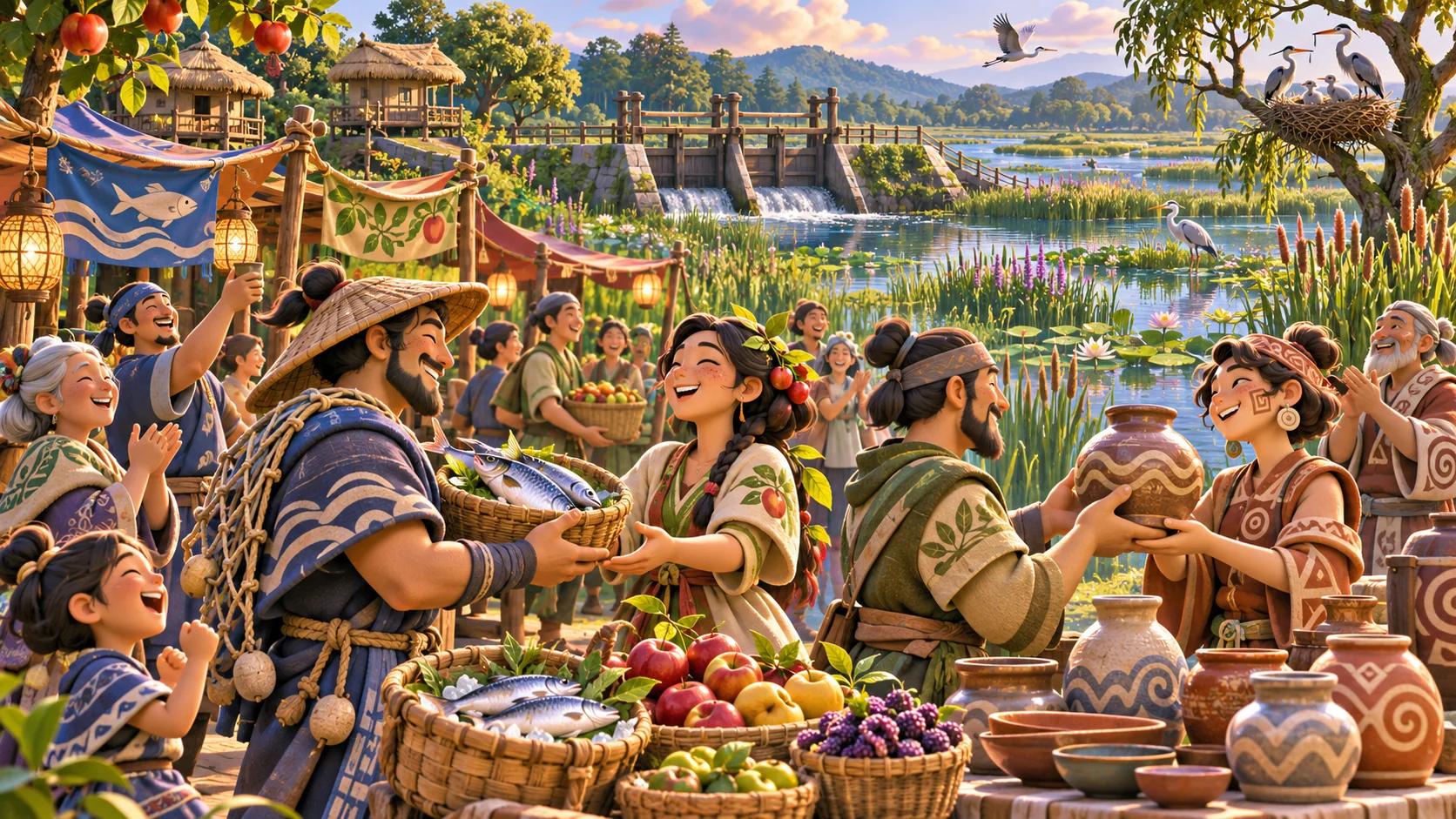
The first sluice draft made high water purely beneficial, so players always opened it. The final rule lets level four carry full loads but floods nesting reeds for one day of habitat damage. Middle levels still restore wetland health, making trade capacity and ecosystem recovery a visible choice.
A second revision clarified the order: production happens before trade, needs resolve at day end, and overflow is capped at four crates. This prevents the route plan from depending on an unstated production or storage order.
Revise the sluice tradeoff
Prototype the stock panel and one route leg before expanding the basin. Make water level, per-leg capacity, habitat change and each unmet community need visible before the player chooses the sluice. The written trace checks the authored rules only; it is not a playable test or a claim that the economy is balanced.
Read the related cozy village design guide.
Try the SEELE AI cozy game workflow.
Frequently asked questions
Does every village produce every good?
No. Reedbank produces fish, Sunridge produces fruit, and Claybend makes pottery. Each settlement relies on imports for a different daily need, so trade routes connect the communities instead of duplicating production everywhere. Their specialties create a reason to keep the river and shared habitat healthy.
Why does the sluice affect wetland health?
Water level four makes every river leg navigable but floods nesting reeds for that day. Water levels two and three restore habitat, while level zero also harms it. The player balances deliveries with the shared wetland instead of maximizing boat access.
Check Godot's official signals guide.
What happens to extra delivered goods?
The destination consumes one crate of its needed import at day end. Any extra delivered crate stays in storage, up to a four-crate cap. Production beyond that cap is lost, so the player needs to read stock levels before choosing both daily routes.
Has the ecosystem economy been tested in a playable game?
No. The production rates, trade rules and day trace are an authored local design brief. They have not been implemented in a playable game, balanced through user tests, or checked in a browser. The numbers are clear starting rules for a prototype iteration.