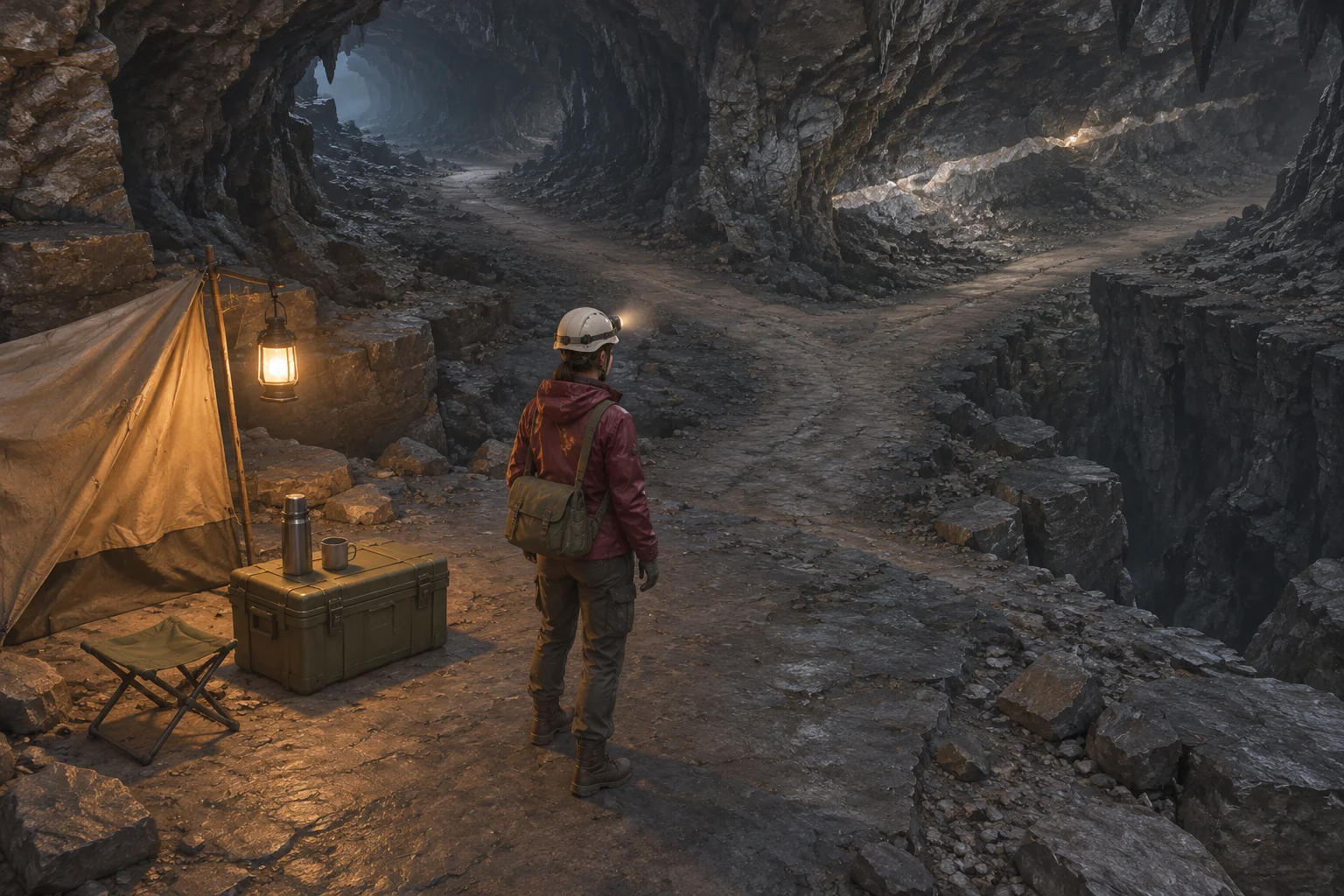
Start with a mining trip that changes the way back. Send the player from a small underground camp to a seam. Taking one sample can close the path they used to get there. One brace can keep the short crossing open or open a hatch on the longer route.
In the fictional Lode Return, the player makes that choice across five locations. The goal is to bring a sample back to camp. Mining changes the map, so reaching the seam is only half the job.
Extract one reason to explore
Fireshine Games’ Core Keeper page describes an underground mining sandbox that combines exploration, resource harvesting, tool crafting, and base building. Developer Pugstorm also describes digging underground in the game.
Use that premise to ask what a resource trip should make the player plan. The original example below gives one sample a direct effect on the route home. A cave shelf and service hatch carry the decision. Give the new game its own setting, characters, and map.
Draw a map that can change
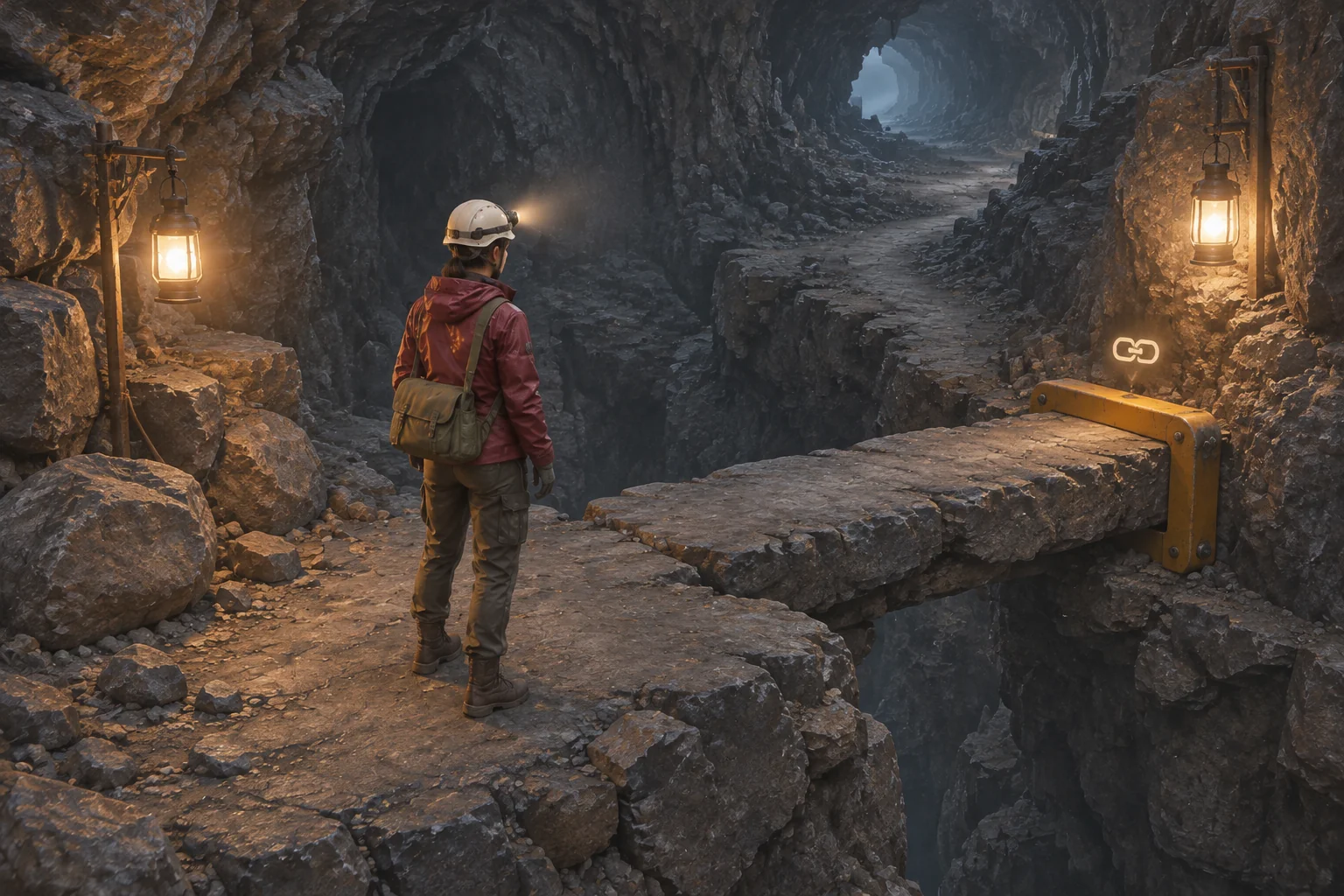
Start the player at camp with one brace and no sample. Use these five locations. An open link works in both directions. Keep the map incomplete at first. Show the weak shelf when the player reaches the junction, the gallery passage at the seam, and the service landing when the player reaches the gallery.
| Location | Connection or action |
|---|---|
| Camp C | Connects to Junction J. Returning with the sample completes the trip. |
| Junction J | Connects to Seam S by a weak shelf. Show a warning and the option to fit the brace. |
| Seam S | Connects to High Gallery H. The player can fit the brace to the shelf before mining and take one sample here. |
| High Gallery H | Connects to Service Landing D. |
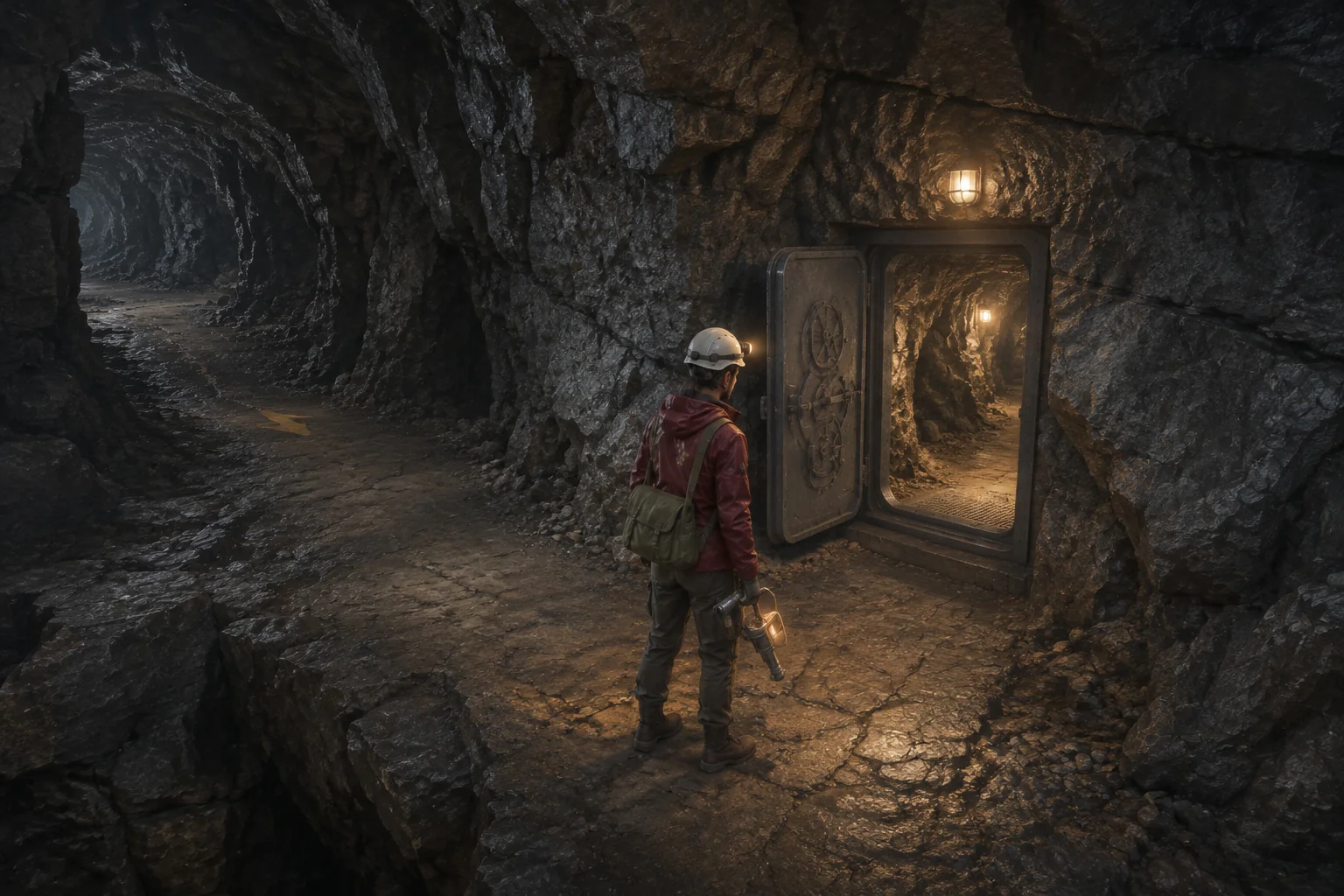
| Service Landing D | Has a closed hatch to camp. Opening it from D takes the brace. |
Make moving across a link, fitting the brace, mining, and opening the hatch separate actions. Fit Brace uses the only brace and keeps the shelf open after mining. If the shelf is still weak when the player mines, grant the sample and close the shelf. The player cannot fit a brace after mining. The unused brace can still open the hatch at D.
Trace both routes back to camp
Before mining, show the state of the shelf and tell the player when it will close. After mining, update the route display and leave the player at the seam. Reject a move onto a closed link without spending the brace, losing the sample, or counting another action.
| Plan | Accepted actions | Result |
|---|---|---|
| Support the shelf | C to J, Fit Brace, J to S, Mine, S to J, J to C. | Six actions. The shelf remains open and the hatch stays closed. |
| Save the brace for the hatch | C to J, J to S, Mine, S to H, H to D, Open Hatch, D to C. | Seven actions. Mining closes the shelf. Opening the hatch restores a route to camp. |
The second plan also covers a useful failure check. After Mine, try to move from S to J. The player should stay at S with one sample, one brace, and three accepted actions. The gallery is still available. A closed edge changes the route without ending the trip.
Give AI one complete underground trip
Use the links and state changes as the first prompt. SEELE’s prompt-led creation offers a starting point for a small build. A simple room view and a route panel are enough to verify whether mining affects the right connection.
Make an original browser exploration game called Lode Return.
Use Camp C, Junction J, Seam S, High Gallery H and Service Landing D.
Open C-J, J-S, S-H and H-D in both directions. Close hatch D-C.
Start at C with one brace and no sample. The shelf J-S starts weak.

Show the shelf and its warning at J. Reveal H from S and D from H.
A reveal never changes whether a link is open.
Move across one open link. Reject a closed or absent link without
changing position, items or the accepted-action count.

Before Mine, Fit Brace at J or S if the shelf is open and weak.
Spend the only brace and mark the shelf supported.
Mine once at S. Add one sample, then close J-S if it is still weak.
Open Hatch at D only, spending an unused brace to open D-C.
Reject a second Mine, a second brace use or an unavailable action.

Win on arriving at C with the sample. Arriving at C empty keeps the
trip open. Reset position, discoveries, links, sample and brace.
Show the current room, route states, sample and brace.
Use an original cavern, camp, explorer and interface.
Replay both routes. Try returning to camp without a sample, mining twice, and opening the hatch from camp. Check that the brace can only be used once. Finally, reset after a win and check that the weak shelf, closed hatch, and unmined seam are back.
Move the collapse to a later action
Change when the weak shelf closes. In the new rule, mining schedules the collapse after the next accepted move. Check that move against the links open when it begins. An invalid move does not trigger the collapse. Fit Brace still has to happen before mining.
Replay C to J, J to S, Mine, S to J, then J to C. In the baseline, the fourth input is refused. With delayed collapse, the player crosses to J before the shelf closes and finishes in five actions with the brace still held. Tell the player when the collapse will occur in each version. The new rule makes a quick return possible and reduces the need to commit the brace early. Use the guide to revising one rule and rerunning the loop to compare the same inputs from reset.
Build one trip before expanding the cavern
Choose a resource that changes one connection and give the player a visible way home. Start your original underground adventure with SEELE’s AI Game Maker and check the return routes before adding more tools or rooms.
Frequently asked questions
How small can the first exploration map be?
Use enough rooms to make the outward and return routes feel different. A camp, a seam, and one detour can do that if taking the sample changes a visible connection. Add more rooms when they give the player a new route decision.
How should I show a blocked route?
Give the link a different state on the map and show the same change in the room. A rejected move should name the blocked crossing and leave the player in place. Keep other open exits visible so the player can choose what to try next.
Do I need a timer to make the return trip matter?
One resource commitment can make the route matter without a clock. Here, spending the brace changes which link can be used. Add a timer only when elapsed time is the decision you want to study. A route change is easier to isolate on its own.
When should I add procedural variation?
Add variation after a fixed map can be replayed and reset. Change one connection or starting item first. For every map the generator produces, check that at least one route can reach the seam and bring the sample back under the stated rules.