To make an original gathering game inspired by Forager, give the first crafted object a job that changes what the player can do next. In this fictional highland yard, the player gathers slate and wick to build a water collector. Its output can open a new terrace or pay for an improvement that produces more water later.
Start with one collector and one gate. The first clay harvest gives you a finish line, and the same opening lets you compare spending on access with spending on production.
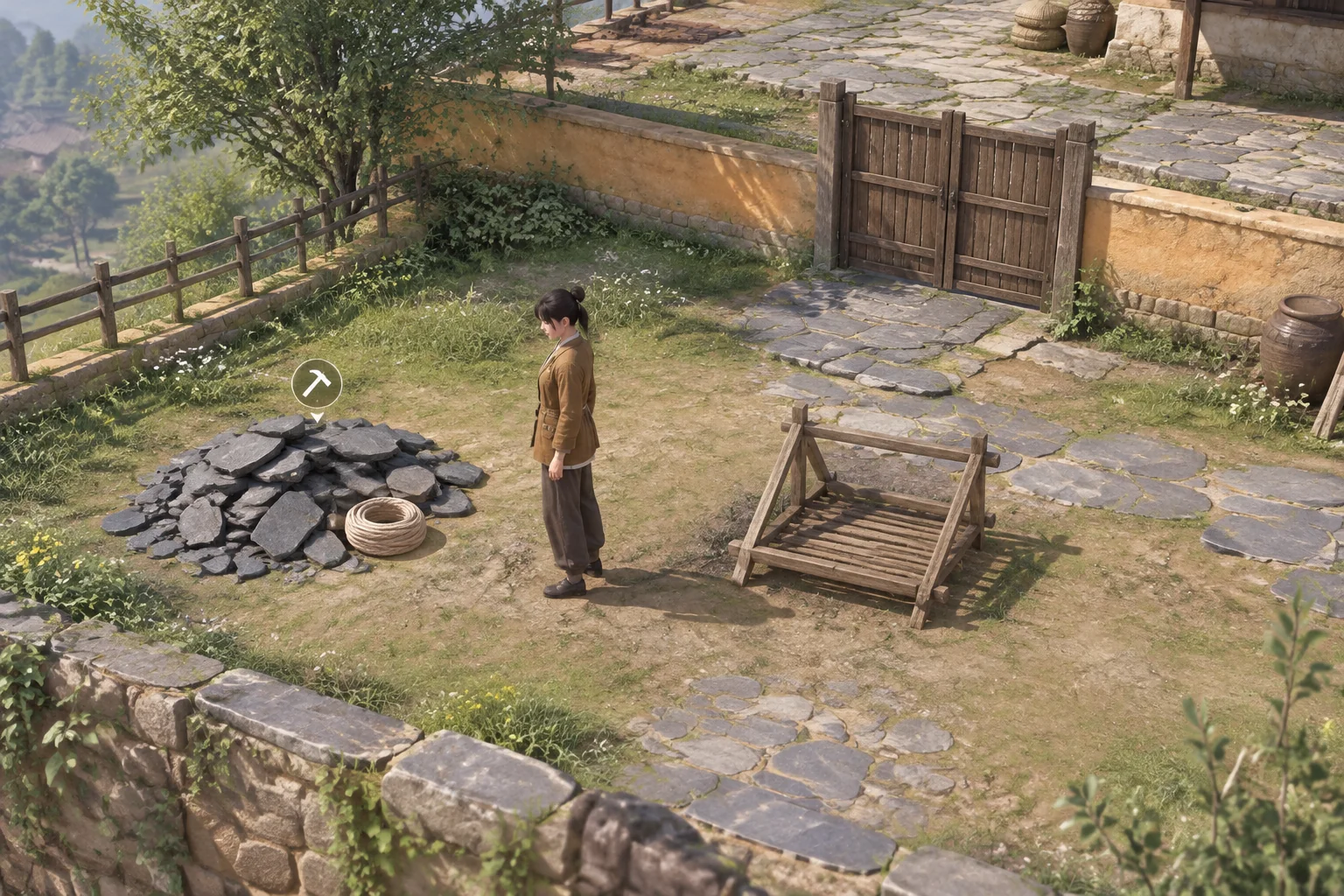
Take the gather-and-expand loop into a new setting
Forager connects gathering and managing resources with crafting and expanding the area the player can explore. Its official descriptions include building up a base and buying land. See HopFrog’s Forager page and the official Steam listing for those details.
For your own game, choose an original place and a reason to open more space. Here, the highland terrace contains a blue clay deposit the player cannot reach from the starting yard. The collector, gate, crafting recipe, and water costs are rules for this new prototype.
Let one collector make the next choice possible
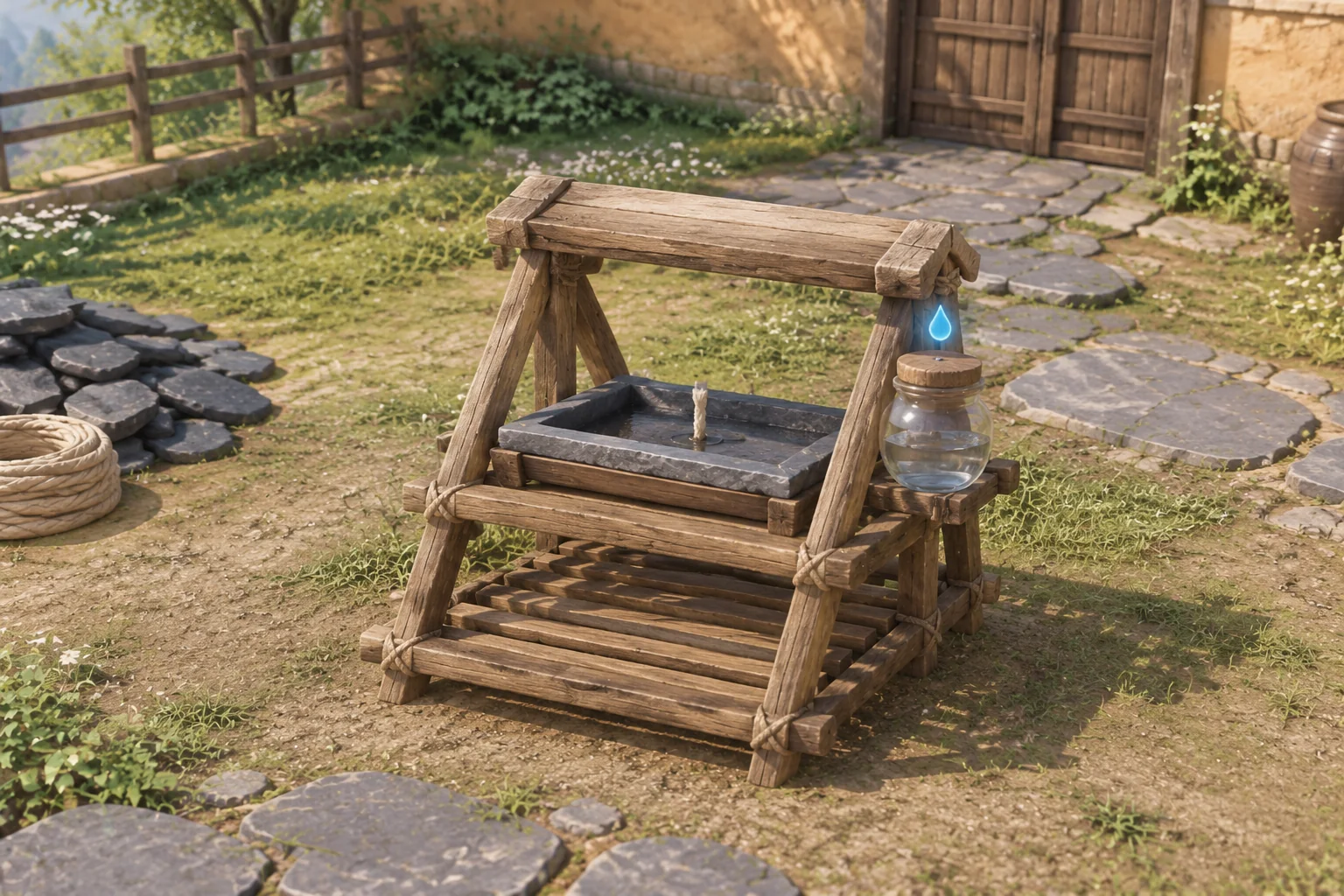
Start with no slate, wick, water, or clay. Gather once from the starter pile to get two slate and one wick. Spend both materials to craft the collector. From the next accepted tick onward, it adds one water after each action.
| Action | Cost or requirement | Effect |
|---|---|---|
| Gather | Available once. | Add two slate and one wick. |
| Craft Collector | Spend two slate and one wick. Available once. | Install a collector that produces one water on later accepted ticks. |
| Improve Collector | Spend two water. Requires the collector and can be done once. | Raise output from one to two water on later accepted ticks. |
| Open Terrace | Spend three water. Available once. | Make the clay deposit accessible. |
| Harvest Clay | Requires the open terrace. | Collect one blue clay and finish after this tick’s output. |
| Wait | Use one tick. | Let the existing collector produce at tick end. |
Record the collector’s rate at the start of each accepted tick. Apply the action, then add water using that recorded rate. Crafting yields no water on its own tick. Improving still uses the old rate that tick. The collector runs on accepted actions rather than elapsed time, and a rejected action produces nothing.
Compare opening the terrace with improving first
Use the same first four ticks for both routes. Gather on tick 1, craft on tick 2, and wait on ticks 3 and 4. The collector makes its first water on tick 3, and the player has two by the end of tick 4.
| Tick | Open first | Improve first |
|---|---|---|
| 5 | Wait. Water rises to 3. | Improve. Spend 2 and add 1 at the old rate. Water ends at 1. |
| 6 | Open the terrace. Spend 3 and add 1. Water ends at 1. | Wait. Add 2 and reach water 3. |
| 7 | Harvest. Add 1 and finish with clay 1 and water 2. | Open the terrace. Spend 3 and add 2. Water ends at 2. |
| 8 | Already finished. | Harvest. Add 2 and finish with clay 1 and water 4. |
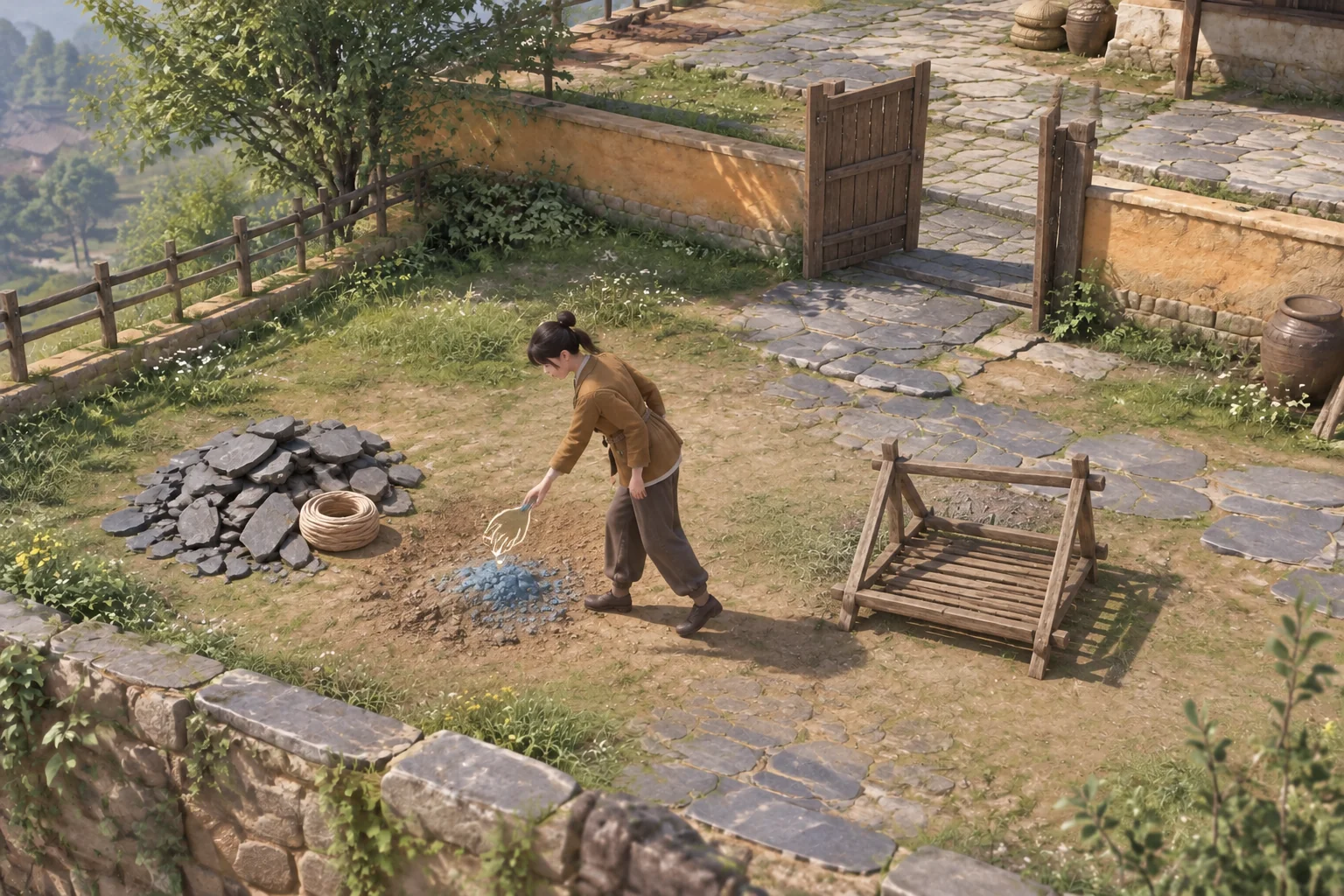
Opening first reaches the clay a tick sooner. Improving first leaves more water at the end, but it delays access. Show both the available water and the next output so the player can tell how long the investment takes to pay back.
Ask AI for the complete resource chain
SEELE’s AI game maker offers a starting point for a small build with one loop to check. Describe the yard and exact resource rules. Let the first draft establish the scene while you verify that the action and production order match the table.
Build one original browser gathering game in a highland yard.
Start at tick 1 with zero slate, wick, water and clay. Use a
starter pile, collector stand, closed terrace and blue clay deposit.

Accept one action per tick. Gather once for 2 slate and 1 wick.
Craft one collector for 2 slate and 1 wick. Its rate is 1 water.
Improve once for 2 water and raise its rate to 2.
Open the terrace once for 3 water. Harvest one clay only after
opening it. Wait uses one tick. Reject invalid or unaffordable
actions without changing time, stock, or output.

Snapshot the collector's existence and rate at the start of an
accepted tick. Apply the action, then add the snapshot water.
Crafting produces nothing that tick. Improving uses the old rate
until the next accepted tick. There is no wall-clock production.

Finish after the first clay harvest and that tick's output. If
tick 8 ends without a harvest, show unfinished. Restart clears
all resources, the collector, gate, harvest and tick state.
Try improving at the start of tick 4 with only one water. The request should be refused without giving another water or spending the tick. Try harvesting with the gate closed. Then run both legal paths and check the output after each action. The guide to checking an AI game in small steps can help you request one focused change when a rule fails.
Change only the improvement cost
Try making the improvement cost one water instead of two. After the first water on tick 3, improve on tick 4. Spend that water and add one at the old rate. Wait on tick 5 to reach three water. Open on tick 6, add two after spending, and harvest on tick 7 with four water remaining.
The open-first route still finishes on tick 7 with two water. In this worksheet, the cheaper improvement closes the timing gap. In a built version, check whether players still have a reason to open the gate first when both routes reach the clay on the same tick.
Make the first expansion change what players can do
Build the starter pile, one collector, and one new terrace. Check the first passive output and replay both spending decisions. Start your original gathering prototype with SEELE’s AI game maker and keep the water table beside the first build.
Frequently asked questions
Can passive production work in a turn-based game?
Yes. Let a machine produce after each accepted action without asking the player to operate it. The turn controls when output arrives. That makes it easy to see how waiting, improving, or opening a gate changes what the player can afford next.
Why check whether an action is affordable before adding water?
That order makes the current balance meaningful. If a player can gain production by attempting an action they cannot afford, a rejected click becomes a way to make water. Keep the tick pending and give the player a valid choice, such as Wait.
How do I decide whether to expand first?
Compare what the new area gives you with what the upgrade adds before you arrive. In this fixture, opening first gets clay sooner, while improving first preserves more water at the finish. Show both outcomes so players can choose the one that fits their current goal.
When should I add another producer?
Add one when players can explain why the first collector makes water and how spending it affects the gate. Give the next producer a different output or constraint so it changes the choice. Retest the first terrace before adding a longer resource chain.