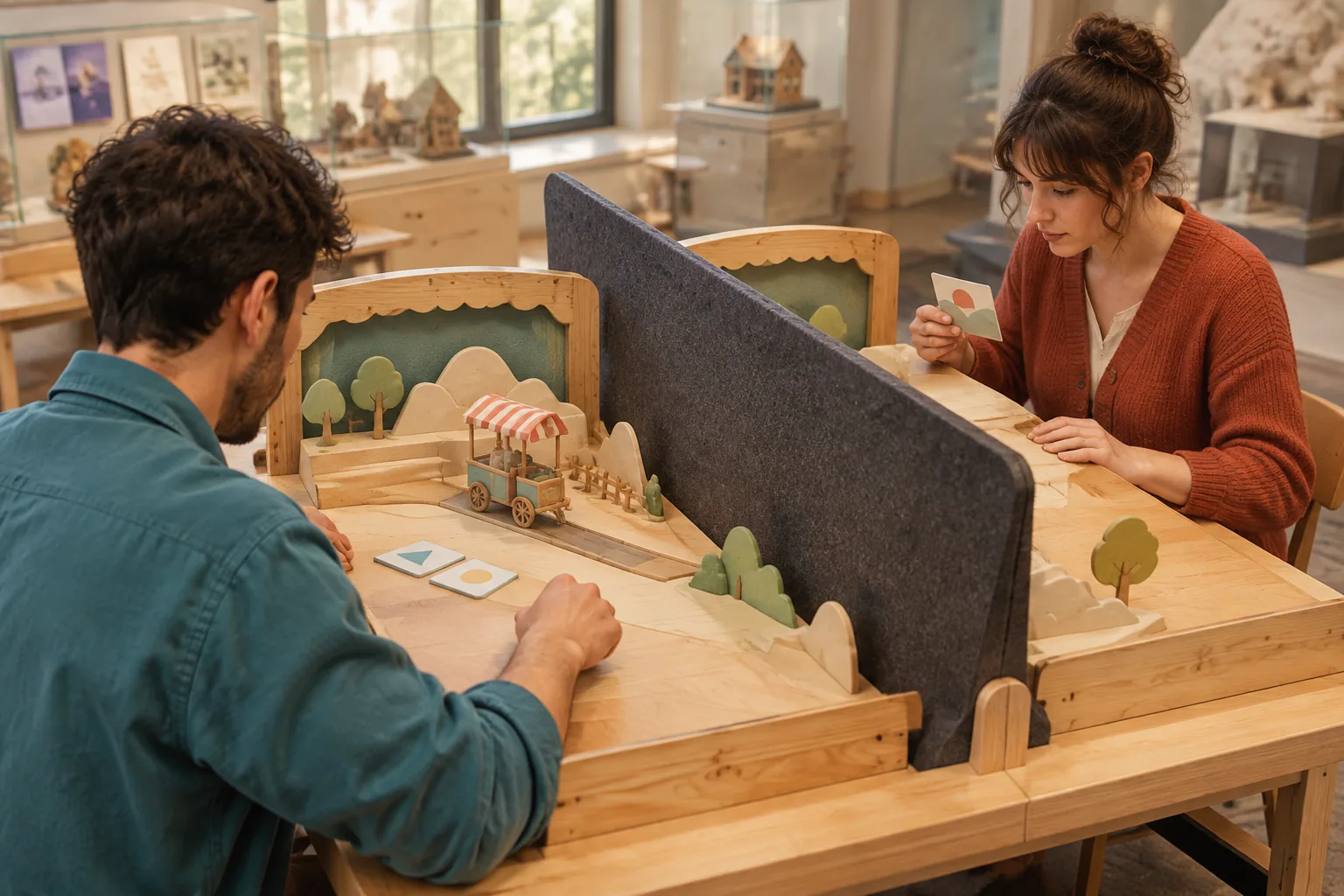
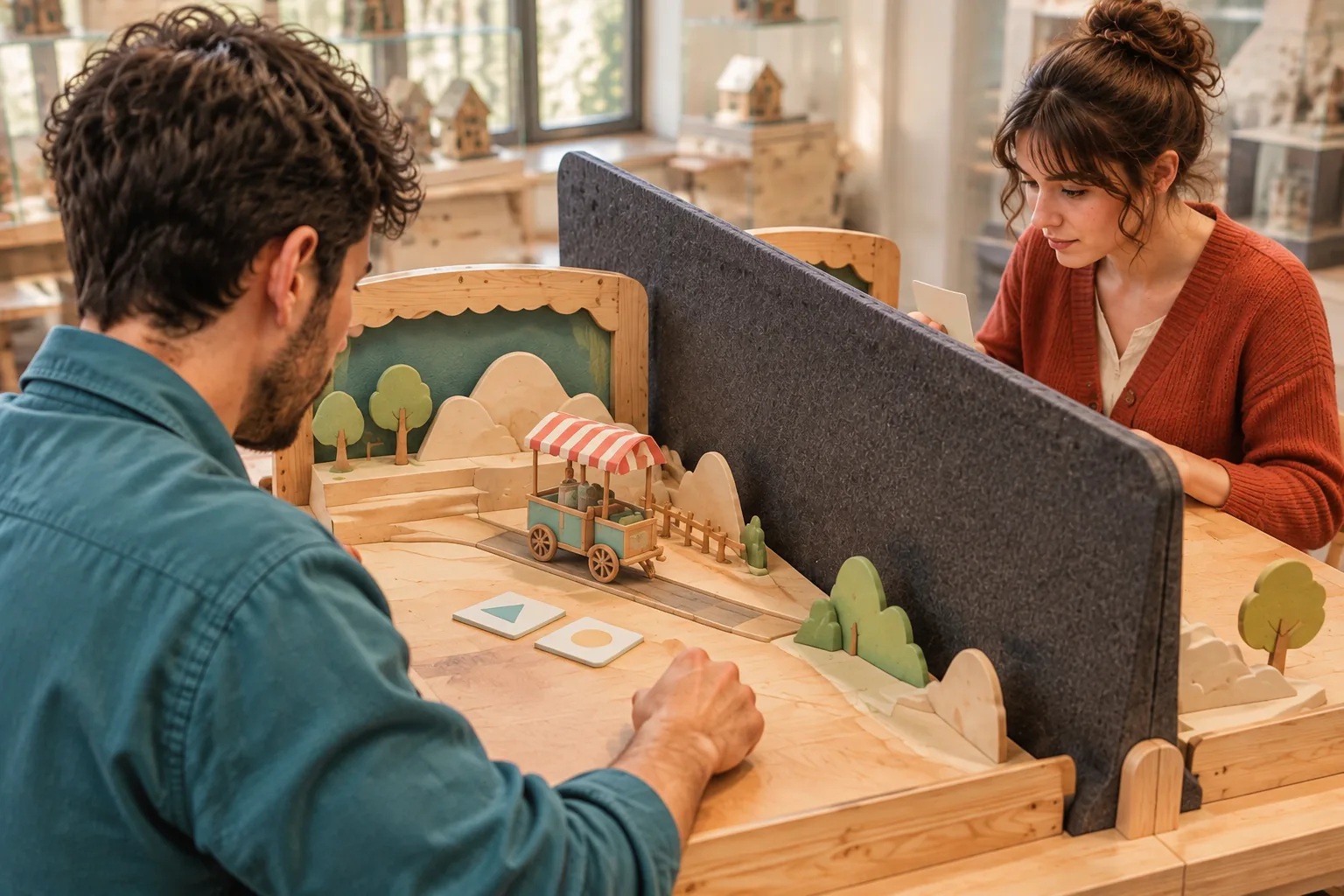
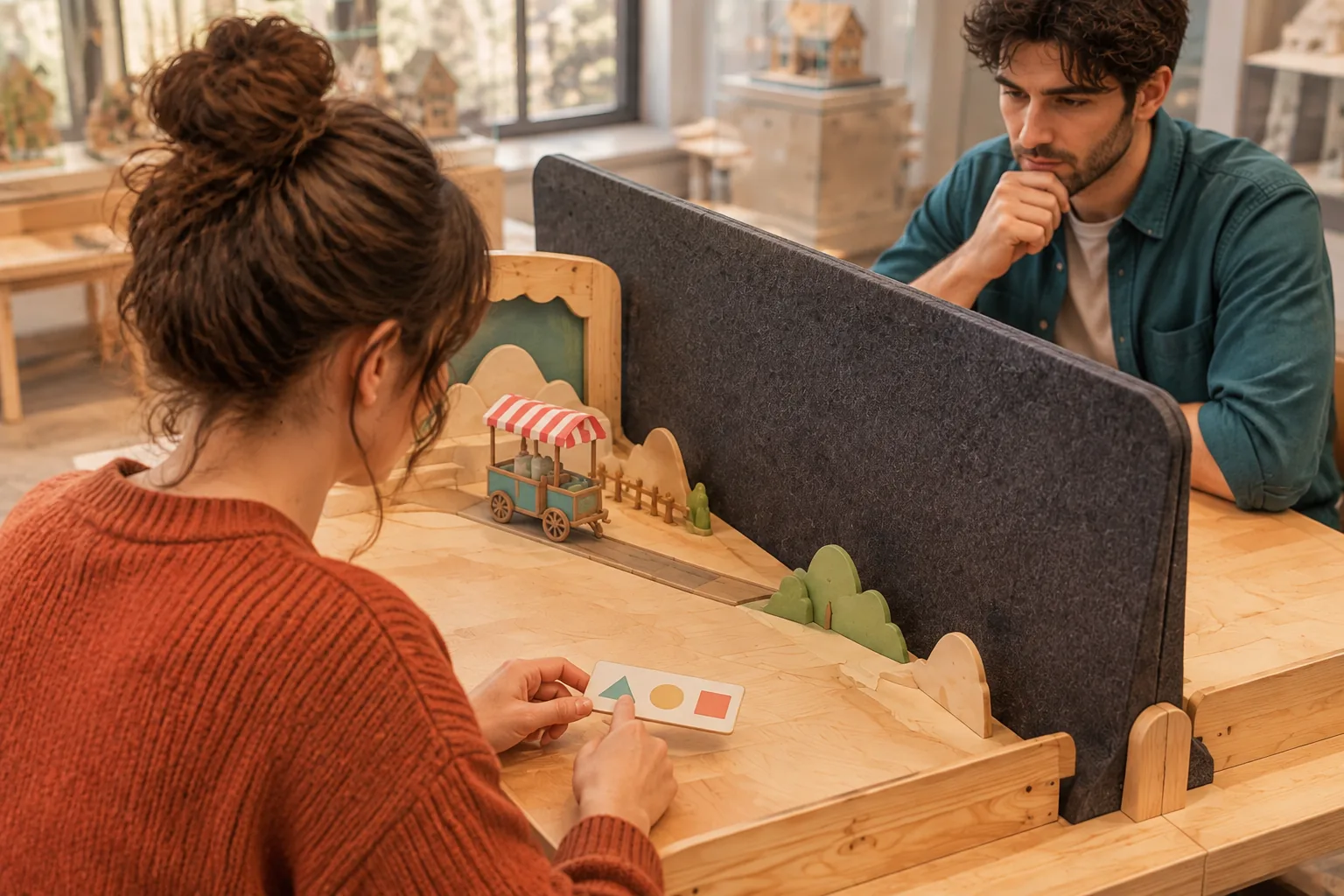
Give one player two markers and the other a private rule for reading them. The first player can see which marker is on the left. The second knows whether the left or right marker comes first. To send a virtual cart to the right places in order, they need to exchange those two clues.
Paper Stage Dispatch is a fictional co-op puzzle set at a miniature theater exhibit. The cart waits at its dock while two players talk. It moves only after the game accepts a complete, correct route.
Give each role a missing clue
Steel Crate Games splits access in Keep Talking and Nobody Explodes. One role sees the in-game device but cannot see the manual. The other reads the manual but cannot see the device. The two roles depend on what the other can describe. See the official role guide.
Use that split to build a different puzzle around a miniature scenery cart. The Stage Tech sees the left marker, the right marker, two destination slots, and the remaining Send credits. The Cue Reader sees a private order cue and a lookup from marker to destination. Only the Stage Tech can draft and send the route.
| Private view | Baseline contents | What to say |
|---|---|---|
| Stage Tech | Leaf on the left, Loop on the right. The order cue and lookup are hidden. | Name each marker and its position. |
| Cue Reader | Right First. Leaf maps to Dune, Loop to Cove, and Star to Deck. The stage and draft are hidden. | Ask for marker positions, then state both destinations in order. |
Dune, Cove and Deck are decorative destinations on the model. The Tech can pick any of the three in either draft slot. Keep the author’s complete fixture separate from each role’s view.
Define what a Send commits
Start with the cart Held at its dock, both draft slots empty and two Send credits. Players can talk freely, and the Tech can edit the draft while the cart is Held. A spoken read-back helps the pair catch a mistake, while the game checks only the submitted slots.
- Incomplete or repeated pair. If either slot is empty or both show the same destination, reject Send without spending a credit, changing the draft, or moving the cart.
- Complete, distinct pair. Spend one credit. If the order is correct, complete once and play one scripted trip through both destinations in order. A correct pair can use the last credit.
- Wrong order or destination. Keep the cart at the dock. With a credit left, the Tech can edit the same draft. At zero, end in Parked without a trip. After completion or parking, only Reset is accepted.
Replay a clean dispatch and a reversal
The Tech says, “Left Leaf, right Loop.” The Reader sees Right First and looks up Loop before Leaf. “Cove first, Dune second.” The Tech reads back, “Cove, then Dune,” sets those two slots and Sends. The correct route completes with one credit left.
Now reset and enter Dune, then Cove. Both destinations are present, but their order is wrong. The cart stays Held and one credit remains. After the Reader repeats the order, enter Cove, then Dune. That second Send succeeds at zero. Sending the reversed pair twice instead ends in Parked with no movement.
Check two drafts before any complete Send. Send with only Cove in the first slot, then try Cove in both slots. Each rejection preserves the draft and both credits. These checks distinguish an invalid draft from a complete submission that fails the route rule.
Give AI a complete two-role fixture
Put the role views and the validation order in the same prompt. Two paper cards can also represent the private views when you walk through the rules by hand.
Make an original two-role puzzle called Paper Stage Dispatch.
Use a virtual miniature theater cart. Start Held at the dock,
with two empty ordered destination slots and two Send credits.

Stage Tech sees Leaf on the left and Loop on the right. Show the
cart, draft and credits. Hide the lookup and cue mode.
Cue Reader sees the selected cue mode, initially Right First,
and Leaf to Dune, Loop to Cove, Star to Deck. Hide the stage
markers and draft. The Reader has no route controls.

While Held, let the Tech freely edit each slot with Dune, Cove
or Deck. Reject Send for an empty slot or repeated destination.
Keep credits, draft and cart unchanged. Conversation is separate
from the game rules and uses no credits.

For a complete distinct Send, spend one credit and compare the
pair to the lookup in the selected cue order. Right First expects
Cove then Dune. Left First expects Dune then Cove.
On correct order, complete once and play one scripted trip.
Otherwise leave the cart at the dock. If credits remain, keep
the draft editable. If none remain, finish Parked.
Check success before the zero-credit failure.
After either terminal result accept only Reset. Reset returns
to Held at the dock with an empty draft, two credits and the
same selected cue mode.
Try editing or sending after completion and after parking. Both should be rejected until Reset. Confirm that Reset clears the draft and restores both credits. Use SEELE’s first-build guide to isolate the next change.
Change only the private cue
Switch the Reader’s cue to Left First and leave the markers, lookup and credits alone. Replay the old correct route, Cove then Dune. It now leaves the cart Held with one credit. The Reader gives the new order, Dune then Cove. The corrected second Send completes at zero.
Record the submitted order, credits left, and whether the cart moved. This modeled replay shows what changes when only the private cue changes.
Start an original co-op puzzle with SEELE’s AI puzzle game maker.
Frequently asked questions
Does the prototype need voice chat?
No. Two players can speak beside a divider or use a separate call while looking at their private materials. The prototype only needs to know the submitted pair. Let people discuss and revise freely so the credit count tracks Send attempts.
How do I make a read-back useful?
Have the Tech repeat both destinations with their positions in the sequence. Saying “Cove first, Dune second” gives the Reader a clear chance to catch a reversal. The read-back is a shared check before Send and does not change the draft on its own.
How do I know the clues are really split?
Look at each role’s view in isolation. The Tech can report where the markers are but lacks the route rule. The Reader knows the rule but lacks the arrangement. Then check the interface for leaked clues, such as revealing the expected route beside the draft.
What should I add after the first fixture?
Keep the first fixture for replay and add a different marker arrangement in a separate round. Use the same cue and lookup first. This lets you see whether a changed arrangement alone produces a new route without also introducing a new rule.