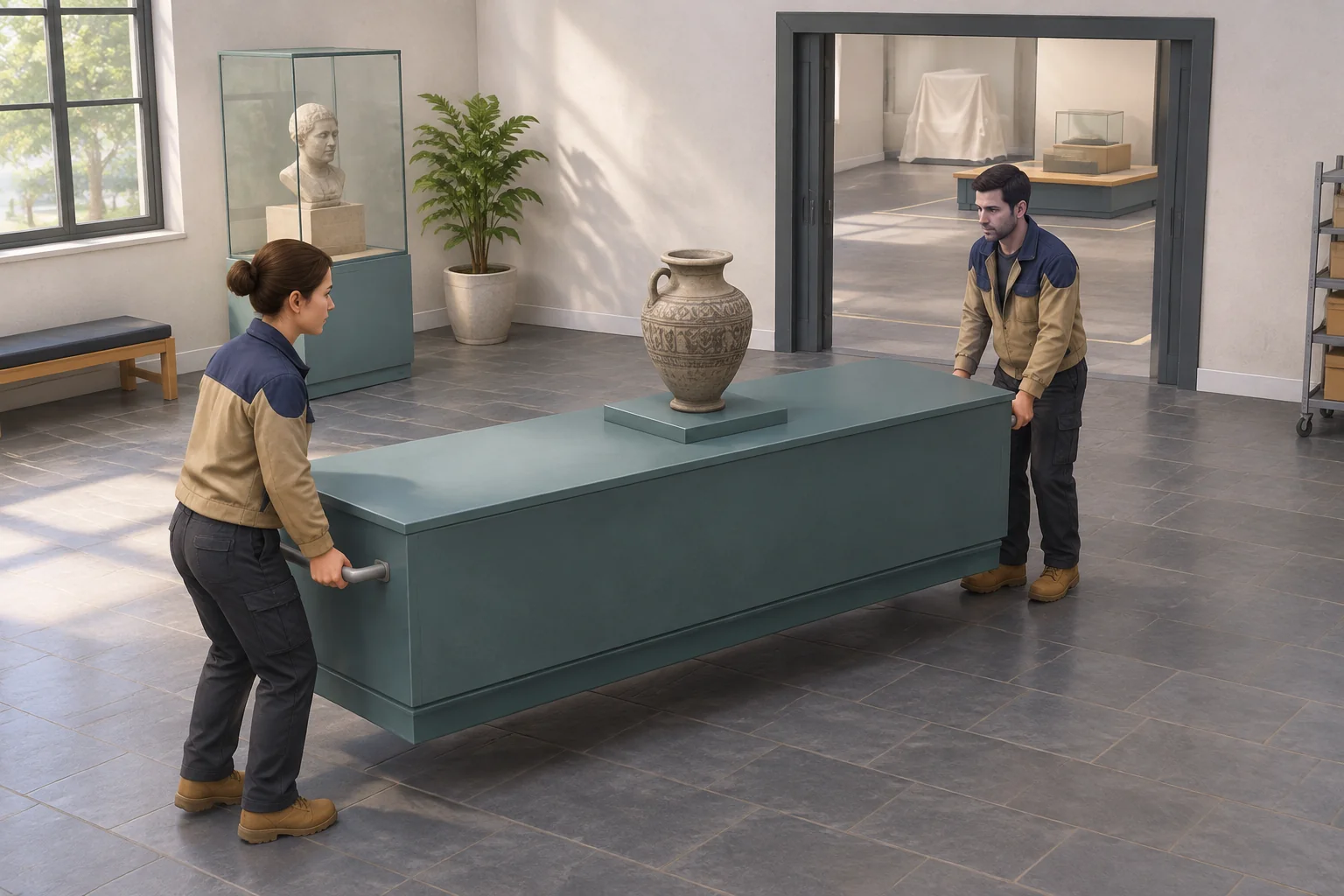
To make an original co-op carrying game inspired by Moving Out, give two players one awkward object and one place where they need to agree. In this fictional museum transfer, the team grips a long display plinth at both ends. It fits through the doorway lengthwise. To get it into that position, the players need enough space to turn before they reach the opening.
Start with two checks. Both players must agree on the intended move, and the proposed move must fit. That gives you a small fixture you can replay before tuning real-time physics.
Turn a shared carry into a puzzle of your own
Team17 describes Moving Out as a physics-based furniture-moving game with local co-op. Its official game page and publisher FAQ describe that premise and credit developers SMG Studio and DevM Games.
Use the idea that both teammates act on the same object. Build your own room, prop, and rules. The museum example uses a grid to make it easy to inspect the first collision rules. The two roles are handle markers attached to the prop. You can add separate character collision after checking the object’s movement.
Give both players a grip and one shared move
Start with the plinth ungripped. Each role chooses one input. Wait for both confirmations before evaluating the pair. A single input, an incompatible pair, or a blocked movement leaves the plinth in place. An unsuccessful move does not release either grip or count as a step.
| Pair | Effect |
|---|---|
| Grip + Grip | Latch both handles when the plinth is ungripped. |
| Matching cardinal moves | With both grips, move the center one cell if the destination footprint is clear. |
| Turn + Turn | With both grips, rotate 90 degrees if the entire centered 3 × 3 square is clear. |
| Set Down + Set Down | Release and finish only with both grips and the plinth horizontal in the delivery bay. |
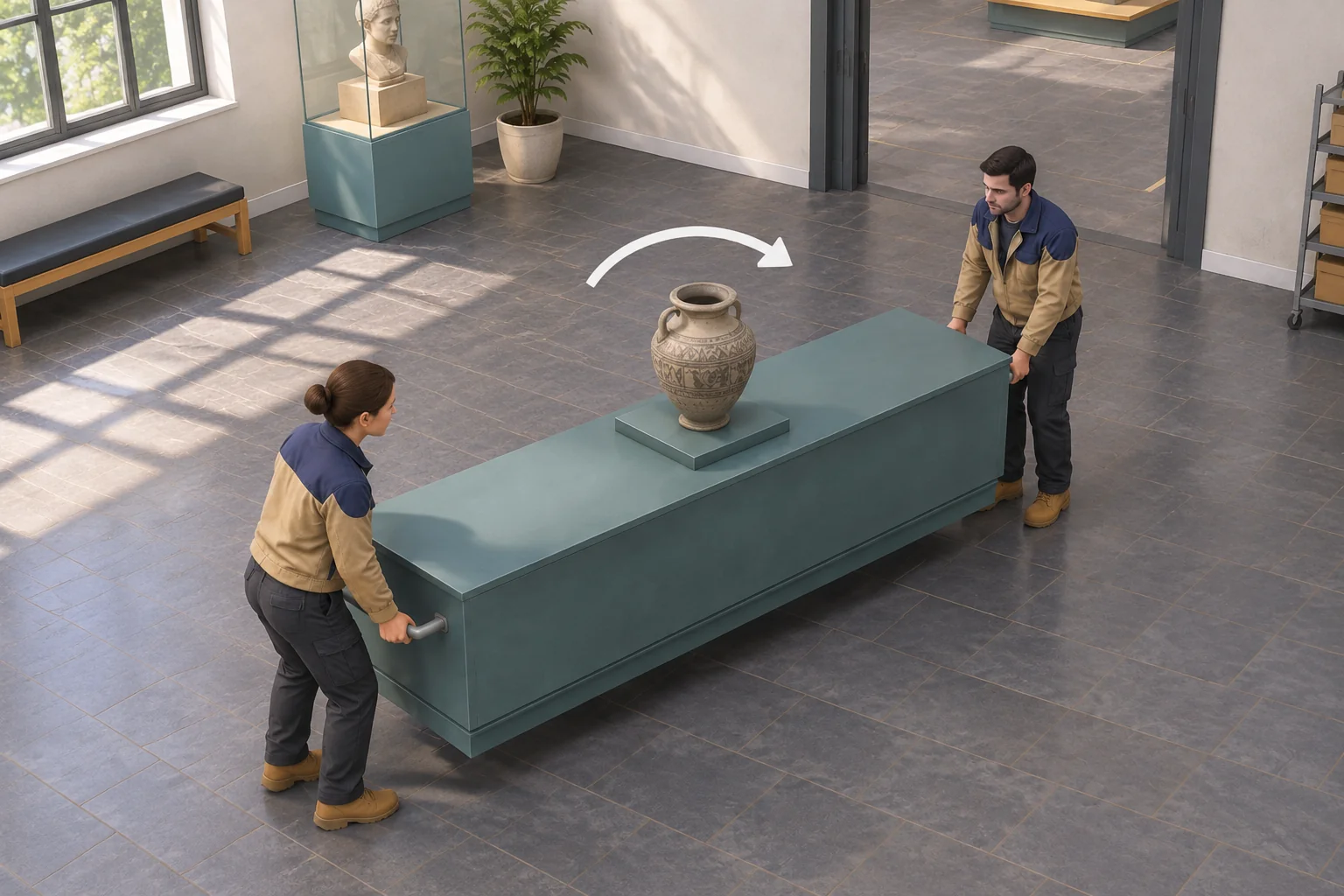
Check the turning space as well as the destination
Use a grid seven columns wide and five rows high. Count x from zero at the left and y from zero at the top. Put a wall in column x=3 with a single open cell at y=2. Every other in-bounds cell is free. The three-cell plinth starts vertical, centered at (1,2). In this model, a vertical plinth occupies the cell above and below its center. A horizontal plinth occupies the cells to the left and right.
The goal is a horizontal plinth centered at (5,2). A translation checks the destination footprint. A turn checks the nine cells around the pivot, including the center. That is a deliberately conservative approximation of the space a turning object needs. At (2,2), the horizontal destination cells fit, but the turn square reaches wall cells (3,1) and (3,3).
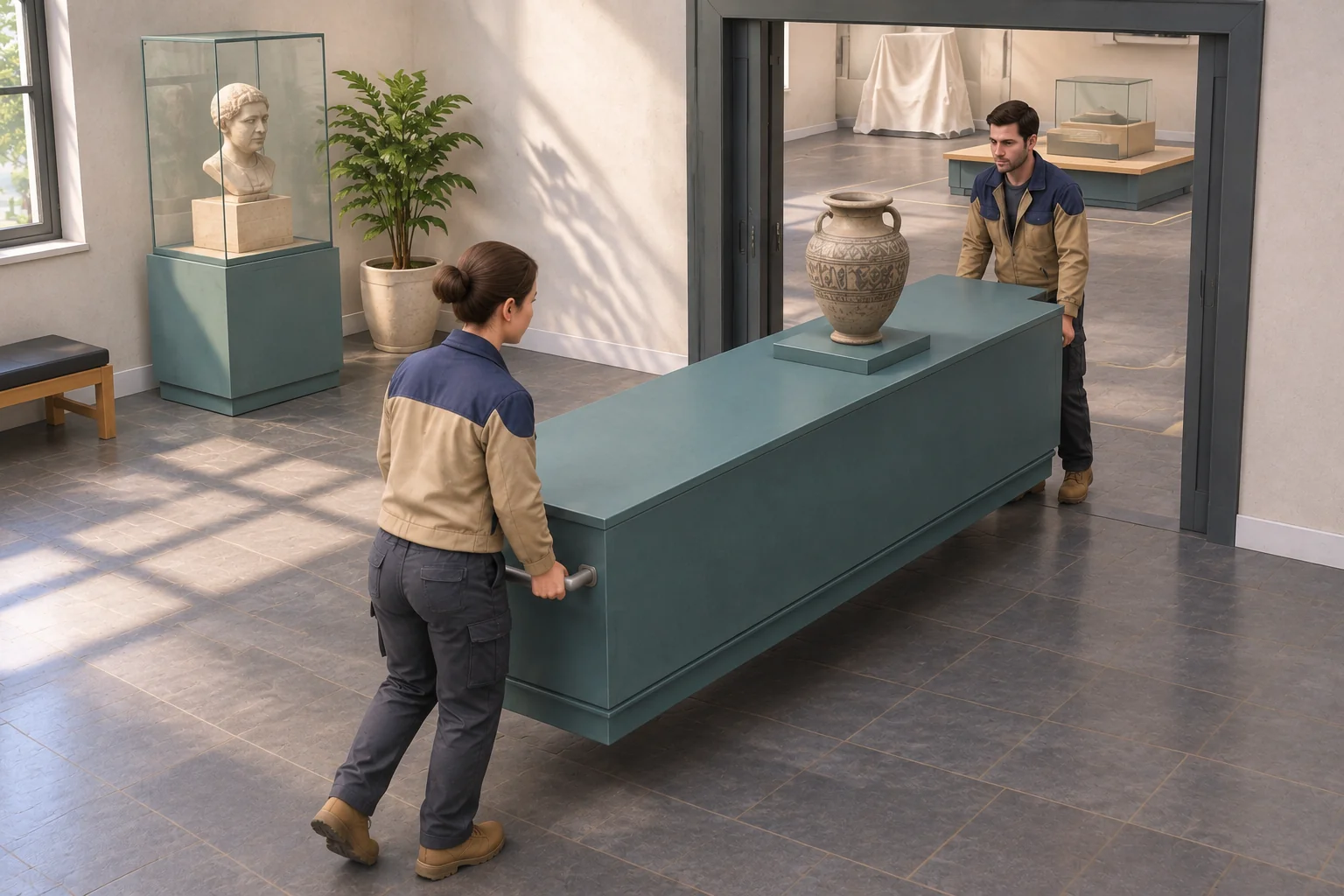
| Accepted step | Turn in the staging area | Try to turn at the doorway |
|---|---|---|
| 1 | Grip at (1,2), vertical. | Grip at (1,2), vertical. |
| 2 | Turn at (1,2), now horizontal. | Move east to (2,2), still vertical. |
| Rejected attempt | None. | The turn at (2,2) is blocked. Pose and grips stay the same. |
| 3–6 | Move east four times and reach (5,2). | Move west, turn at (1,2), then move east twice to (3,2). |
| 7 | Set down and finish. | Move east to (4,2). |
| 8–9 | Finished. | Move east to (5,2), then set down and finish. |
Trying the late turn adds no step by itself. The two extra moves come from going east into the tight spot and then backing out. The team can keep both grips during recovery.
Give AI a fixture with a blocked turn and a legal passage
Ask for the proposed pose and the accepted pose to be visible. An overlay showing the three-cell footprint and nine-cell turn square helps you trace exactly why a move is refused.
Build a two-role museum carrying puzzle on a 7 by 5 grid.
Coordinates start at (0,0). Wall column x=3 is solid except y=2.
The 3-cell plinth starts vertical with center (1,2) and no grips.
Its delivery pose is horizontal at (5,2).

Wait for one input from each role. Both Grip to attach handles.
Both must send the same cardinal move or both send Turn.
Check the destination footprint for a one-cell move.
For a 90-degree turn, check all cells of the centered 3 by 3 square.
Treat out-of-bounds cells as solid. Keep handles attached on a block.

Both must send Set Down in the exact delivery pose to finish.
Invalid pairs, blocked movement and early Set Down change nothing
and cost no accepted step. Reset restores pose, grips and inputs.
Try one Grip on its own and check that nothing moves before the second input. Once both grips are attached, try East and Turn together, then try an early Set Down. Both pairs should preserve the pose. Next move east while vertical and try to enter the doorway without turning. The wall should block that move. Replay the two legal finishes and confirm that Reset restores the original pose.
Widen only the opening and repeat the late turn
Open rows one, two, and three in the wall instead of just row two. Keep the start, delivery bay, and input rules the same. Grip, move east while vertical, and turn at (2,2). The turn square now fits, so the team can move east three more times and finish on step seven. The staging turn also still finishes in seven steps.
This comparison shows what the extra clearance changes in the grid model. In a real-time build, separately test how player bodies and an angled prop interact with the doorway. The guide to replaying a build after one change helps keep that check focused.
Build one carry the team can diagnose together
Start with one object and one doorway. Test mismatched commands and blocked turns before adding more rooms or objects. Start your original co-op carrying puzzle with SEELE’s AI game maker and use the two traces to check the first room.
Frequently asked questions
How can both players see what move they agreed to?
Give each role a visible intent cue while the pair is pending. Highlight the proposed pose once both inputs arrive. If the inputs differ, show the mismatch near the object and leave both grips active so the players can choose again.
Why check more than the final pose during a turn?
An object can fit before and after turning while one of its corners crosses a wall in between. The larger square in this fixture reserves that space conservatively. Use it to check the design first, then test a more precise sweep if the real-time puzzle needs it.
What should a blocked turn show?
Mark the part of the turning area that intersects the wall and leave the plinth at the last accepted pose. Show that the grips are still attached. That tells both players what failed and gives them a clear way to back out.
When should I add continuous physics?
Add it after you can replay the intended moves and identify the blocked poses. Start by matching the behavior at the doorway, then test angled contact and avatar collision. Keep the grid fixture as a comparison when you decide which changes make the carry feel better.