Give the village one change the player can see and a reason to put it in one spot rather than another. A shared bench is enough. Let two cottages ask for somewhere to sit nearby, then show what each household can reach as the player connects the lane and chooses a place for the bench.
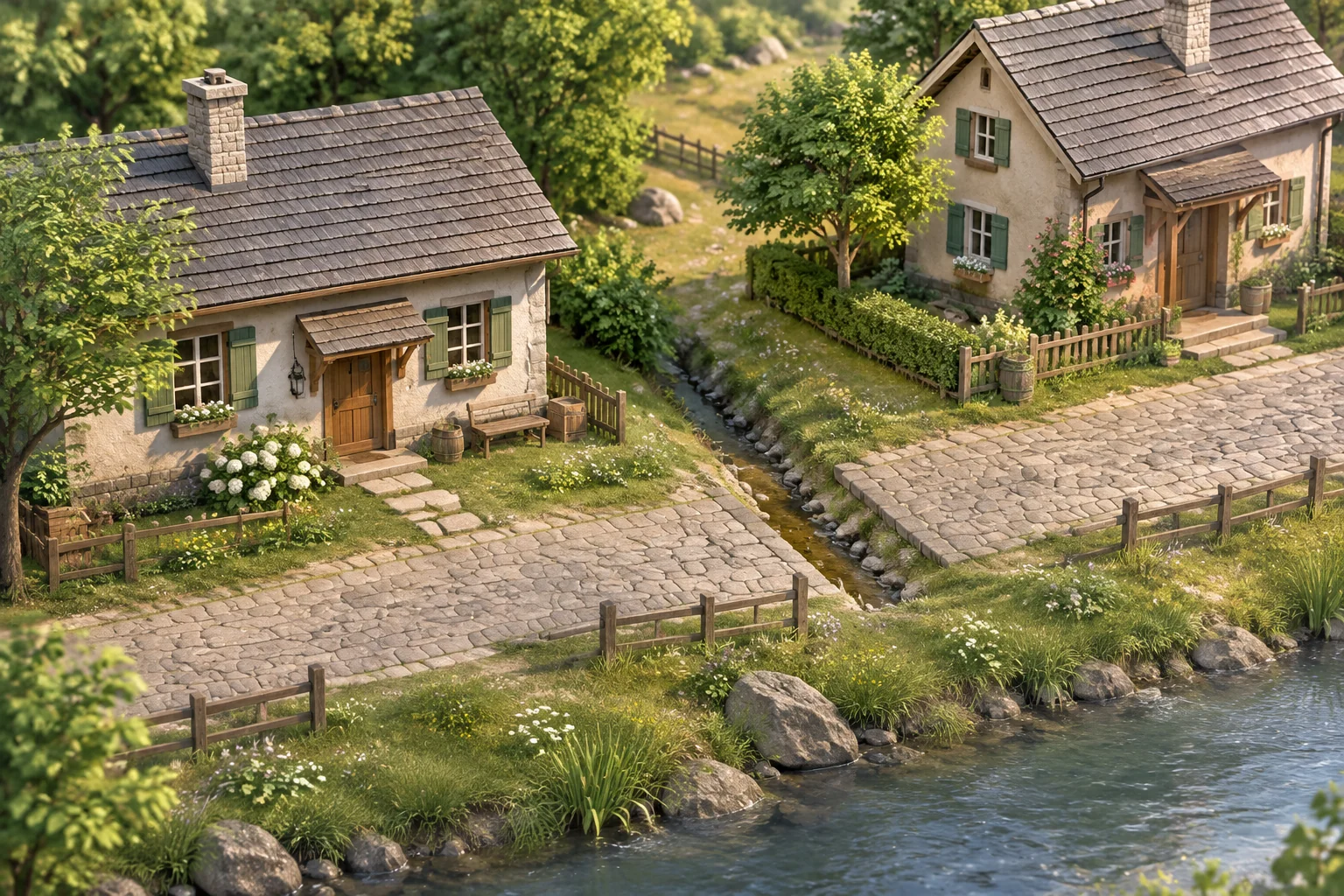
In the fictional Alder Terrace, a narrow drain divides a village lane. The player has five planks, enough for one crossing and one bench. They can give the west cottage a seat on the first day or join the lane first and place the bench where both cottages can reach it.
Give a small village change a purpose
The official Littlewood listing credits Sean Young and SmashGames and describes customizing a town and fulfilling resident requests. The publisher’s Nintendo eShop description also mentions gathering materials, building structures and requests about the surroundings. In your own village, let one resident’s request give the player a reason to reconsider a placement. Alder Terrace uses original cottages, resources and path rules.
Keep both requests visible from the start. Each cottage wants a bench it can reach within one link along the lane. The player can inspect either pocket and see whether a future bench would be reachable before spending any planks.
Count connections along the lane
Label five lane nodes P1 through P5 from west to east. The west cottage connects to P2 and the east cottage connects to P4. The player can place the bench beside P2 or P3 in a pocket off the lane, so the seat itself never blocks a route.
P1 — P2 — P3     P4 — P5
     west        east
     cottage     cottage

Bench pockets at P2 and P3
Missing crossing between P3 and P4
Count the built links between a cottage’s node and the bench’s node. A bench at the same node counts as zero links because both connect to the same point. If the crossing is missing and the cottage is across the drain, show “No walking route.” If there is no bench yet, show “No bench placed.” Keep those states distinct from a connected path that exceeds a resident’s limit.
Develop the lane one project at a time
| Project | Planks | What changes |
|---|---|---|
| Build Crossing | 2 | Adds a two-way link between P3 and P4. |
| Place Bench | 3 | Adds the only bench at P2 or P3. |
| Move Bench | 0 | Moves the existing bench to the other pocket. It still uses the day’s project slot. |
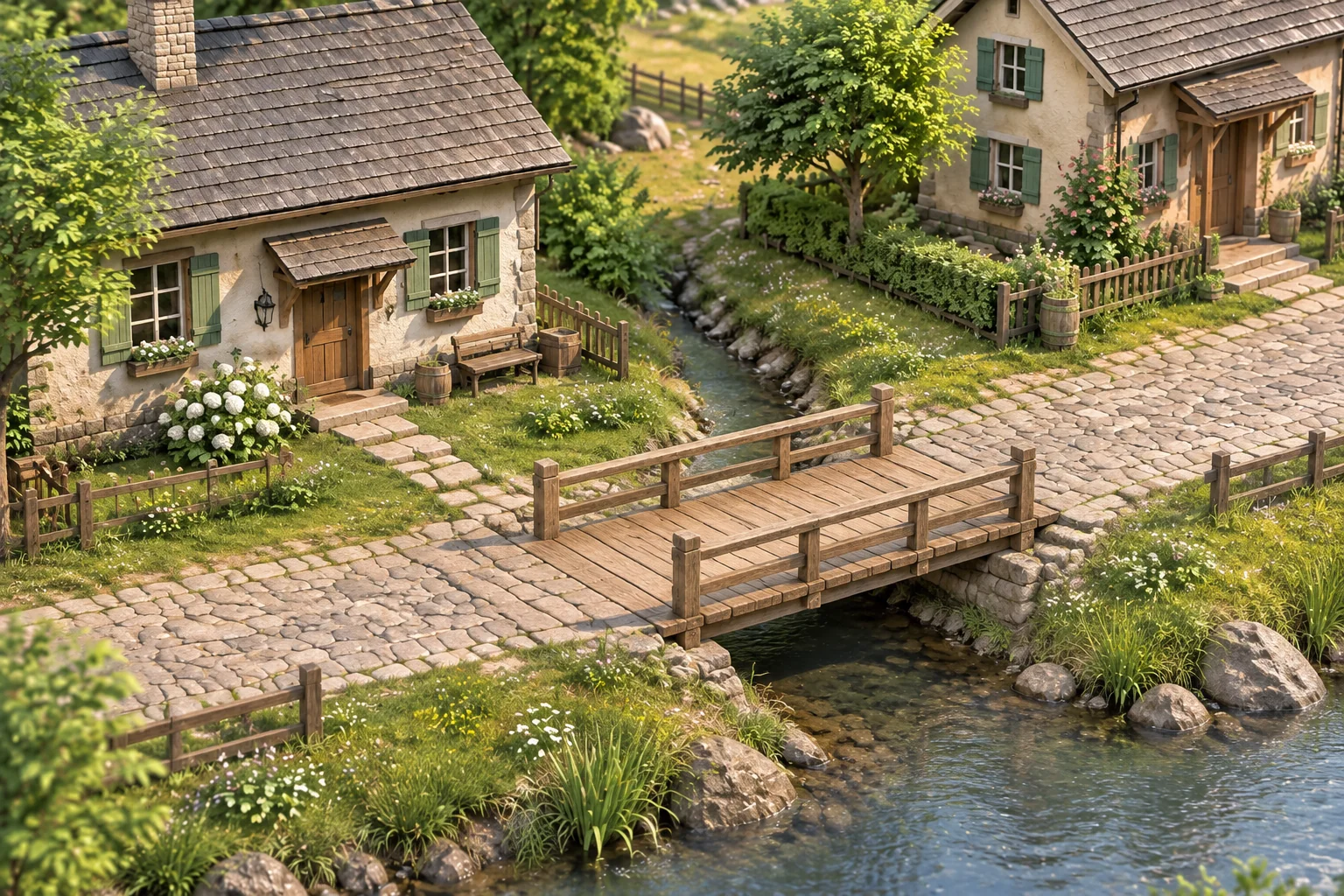
Take one project per day. The player chooses when to start the next day, even if they did nothing that day. Advancing refreshes the project slot and preserves the village. Open requests stay visible without any loss of materials or progress.
| Day | Bench-first action | State after the action |
|---|---|---|
| 1 | Place the bench at P2. | Two planks left. West is satisfied at distance zero. East has no walking route. |
| 2 | Build the crossing. | Zero planks left. West is still satisfied. East can walk two links and its request stays open. |
| 3 | Move the bench to P3. | Zero planks left. Both cottages are one link away and satisfied. |
Try the other order. Build the crossing on day one and keep three planks. Both cottages still need a bench. Place it at P3 on day two. Both are one link away, so both requests are satisfied with zero planks left. This plan uses two projects. The first plan uses three and gives the west cottage a seat one day earlier.
Give AI one complete town block
Give the SEELE workspace the written fixture and ask for a small browser prototype with a lane, build controls and request status. Use the lane diagram to specify the distances. In the first draft, check that the walk calculation uses built links rather than the visual space between houses.
Build an original cozy village prototype called Alder Terrace.
Use five path nodes P1 through P5. Start with links P1–P2,
P2–P3 and P4–P5. All links work in both directions.
West cottage connects to P2 and east connects to P4.
Allow one bench in a separate pocket at P2 or P3.

Start day 1 with 5 planks, one project slot, and no bench.
Build Crossing costs 2 and adds link P3–P4 once.
Place Bench costs 3. Move Bench to the other pocket costs 0.
Each accepted project uses the day's slot without advancing time.
Reject repeats, invalid pockets, insufficient stock or a used slot.

Next Day refreshes the slot and retains stock and village state.
Inspect and preview for free. Compute shortest paths in built links.
Both requests need a reachable bench within 1 link.
Distinguish no bench, no walking route and a distance over the limit.
Refresh requests after any accepted project. No deadline or reward lock.
Reset all state. Use original buildings, art and interface.
Change one resident’s request
Let the east cottage accept a bench two links away. Replay the first two days of the bench-first plan. On day one there is still no route from the east cottage. On day two the crossing makes a two-link route available, so both requests are now satisfied with the bench at P2.
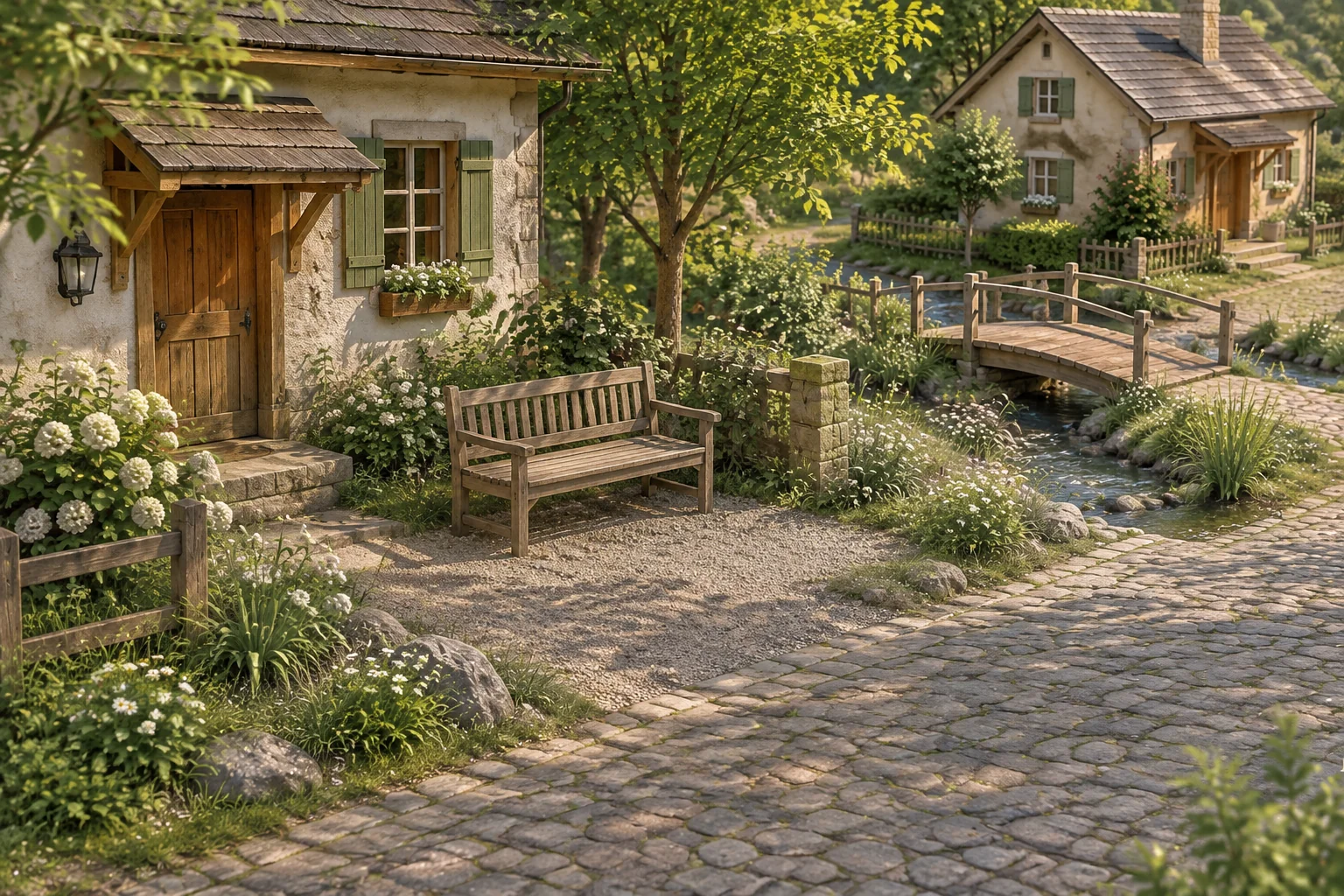
Keep the west limit, project costs and path layout fixed. The route stays two links long. Only the east cottage’s acceptance changes. Use the guide to revising one rule at a time to check both days from the same starting state.
Finish one village improvement
Start your original village game with SEELE’s AI Cozy Game Generator. Build one lane and one shared improvement, then replay a different order and see which residents can use it after each project.
Frequently asked questions
Why count path links instead of straight-line distance?
The player is placing things people need to reach. A bench can look close across a drain and still have no route from a cottage. Counting built links makes the crossing matter, and it gives the player a clear way to verify the result.
How can the game have days without feeling timed?
Let the player choose when the day advances. Use the next day to refresh an action slot while keeping projects and materials where they are. A missed day should leave the request open if the design is meant to support planning at a comfortable pace.
Do resident requests have to unlock rewards?
They can simply express a preference and show whether the current layout meets it. Keeping them as status labels makes relocation easier to understand. If the bench moves farther away again, the request can reopen without subtracting a reward the player already earned.
When should I add a second shared amenity?
Add it after the first object has two understandable placements and the path display explains both outcomes. Give the next object a different reason to sit in a particular place. Check that players can still tell which request changed after a project.