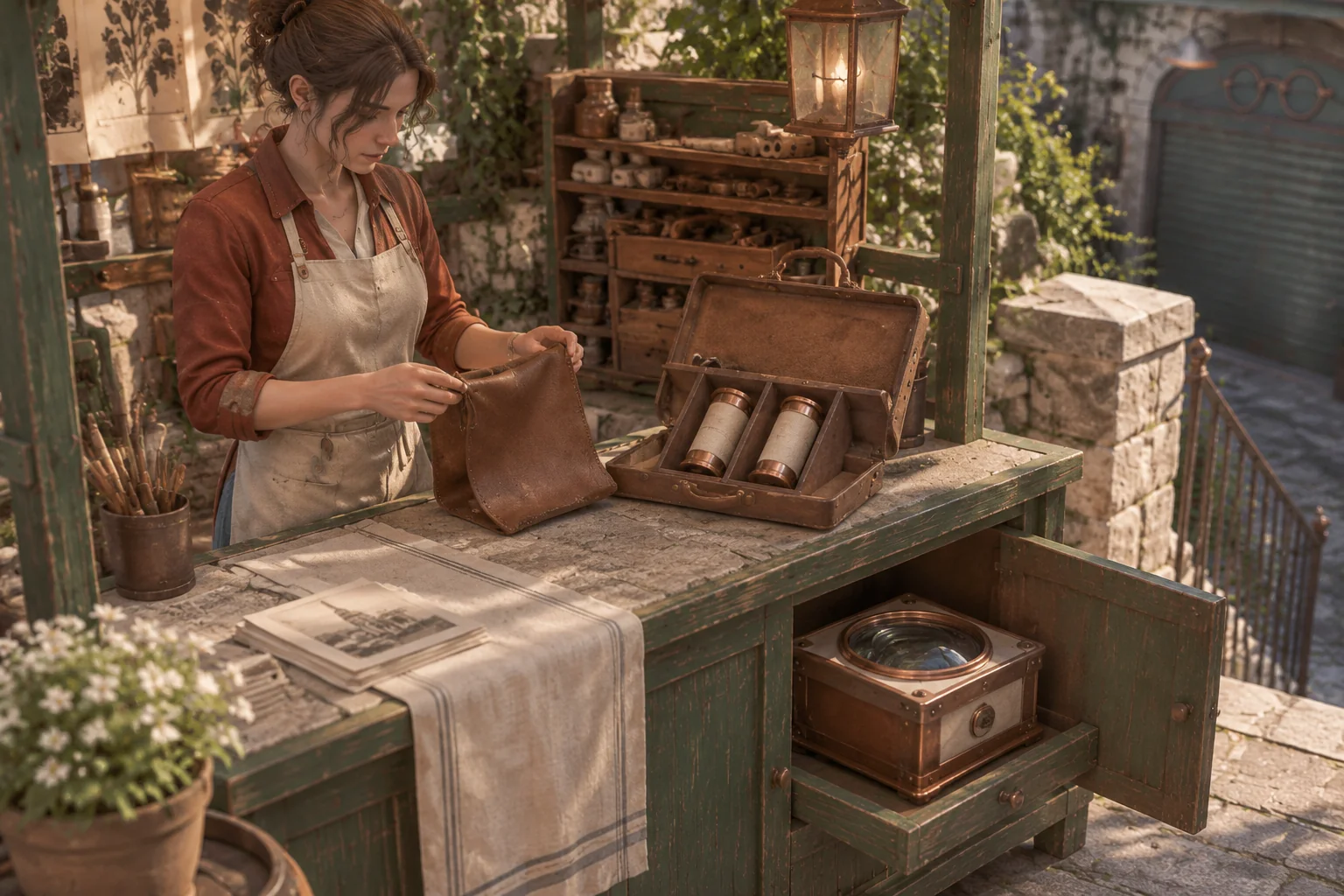
To make an original shopkeeping adventure inspired by Moonlighter, let the expedition decide what goes on sale. In this fictional hillside market, a printmaker retrieves optical parts from an old workshop beneath the stall. Two small spools fill the first two customer orders. A larger lens earns more from one buyer, but takes both slots in the carrying case.
Give the player a way to bring either haul home. Then count the money and the filled orders separately. A haul can earn more and still miss the stall’s goal.

Make the expedition stock the shop
Digital Sun describes Moonlighter as an action RPG with roguelite and shopkeeping elements. The developer’s official game page describes the shopkeeper exploring dungeons to find loot and selling it afterward. The 11 bit studios game page also describes the two sides of that role.
Use the connection between an expedition and the next sale. Give your version its own place, items, customer requests, and objective. The printmaker’s stall uses a compact case and three known orders. Showing those orders before the trip gives the player a reason to think about what fits.
Pack one haul and leave enough charge to return
The Stall connects to the Near Alcove, and the Near Alcove connects to the Deep Cabinet. Start at the Stall with four lamp charge and an empty case. Each move spends one charge. Inspecting, collecting, and leaving items use no charge in this fixture.
| Room | Available haul | Cargo rule |
|---|---|---|
| Near Alcove | Two wrapped Spools | Collect both once. Each uses one slot. |
| Deep Cabinet | One sealed Lens | Collect once. It uses both slots. |
Reject the Lens pickup if both slots are full. Keep the Spools until the player explicitly leaves them in the Deep Cabinet’s return bin. That clears both slots, and the Spools stay unavailable for the rest of the run. The player can also skip the Spools on the way down and collect the Lens with an empty case.
Returning to the Stall from the Alcove opens the shop and transfers the cargo into stock once. Check for arrival before checking charge. Reaching the Stall with zero charge succeeds. If a move uses the last charge underground, the expedition ends there and the shop stays closed.
Resolve the same orders against both hauls
The first two customers each want a Spool and pay three coins. The third wants a Lens and pays eight coins. Serve Next checks one request in order. If the requested item is available, remove one from stock and record the payment and sale. Otherwise, mark the request unfilled and advance. Finish after the third request and check whether at least two sales were completed.

| Haul | Expedition | Shop result |
|---|---|---|
| Near | Move to Alcove with 3 charge. Collect two Spools. Return to Stall with 2 charge. | Serve both Spool buyers. Lens order unfilled. Finish with 6 coins and 2 sales. Goal met. |
| Deep | Move to Alcove with 3, collect two Spools, then move to Cabinet with 2. Lens pickup is refused. Leave the Spools, collect the Lens, and return through Alcove with 1. Reach Stall at 0. | Both Spool orders unfilled. Sell the Lens. Finish with 8 coins and 1 sale. Goal missed. |
Both hauls reach the stall. The Spools cover more buyers, while the Lens earns more coins. Show those results side by side so the player can see how the expedition choice affected each measure.
Give AI one expedition and one sales queue
Ask for the return and sale rules together. The important handoff is the moment the case stops being carried cargo and becomes shop stock.
Build an original printmaker expedition and stall.
Connect Stall to Near Alcove and Near Alcove to Deep Cabinet.
Start at Stall with 4 charge and 2 empty cargo slots.
Move spends 1 charge per link. Inspect and collect are free.

Near Alcove provides 2 Spools at once, 1 slot each. Deep Cabinet
provides 1 Lens that needs 2 free slots. Reject a full pickup
without losing any cargo. Leave Spools at Cabinet to free both
slots and make them unavailable for the rest of this run.

On return to Stall, transfer the carried items to stock once
and open the shop. Check arrival before zero-charge failure.
End without sales if charge reaches zero underground.

Resolve one customer per Serve Next. Orders are Spool for 3,
Spool for 3, then Lens for 8. Unfilled orders advance free of
stock and coin changes. Finish after three orders. Report
coins and sales separately. Require at least 2 sales.
Reset locations, charge, items, buyer order and both totals.
Try the Lens pickup with a full case, then check that the Spools remain. Replay the deep route and verify that arriving at zero still opens the shop. Check that an item sold to one customer cannot also serve the next. Restart after each result and confirm both loot sources return.
Change the sales target and replay the same trips
Lower the goal from two sales to one. Leave the trips, inventory, buyers, and prices alone. The Spools still earn six coins from two customers. The Lens still earns eight coins from one, and now it meets the goal. In the worksheet, this single change makes both hauls viable under different priorities.
Use the guide to replaying a build after one change to compare the two goals in your own prototype.
Make the first haul worth thinking about
Start with one trip and a known set of buyers. Check which items make it onto the counter and which orders they fill before adding shop upgrades. Start your original shopkeeping adventure with SEELE’s AI game maker and use the two hauls as checks.
Frequently asked questions
Should the player see the customer requests before the trip?
Show the requests when choosing what to carry is the challenge. A visible buyer list lets the player compare the Spools and Lens before leaving. Later you can reveal only part of the demand if you want uncertainty to become a separate decision.
How should the game show that a bulky item will not fit?
Show the slots the item needs and the slots that are occupied before the player confirms. If a pickup fails, keep the current cargo visible and point to the option to make space. A refusal should leave the player with a clear next action.
Why track sales and revenue separately?
The two measures reward different choices. Sales show how many customer requests were fulfilled. Revenue shows how much those orders paid. Showing both makes the value of the near and deep trips easy to compare even when the stall’s target emphasizes one measure.
What should a second expedition add?
Change one buyer request or add one item with a different cargo footprint. Check how that change affects the known trips before expanding the map. Keep the first expedition available as a comparison so you can tell why the new haul is attractive.