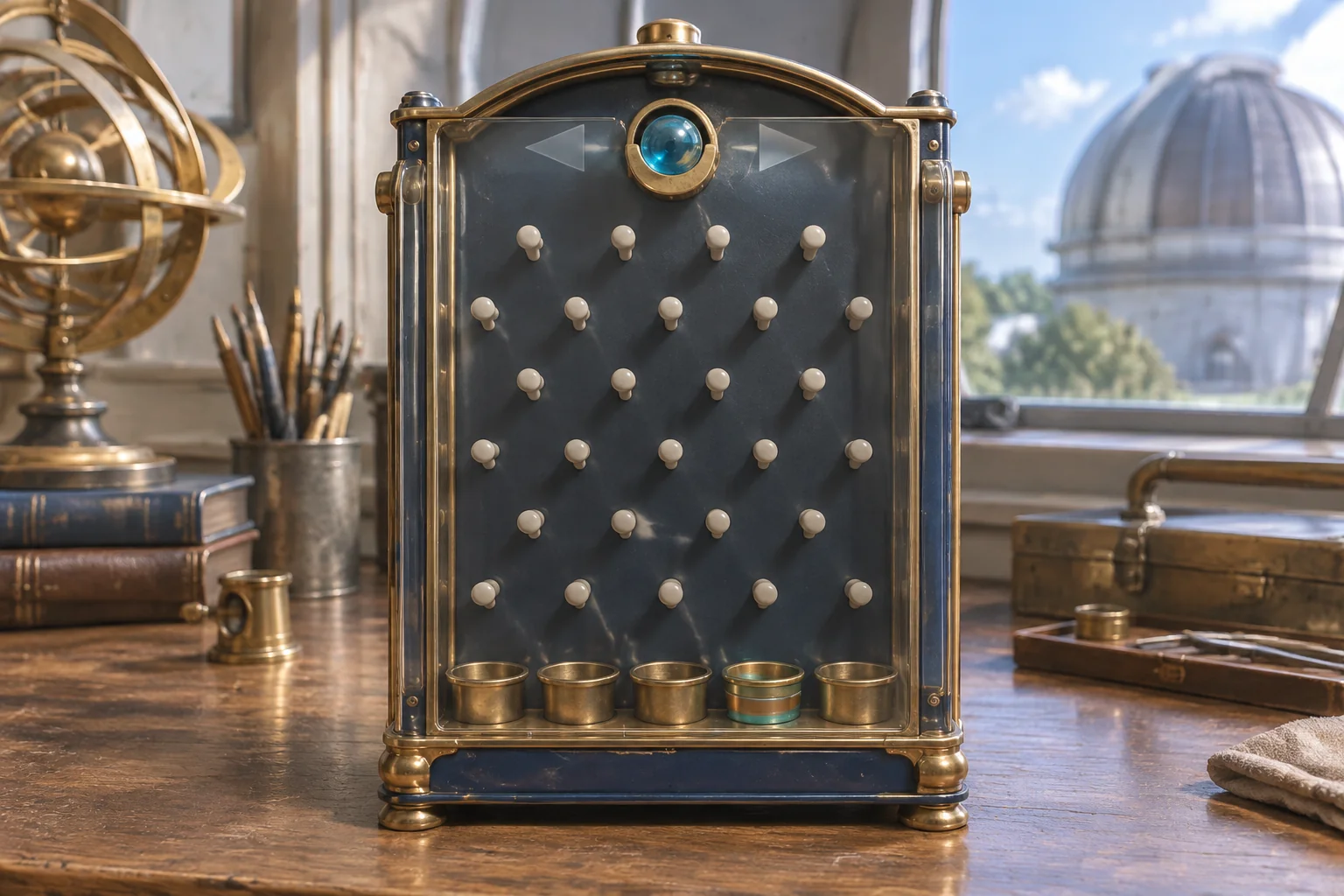
To make an original peg-shot game inspired by Peglin, give each bounce a consequence the player can see. In this fictional observatory workshop, a blue glass ball collects charge from ceramic pins. A relay powers up only when the ball reaches the right cup with enough charge.
Start with two launch directions and one short board. Replay both shots, then move a single peg. The comparison shows why a ball can reach the same cup and still get a different result.
Give a peg hit a purpose in the encounter
Red Nexus Games describes Peglin as a pachinko roguelike that uses peg hits to damage enemies. The official Steam listing also describes using orbs and relics to change play.
Use the broad idea that contacts on a board matter somewhere else in the encounter. Give your version its own target and rules. The observatory board turns contacts into charge and checks that charge when the ball comes out. Start with a grid you can trace by hand before tuning continuous motion.
Resolve the wall first and the peg second
Use five columns numbered zero to four and six rows numbered zero to five. Count x to the right and y downward. The ball starts at (2,0) with zero charge. Aim Left starts it with horizontal direction −1. Aim Right starts it with +1. After selecting an aim, Fire launches one ball and locks that choice. Each Step then advances one row.
For each Step, add the direction to the current x. If the proposed x leaves the board, reverse direction and recompute from the current x. Move to the new cell. When the cell contains a peg, add one charge and reverse the direction for the next row. A wall reflection changes direction without adding charge. If both events happen on one Step, resolve the wall before the peg.
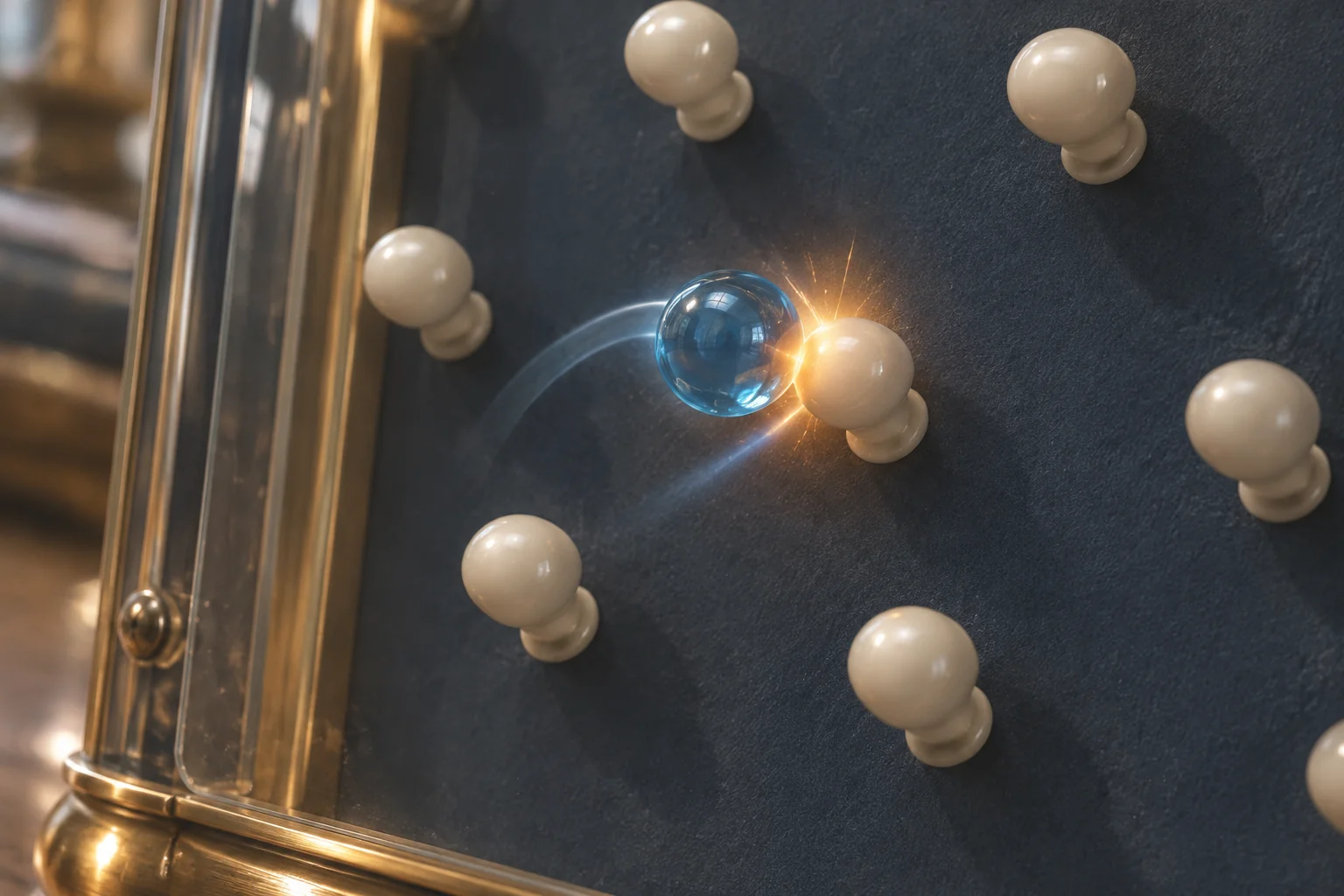
Put the pegs at (1,1), (4,2), and (4,4). The exit row has no pegs. A ball entering the receiver at (3,5) needs at least two charge to power the relay. At that cup with less charge, report undercharged. At any other exit, report wrong receiver and display the charge the shot collected.
Replay both launch directions from the same board
The table shows the ball after each move and any contact. Charge starts at zero on both shots. The direction changes on a peg take effect on the following row.
| Row | Left launch | Right launch |
|---|---|---|
| 1 | x=1, hits a peg. Charge 1, direction now right. | x=3, charge 0, direction stays right. |
| 2 | x=2, charge 1. | x=4, hits a peg. Charge 1, direction now left. |
| 3 | x=3, charge 1. | x=3, charge 1. |
| 4 | x=4, hits a peg. Charge 2, direction now left. | x=2, charge 1. |
| 5 | x=3, charge 2. Relay powers up. | x=1, charge 1. Wrong receiver. |
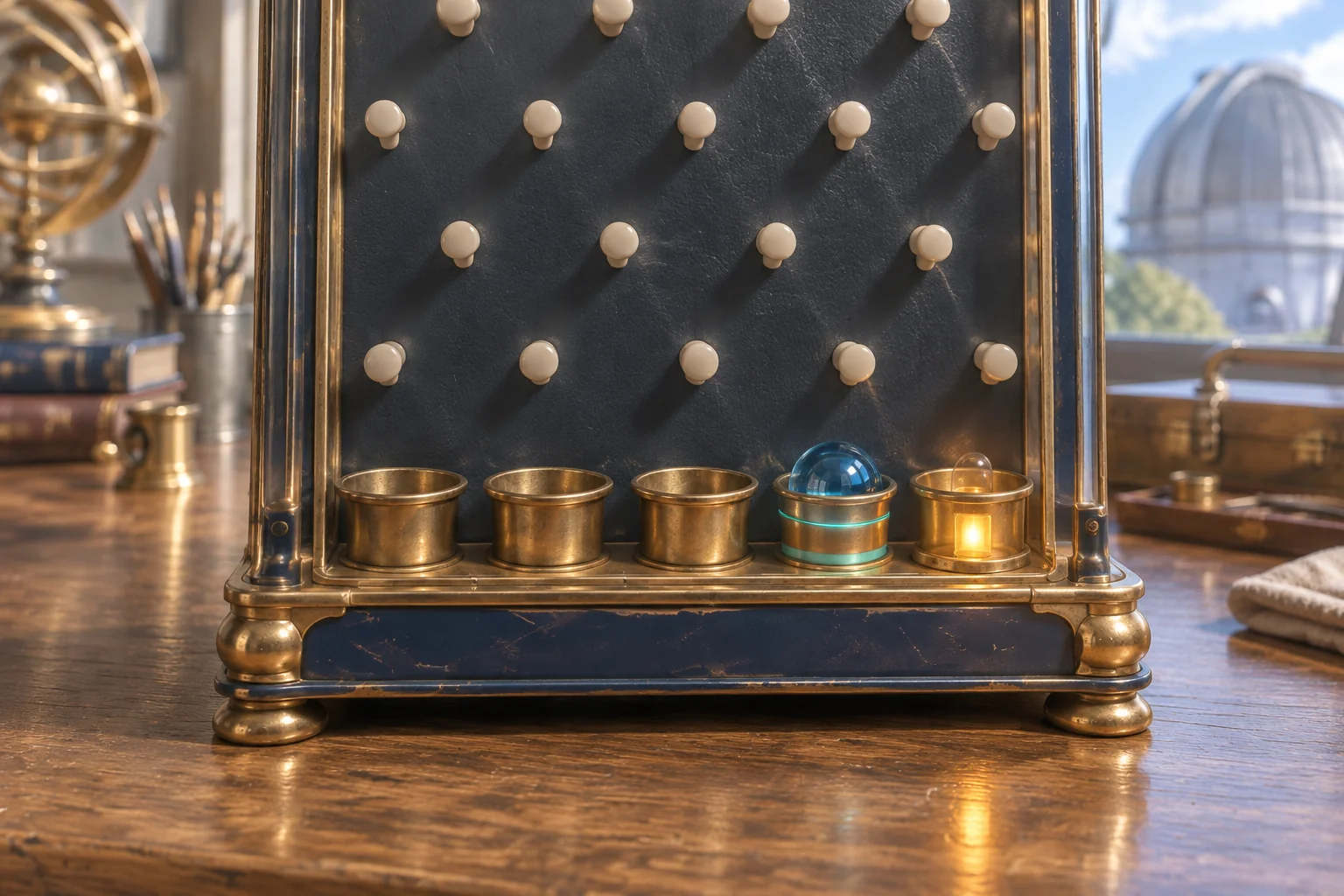
The two shots meet in the same column on row three. They leave it in different directions because they hit different pegs earlier. Keep position, direction, and charge in the trace so you can explain how two balls at the same point can end up in different cups.
Give AI a small board and an exact check
Ask for Aim, Fire, Step, and Reset with a visible row trace. Use one ball and keep the pegs fixed during each run. That makes each rebound easy to compare with the worksheet.
Build an original peg-shot puzzle in an observatory workshop.
Columns are x=0..4, rows y=0..5. Start at (2,0) and charge 0.
Choose Aim Left for dx=-1 or Aim Right for dx=+1, then Fire.
Accept Fire once after aim is selected. Lock aim during a shot.

Step advances one row. If x+dx would leave the board,
reverse dx and recompute the proposed x from the current cell.
Move, then check for a peg. A peg adds 1 charge and reverses dx.
A wall reflection adds no charge. Pegs remain on the board.

Pegs are (1,1), (4,2), and (4,4). End on row 5.
At (3,5) with charge at least 2, power the relay.
At (3,5) with less charge, report undercharged.
At any other exit, report wrong receiver and show charge.

Reject Step before Fire and new aim or Fire during a shot.
Freeze on a result. Reset position, aim, charge, and result.
Keep the selected peg layout for a repeat.
Step before Fire and check that the ball stays put. Run both directions and compare the three state values at each row. Try to fire again mid-shot. When a shot ends, check the receiver and charge together, then Reset and replay the same input.
Move one peg and compare the same shots
Move the peg at (4,4) to (2,4). Keep the other pegs, walls, receiver, and charge requirement fixed. The Left shot still reaches x=4 on row four, but misses the moved peg. On the last Step, the wall reflects it into the same receiver. Its charge is only one, so it ends undercharged.
The Right shot now hits the moved peg at x=2 on row four. It reverses right and reaches the receiver with charge two. The new shot powers the relay. The guide to replaying a build after one change can help you check the same comparison after implementation.
Make the first bounce trace easy to inspect
Use one board and two shots before adding special balls or encounters. Start your original peg-shot game with SEELE’s AI game maker and check each row of the first build against the trace.
Frequently asked questions
What should I record after the first bounce?
Record the cell, charge, and outgoing direction. That gives you enough information to predict the following Step. If you store only the position, two shots may look identical at a shared point even though they will move in different directions next.
How can players distinguish a wall reflection from a peg hit?
Give the wall a direction cue at the edge and give the peg a local pulse where contact happens. Update charge only on the peg event. The separate cues help players tell when they changed direction and when they also gained something.
Why show undercharged and wrong receiver separately?
The two outcomes point to different fixes. Undercharged means the shot found the target but needed another contact. Wrong receiver means the route missed its destination. Show the landing position and charge so the player can decide what to change on the next attempt.
When should I switch from a grid to continuous motion?
Start after you can explain the intended rebounds and result checks with the grid. In a continuous version, record actual trajectories for both launch directions. Use those observations to tune collision and timing, and verify that the charge and receiver cues still explain the outcome.