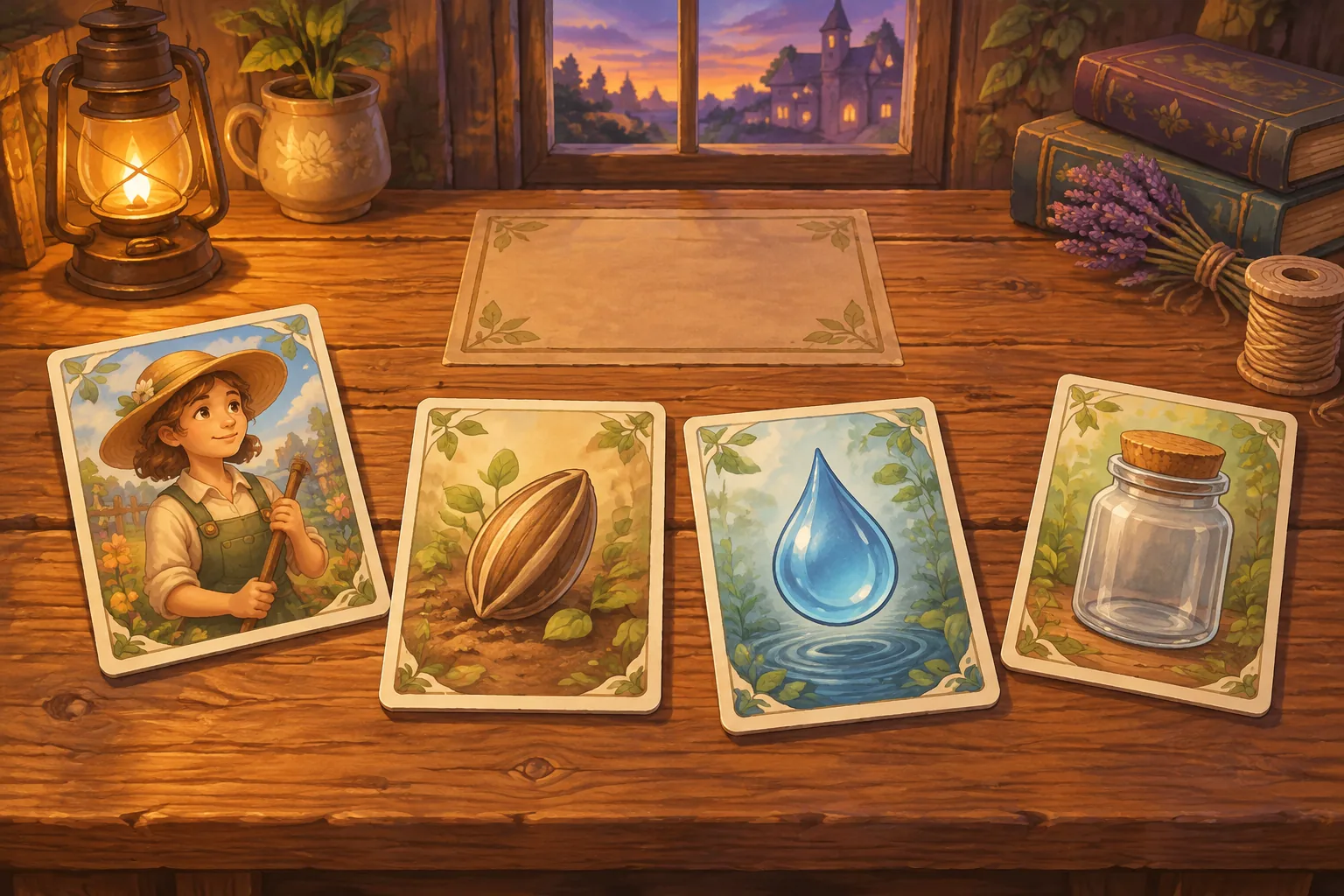
Build an original relationship game around a small request and a considerate farewell. In the fictional Valley Library Cart, a guest named Mara asks for a story and a warm herbal drink before continuing her journey. The player has two action slots each day, so care and departure take place across two days.
Start with a visible request and a few clear state changes. A brief response after each action helps the player understand how an ordinary task contributes to the relationship.
Give a guest a specific request

Thunder Lotus describes Spiritfarer as a cozy management game in which players care for spirit friends while traveling. Use the broad combination of care and a journey to design your own setting and characters. Mara's visit is a fictional trip through a valley.
The cart starts on day one with two action slots, one herb, one water and trust 0. Mara has not yet shared her story or received her drink. The player can listen, serve a drink, invite a farewell or end the day. Show the request and each resource before asking for a choice.
Define care actions and their costs
| Action | Requirement and cost | Result |
|---|---|---|
| Listen | One available action slot. Available once. | Mark the story heard and add 1 trust. |
| Serve drink | One action slot, one herb and one water. Available once. | Consume the ingredients, mark the drink given and add 1 trust. |
| Invite farewell | One action slot, both care actions completed and trust at least 2. | Open a confirmation choice. Confirm departure or decline and keep Mara at the cart. |
| Rest | End the current day before departure. | Begin the next day with two slots. Ingredients do not refill. |

Reject an unavailable action without spending a slot or ingredients. Assign each action event an ID and ignore a repeated event with the same ID. These rules keep a delayed or repeated click from serving the same drink twice.
An invitation uses its slot when the confirmation opens. If the player declines, Mara stays and the slot is not refunded. State that cost before confirmation so the player can decide whether to invite again or rest.
Trace the two-day visit
| Step | State after the action | What the player learns |
|---|---|---|
| Day 1: Listen | Trust 1, slots 1, story heard. | Mara's request has a specific first step. |
| Day 1: Serve drink | Trust 2, slots 0, herb 0, water 0, drink given. | Both care requirements are complete. |
| Rest | Day 2 begins with slots 2. Other values remain. | Rest restores time rather than ingredients. |
| Invite and confirm | Slots 1, trust 2, Mara departed. | The visit ends after an explicit choice. |

From reset, a premature invitation is rejected and changes nothing. After completing both day-one care actions and resting, the player may invite, decline and invite again. Confirming the second invitation uses the second day-two slot and ends the visit. This provides a test for both the consent choice and its time cost.
Give AI the complete visit
Give the builder a complete state model and expected outcomes. The following prompt describes an authored prototype rather than a recorded playtest.
Build an original browser relationship game called Valley Library Cart.
A guest named Mara wants to share a story and receive a warm herbal drink before continuing her journey.
Start day 1 with 2 action slots, 1 herb, 1 water, trust 0, listened=false, drinkGiven=false, departed=false.
Listen requires a slot, is available once, uses 1 slot, sets listened=true and adds 1 trust.
Serve drink requires a slot, 1 herb and 1 water, is available once, consumes those resources, sets drinkGiven=true and adds 1 trust.
Invite farewell requires a slot, listened=true, drinkGiven=true and trust at least 2.
Inviting uses 1 slot and opens a confirmation. Confirm sets departed=true, ends the visit and locks guest actions. Decline keeps Mara and does not refund the slot.
Rest ends the day and starts the next with 2 slots. It does not refill ingredients. Rest is unavailable after departure.
Reject invalid or repeated one-time actions without spending resources or slots. Ignore repeated event IDs.
Reset restores day 1, all starting resources, flags, counters and action IDs.
Listen then Serve on day 1: trust 2, both flags true, slots 0, herb 0, water 0.
Rest, invite and confirm: day 2, slots 1, departed=true.
Inviting from reset is rejected with no state change.
After the successful day 1, rest, invite, decline, invite and confirm: day 2 ends with slots 0 and departed=true.
Show state, accessible labeled controls and a short original response after each action. Use original valley-library art.
Replay the successful path, the premature invitation and the declined confirmation from reset. If ingredients return after rest, check that time and inventory reset separately. If Mara leaves on decline, inspect the confirmation branch.
Use the first-build guide to adapt this visit to your own characters. Build Valley Library Cart in SEELE AI Game Maker and verify the two-day journey before adding more guests.
Frequently asked questions
How many characters should my first relationship game include?
Start with one guest and one specific request. Two care actions and a farewell can show how a relationship develops without requiring a large cast. Add another guest only after the first visit, dialogue feedback and reset work reliably. This makes the transition between actions easier to debug.
How can ordinary tasks support a character journey?
Connect each task to something the character has asked for and provide a short response after it completes. In the fictional library fixture, listening and serving a drink each contribute one trust. The player can see why those actions matter before inviting a farewell.
Why make the farewell a confirmation choice?
A confirmation gives the player a clear point to finish the visit or keep the guest for now. In this fixture, declining preserves the guest but does not refund the action slot. Explain that cost in the interface before the player makes the choice. A visible remaining-slot counter helps make the cost clear.
What should I test when a day ends?
Confirm that the next day restores action slots while preserving completed care flags, trust and remaining ingredients. Test a premature farewell and a declined confirmation too. Reset should separately restore the complete original state, including processed action IDs. Record each result in the visit log for comparison.