Introduction
A good perspective puzzle makes you stop, change where you stand, and reinterpret something you thought you understood. If you want to make a game like Superliminal, use that “look again” feeling as a design prompt, then choose a different rule for your own world. This guide builds that rule around a fictional isometric puzzler called Parallax Post: the shadow of a placed postcard chooses which delivery lane a parcel can use.
The example is a design exercise, not a finished game or tested SEELE output. Its goal is to show how to turn a broad reference into a small interaction players can predict, try, and learn.
Borrow a design question, not a level or object
The official Steam listing describes Superliminal as a first-person puzzle game based on forced perspective and optical illusions (official game description). That is enough to identify the kind of experience this article discusses. It does not mean a new project should reuse its rooms, props, art direction, interface, story, or specific puzzle solutions.
Start with the question behind the reference: “What can the player notice that changes their next action?” Then choose a rule that belongs to your game. Parallax Post does not resize an object. Instead, the player rotates a postcard tile beneath a fixed lamp; its cast shadow touches one of three lane marks, and that mark determines where a parcel can travel. The player is solving a routing problem through visual interpretation, with a rule that can be explained in one sentence.
Make the rule visible before making it surprising

A perception puzzle needs a stable connection between what the player sees and what changes. In Parallax Post, the postcard, lamp, three lane marks, and parcel chute stay visible in the room. Only the postcard’s rotation changes which lane its shadow reaches.
| Element | Player action or observation | Game response | Clue to show |
|---|---|---|---|
| Postcard tile | Rotate it on the marked floor pad | Its shadow sweeps across the lane symbols | A bright edge tracks the shadow tip |
| Three lane marks | Read the symbol under the shadow | One route indicator lights up | Each lane has a distinct shape and color |
| Parcel chute | Send the parcel | The parcel follows the selected lane | A preview line appears before dispatch |
| Reset bell | Restart the room | Parcel and tile return to initial positions | Bell stays in view and has a clear label |
This table defines the player’s contract with the puzzle. If the preview line disagrees with the shadow, the rule feels arbitrary. If both agree before the parcel moves, a wrong choice can teach the player what to change.
Build one complete room around one rule
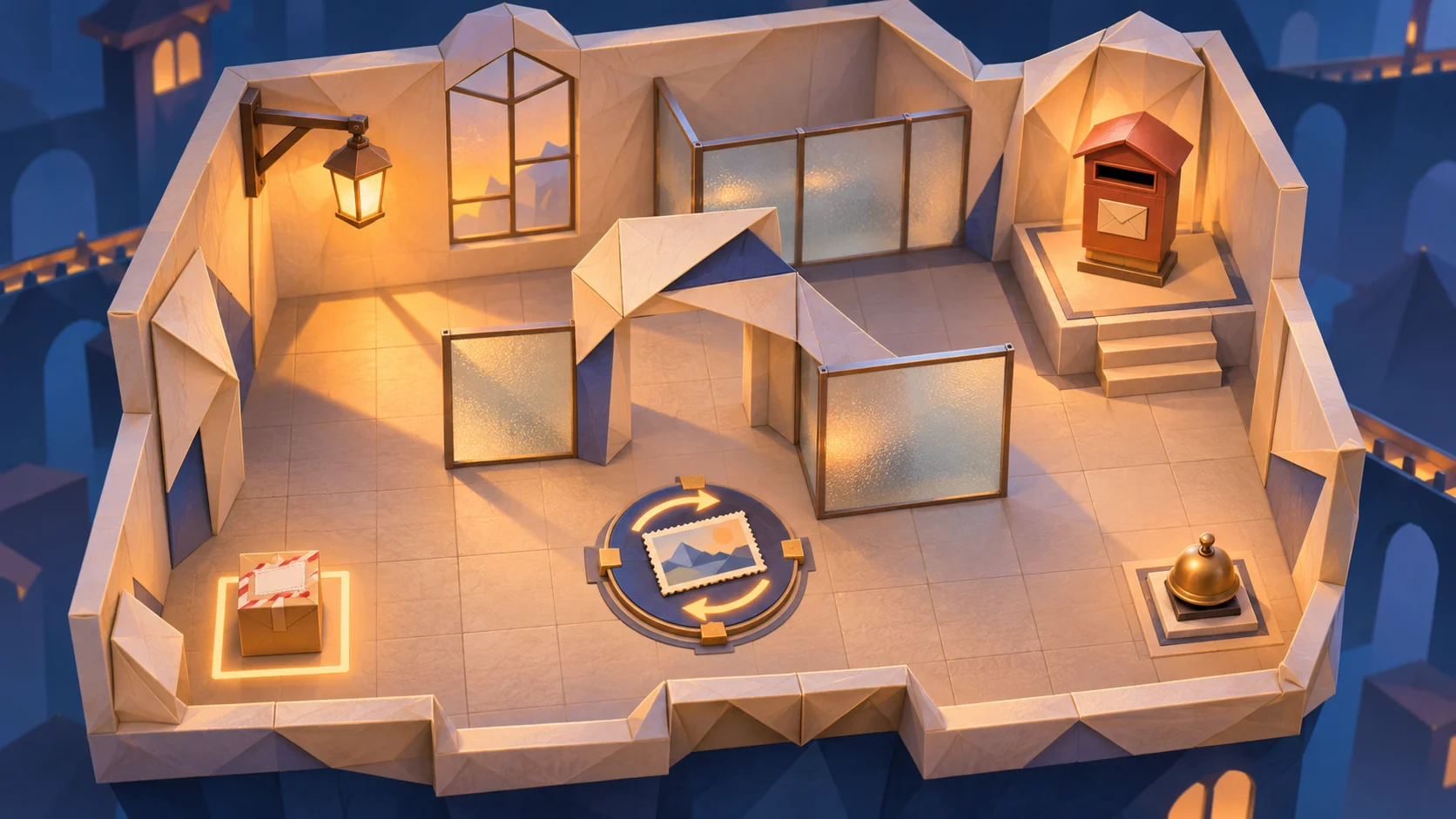
Begin with a room that has a single goal: route one parcel to the matching mailbox. Make the lane symbols large, keep the lamp and target visible in the starting camera, and place the postcard where its shadow is easy to read. Do not add a timer, multiple parcels, movable lamps, or hidden switches yet. Each extra system would make it harder to know whether the projection rule itself is understandable.
A useful paper prototype can be as simple as a top-down room sketch. Draw the lamp position, the postcard’s rotation arc, the three lane marks, the parcel start, and the destination. For each postcard orientation, mark which symbol the shadow crosses. If you cannot predict the chosen lane from the sketch, tighten the rule before implementing it.
Next, define the exact interaction states:
- Inspect: The player sees the postcard, lamp, lane marks, and destination.
- Rotate: A clear input turns the postcard in fixed steps; the shadow moves with it.
- Preview: The selected lane glows and a path line shows the parcel’s expected route.
- Dispatch: A separate action sends the parcel along that route.
- Recover: The reset bell restores the original state if the player picked the wrong lane.
Separating preview from dispatch matters. It lets the player form a prediction before committing, which gives a playtest a meaningful question: did they understand the shadow rule, or did the game merely reveal the answer after they clicked?
Use a small prompt that asks for inspectable behavior
An AI-assisted starting prompt should describe what the player can do and what they should see. Avoid asking only for “a mind-bending puzzle like Superliminal”; that phrase gives no original interaction rule and encourages imitation.
Create an original, single-room isometric puzzle prototype called Parallax Post. The player rotates one postcard tile beneath a fixed lamp. Its shadow selects one of three visibly marked delivery lanes. Show the selected lane and parcel path before the player dispatches a parcel to a matching mailbox. Include a reset bell, a short instruction, and clear visual feedback for rotate, preview, dispatch, and reset. Keep the room and rule self-contained, use original placeholder art, and do not reproduce any existing game, level, object design, character, interface, or text. Make the lane mapping and interaction inputs easy to inspect and change.
Treat the prompt as a proposed starting point, not proof that a particular build exists or works. If a creation tool gives you a prototype, inspect whether the shadow and preview agree, then change one condition at a time. SEELE’s catalog describes a prompt-led game studio and playable-game creation, so it can be a place to explore a concrete starting idea. The catalog does not establish that this projection mechanic has already been implemented or tested. You can begin with the free AI game maker and provide the rule, inputs, and visible feedback above.
Diagnose confusion by separating visual and rule problems
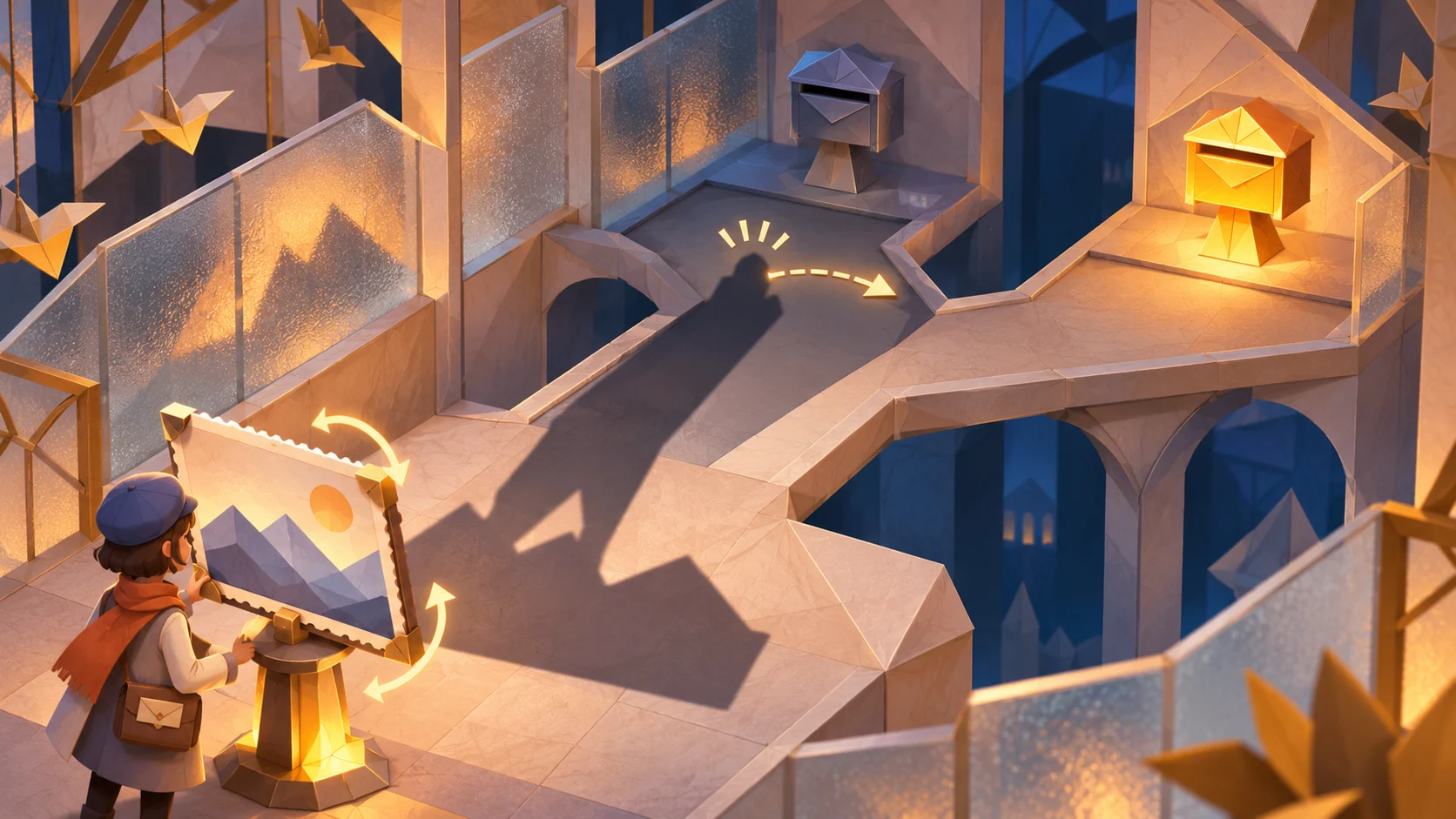
When a player chooses the wrong lane, do not immediately make the puzzle easier. First ask what they thought the shadow indicated. If they saw the wrong symbol, improve contrast or the camera angle. If they saw the right symbol but expected a different lane, clarify the mapping. If the preview showed one lane and the parcel took another, fix the implementation before adding a hint.
| What the player does | Likely issue to investigate | First change to try |
|---|---|---|
| Rotates repeatedly without noticing the shadow | Shadow edge or rotation feedback is hard to see | Brighten the contact point and slow the preview sweep |
| Predicts a lane but dispatch goes elsewhere | Visual rule and route mapping disagree | Make the selected symbol and route preview share one signal |
| Finds the answer only by trying every angle | No useful prediction step | Add a stable alignment cue or let the player preview one orientation at a time |
| Cannot recover after a wrong dispatch | Reset path is hidden or state is unclear | Keep the reset bell in view and explain what it restores |
These are diagnostic hypotheses, not findings from a real playtest. Change one cue, then repeat the same prompt and room setup. That makes it easier to tell whether the cue helped.
Test whether a player can predict the result
Before expanding the room, run a small test with someone who has not seen the rule. Ask them to say which lane they expect before they dispatch the parcel, and why. Record their prediction and explanation separately from whether the parcel arrives. A lucky guess is not the same as understanding.
| Test case | Ask before dispatch | A useful signal |
|---|---|---|
| Initial orientation | Which lane will the shadow select? | Player points to the symbol under the shadow |
| Rotate one step | What changed, and which lane is now active? | Player tracks the shadow movement rather than guessing |
| Preview mismatch | Does the path line match the selected symbol? | Player notices and reports any disagreement |
| Wrong destination | How would you recover? | Player locates reset and knows what it restores |
| New postcard graphic | Does the same rule still make sense? | Art changes without changing the lane logic |
If several people miss the same cue, change the visual explanation before adding a second rule. If they understand the mapping but still find the room dull, then add one controlled variation—such as a wall that blocks one lane—while preserving the original shadow-to-lane rule.
Conclusion
To make a game like Superliminal in spirit while keeping your project original, begin with the player’s act of reinterpretation and invent a different cause-and-effect rule. Parallax Post uses a shadow to select a delivery route, then gives the player a preview, a deliberate dispatch action, and a reset path. Build that one-room loop first, watch whether players can predict the result, and expand only after the visual rule is clear.
FAQ
How do I make a game inspired by Superliminal without copying it?
Use the reference to identify a broad player feeling or design question, then create a different mechanic, world, art, and puzzle sequence. This article’s shadow-routing rule is a fictional example rather than a recreation of a Superliminal puzzle.
Does a perspective puzzle need a first-person camera?
No. Camera choice should support the rule. A first-person view can emphasize sightlines, while an isometric view can make room layout and route choices easier to read. Test whether players can see the clue that controls the outcome.
How many mechanics should I put in the first puzzle room?
Start with one rule and one goal. Add a second mechanic only after players can explain the first rule and you know what new decision the second one creates.
How can I test a puzzle before it is fully built?
Sketch the room, mark the player’s possible actions, and draw the expected result for each state. Then ask someone to predict the outcome from the sketch. This checks whether the rule can be understood before you invest in more content.
Can AI build and test the puzzle for me?
AI can help create a starting point from a concrete prompt, but this example has not been built or tested. Inspect any generated result, verify the projection and route feedback, and use player observations to decide what to change.