Introduction
A compact adventure can make a small area feel mysterious when the player notices how a landmark, object, or route fits into the world. If you want to make a game like Tunic, begin with the broad pleasure of exploration, then invent a new interaction that belongs to your own setting. This guide uses Prismwake, a fictional isometric adventure where the player rotates a found glass prism to guide a moving beam through stone receivers and reveal a safe crossing.
This example is a design exercise, not a finished or tested game. It demonstrates one way to build curiosity and cause-and-effect into a small area without copying another game’s character, manual, map, art, or puzzle rules.
Choose the feeling you want, then design your own interaction
The official TUNIC listing describes an isometric action-adventure about exploring a land of legends and mysteries (official game listing). That broad description can help you decide whether you want exploration, discovery, or combat in your own project. It does not make TUNIC’s fox, instruction manual, locations, visual language, items, puzzles, or progression a template to reproduce.
Prismwake focuses on one different question: “How can a player use a found object to change a route through an unfamiliar ruin?” The player discovers a prism, rotates it on a stone socket, and watches a beam travel toward a receiver. The interaction is visible before it succeeds, so the player can form a prediction and correct the angle.
Connect object, clue, and route
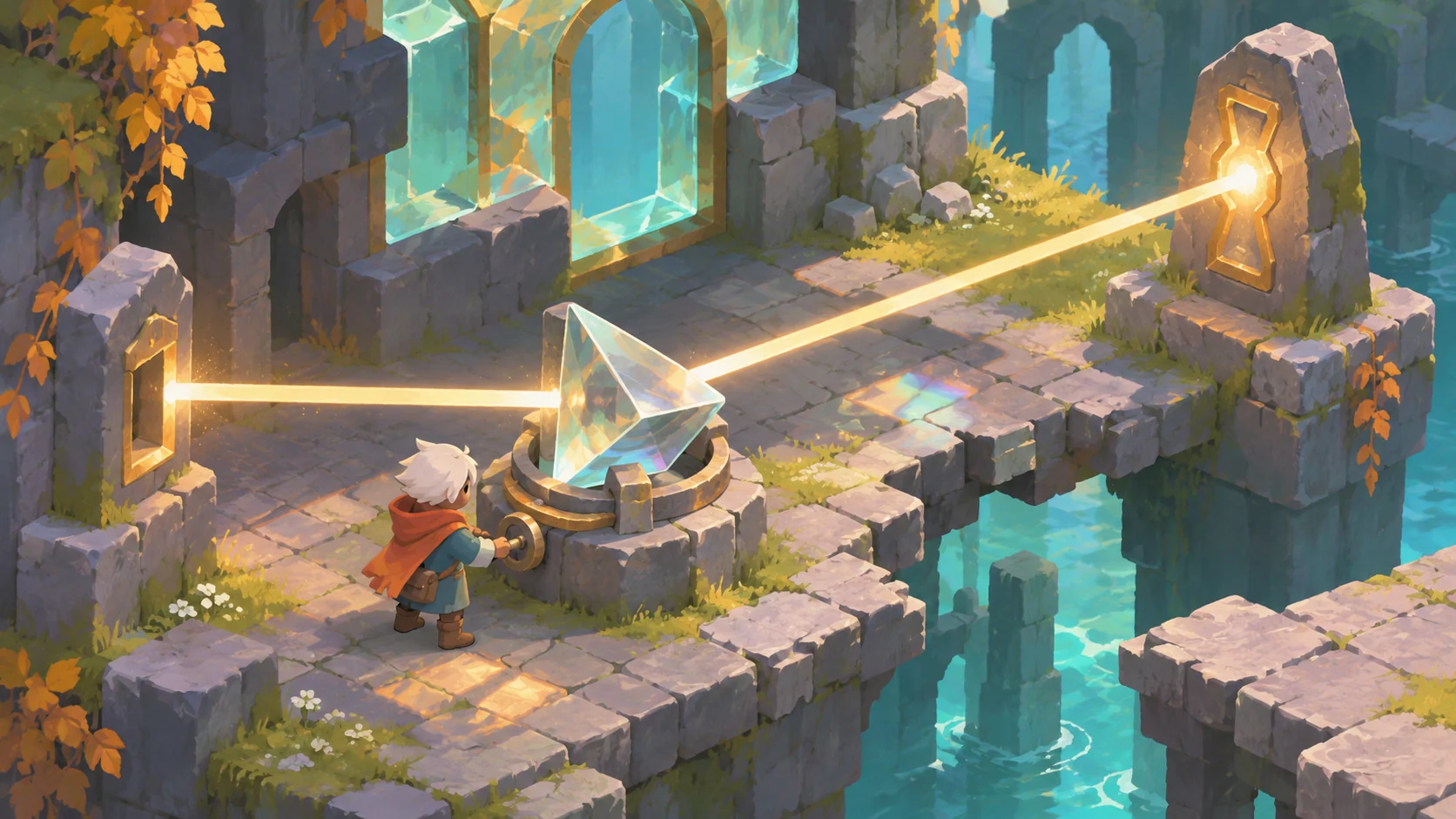
Before building a large map, make one ruin where the beam has a clear destination. Place the prism socket, a moving shaft of light, two receiver stones, and a broken crossing in view. One receiver is optional; the other lowers the bridge when lit.
| State | Player action or clue | World response | What to make clear |
|---|---|---|---|
| Find | Notice the beam and socket | Prism lies nearby or becomes reachable | The prism is relevant to the beam |
| Rotate | Turn the prism in fixed steps | Beam direction changes | A highlight shows the outgoing direction |
| Route | Align beam with a receiver | Receiver glows and hums | The beam and receiver visibly connect |
| Complete | Light the required receiver | Stone crossing lowers | The path is the reward |
| Recover | Turn the prism again or reset | Beam and crossing return to a known state | A wrong angle is reversible |
The table is the player’s contract with the puzzle. If the receiver lights without a visible beam path, the result may feel arbitrary. If the beam visibly connects before the crossing moves, the player can understand why the route changed.
Prototype one ruin, not an entire adventure
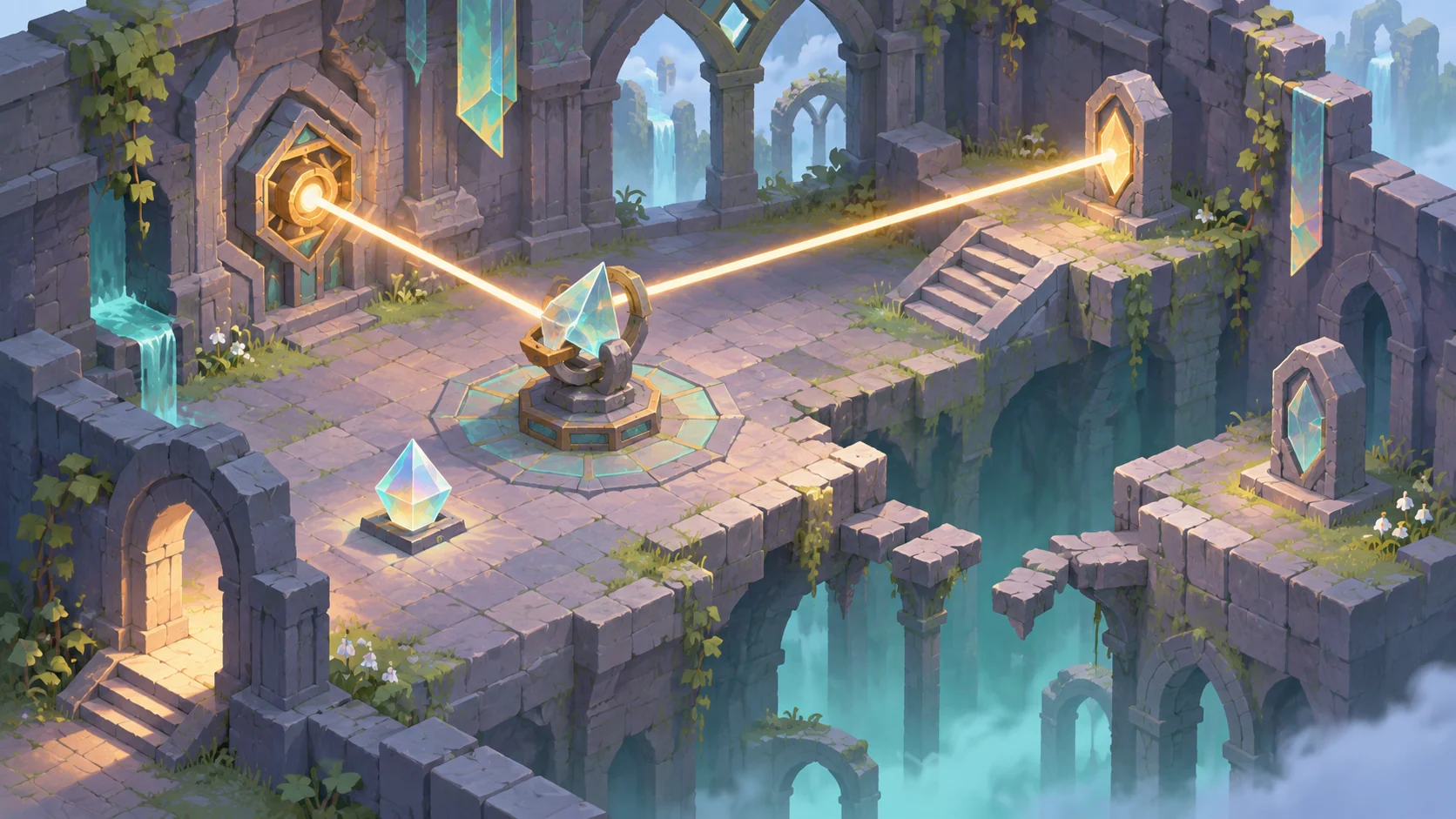
Draw the room as a simple top-down map. Mark the player’s entrance, prism, socket, beam source, receiver and crossing. Make sure the player can see the broken crossing from the starting area. If the goal is hidden around a corner, they may not know why rotating the prism matters.
Use a small, inspectable state sequence:
- The beam source is active, but no receiver is lit.
- The player carries the prism to the socket.
- Rotating the prism changes the beam path in visible increments.
- A receiver lights only when the beam reaches its marked surface.
- The crossing changes when the required receiver is lit.
- Reset restores the initial beam and bridge state.
This version does not need enemies, inventory upgrades, a large world map, or a long lore sequence. Add those systems only if they create a decision that supports your first interaction. For example, an optional second receiver could reveal a shortcut, but the first route should work without a collectible hunt.
Make discovery fair without giving away the answer
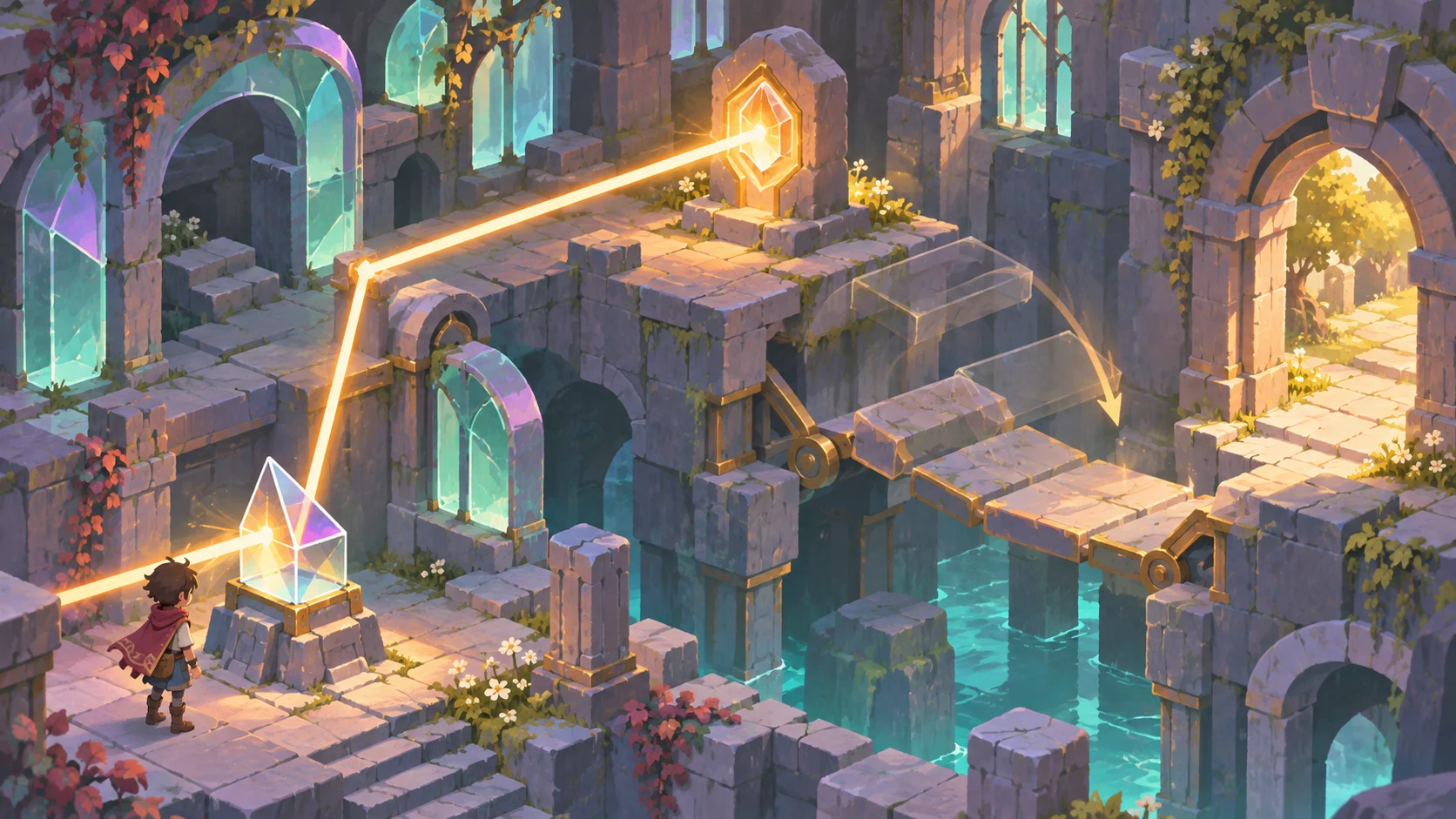
An unexplained world invites curiosity, but important feedback still needs to be consistent. Give the beam source a distinct sound or color. Let receiver stones share a subtle visual material with the beam’s endpoint. When the player rotates the prism, show a preview that helps them understand what changed.
A clue should support inference rather than spell out every step. A repeated arc shape on the socket and receiver might suggest the beam’s turn. If players repeatedly miss the same clue, increase its contrast or let them inspect the socket. Do not add more symbols until you know what the existing ones communicate.
Use an AI prompt that specifies observable behavior
A useful prompt describes the actions, rules, and feedback the prototype should expose. “Make an adventure like Tunic” does not define an original mechanic or a way to check it.
Create an original isometric exploration-adventure prototype called Prismwake. In one small stone ruin, the player finds a glass prism and places it in a rotating socket. A moving beam changes direction in visible steps and can light two distinct receiver stones. Lighting the required receiver lowers a broken crossing to an exit. Preview the outgoing beam before each rotation is committed, and include a reset action. Keep the beam, receiver, bridge, and state changes easy to inspect. Use original placeholder art and do not reproduce any existing character, manual, map, item design, puzzle, interface, or text.
Treat this as a proposed starting point, not evidence that a working build exists. SEELE’s catalog describes prompt-led game creation and playable games, so it can be one place to explore a concrete idea. It does not establish that Prismwake has been generated or tested. You can try the free AI game maker, then inspect whether the result follows your rules.
Diagnose the puzzle by following the beam
When a player does not reach the crossing, separate the problem into stages. Did they notice the prism? Did they understand that rotation redirects the beam? Could they see when a receiver was active? Did the bridge respond to the correct receiver? Each question points to a different repair.
| What happens | Possible issue | First thing to inspect |
|---|---|---|
| Player walks past the prism | The object does not look useful | Improve its contrast or show a faint beam interaction nearby |
| Player rotates without a prediction | The outgoing direction is hard to read | Add a visible beam preview or clear rotation steps |
| Receiver appears lit without connection | The beam endpoint is ambiguous | Make the contact point and receiver surface clearer |
| Receiver lights but crossing stays broken | Puzzle and traversal state disagree | Make both respond to the same receiver condition |
| Player solves the route but does not continue | The crossing goal or exit is not visible | Show the destination before the puzzle is solved |
These are diagnostic hypotheses for a fictional prototype, not completed test findings. Change one cue at a time and replay the same state sequence so you can see whether players’ explanations become clearer.
Test whether players can predict the bridge
Before adding another room, ask a new player where they think the beam will go before rotating the prism. Then ask which receiver they expect to activate after a single turn. Record the prediction and reason separately from whether they are right. A lucky guess does not show that the rule is understood.
Try five states: beam not connected; one rotation; a receiver hit; the required receiver hit; reset after an incorrect route. If the player cannot explain the outcome, check the visual preview before adding a hint. If the rule is understood but the room still feels empty, add one optional route or landmark rather than a second beam system.
Conclusion
To make an adventure inspired by Tunic while keeping it original, focus on the exploration experience you want and invent a separate interaction. Prismwake uses a found prism, a visible beam, receiver stones, and a route that changes when the player aligns them. Prototype one ruin, make the state changes readable, and expand only after players can predict why the crossing opens.
FAQ
How do I make a game inspired by Tunic without copying it?
Use a broad goal such as exploration or discovery, then design your own character, world, puzzle, items, visuals, and progression. Prismwake’s beam-routing rule is a fictional original example, not a recreation of Tunic content.
Does the first prototype need combat?
No. Include combat only if it supports the decision you are trying to test. A small exploration puzzle can first show whether players understand how an object changes the route.
How can I make environmental puzzles understandable?
Keep the clue, player action, and result connected by consistent visual feedback. Let players see the target before they solve the puzzle, and show how their action changes the state.
How many rooms should I build first?
One complete room is enough to test a central interaction. Add a second room only after the first teaches the rule and you know what new decision the next room adds.
Can AI generate and test the adventure automatically?
A prompt can describe a starting idea, but this example has not been generated or tested. Inspect the actual beam route, receiver feedback, reset behavior, and player understanding before treating a build as finished.