Introduction
A party platformer can turn level construction into part of the fun: players make a route, then find out whether it works. If you want to make a game like Ultimate Chicken Horse, start with that broad build-and-play rhythm, then create a different player relationship and goal. This guide uses the fictional Beacon Relay, where two players cooperate to route a signal to an exit; one lays out a path while the other tests it, and they switch roles after each run.
Beacon Relay is a design exercise, not a working multiplayer game or tested result. It shows how a small piece budget and clear role changes can make construction feel social without copying competitive trap placement.
Borrow the build-and-play rhythm, not the same contest
The official Steam page describes Ultimate Chicken Horse as a party platformer where players build the level while playing and place hazards that can also affect themselves (official game listing). That describes the reference at a high level. It does not mean a new game should reuse its characters, hazards, levels, interface, visual style, or round rules.
Beacon Relay changes the goal from trying to outlast friends to helping a teammate reach a shared beacon. One player places a limited set of signal tiles; the other attempts the route and reports where the path is unclear or unsafe. After the run, they swap roles and revise one tile. The interesting decision is how to communicate a route with a small budget, not how to surprise an opponent with a trap.
Give each round a clear construction question
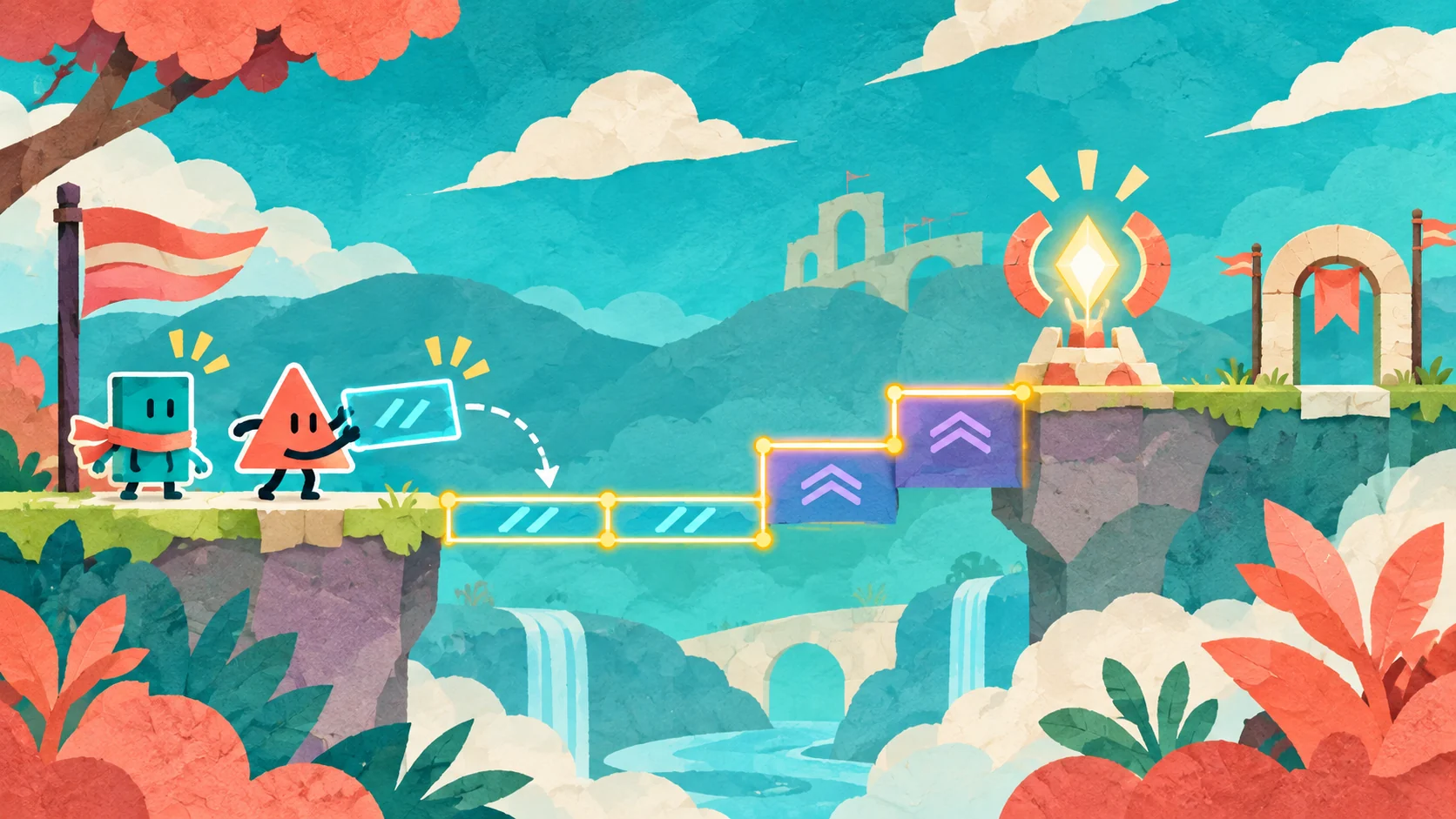
Before drawing a full course, decide what the builder is trying to communicate. Beacon Relay begins with a gap, a start ledge, a beacon on the far side, and four signal tiles that can form steps or short bridges. A tile has a bright edge that indicates which side connects to the next one.
| Round phase | Builder’s task | Runner’s task | What to learn |
|---|---|---|---|
| Plan | Place up to four signal tiles | Watch the route and ask one question | Can the intended path be read? |
| Run | Observe without changing tiles | Cross to the beacon | Where does the route feel unclear or unsafe? |
| Review | Choose one change | Explain the first confusing moment | Which single piece caused the problem? |
| Switch | Take the other role | Build the next variation | Do both players understand the rule? |
This structure makes the round purposeful. If the runner falls, the review should help the builder understand whether the gap was too wide, the connection cue was hidden, or the route was simply difficult.
Keep the first piece set small

Use only two tile types at first: a flat bridge and a raised step. Both should have visible connection points. Give the builder four total pieces and a clear placement area. A small budget makes each decision visible and lets players talk about the same route instead of filling the screen with options.
A paper prototype can work before you add movement. Draw a start, three gaps and a beacon. Cut out four bridge and step tiles. Ask one person to build the route and another to trace it. If the runner cannot tell which surfaces connect, improve the tile edges before adding moving platforms or hazards.
Make role switching part of the design
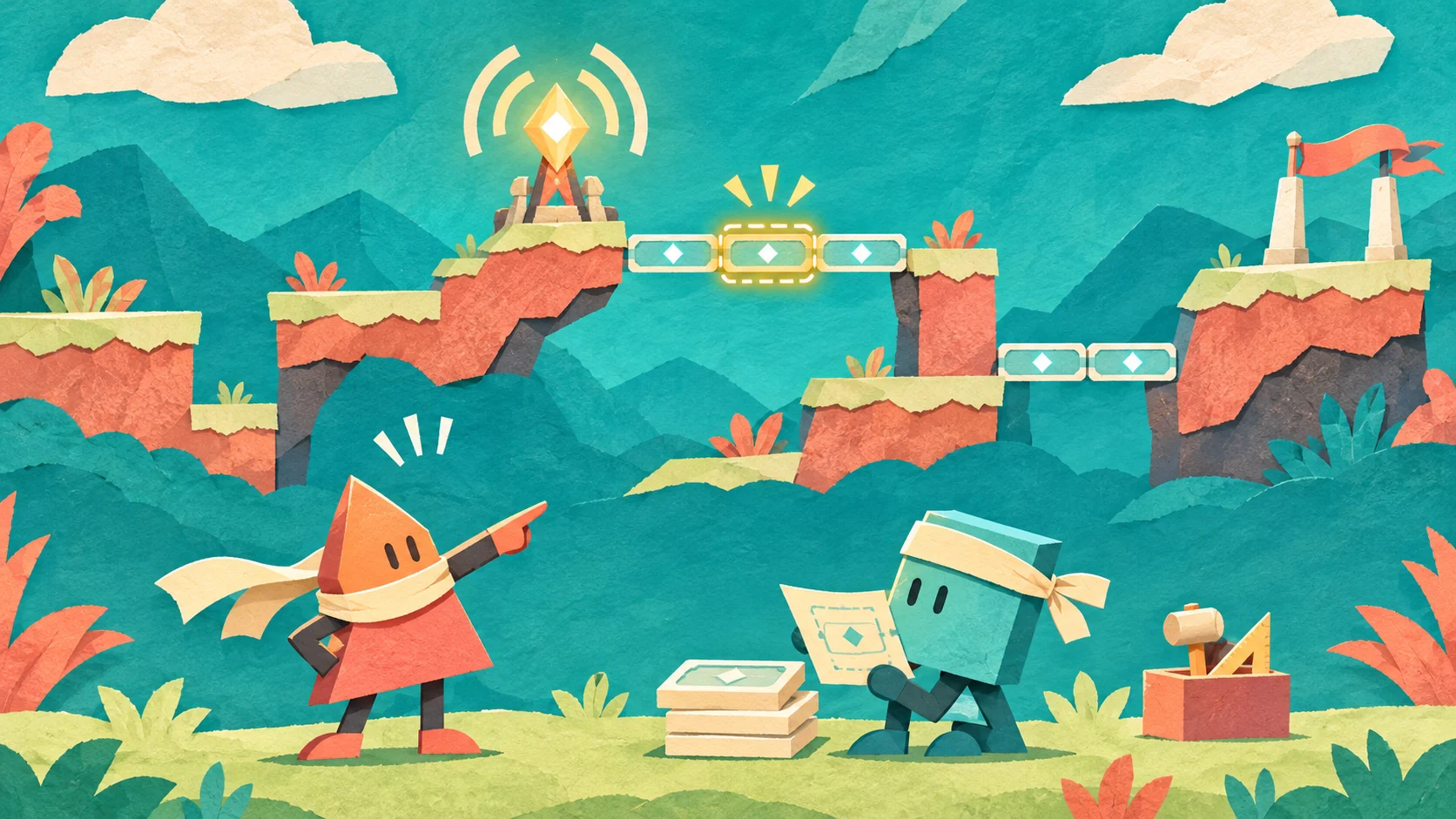
A cooperative mode can become one player directing and the other following. Switch roles after every attempt so both people practice reading and constructing routes. The runner should be able to give feedback, but avoid letting them move tiles during the run; otherwise, the game may stop testing whether the builder’s route communicated clearly.
Beacon Relay can show a small checkpoint after each successful crossing. If a player falls, restart near the last completed segment rather than replaying the whole course. This keeps the cost of experimentation low while preserving the need to plan the next connection.
Prompt for an original local prototype
A prompt should explain the player roles, pieces, round sequence and success condition. Asking for a game “like Ultimate Chicken Horse” does not say what you want to build.
Create an original two-player cooperative platformer prototype called Beacon Relay. In each round, one player places up to four signal tiles between a start ledge and a beacon, and the second player runs the route. Include two tile types: flat bridge and raised step, with bright connection edges. After the run, let players switch roles and revise one tile. Add a checkpoint after each successful segment and a simple shared finish goal. Keep piece placement, collision and role switching easy to inspect. Use original abstract characters and paper-cut scenery; do not copy any existing game's characters, traps, levels, art, interface or text.
Treat this as a proposed starting point, not proof that a multiplayer build exists. SEELE’s product catalog describes prompt-led game creation and playable games, so it can help explore an idea at the concept stage. It does not establish networking, synchronized co-op, or a tested Beacon Relay output. You can try the free AI game maker with the roles and rules above.
Diagnose failure as communication or movement
If a route fails, first find out what the runner expected. If they could not see which tiles connected, improve visual cues. If they understood the route but the jump felt impossible, adjust the gap or movement. If a tile appears connected but the player falls through it, check the collision rule before revising the level.
| What happens | Question to ask | First change |
|---|---|---|
| Runner hesitates at a tile edge | Is the connection direction visible? | Strengthen the edge cue or add a preview line |
| Runner falls despite a clear route | Is the gap within the jump range? | Shorten the gap or allow one more bridge tile |
| Builder uses all pieces without a plan | Is there a meaningful placement budget? | Reduce the piece set or clarify the beacon route |
| One player makes every decision | Are roles switching and feedback balanced? | Switch roles sooner and let the runner name one issue |
| Revisions do not improve the route | Is the review about a specific point? | Ask where the runner first felt uncertain |
These are possible prototype issues, not real playtest findings. Change one route cue or movement parameter at a time so the next run can explain what improved.
Test whether the course invites collaboration
Test with the same short course and switch roles after every attempt. Ask the runner to describe the route before moving, then ask the builder to explain the intended connection. Compare those explanations. If they differ at the same tile, the course needs a clearer cue or a simpler connection rule.
Try one course with a wide safe route and one with a narrow optional shortcut. See whether players discuss the tradeoff, or whether the shortcut only adds frustration. A useful variation gives the team a choice they can explain, rather than adding difficulty without a new decision.
Conclusion
To make a game inspired by Ultimate Chicken Horse while keeping it distinct, use a build-and-play rhythm and change what players are working toward. Beacon Relay turns the round into shared route planning, a short run, one revision, and a role switch. Start with two tile types, make connections visible, and test whether players can communicate the intended path.
FAQ
What should I prototype first in a build-and-play platformer?
Prototype one short route, a small piece budget, and a repeatable run. Make sure players can explain how pieces connect before adding more hazards or movement types.
How can I make a game like Ultimate Chicken Horse without copying it?
Use the broad idea that construction affects a platforming round, then invent different goals, roles, art, pieces, and rules. Beacon Relay is a fictional cooperative example rather than a recreation.
Does the prototype need online multiplayer?
No. You can test the route-building decision with two people taking turns locally or even with paper pieces. Do not promise online play unless it has been implemented and tested.
How many level pieces should the first version include?
Two simple piece types are enough to test whether players understand connections and route planning. Add a new piece only when it creates a distinct choice.
How can I tell whether the level is difficult or unclear?
Ask the runner to describe the intended path before they move. If they understood the route but struggled with the jump, tune movement; if they chose a different route, improve the connection cue.