A grid-based tactics game makes position part of every decision. A unit must reach a useful square, respect obstacles and attack from a defined range before the opponent responds. Start with a small board and one unit per side so you can verify those relationships before adding classes, equipment or a long campaign.
This guide describes a fictional turn-based prototype and an AI-assisted build request. Its coordinates and damage values are design choices for an example, not observations from a completed game. Use the walkthrough to check the behavior of your own build.
Make the board and its rules explicit
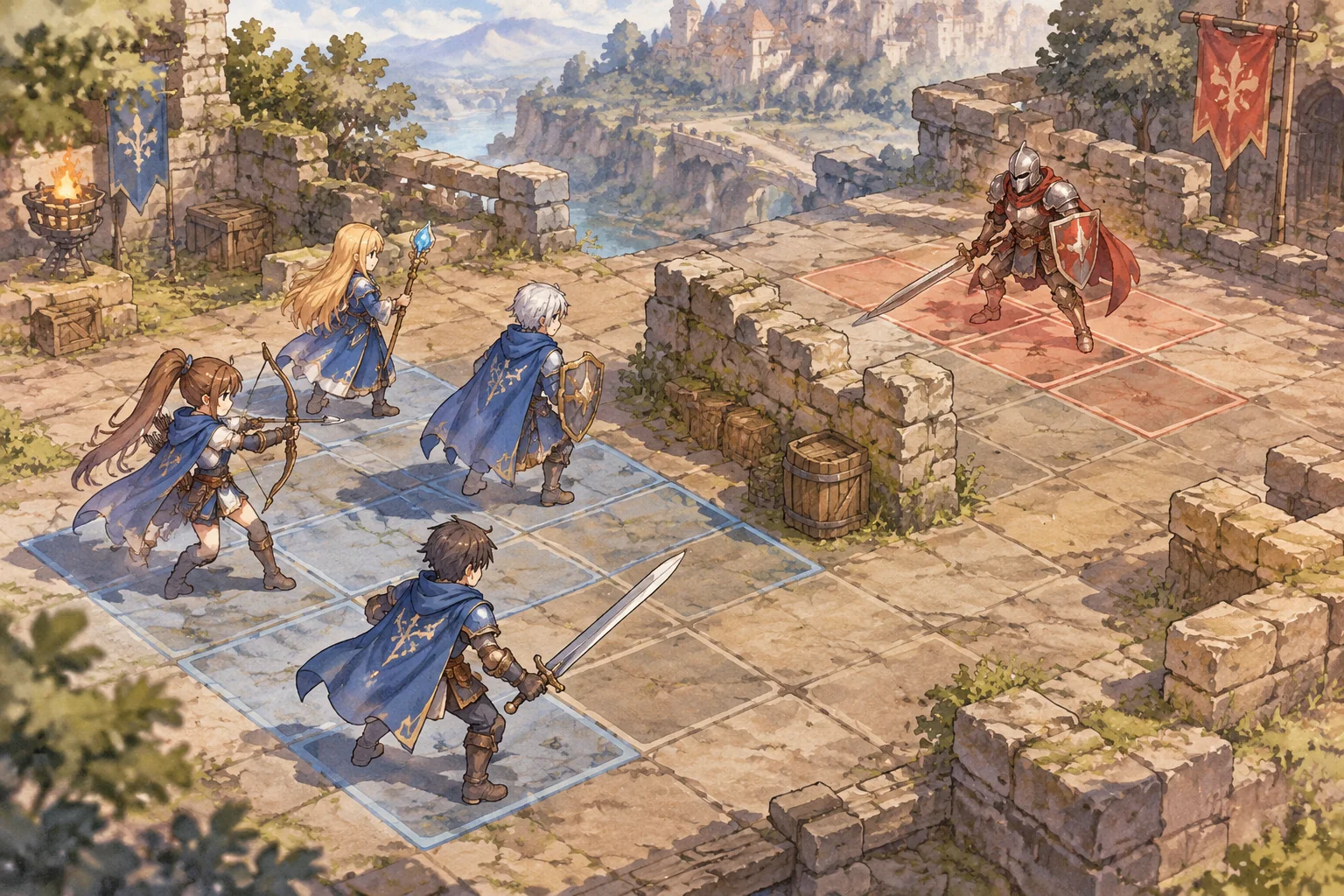
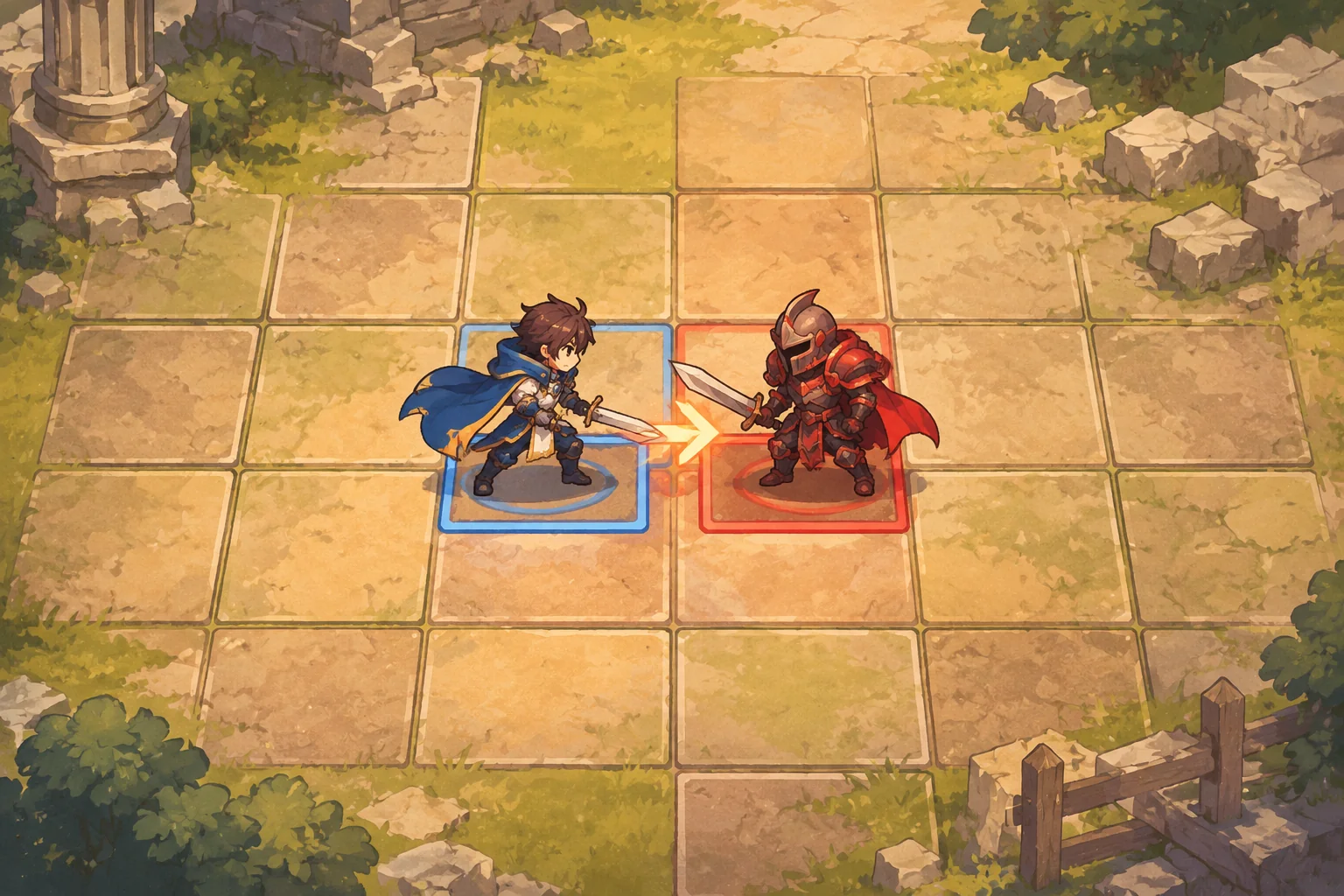
Use a five-by-five board. Number columns and rows from 1 to 5, and write a position as column first, then row. Place the player at (1,1), the opponent at (3,1), and an impassable obstacle at (2,2). Both units start with 4 health.
| Board element | Example rule | Player feedback |
|---|---|---|
| Open square | A unit may occupy one empty square | Show the selected destination |
| Obstacle | Cannot be entered or crossed | Mark it as blocked |
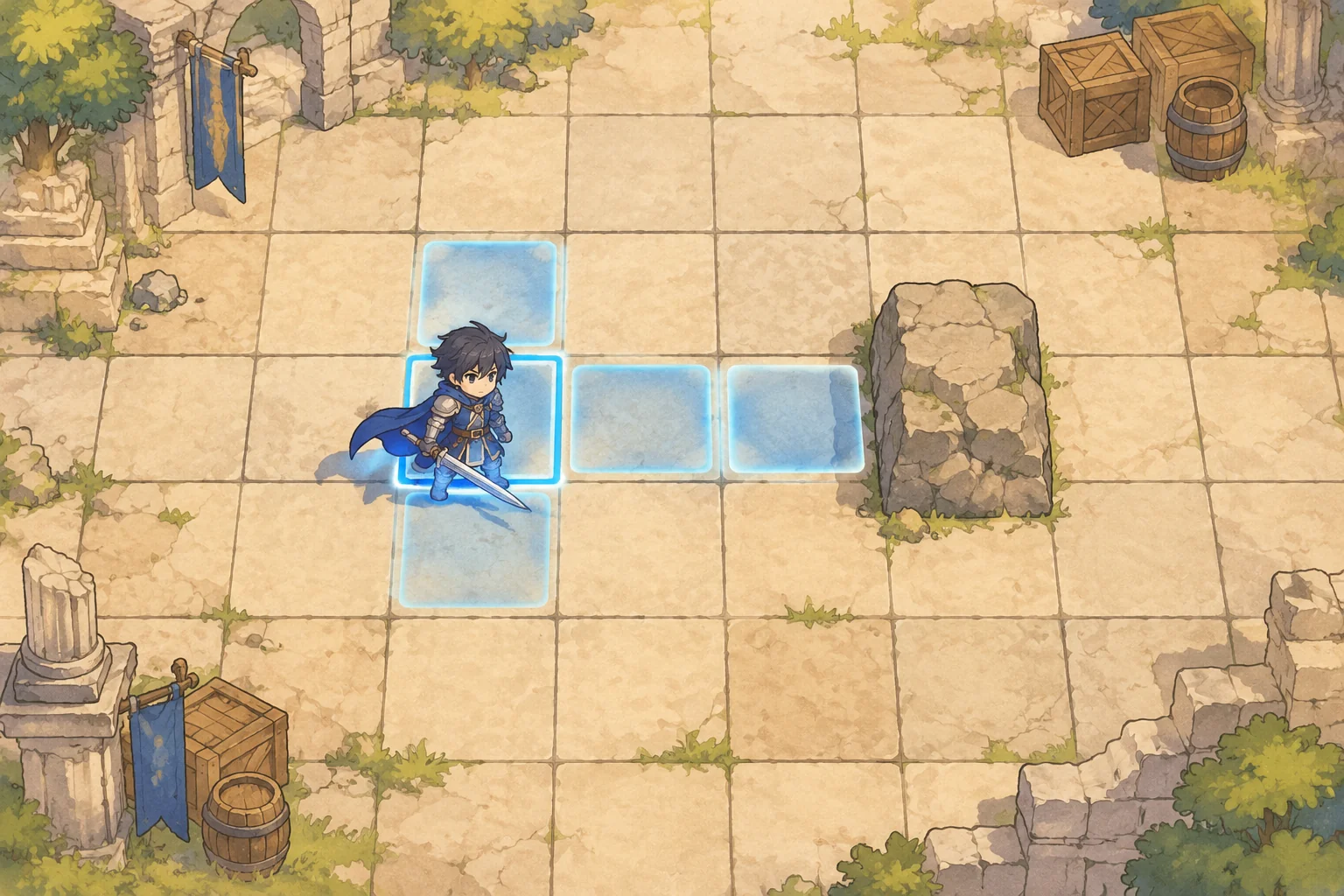
| Movement | Up to two orthogonal steps | Highlight reachable empty squares |
| Attack | One orthogonally adjacent target | Show the valid target and damage |
Orthogonal means up, down, left or right, not diagonally. A route must remain on the board and cannot pass through an occupied or blocked square. Highlight actual reachable destinations rather than drawing a simple radius that includes unreachable cells behind an obstacle.
Define a complete turn
On the player's turn, the unit may move once, up to two valid steps, and may then attack once. Either action may be skipped. An attack deals 2 damage and is legal only when the opponent shares an edge with the player's square. End the turn after these choices.
The opponent uses a deliberately simple rule: it stays in place and attacks for 2 damage if the player is orthogonally adjacent when the player ends the turn. Otherwise it waits. A unit at zero health or below is defeated immediately, and the match ends before any further response. The player wins by defeating the opponent and loses if the player's unit is defeated.
This opponent is a test fixture, not a complete competitive AI. Its predictable behavior helps isolate movement, adjacency and turn-order errors.
Walk through one legal sequence
Move from (1,1) to (2,1). That destination is empty and one orthogonal step away. Attack the opponent at (3,1), an adjacent square, reducing its health from 4 to 2. End the turn: the opponent remains adjacent and reduces the player's health from 4 to 2.
| Moment | Player position | Player health | Opponent health |
|---|---|---|---|
| Start | (1,1) | 4 | 4 |
| After move and attack | (2,1) | 4 | 2 |
| After opponent response | (2,1) | 2 | 2 |
| Second player attack | (2,1) | 2 | 0: victory |
On the next player turn, stay in place and attack once. The opponent reaches zero, so the game ends immediately and the opponent does not attack again. This is a calculation from the stated rules, not a playtest result.
Give an AI game maker a precise specification
Describe board coordinates, valid paths, action limits and the order of effects. SEELE's capability catalogue describes creating a game from a written idea and producing 2D characters, scenes and interface elements. Those categories do not prove that this exact grid, pathfinding or turn system has been generated or tested.
Create an original single-player turn-based tactics prototype.
Use a 5-by-5 grid with columns and rows numbered 1 through 5.
Place the player at (1,1), an opponent at (3,1), and a blocked tile at (2,2).
Both units start with 4 health. On each player turn allow at most one move
of up to two orthogonal steps through empty, in-bounds, unblocked squares.
Allow one optional attack after the move; it can target only the opponent
on an orthogonally adjacent square and deals 2 damage. Either action may be
skipped. Show the reachable cells, selected unit, health and turn state.
When the player ends the turn, the opponent stays in place and deals 2
if orthogonally adjacent; otherwise it waits. A unit reaching zero or less
health is defeated immediately, ending the match before any later response.
Reject illegal movement, occupied destinations and diagonal attacks.
Restart restores starting positions, health, obstacle and player turn.
Use original art, not characters or interfaces from an existing game.
First make the grid and occupancy visible, then implement movement and its highlighted destinations. Add the attack and opponent response after movement is reliable. If a route is wrong, give the assistant the starting square, destination, obstacles and expected result rather than asking it to make the game “more tactical.”
Explain why a move is unavailable
Separate an invalid destination from an unreachable path. An empty square can still be unreachable if every route within the movement budget is blocked. Keep the unit in its original square when a move fails, preserve its remaining action and show a brief reason.
Use a distinct visual cue for an attackable target rather than treating every nearby square as attackable. After a move, recalculate adjacency from the new square. If the opponent is defeated, remove or disable further actions and show the result once.
Check the board and turn sequence
- Movement: from (1,1), move to (2,1), then restart and try the blocked square (2,2). The second move must fail without changing position.
- Occupied and out-of-bounds cells: reject the opponent's (3,1) square as a destination and reject any position outside the 1–5 range.
- Adjacency: place the player diagonally from the opponent and confirm that an attack is unavailable. From (2,1), confirm the attack is legal.
- Action limits: after moving once, reject a second move that turn; after attacking once, reject a second attack. An invalid action should not consume a valid one.
- Victory and reset: follow the two-attack example. Check that the opponent does not respond after defeat, then restart and verify initial positions and health.
For a failed check, include the coordinates and the full turn state. For example: “Player at (2,1), opponent at (3,1) with 2 health. The player attacked for 2, but the opponent still responded. End the match immediately when the opponent reaches zero.” Retest a nonlethal attack too, because that one should still receive a response after the turn ends.
Plan one hypothetical cover rule
After the basic turn works, consider marking a separate empty square as cover. In this proposed iteration, a unit standing on that square takes 1 less damage from the next incoming attack, to a minimum of zero; the protection is consumed by that attack. Choose the cover square and show it before the match begins. This is a design proposal, not an observed test result.
For a check, put a unit on the marked cover square and apply a 2-damage attack: the unit should lose 1 health, and the next 2-damage attack should deal the full 2 unless the protection is renewed under a rule you have explicitly defined. Decide whether cover refreshes when a unit leaves and returns before adding it to a longer encounter.
Frequently asked questions
How large should the first grid be?
A small board is easier to reason about because you can inspect every reachable cell. The example uses five rows and five columns, but the right size depends on movement and attack range. Increase it only after routes, action limits and turn transitions work on the smaller board.
Should movement and attack use the same range?
They can differ. Here the unit moves up to two orthogonal steps but attacks only an orthogonally adjacent opponent. Display both kinds of valid targets separately so players can understand whether a square is reachable and whether an attack is possible after moving.
What if an obstacle blocks a direct path?
Find a valid route through empty, in-bounds cells within the movement budget. A destination that is geometrically close can still be unreachable if its only routes cross an obstacle or unit. Explain the failed move and keep the unit's position unchanged.
How can I reproduce a turn-order bug?
Record the board positions, health values, current turn and exact action. Use a fixed opponent and repeat the same sequence after a change. Once the basic rules work, additional opponent behaviors or randomized maps can be tested with their starting conditions recorded as well.
Make one positional decision work first
A small grid, a constrained move and a clear response already give the player a tactical problem. Verify the board, attack range and end-of-match timing before adding units or terrain effects. Develop your own board in the SEELE AI Creator Game Maker, then check each new rule against the same simple scenario. For a broader workflow, read how to create a game with AI.