Introduction
A mechanic validation game gives a game designer a playable way to examine a design hypothesis. The useful result is not a polished feature list; it is an observable interaction that helps the team decide what to keep, change or investigate next. A prototype can expose questions, but one play session does not establish that a mechanic is fun or broadly effective.
This guide uses Pulse Bridge, a fictional platform game mechanic in which a temporary bridge appears after a timed input. The game, player feedback and observations below are illustrative. No playable build, playtest or design team is represented.
Turn a design idea into a testable hypothesis
Write the hypothesis as a relationship between an action and an observable result. For example: “When a player triggers a temporary bridge before jumping, they can cross the gap with more deliberate timing.” Define what success might look like in a future test, what alternative explanations could exist and which assumptions the prototype cannot answer.
Prompt 1 — mechanic validation brief
Write a brief for a fictional mechanic validation game called Pulse Bridge. State the target player, one design hypothesis, the intended action, visible feedback, a possible observation measure, alternative explanations, prototype scope and open questions. Mark the mechanic fictional and leave all test results pending.
Separate the design question from implementation details. If the question is about timing and risk, avoid adding unrelated upgrades, enemies or narrative that could obscure what caused a player’s response.
Isolate one mechanic in a short loop
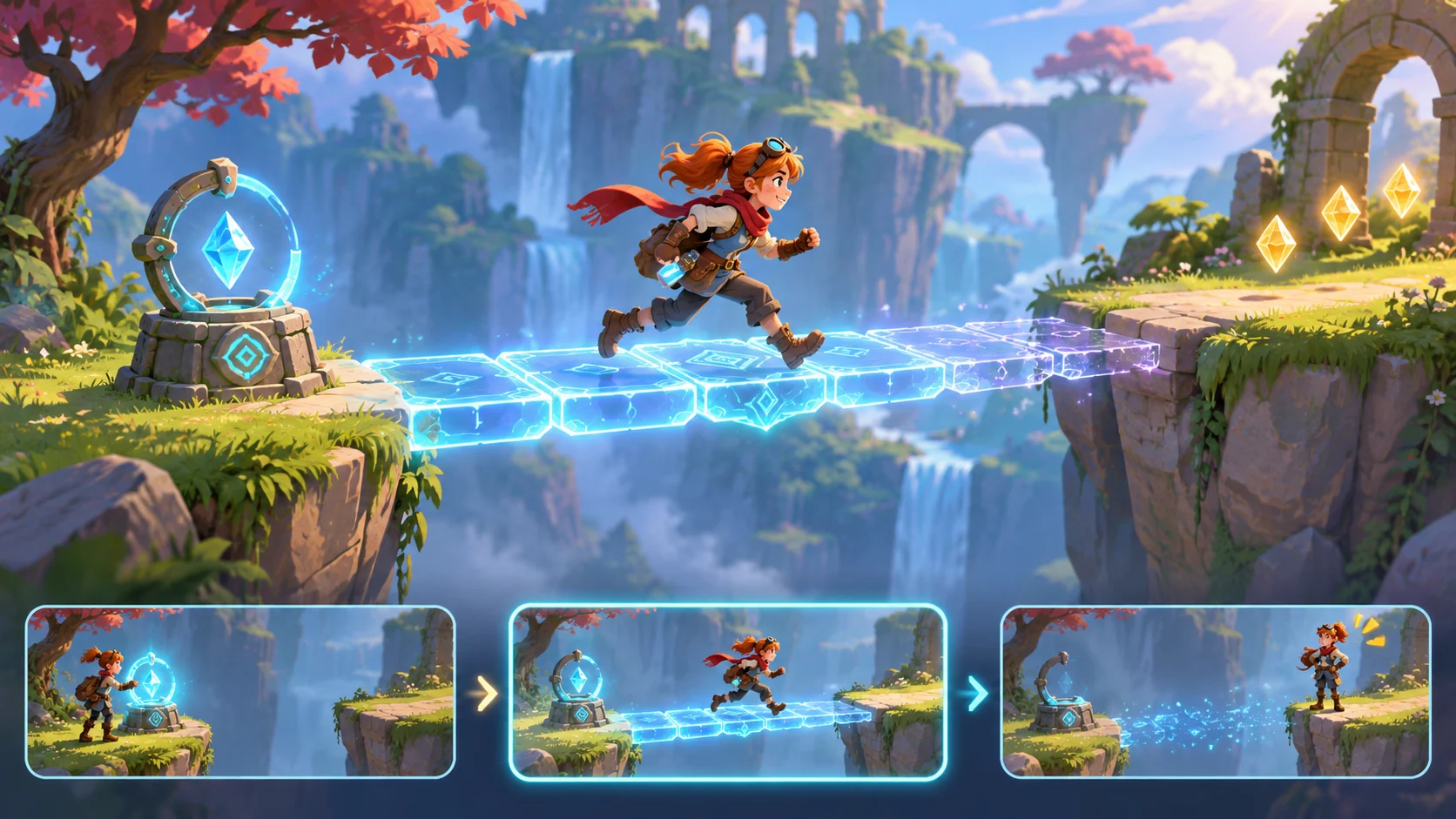
A compact loop might show a gap, let the player trigger the bridge, give time to jump, and then show a clear outcome. Keep controls consistent and make the timing window inspectable. If the mechanic fails, distinguish input timing from confusion about the control or from difficulty reading the scene.
Prompt 2 — mechanic loop
Specify a short Pulse Bridge loop with a start state, player input, timing window, bridge response, crossing attempt, outcome feedback and reset. Identify the single variable being explored and list confounds to avoid. Do not claim that the mechanic has been tested.
| Loop stage | Fictional prototype behavior | What a designer could inspect later |
|---|---|---|
| Start | A character stands before a short gap | Is the goal visible? |
| Trigger | Player presses one clearly labeled control | Is the input discoverable? |
| Response | A bridge appears for a limited interval | Is feedback immediate and legible? |
| Attempt | Player jumps or waits | Can timing be observed separately from control confusion? |
| Outcome | The scene shows crossing or reset | What alternative explanations remain? |
The table describes a proposed test slice, not a functioning build or observed player behavior.
Choose measures that answer the question
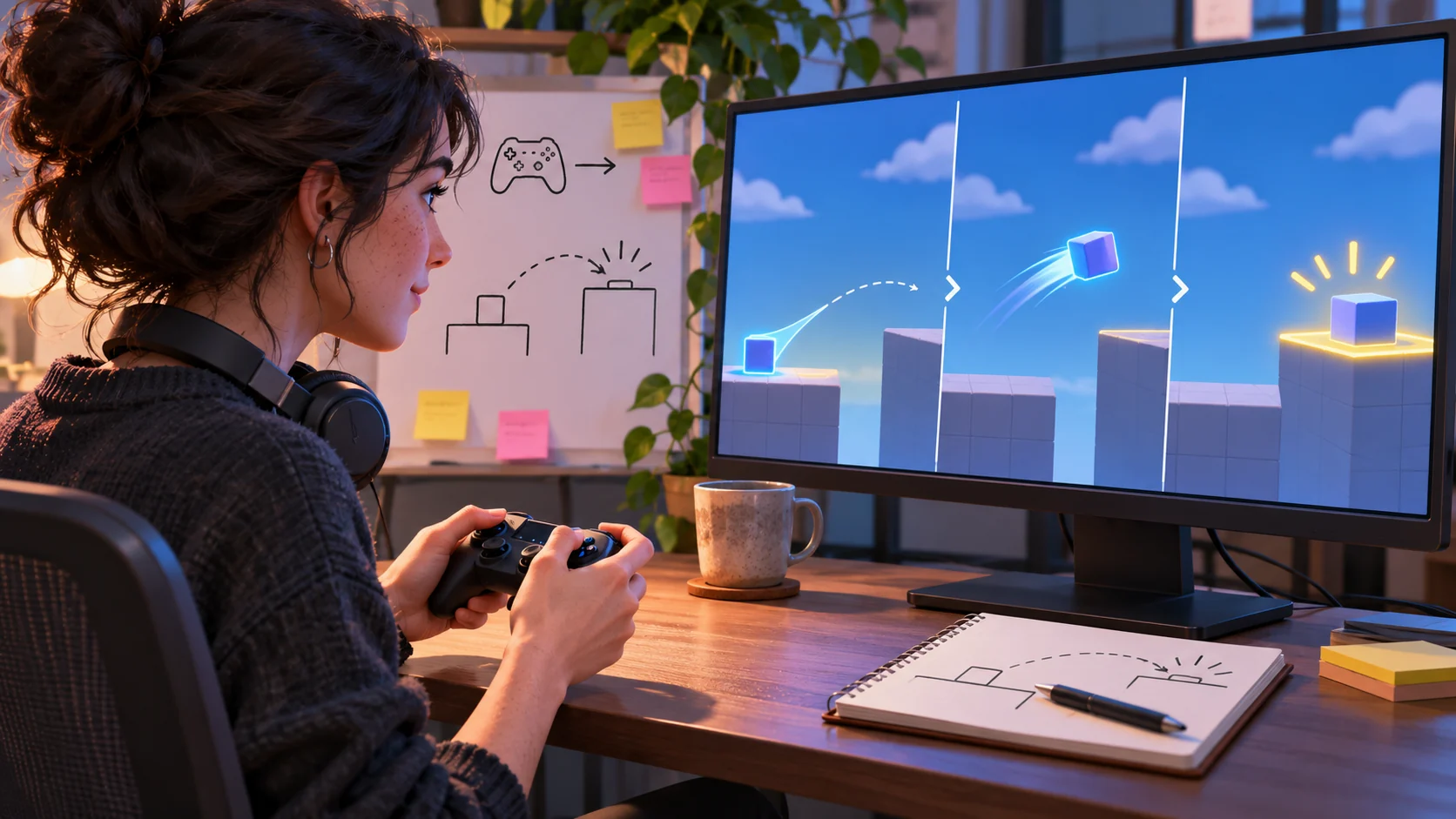
Decide what evidence would be useful before running a playtest. A designer may later observe whether participants notice the feedback, how they time an action or what they say about the mechanic. Define the measure and collection method in advance, and respect consent and data-handling requirements. Do not infer enjoyment from completion alone or treat a small sample as proof of general preference.
Prompt 3 — observation plan
Create a future observation plan for the fictional Pulse Bridge prototype. Define one behavioral measure, one qualitative question, a collection method, consent and privacy notes, and possible interpretations. Leave findings blank. State why completion or failure alone cannot prove fun or usability.
Keep the first prototype focused enough that a reviewer can connect a visible interaction to the hypothesis. If the session includes unfamiliar controls or unclear instructions, record those as possible confounds rather than as evidence about the mechanic itself.
Keep the mechanic specification editable
Store the hypothesis, controls, feedback, parameters and planned observations separately from the scene. The JSON below is a fictional starting point. Its values are placeholders, not tuned design recommendations or playtest results.
{
  "prototypeName": "Pulse Bridge — fictional mechanic test",
  "status": "concept; unbuilt and untested",
  "hypothesis": "A timed bridge response may make a short gap crossing feel deliberate",
  "playerAction": "press the trigger control, then jump",
  "prototypeLoop": ["show gap", "accept trigger", "display bridge", "allow crossing attempt", "show outcome", "reset"],
  "parameters": {
    "bridgeDurationSeconds": "placeholder; choose for a future test",
    "triggerFeedback": "visible and audible cue; review accessibility",
    "jumpControl": "single consistent input"
  },
  "observations": [
    {"measure":"time from cue to action", "status":"planned; no data collected"},
    {"measure":"player explanation of the cue", "status":"planned; no data collected"}
  ],
  "confoundsToReview": ["control familiarity", "instruction clarity", "visual contrast", "difficulty tuning"],
  "nextActions": ["inspect mechanic", "record open questions", "reset to known state"],
  "evidenceBoundary": "fictional example; not a playtest result"
}
Keep placeholder parameters explicit until a designer chooses values for a real prototype. If a value is adjusted during a future session, record the version so observations from different builds are not accidentally combined.
Build and inspect a playable slice

Start with one scene, one control, one mechanic, clear feedback and a reliable reset. A playable prototype should make its controls work and expose the timing behavior. A static illustration can communicate intent but cannot validate input response. Record which elements are implemented, simulated or still missing.
Prompt 4 — playable validation slice
Build a small local Pulse Bridge prototype from the editable specification. Include the gap, trigger control, visible bridge timer, one crossing attempt, outcome feedback and reset. Add a developer view for changing the timing parameter. Label this fictional and untested. Report implemented interactions separately from static art and unresolved design assumptions.
Inspect the prototype without claiming player findings: can a reviewer trigger it, see the timing window, attempt the crossing and reset? Check that feedback is not conveyed by color alone and that the control is explained. These are prototype checks, not evidence that players understand or enjoy the mechanic.
Simulate a design iteration
For a fictional iteration, imagine the bridge’s visual cue changes from a full-screen flash to a short pulse around the gap, while the control and timing parameter remain fixed. The purpose is to show how an editable prototype can isolate a change. This is a design scenario, not a tested improvement or a result from players.
Prompt 5 — fictional mechanic iteration
Make a fictional Pulse Bridge iteration that changes only the visual cue while keeping input, scene and timing constant. Document the version difference, expected observation and remaining confounds. Do not claim the iteration improves usability or enjoyment without a future test.
Prompt 6 — designer review checklist
Review the local Pulse Bridge slice for hypothesis alignment, control clarity, visible response, timing, reset, accessibility, version tracking and observation readiness. Mark each item implemented, static, missing or not tested. Do not record participant behavior or playtest conclusions.
Interpret future evidence carefully
A future test can help a team identify whether a specific interaction is visible or confusing in the tested context. It cannot by itself prove that the mechanic will be enjoyable for all players, work across genres or improve retention. Keep build versions, test context, participant consent and observations together, and separate direct observations from interpretations.
Prompt 7 — evidence review plan
Create a review template for a future Pulse Bridge playtest. Separate observed behavior, participant statements, designer interpretation, build version, test conditions, consent status, limitations and next experiment. Keep result fields empty and warn against generalizing from a small or unrepresentative sample.
Conclusion
A mechanic validation game for game designers should isolate a design hypothesis in a short, observable loop. Keep controls, feedback and parameters editable; plan evidence collection before testing; and separate prototype inspection from player research. Pulse Bridge and its iteration are fictional and untested. Build the slice, run an appropriate playtest and report only what the evidence supports before deciding whether the mechanic works.
You can shape a small concept in the Free AI game maker, then compare it with the editable mechanic specification.
FAQ
What is a mechanic validation game?
It is a focused playable prototype designed to make a game mechanic and its outcomes observable for a specific design question.
How many mechanics should a validation prototype include?
A first slice should isolate the mechanic related to the hypothesis and minimize unrelated systems that could obscure the result.
Does completing a prototype test prove that a mechanic is fun?
No. Completion alone does not establish enjoyment. A suitable playtest and careful interpretation are needed to answer player-experience questions.
What should designers measure in a mechanic test?
Choose measures tied to the hypothesis, such as whether feedback is noticed or how an action unfolds, and define the method before collecting data.
Can an AI-generated prototype validate a game design automatically?
No. AI can help produce a prototype or test plan, but design conclusions require appropriate observation and evidence from the intended context.